
Facade Restoration Contractors
A production-ready glass restoration system for real jobsite conditions
GlassRenu equips façade restoration contractors with contractor-grade tools, consumables, and training so crews can restore damaged architectural glass when feasible — reducing replacement scope while protecting optical quality and jobsite efficiency.
Why restoration matters on façade projects
On exterior restoration scopes, glass damage is rarely isolated. It’s often spread across elevations, discovered late, and tied to access complexity. Replacement can mean long lead times, staging challenges, and coordination across multiple trades — all while the building is occupied or close to turnover.
Restoration can be the cleaner path when feasible, but only if it’s handled like a production process: consistent method, trained execution, clear limits, and tight quality control. GlassRenu exists to make glass restoration behave like a trade — not an experiment.
What GlassRenu enables contractors to do
GlassRenu helps contractors build a restoration capability that can be deployed at scale across a façade. That means:
- A structured way to assess damage and decide what’s feasible to restore
- A repeatable process crews can follow to produce consistent results
- A training pathway that builds capability from common jobs to higher-severity work
- Consumables and tooling designed for professional outcomes, not DIY shortcuts
Whether you’re self-performing or managing subs, the point is the same: predictable workflow and controlled results.
Where your crews see the best payoff
Glass restoration becomes valuable when replacement is costly, slow, or disruptive, such as:
- Post-construction damage during punch, turnover, or owner walk
- Chemical etching from masonry cleaners, acid exposure, and jobsite handling
- Maintenance and rehab scopes where glass condition undermines the finished façade
- Occupied buildings where replacement creates access and tenant coordination headaches
Restoration is also useful when there’s a mix of outcomes — some panes restored, some replaced — as long as scope and acceptance are aligned up front.
The contractor value proposition
✔ Reduce replacement scope without slowing production
When feasible, restoration can reduce the number of panes that become a procurement and access problem. But restoration has to run like a production line: repeatable sequence, disciplined technique, and predictable cycle time.
✔ Standardize the work across crews
On façade projects, inconsistent technique is what creates callbacks: visible haze, distortion, uneven clarity, or mismatch across panes. GlassRenu’s method is designed to be taught, repeated, and checked — so quality doesn’t depend on a single “artist” on the crew.
✔ Protect optical quality and reduce risk
Architectural glass is unforgiving. The job isn’t just “remove the scratch.” The job is to restore the surface in a way that performs visually when the sun hits it, when you step back, and when the owner inspects it. A controlled method and trained execution reduce the risk of distortion and unacceptable finish.
✔ Win more scopes by offering an alternative
Owners and GCs like options when replacement is painful. Contractors who can credibly propose restoration—backed by a defined method, training, and QC—often have an advantage when schedules tighten and budgets get stressed.
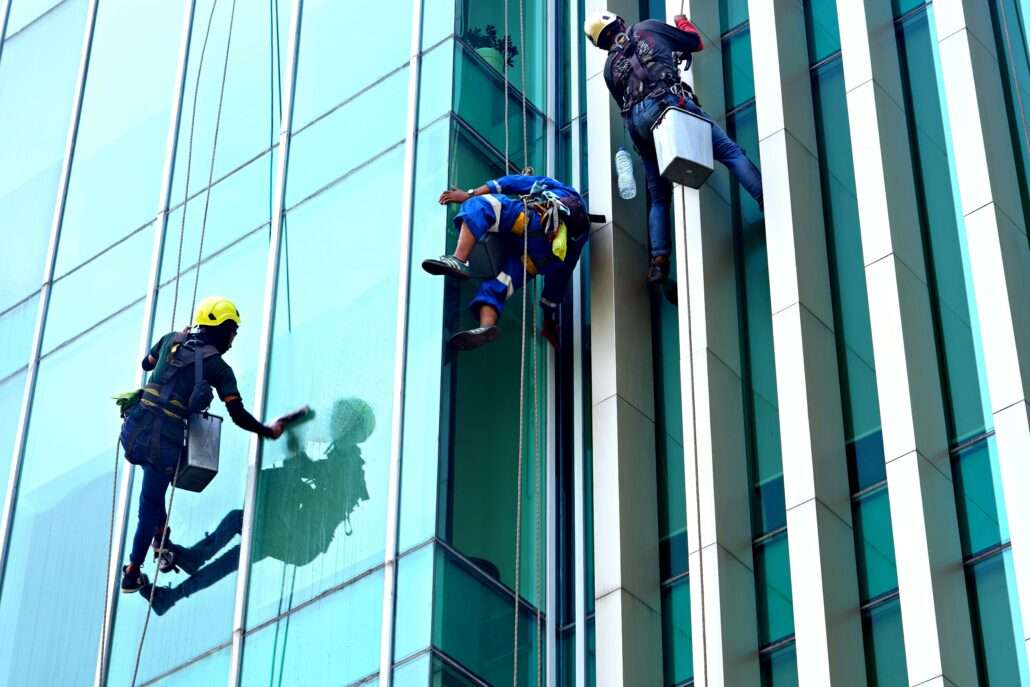
How restoration runs in the field (production workflow)
- Assessment & scope definition
Damage is categorized by type and severity, feasibility is confirmed, and a plan is established for restore vs. replace vs. mock-up. - Pilot area / mock-up (recommended for larger scopes)
A controlled test area establishes what the finish looks like under real lighting and viewing distances, and it aligns expectations before full production work. - Controlled restoration progression
Crews follow a step progression to level the surface and return clarity. The process is method-driven so results are consistent across elevation, access method, and technician. - Inspection and quality checks
Finish is verified under agreed conditions, and the work is documented to reduce disputes and avoid “surprise rejection” at the end.
What you get with GlassRenu
Contractor-grade systems + consumables
Built for production use: the right abrasives, compounds, and pads for a controlled progression.
Hands-on training for crews
Training focuses on technique discipline that matters at height and under pressure: flatness control, step progression, efficiency, and quality checks.
Standards-based guidance
A structured decision framework helps crews avoid wasting time on non-feasible panes and helps PMs communicate scope clearly.
Support for scaling capability
Start with manageable damage types and expand into higher-severity restoration as capability and confidence grow.
What makes a restoration scope successful (jobsite reality)
Glass restoration on a façade works best when the plan is clear early. The biggest drivers of success are:
- Aligned expectations (what “acceptable” looks like, where the glass will be viewed from, and how it will be inspected)
- Clear restore vs. replace thresholds so time isn’t wasted on non-feasible damage
- Method discipline so optical quality remains consistent across panes
- Documented checks to avoid late-stage disputes and callbacks
When those are in place, restoration becomes a reliable tool — not a risk.
Next Steps
If you’re bidding or managing a façade scope where replacement is costly or disruptive, we can help you evaluate restoration feasibility and build a production plan.
Next steps:
- Review the scope and identify restore vs. replace thresholds
- Plan a pilot mock-up for acceptance alignment
- Equip and train your crews for repeatable production outcomes
GlassRenu.com
[email protected] | 888-769-0001