


Visual Inspection Standards for Architectural Glass Damage Assessment and Restoration
VIS-A / VIS-DA
Version 1.1
Table of contents
1 Scope (Normative)
1.1 Purpose
This Standard defines objective, process-neutral criteria for (a) classification of architectural glass condition (CAT-0 through CAT-5), (b) identification of repairable vs. non-repairable conditions, and (c) post-restoration visual acceptance of exposed glass surfaces under specified inspection conditions (see Section 5). It does not prescribe tools, products, or procedures.
1.2 Intended Users
Restoration technicians, window cleaners, inspectors, contractors, manufacturers, building owners, and other parties evaluating glass condition before or after cleaning and/or restoration.
1.3 Field of Application
In-field evaluation of transparent architectural glass in commercial and residential settings, including monolithic and insulating units, and common constructions such as annealed, tempered, and laminated glass with or without functional coatings on the exposed surface under evaluation.
1.4 What This Standard Covers
- Visual classification of surface condition (Section 4).
- Inspection environment, viewing distances, and angles (Section 5).
- Post-restoration acceptance thresholds expressed as observable outcomes (Section 6).
1.5 Exclusions and Limits
- This Standard does not provide restoration methodology, step sequences, or product selection.
- Subsurface defects, defects between panes of insulating units, defects within laminated interlayers, and conditions that cannot be addressed in place are outside scope for in-field restoration acceptance (see CAT-5).
- Decorative/opaque surfaces (e.g., ceramic frit fields, patterned textures), mirrored back-coatings, plastics, and non-glazed substrates are not addressed.
- Structural design, safety glazing compliance, fabrication tolerances, warranty terms, and liability assignments are not established by this Standard; applicable codes and specifications govern.
1.6 Use Context
The Standard supports consistent pre- and post-cleaning/restoration assessments and objective acceptance decisions across trades and project phases. Where project specifications include additional appearance criteria, those criteria may be applied in addition to this Standard.
2 Referenced Documents
2.1 General
This Standard minimizes external dependencies. Normative references are limited to documents that provide indispensable terminology or baseline product definitions. Informative references may aid understanding but are not required for application of this Standard.
2.2 Normative References
The following documents are indispensable for the application of this Standard. For dated references, only the edition cited applies; for undated references, the latest edition (including amendments) applies.
- ASTM C162, Standard Terminology of Glass and Glass Products. [latest ed.]
- ASTM C1036, Standard Specification for Flat Glass. [latest ed.]
- ASTM C1048, Standard Specification for Heat‑Strengthened and Fully Tempered Flat Glass. [latest ed.]
- ASTM C1376, Standard Specification for Pyrolytic and Vacuum Deposition Coated Glass. [latest ed.]
- ASTM C1172, Standard Specification for Laminated Architectural Flat Glass. [latest ed.]
- ASTM E2190, Standard Specification for Insulating Glass Unit Performance and Evaluation. [latest ed.]
- ANSI Z97.1, Safety Glazing Materials Used in Buildings—Safety Performance Specifications and Methods of Test. [latest ed.]
- IWCA Glass Committee Field Guidance (terminology only). [latest ed.]
Note: These references support definitions only; they do not govern appearance acceptance for repaired glass, which is established by this Standard.
2.3 Informative References
The following may be cited for background or application notes and may be listed in Appendix X1 when finalized:
- NGA/GANA Glazing Manual (latest).
- NGA GTP FB67‑20 – Guidelines on How to View Decorative Glazing Products in Interior and Exterior Applications (viewing conditions & timing).
- NGA/IWCA FB01‑00 (2023) – Proper Procedures for Cleaning Architectural Glass Products.
- NGA *Methods of Measuring Optical Distortion in Heat‑Treated Flat Glass.
- ASTM C1651 – Measurement of Roll Wave Optical Distortion in Heat‑Treated Flat Glass.
- ISO 12543 series – Laminated glass and laminated safety glass.
- ISO 9050 – Determination of luminous/solar characteristics of glazing.
- EN 12150 (toughened), EN 1863 (heat‑strengthened), EN 1096 (coated), EN 1279 (IGUs), EN 572 (basic glass).
- IWCA Glass Surface Maintenance Matrix and Glass Protection Checklist (construction protection & non‑routine work risk).
- GlassRenu Glass Restoration Standards Reference Handbook (2025).
2.4 Reference Hierarchy and Application
Where a conflict exists between this Standard and any referenced document regarding visual classification (Section 4), inspection (Section 5), or acceptance (Section 6), this Standard shall govern. Referenced documents continue to govern product design, fabrication tolerances, structural performance, and safety compliance outside the scope of this Standard.
2.5 Edition Control
Project documents should state the applicable edition dates of any referenced standards when needed for contract control.
3 Terminology
Unless otherwise defined in this Section, terminology conforms to ASTM C162 – Terminology of Glass and Glass Products.
Definitions for coated, laminated, and insulating glass correspond respectively to ASTM C1376, C1172, and E2190 (informative).
Where a definition has been refined or extended for post-restoration evaluation, the source standard is noted as “adapted from.”
3.1
Material Terms
Architectural Glass — Glass used in building enclosures, including but not limited to windows, curtain walls, doors, skylights, and partitions. (Adapted from ASTM C162.)
Annealed Glass — Float glass cooled at a controlled rate to reduce internal stresses. (ASTM C162.)
Tempered Glass — Heat-treated safety glass with increased strength and designed to fracture into small, blunt pieces upon failure. (ASTM C1048.)
Laminated Glass — Safety glass composed of two or more plies bonded by one or more interlayers, designed to remain intact when fractured. (ASTM C1172.)
Insulating Glass Unit (IGU) — Factory-assembled glazing unit of two or more lites separated by a sealed cavity and perimeter spacer/seal system (with desiccant). (ASTM E2190.)
Lite — A single pane of glass within a frame or insulating glass unit. (ASTM C162.)
Functional Coating — Surface treatment applied during manufacturing (e.g., low-E, reflective, anti-glare) that alters optical or thermal performance. (ASTM C1376.)
Heat-Strengthened Glass — Heat-treated glass with strength between annealed and fully tempered; fractures in larger pieces than tempered and is not a safety glazing by itself. (ASTM C1048.)
Wired Glass — Glass with embedded wire mesh for fire resistance; prone to stress concentration and crack propagation under localized heating. (ASTM C162.)
IGU Cavity — The sealed air or gas space between lites within an IGU. (ASTM E2190.)
Surface Numbering (General) — Surfaces are counted from exterior to interior:
- Monolithic: #1 = exterior air side; #2 = interior room side.
- Laminated (n-ply): Number sequentially #1 … #(2n), exterior → interior. Odd numbers are outer faces; even numbers are interlayer-adjacent (laminate-internal).
- IGU (two lites): Use #1–#4 for the cavity-bounding faces only: #1 = exterior air side of outboard lite; #2 = cavity side of outboard lite; #3 = cavity side of inboard lite; #4 = interior room side of inboard lite.
- Composites: For laminated lites within an IGU, retain IGU positions #1–#4 for the cavity-bounding faces; identify laminate-internal faces as “laminate-internal.”
(Informative source: NGA/GANA Glazing Manual.)
Worked Surface — Surface of the lite on which restoration work is performed.
Exposed Surface — Glass surface accessible to inspection or restoration.
Non-Exposed Surface — Surface not accessible for in-place inspection or restoration, including IGU cavity faces and laminate-internal faces.
Outboard / Inboard — Outboard = oriented toward the exterior; Inboard = oriented toward the building interior.
3.2
Damage and Condition Terms
Damage — Any physical, chemical, or combined alteration of the glass surface that changes its appearance, clarity, or structural performance.
Undamaged Glass (CAT-0) — Glass free of bonded residues, staining, or visible damage after routine cleaning.
Repairable Damage — Damage that can be reduced or removed through restoration without introducing unacceptable distortion, haze, or risk of structural compromise.
Non-Repairable Damage — Damage that cannot be safely or effectively restored, including but not limited to cracks, edge failures, or damage within laminated or insulated layers.
Categories of Damage (CAT-0 through CAT-5) — Classification system defined in Section 4 of this Standard.
Micro-Chipping — Small, bright edge fractures along a scratch flank visible under raking light, indicating increased depth.
Chip Flank — Roughened edge profile adjacent to a line defect where micro-chipping is present.
Pit / Crater — Localized depression in the surface, often from fused particles or slag; may present with a halo in raking light.
Modeled Micro-Texture — Subtle, non-linear surface relief typical of chemical etch or over-refined fields (appears as “milky” modeling in raking light).
Matte / Frosted Field — Uniform micro-texture that scatters light broadly, reducing specular clarity.
Parallax (location cue) — Apparent relative motion between a mark and its reflection when the observer moves; fixed parallax within an IGU indicates a between-pane condition. (Informative cue per NGA Glazing Manual.)
3.3
Inspection Terms
Acceptance Standard — The visual benchmark against which post-restoration glass is judged to be acceptable.
Affected Area — Percentage of a glass surface impacted by visible damage.
Viewing Geometry — Standardized viewing distances and angles (close, standard, wide-field) for consistent evaluation. (Adapted from NGA FB67-20.)
Optical Distortion — Visible warping, bending, or haze of transmitted or reflected images caused by uneven surface alteration. Note – For measurement background on roll-wave/optical distortion in heat-treated flat glass, see ASTM C1651. [Informative]
Raking Light — Low-angle illumination used to highlight surface topography.
Surface Catch (result) — Observed outcome of a Manual Surface-Relief Test used to detect shallow surface relief; record as none, slight, or clear. Non-marring and shall not alter the surface.
Manual Surface-Relief Test (method) — Non-destructive field test using a non-marring stylus (e.g., clean, dry fingernail or polymer tip) lightly passed across a suspected feature to sense relief. Used only to support classification (see Section 4).
Transition Edge (visual) — Perceivable line, ring, or contour that marks the outer limit of a worked region under inspection conditions of Section 5. Presence indicates localized demarcation; acceptable work shows no visible transition edge.
Transition Zone (visual) — Area over which a worked region merges into adjacent glass. When compliant, the transition is non-directional and not perceptible as a boundary under required views.
Normal Incidence — Observation with line of sight perpendicular to the glass surface.
Oblique Sweep — Observation across an arc about the surface normal (approximately 60°–120°) to reveal surface relief.
Non-Invasive Reveal — Pre-inspection cleaning using distilled or neutral-pH water and lint-free microfiber to lift soil without abrasion, separating removable residue from bonded damage. (Informative source: NGA/IWCA Proper Procedures for Cleaning Architectural Glass Products 2023.)
Non-Directional Variation — Subtle, uniform tone or shine change without linear or swirl patterning and without a visible edge or ring.
Directional Patterning — Linear, arcuate, or web-like visual cues (including halos / rings) that imply motion paths.
Coating Anomaly (visual) — Visible sheen shift, color cast, patchiness, or pattern introduced on a functional coating. (Adapted from ASTM C1376.)
3.4
Damage Mechanism Terms
Mechanical Damage — Abrasion or scratching resulting from physical contact (e.g., tools, debris, construction activities).
Chemical Damage — Surface alteration caused by interaction with acids, alkalis, or mineral deposits.
Mixed Damage — Combination of chemical and mechanical effects present on the same surface.
Staining — Bonded deposits or residues on the glass surface that may progress into etching.
4 Classification of Glass Damage
4.1
Overview (Normative)
This Section classifies architectural glass condition into six categories (CAT-0 through CAT-5) based on observable, repeatable field cues. Categories describe appearance and severity only; restoration methods are outside the scope of this Standard. Acceptance of post-restoration results is defined in Section 6. A compact quick-reference matrix is provided in Appendix X4 (informative).
Classification observations are made under the inspection environment (lighting) of Section 5.3 and the viewing geometry of Section 5.4.
- Detection of features may use raking light and close viewing (including < 12 in) to locate and cue the condition.
- Acceptance is judged only at the required distances and angles in Section 6.
Visibility convention
A condition is considered “visible at 12 in / 36 in / 72 in” if it can be perceived by an observer meeting Section 6.2.c under the lighting of Section 5.3 and the angles/distance of Section 5.4, within the reasonable viewing time described in Section 5.4.
Classification inputs
Classification uses both visual cues (under Section 5.3/Section 5.4) and the qualitative Manual Surface-Relief Test (Section 5.5) to determine the presence or absence of surface relief (“surface catch” per Section 3.3). Each category in Section 4.2 states the required catch status (none / slight / clear). The test is a single, non-marring pass and is used only to confirm classification, not to determine acceptance (see Section 6).
4.1.1
Use of Manual Surface-Relief Test (Normative)
- Perform one light pass with a non-marring stylus per Section 5.5 to sense relief; do not abrade or “probe” the surface.
- When visual cues alone are sufficient to assign the category, the test need not be performed.
- On suspected coated worked surfaces, use a polymer stylus only and default to visual morphology + location cues where there is any risk of coating disturbance (see Section 5.5 and Section 6.2.e).
4.2
Category Descriptions (Normative)
Apply category descriptions using the visibility convention above and the inspection conditions of Section 5.3/Section 5.4; use close viewing only to detect features, not to determine acceptance (see Section 6).
4.2.1
CAT-0 – Undamaged
Definition: Immediately after a Non-Invasive Reveal (Section 5.2) and full drying, the surface shows no visible scratches, stains, halos, ghosting, coating anomalies, or prior-work artifacts under the inspection conditions in Section 5.
Field cues:
- Surface catch: none (per Section 5.5).
- Edge/surface morphology: none present.
- Visual signature: uniform appearance at close, standard, and wide-field views; no localized cues in normal or oblique sweep.
- Origin cues: Not applicable.
- Location/access notes: Pertains to the exposed surface being evaluated.
- Reclassify when: Any visible artifact remains after reveal → classify CAT-1 through CAT-4 by cues below; location/condition placing defect out of scope → CAT-5.
Note: Subtle non-directional variation inherent to the product is not considered damage (see Section 3.3).
4.2.2
CAT-1 – Faint
Definition: Visible but non-tactile surface irregularities. A clean, dry fingernail does not catch. Includes cues that are removable by Non-Invasive Reveal (Section 5.2) or present no measurable surface relief after reveal.
Field cues:
- Surface catch: none.
- Edge/surface morphology: smooth; no micro-chipping.
- Visual signature: faint films, transfers, imprints, or ultra-fine marks that remain non-tactile; read best in raking light but do not localize with directionality at acceptance geometry.
- Typical origin cues: Light mineral spotting/early stain shadow; metallic rub/transfer; suction-cup imprints; faint cleaning marks.
- Location/access notes: Must be on the exposed surface.
- Reclassify when: Any tactile catch or edge sparkle/micro-chipping is detected → consider CAT-2 or CAT-3 depending on depth cues.
- Post-reveal rule: After Section 5.2 cleaning, material that is no longer visible is not damage (reclassify to CAT-0).
4.2.3
CAT-2 – Light
Definition: Shallow, slightly tactile defects with clean, fine edges and no pronounced micro-chipping.
Field cues:
- Surface catch: slight detect with a light fingernail pass.
- Edge/surface morphology: narrow, clean-edged lines or shallow micro-texture; no chip flanks.
- Visual signature: light lines/scuffs or faint micro-texture visible in raking light; limited impact at standard view when clean.
- Typical origin cues: Early mineral etch; fine mechanical marks; light glass-on-glass contact.
- Location/access notes: Exposed surface; where suspected, note presence of a functional coating on the worked surface (terminology only).
- Reclassify when: Chip flanks appear, cratered pits are evident, or persistent texture/lines indicate greater depth → consider CAT-3.
4.2.4
CAT-3 – Moderate
Definition: Prominent, tactile defects where a fingernail clearly detects the line or pit; minor edge micro-chipping may be present; appearance is noticeable at standard viewing distance.
Field cues:
- Surface catch: clear detect.
- Edge/surface morphology: lines with minor chip flanks or modeled micro-texture.
- Visual signature: prominent line(s) or modeled texture visible at standard distance; strongest under raking light under the inspection conditions of Section 5.
- Typical origin cues: Scraper scoring with fine chip flanks; moderate glass-on-glass tracks; early acid incidents exhibiting visible modeling.
- Location/access notes: Note proximity to frames/corners only for inspection context (classification remains based on observable cues).
- Reclassify when: Rough, pronounced chip flanks, crater fields, embedded particulates, or matte fields are evident → consider CAT-4.
4.2.5
CAT-4 – Severe
Definition: Deep, extensive, predominantly mechanical damage with pronounced edge chipping, pits/craters, or matte/frosted fields.
Field cues:
- Surface catch: clear to strong detect.
- Edge/surface morphology: rough chip flanks; peppered pits/craters; fused nodules; uniformly matte or frosted regions.
- Visual signature: deep lines with bright, rough flanks in raking light; cratered or frosted textures that present distinctly at standard and wide-field views.
- Typical origin cues: Severe mechanical events; welding slag or grinding overspray (fused metal nodules, pinholes); media-blast/frosted texture; large but non-structural divots.
- Location/access notes: Classification is by observation; if location/condition places the defect out of in-place scope, see CAT-5.
- Reclassify when: Indicators show the condition cannot be addressed in place or falls outside scope (between panes, coating-side to be worked, active crack, etc.) → CAT-5.
4.2.6
CAT-5 – Non-Repairable / Out of Scope for In-Place Restoration
Definition: Conditions that cannot be addressed in place or are outside this Standard’s scope.
Field cues:
- Surface catch: not determinative; classification is driven by location/condition.
- Edge/surface morphology: may vary; out-of-scope status controls.
- Visual signature: defects that persist regardless of surface reveal or present as structural/inaccessible conditions.
Typical origin/condition cues:
- Location/access: defects between panes of an IGU; damage concealed by gaskets/frames where compliant presentation is not possible.
- Integrity indicators: active cracks, star breaks, running edge cracks, panes moving in frame.
- Construction/coatings: confirmed functional-coating loss on the surface to be worked; wired glass with embedded mesh; active laminated interlayer disturbance.
- Location/access notes: Document and refer to appropriate parties (e.g., replacement or manufacturer service) per project protocols.
4.3
Classification Notes (Informative)
- Surface numbering & location cues: When IGUs are present, identify faces as #1–#4; denote laminate-internal faces as “laminate-internal.” Fixed parallax within an IGU indicates a between-pane condition → classify CAT-5 (out of in-place scope).
- Further examples: For expanded morphology cues and photographic examples, see the GlassRenu Glass Restoration Standards Reference Handbook (2025) and the Damage Specification Sheets (informative).
- Three-part cueing: Determine (a) surface catch, (b) edge/surface morphology, and (c) location/access. Agreement of at least two cues should guide the category.
- Mechanism shorthand: Droplets/flows/halos suggest chemical history; linear directionality with chip flanks suggests mechanical history; mixed presentations are common in construction contexts.
- Boundaries: CAT-1/2 are typically shallow presentations; CAT-3/4 indicate progressively greater depth by morphology. CAT-5 is defined by location/condition placing the defect outside in-place scope, not by severity alone.
- Coatings: Record whether a functional coating is present on the worked surface (if known); see Section 6.2.e for coating-appearance acceptance.
- Acceptance is separate from classification. Meeting a category definition does not imply acceptability; see Section 6 for post-restoration Acceptance Standards under the defined viewing conditions of Section 5.3/Section 5.4.
5 Evaluation Procedures
5.1
Purpose
To establish consistent visual inspection conditions and cues for classifying glass (Section 4) and determining post-restoration acceptance (Section 6).
5.2
Pre-Inspection Conditioning (Normative)
- Non‑invasive reveal: Clean the exposed surface using distilled or neutral‑pH water and a lint‑free microfiber; lift soils rather than abrade. Dry completely. [NGA/IWCA Cleaning 2023]
- No alteration. No acids, blades, or abrasives are permitted prior to evaluation. [NGA/IWCA Cleaning 2023]
5.3
Inspection Environment (Normative)
- Lighting: Use raking light: natural low-angle daylight or an artificial source placed at a shallow angle to the surface to reveal relief and scatter; minimize glare and reflection as practical.
- Glare and moisture: Avoid precipitation, condensation, or wet surfaces. Minimize specular glare and strong interior reflections (use a neutral backdrop if necessary).
- Observer condition: Observers shall have unaided or corrected visual acuity of ~20/20.
5.4
Viewing Geometry (Normative)
- Distances: Evaluate at three distances: 12 in (300 mm), 36 in (900 mm), and 72 in (1800 mm).
- Angles: View at normal incidence and perform an oblique sweep across the surface (approximately a 60°–120° arc relative to the normal).
- Field of view: At each distance, scan the full lite, including edges and corners.
Background (informative): Factory inspection of new glass is commonly performed at ~3 m / 10 ft under controlled lighting with defined viewing times (e.g., ASTM C1036/C1048). This Standard intentionally adopts closer distances (12 in, 36 in, 72 in) to evaluate post‑restoration appearance at practical occupant viewing distances and angles, consistent with glazing viewing guidance that specifies distance, angle, lighting, and time discipline. [ASTM C1036] [ASTM C1048] [NGA FB67‑20]
Suggested maximum scan times per lite (by area) (informative): up to 6 ft² → ≤30 s; 6–20 ft² → ≤60 s; >20 ft² → ≤90 s. Apply once per distance. [NGA FB67‑20]
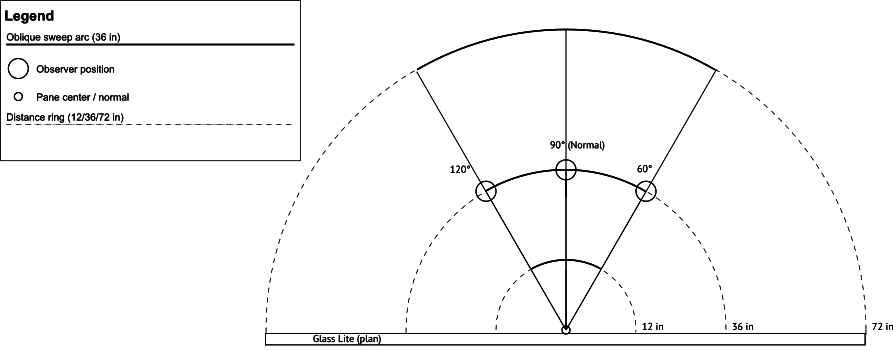
(Fig 5.4A— Viewing geometry and distance zones)
5.5
Manual Surface-Relief Test (Surface catch)
Using a non-marring contact stylus-a clean, dry fingernail or a polymer tip (PTFE/POM/UHMW-PE) with a smooth hemispherical end (~1.5–2.0 mm radius)-make one light pass across the suspected feature at ~25–50 mm/s, applying minimal force (≤0.2 N; ~20 g). Do not mar the surface. Record surface catch as none/slight/clear. On coated surfaces, a polymer stylus is preferred. Do not repeat passes in a way that could alter the surface.
Warning: Do not use the test to probe exposed functional coatings. On suspected coated surfaces, use a polymer stylus only; when in doubt, rely on visual morphology and location cues (Sections 4 & 5). Coating appearance expectations are described in ASTM C1376. [ASTM C1376] (informative)
5.6
Location and Construction Cues (Informative)
- Inter‑pane indication: Fixed parallax within an IGU indicates a between‑pane condition → classify CAT‑5 (see 4.2.6).
- Functional coatings: Where a functional coating is confirmed on the worked surface, Acceptance (6.2.e) prohibits introducing any coating anomaly. [ASTM C1376] (informative)
- Glass type: Note if the lite is annealed, tempered, or laminated when relevant to observation.
5.7
Documentation (Informative)
- Indicate whether a functional coating is present on the worked surface (if known).
- Record surface numbering (#1–#4 / laminate‑internal) when IGUs/laminates are present.
Record pane identification, date/time, lighting used, viewing distances/angles employed, and classification outcome. Photographs at overview, mid-range, and close-up under raking light are recommended to support findings.
6 Acceptance Standards
6.1
Purpose (Normative)
Define post-restoration visual acceptance for architectural glass under the inspection conditions of Section 5. Criteria are process-neutral and apply regardless of tools, products, or methods.
6.2
General Conditions (Normative)
- Clean & dry: Evaluate only after a non-invasive reveal and complete drying (Section 5.2).
- Viewing geometry: Assess at 12 in, 36 in, and 72 in at normal incidence and via a 60°–120° oblique sweep under raking light (Section 5.3–Section 5.4).
- Observer: Unaided or corrected visual acuity ~20/20; no magnifiers or filters unless specified.
- Surface/location: Acceptance pertains to the exposed surface under evaluation.
- Coatings: Where a functional coating is present on the worked surface, no coating anomaly introduced by restoration shall be visible. (appearance context: ASTM C1376; informative). [ASTM C1376]
- Scope note: Classification (Section 4) describes condition; Acceptance (Section 6) confirms outcome.
6.3
Acceptance by Completion Category (Normative)
Apply 6.3 criteria at each distance in 5.4 and under 5.3 lighting; evaluate both normal incidence and oblique sweep.
Interpretive notes:
- Non-directional variation = subtle, uniform tone/shine change with no linear or swirl patterning and no visible edge or ring.
- Directional patterning = visible lines, arcs, webs, halos, or rings that track a motion path.
- Transition edge = a visible demarcation between a worked area and adjacent glass.
A compact quick-reference table is provided in Appendix X4 (Informative).
6.3.1
CAT-0 (Undamaged at Completion)
At 12 in, 36 in, and 72 in, the surface shall exhibit no visible marks, haze, halos, ghosting, or prior-work artifacts in normal or oblique views. Directional patterning and transition edges are not permitted. Coating anomalies are not permitted on coated surfaces.
6.3.2
CAT-1 (Faint at Completion)
At 12 in, no visible residues, imprints, or films shall remain. At 36 in and 72 in, no visible artifacts shall be present in normal or oblique views. Directional patterning and transition edges are not permitted. Coating anomalies are not permitted.
6.3.3
CAT-2 (Light at Completion)
At 12 in, at most trace, non-directional variation is permissible, provided it does not localize or read as a ring/edge. At 36 in and 72 in, no visible artifacts shall be present. Directional patterning and transition edges are not permitted. Coating anomalies are not permitted.
6.3.4
CAT-3 (Moderate at Completion)
At 12 in, minor, non-directional variation is permissible if non-distracting and not localized. At 36 in, no visible lines, halos, or swirl shall be present. At 72 in, none or only trace, non-directional variation is permissible. Directional patterning and transition edges are not permitted. Coating anomalies are not permitted.
6.3.5
CAT-4 (Severe at Completion)
At 12 in, slight, non-directional variation is permissible if non-distracting. At 36 in, no visible lines, halos, or swirl shall be present. At 72 in, slight, non-distracting, non-directional variation is permissible. Directional patterning and transition edges are not permitted. Coating anomalies are not permitted.
6.3.6
CAT-5 (Out of Scope for In-Place Acceptance)
Conditions classified CAT-5 are not subject to in-place acceptance under this Standard.
6.4
Disqualifying Features (Normative)
The following shall not be present at acceptance for CAT-0 through CAT-4:
- Directional patterning (linear, circular, or webbed forms).
- Visible transition edge (ring, contour, or perimeter signature) at any required distance/angle.
- Residual pits, craters, or embedded particulates visible at 36 in.
- Coating anomalies (sheen shift, color cast, patchiness) on coated surfaces. (see appearance context in ASTM C1376; informative). [ASTM C1376]
6.5
Localized vs. Full-Lite Outcomes (Informative)
- Localized repairs: Apply Section 6.3 to the worked region and its immediate surroundings; artifacts shall not telegraph as a boundary.
- Full-lite work: Evaluate the field as a continuous surface; any localized artifacts are judged per Section 6.3 and Section 6.4.
6.6
Acceptance Documentation (Informative)
Photos should document the viewing distance (12/36/72 in) and incidence (normal/oblique).
Record pane/lite ID, date/time, inspection geometry, lighting, completion category, and acceptance result (Accepted/Not Acceptable). Include overview, mid-range, and close-up photos under raking light. (Templates provided in Appendix X3.)
7 Significance and Use
7.1
Purpose
This Standard establishes a common, objective basis for describing glass condition and determining post-restoration acceptance across trades and project phases.
7.2
Typical Applications
- Pre-/post-cleaning assessments to distinguish soil from bonded damage.
- Post-construction evaluations to document condition and support fair assignment of responsibility.
- Restoration scope definition and progress/closeout documentation.
- Owner/inspector acceptance of completed work against defined viewing conditions.
- Dispute resolution by providing consistent terminology and inspection geometry.
7.3
Users
Restoration technicians, window cleaners, inspectors, contractors, manufacturers, building owners, and other parties involved in evaluating architectural glass appearance.
7.4
Limitations
This Standard addresses visual condition and acceptance only. It does not establish structural performance, safety glazing compliance, fabrication tolerances, warranties, or liability assignments.
7.5
Rationale for Viewing Geometry
Inspection distances in this Standard are intentionally closer than factory criteria for new glass (commonly ~3 m / 10 ft) to reflect the practical viewing of restored surfaces at arm’s-length and typical occupant distances. Distance, angle, lighting, and reasonable time limits are specified to produce repeatable, fair acceptance decisions. [ASTM C1036] [ASTM C1048] [NGA FB67‑20]
8 Appendices (Informative)
The following appendices are informative and do not constitute requirements of this Standard. Titles and contents may be expanded during final compilation.
Appendix X1
Extended References and Bibliography
Normative (indispensable; duplicates Section 2.2 list for convenience):
- ASTM C162 — Terminology of Glass and Glass Products
- ASTM C1036 — Flat Glass
- ASTM C1048 — Heat-Strengthened and Fully Tempered Flat Glass
- ASTM C1376 — Pyrolytic and Vacuum Deposition Coated Glass
- ANSI Z97.1 — Safety Glazing Materials Used in Buildings
- (If included in Section 2.2) ASTM C1172 — Laminated Architectural Flat Glass
- (If included in Section 2.2) ASTM E2190 — Insulating Glass Unit Performance and Evaluation
Informative (selected):
- NGA/GANA Glazing Manual
- NGA Guidelines on How to View Decorative Glazing Products (FB67-20)
- NGA/IWCA Proper Procedures for Cleaning Architectural Glass Products (2023)
- ASTM C1651 — Measurement of Roll Wave Optical Distortion in Heat-Treated Flat Glass
- ISO 12543 series — Laminated Glass and Laminated Safety Glass
- ISO 9050 — Optical/Solar Characteristics of Glazing
- EN 12150 / EN 1863 / EN 1096 / EN 1279 / EN 572 families
- GlassRenu Learning Center — Reference Handbook; Damage Specification Sheets
- GlassRenu Glass Restoration Standards Reference Handbook (2025)
Appendix X2
Inspection Environment & Viewing Geometry Quick Card
Use with Section Section 5.3–5.4 and Section 6.
- Lighting: Use shallow-angle raking light to reveal surface relief; minimize glare and reflections; surfaces clean and dry.
- Distances: Evaluate at 12 in, 36 in, 72 in.
- Angles: Normal incidence and oblique sweep (~60°–120° about the surface normal).
- Time discipline (per lite):
- up to 6 ft² → ≤30 s
- 6–20 ft² → ≤60 s
- >20 ft² → ≤90 s
(Apply once per distance to avoid hyper-scrutiny.)
- Observer (per Section 6.2.c): Normal corrected vision; no magnifiers/filters unless specified.
- Photo documentation: Include a ruler or known reference when practical; record distance (12/36/72) and incidence (normal/oblique) in the frame; avoid filters that alter appearance.
Appendix X3
Sample Inspection & Acceptance Forms
Include the following fields in project forms/logs:
- Project / Area / Pane ID (building, elevation, floor, bay)
- Product family (monolithic / laminated / IGU) and surface numbering (#1–#4; laminate-internal)
- Worked surface identified (Y/N)
- Functional coating present on worked surface? (Y / N / Unknown)
- Pre-inspection reveal completed (Section 5.2) (Y/N) and dry surface (Y/N)
- Inspection conditions (lighting notes; raking used Y/N; time of day)
- Viewing geometry checklist: 12 in / 36 in / 72 in × normal / oblique (results at each)
- Manual Surface-Relief Test (Section 5.5) result: SC-0 none / SC-1 slight / SC-2 clear
- Classification (Section 4): CAT-0 / 1 / 2 / 3 / 4 / 5
- Acceptance decision (Section 6): Accept / Rework / Escalate
- Photos attached (count and filenames/links)
- Inspector name / signature / date
Appendix X4
Classification Decision Aids
Quick decision tree (summary of Section 4):
- Reveal & dry (Section 5.2). If cue disappears → CAT-0.
- Visual cue persists? If no → CAT-0. If yes, proceed.
- Surface catch (Section 5.5):
- None → consider CAT-1 (faint/non-relief)
- Slight → CAT-2 (light)
- Clear → CAT-3/4 depending on morphology
- Morphology: micro-chipping, pits/craters, matte/frosted → trend CAT-3 → CAT-4
- Location/access: between panes, concealed, coating-loss on surface to be worked, active cracks, wired glass, active laminate issues → CAT-5
Cue matrix (abbrev.):
- CAT-1: non-tactile; faint films/transfers; no directionality at acceptance geometry.
- CAT-2: slight catch; clean edges; shallow micro-texture.
- CAT-3: clear catch; minor chip flanks or modeled texture; noticeable at standard view.
- CAT-4: clear-to-strong catch; rough chip flanks; pits/craters; matte/frosted.
- CAT-5: out-of-scope by location/condition (not by severity).
Appendix X5
Example Language for Project Specifications
Visual Acceptance of Restored Glass: Post-restoration appearance shall comply with Visual Inspection Standards for Architectural Glass Restoration (GlassRenu VIS, 2026 ed.), Section 6. Inspection per VIS Section 5 (12/36/72 in; normal & oblique sweep; raking light). Where project documents reference factory acceptance for new glass (e.g., ASTM C1036/C1048), VIS governs acceptance of restored glass. [ASTM C1036] [ASTM C1048]
Optional additions (project-dependent):
- Coated glass areas: “No coating anomalies introduced by restoration shall be visible under VIS Section 6.2.e.”
- Documentation: “Submit VIS inspection forms and photo log per Appendix X3.”
Appendix X6
Manual Surface-Relief Test (Method Card)
X6.1
Purpose
Standardize how surface catch is observed without prescribing restoration methods. (Supports classification only; not acceptance.)
X6.2
Equipment (field-practical, non-marring)
- Contact stylus: clean, dry fingernail or polymer tip (PTFE, POM/Delrin, UHMW-PE), hemispherical end ~1.5–2.0 mm radius, smooth finish.
- Wipes: lint-free microfiber (dry).
- Optional calibration panel: scrap lite with known shallow scribe lines for training only.
X6.3
Conditioning
- Surface clean and dry (non-invasive reveal complete).
- No powders, lubricants, or liquids during the test.
X6.4
Procedure
- Align stylus normal to the glass; do not use edges or corners.
- One pass, light contact, 25–50 mm/s across the suspected feature.
- Observe feel and sound (if any); do not abrade or repeat to “force” a response.
- Record surface catch code: SC-0 (none) / SC-1 (slight) / SC-2 (clear).
- SC-0 — no detectable relief.
- SC-1 — faint interruption; edges feel clean.
- SC-2 — distinct interruption; edges may exhibit micro-chipping (see Section 4 morphology).
- If the surface is functionally coated, prefer a polymer stylus. If any doubt remains, rely on visual morphology + location cues (Sections 4 and 5).
X6.5
Do / Don’t
- Do: keep the tip smooth; keep the pass singular and light; document result.
- Don’t: use metal, blades, or abrasive tips; don’t repeat swipes; don’t test on wet/condensing surfaces; don’t test over masking debris.
X6.6
Notes
- Do not use on exposed functional coatings; polymer stylus only when a coating is suspected. (Informative context: ASTM C1376).
- When in doubt, classify using visual morphology + location (Sections 4 & 5); do not abrade to “force” a response.
- The test is qualitative, used only to support classification. Where coatings or specialty glass are present, treat the stylus as auxiliary—classification remains grounded in visual and location cues.
Copyright and Permissions
© 2026, GlassRenu, LLC. All rights reserved.
This publication—including all text, figures, tables, images, and illustrations—is the intellectual property of GlassRenu. Unauthorized reproduction, distribution, or transmission of any part of this document, in any form or by any means, without prior written permission from GlassRenu is prohibited under U.S. and international law.
Limited permission for specification use. You may quote unmodified clauses of this Standard within project specifications, submittals, and QA/QC plans with attribution (“GlassRenu VIS-2026, §[x]”) and without commercial resale. Any broader reproduction or distribution requires written permission from GlassRenu.
Trademarks
GlassRenu™ is a trademark or service mark of The REDD Group, LLC, used under license by GlassRenu, LLC.
Third-party trademarks. Logos, trademarks, and company names appearing in this publication are the property of their respective owners. Their inclusion does not imply ownership by GlassRenu or endorsement of GlassRenu by those companies; they are used solely for identification or illustrative purposes.
Non-Endorsement of Referenced Organizations
References to external standards, guidance, or publications (including but not limited to ASTM, ANSI, ISO/EN, NGA, IWCA) are provided for context and citation only and do not constitute endorsement or implied endorsement of GlassRenu by those organizations, nor endorsement by GlassRenu of any specific products, services, or entities.
Patent and Intellectual Property Notice
GlassRenu does not take a position on the existence, validity, or scope of any patent or other IP rights that may relate to items, products, methods, or processes referenced in this Standard. Users are solely responsible for identifying such rights and addressing any risk of infringement, licensing, or permissions.
Revision Cycle and Public Comment
This Standard may be revised at any time by the responsible GlassRenu standards working group and is reviewed at least once every five years.
Comments and proposals for revision or for new standards are welcome at [email protected]
Participation
Participation in the development and maintenance of GlassRenu standards is open to interested stakeholders. To request working-group access or meeting information, contact [email protected].
Use and Safety
This Standard addresses visual inspection and appearance acceptance for restored architectural glass. It does not establish safety procedures, structural performance, or regulatory compliance. Users are responsible for appropriate safety practices, verifying compliance with applicable codes and laws, and determining the suitability of this Standard for their specific application.
Contact
Email: [email protected]
Web: https://glassrenu.com (Learning Center → Standards)
Postal:
GlassRenu Standards Program
3265 Monier Cir. STE A
Rancho Cordova, CA 95742
Phone: 888-769-0001
Suggested Citation
GlassRenu VIS-2026: Visual Inspection Standards for Architectural Glass Restoration. GlassRenu, 2026 ed. Available at: www.a7df714357.nxcli.io