
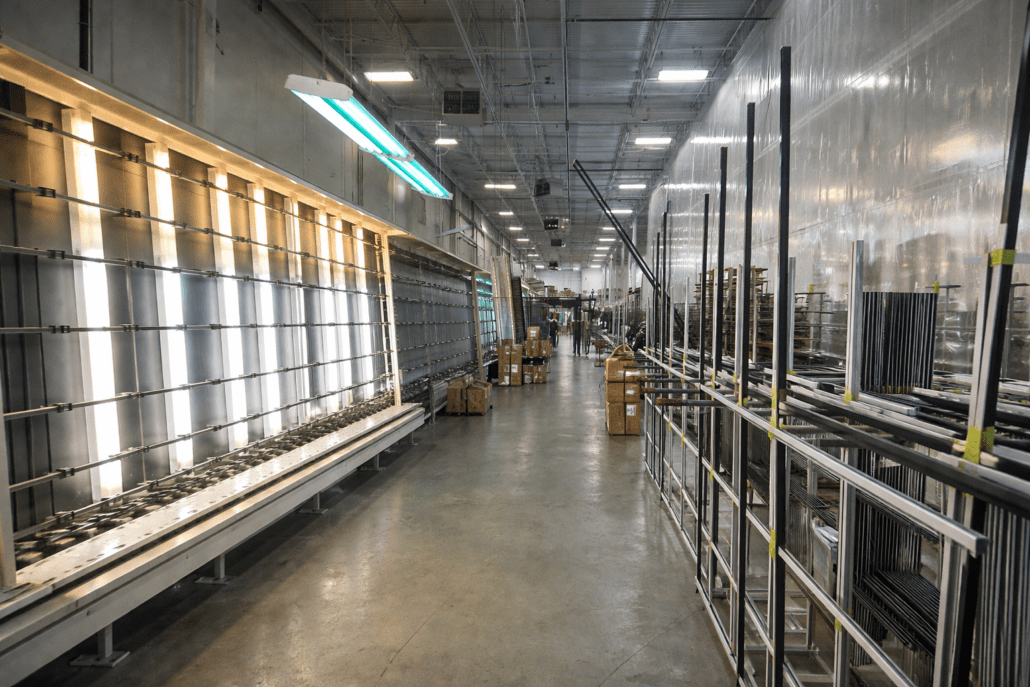
Manufacturing and Fabrication; QA & Production
Reduce scrap, rework, and delays by restoring glass defects when feasible
GlassRenu helps manufacturers and fabricators restore certain surface defects on glass when feasible using a controlled, standards-based process — turning potential rejects into shippable product and reducing the cost of quality.
The manufacturing reality: defects don’t just cost materials
In fabrication and manufacturing, a surface defect is rarely “just a scratch.” It can trigger a chain reaction: hold tags, rework queues, scheduling disruptions, missed ship dates, and replacement cost that adds up fast. Even when the glass itself is replaceable, the downstream impact (labor, logistics, customer friction) is often the real cost.
Many facilities can’t justify “trial and error” polishing on production glass because optical expectations are tight and inconsistency creates new problems. That’s why GlassRenu is positioned as a method, not a hack: a defined process with training, tooling, and controls designed to make restoration a disciplined capability inside your quality system.

What GlassRenu enables in a plant environment
GlassRenu supports teams that want a structured way to evaluate and address certain surface defects when feasible:
- A decision framework for restore vs. scrap vs. reprocess
- A controlled restoration method designed to return surface clarity without improvisation
- Training and standard work so results are repeatable across operators
- Tooling + consumables selected to support a consistent step progression
- Quality checks and acceptance alignment so the result is measurable, not subjective
The goal is not to “save everything.” The goal is to reduce avoidable rejects and protect throughput when restoration is the best available option.
Where restoration is commonly considered
Use cases vary by process and product, but many teams explore restoration when:
- A surface defect is discovered late (after value has already been added)
- The defect would otherwise cause scrap or downgrade
- Replacement creates lead-time or scheduling constraints
- There’s a need for consistent rework capability instead of ad-hoc heroics
Depending on the facility, restoration may be used as:
- A controlled rework process for specific defect types
- A triage tool to reduce scrap on high-value parts
- A way to stabilize quality outcomes while upstream root causes are being addressed
The value proposition for QA and production leaders
✔ Reduce the cost of quality
When feasible, restoration can reduce scrap and replacement cost on parts that would otherwise be rejected — especially when the defect is localized and the alternative is starting over.
✔ Improve throughput and protect ship dates
Instead of waiting on remake cycles, restoration can create a faster path to recovery on urgent orders, reducing schedule volatility.
✔ Standardize rework (make it teachable and auditable)
A repeatable method and trained operators reduce variability. That means fewer “one-off” outcomes and fewer surprises at final inspection.
✔ Build a clearer decision system
Restoration becomes a defined option within your quality system — with documented criteria for when it’s allowed, when it requires escalation, and when the part should be scrapped.
How it works (standard-work-friendly workflow)
- Defect identification and feasibility
The defect is characterized by type and severity, and feasibility is evaluated based on the product’s optical and dimensional requirements. - Method selection
The restoration approach is selected based on defect category. This step avoids over-processing and reduces the chance of inconsistent finish. - Controlled step progression
Operators follow a defined progression to level the surface and return clarity. The focus is consistency and repeatability, not “creative polishing.” - Verification and acceptance
Results are checked against agreed criteria and documented under the same inspection conditions used for production.
What you get with GlassRenu
Process + tooling designed for repeatability
Contractor-grade restoration systems and consumables selected to support a controlled progression.
Training built around consistency
Hands-on training focuses on technique discipline, method selection, and repeatable outcomes—so restoration can be operated as standard work rather than a specialty craft.
Documentation and support for implementation
We help teams think through how restoration fits inside their workflow: decision thresholds, escalation rules, inspection conditions, and operator qualification.
A practical implementation path
Most manufacturing teams start by:
- Identifying one or two defect types that create avoidable scrap
- Defining restore vs. scrap thresholds with QA ownership
- Running a pilot on a controlled set of parts
- Creating standard work + training for a limited operator group
- Scaling only after results and acceptance criteria are proven
This approach keeps restoration disciplined, measurable, and aligned with your quality system.
Call to action
If surface defects are driving scrap, rework congestion, or delayed shipments, restoration may be a practical capability to add—when feasibility and acceptance are aligned.
Next steps:
- Discuss your defect types and define restore vs. scrap thresholds
- Run a pilot with documented acceptance criteria
- Train operators and implement standard work for consistent outcomes