
INDUSTRY APPLICATION · Professional window-cleaning businesses
Window Cleaners
Revenue pathway · Add restoration beyond routine cleaning
Recognize when cleaning ends and a qualified, separately priced restoration opportunity begins.

WHY EVALUATE RESTORATION
For suitable conditions: lower total cost, faster resolution, controlled quality
These are decision criteria, not universal promises. Confirm the glass, condition, access and acceptance requirements through a representative trial.
Offer a priced repair option where cleaning alone cannot resolve the concern.
Identify restoration opportunities during established customer service relationships.
Identify the condition, qualify the method and inspect the finished glass.
START WITH YOUR QUESTION
What brought you here?
WHAT ARE YOU SEEING?
Go directly to the conditions most relevant to your work


THE DECISION
A practical restoration decision
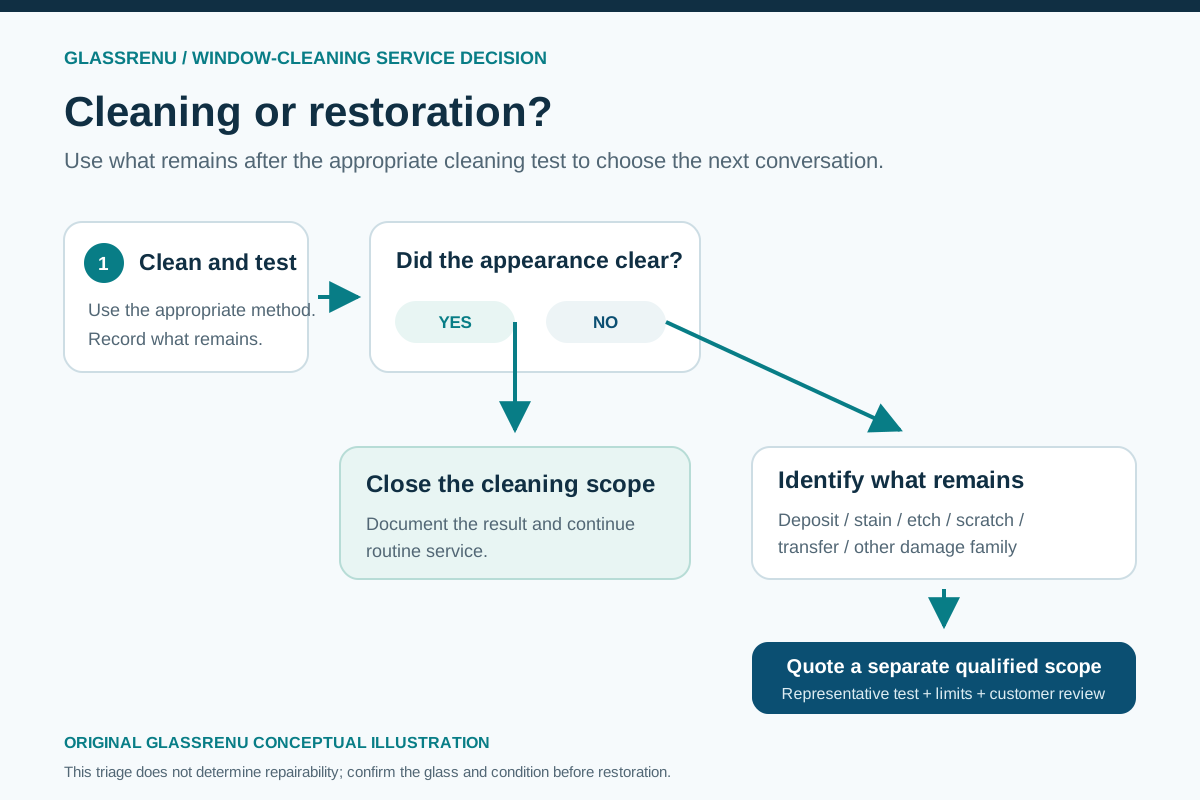
Some visible marks remain after appropriate cleaning. Recognize when a concern needs restoration assessment rather than another cleaning attempt.
FROM ASSESSMENT TO ACCEPTANCE
Know when the cleaning visit becomes a restoration conversation
Do not keep escalating cleaning chemistry or abrasion when the remaining condition needs identification.
- Complete the appropriate cleaning test and document what remains.
- Identify deposit, stain, etch, scratch or another damage family.
- Explain the separate restoration scope, limits and representative test.
- Inspect the test with the customer before pricing or expanding the work.
TECHNICAL DETAIL
Use the decision model in this work environment
Still removable
If the appropriate cleaning test changes or removes the material, remain in the cleaning scope and document the result.
Persistent appearance
If the concern remains, classify deposit, stain, etch, scratch or transferred material before changing tools or chemistry.
Separate restoration scope
Quote restoration as a distinct service with a representative test, stated limits and customer review - not as more aggressive cleaning.
CONNECTED REFERENCE
Continue with definitions, standards and guidance
Relevant terms
Guides and pathways
External context
- NGA: Proper Procedures for Cleaning Architectural Glass Products, December 2023external contextual reading; not a GlassRenu endorsement or restoration approval
YOUR NEXT MOVE
Revenue pathway · Add restoration beyond routine cleaning
Begin with the glass problems customers already ask about. GlassRenu can help your team separate cleaning from restoration, select training and define the first services you can quote responsibly.
COMMON QUESTIONS
Before a pilot or project begins
When should cleaning become an assessment conversation?
When the appearance concern persists after the appropriate cleaning approach, document it and identify the condition before proposing a more aggressive process.
Do I need a trained in-house operator?
You can develop in-house capability through a suitable system and training plan, or connect the customer with an independent provider. Confirm the provider’s training and project suitability.
READY TO CONTINUE?
Recognize when cleaning ends and a qualified, separately priced restoration opportunity begins.
Build a restoration service around the glass problems customers already show your team.