
INDUSTRY APPLICATION · Multi-site service providers and facility crews
Jan-San & Facility Services
Revenue pathway · Add a qualified specialty service
Give site teams a reliable escalation path when routine cleaning cannot resolve the glass concern.

WHY EVALUATE RESTORATION
For suitable conditions: lower total cost, faster resolution, controlled quality
These are decision criteria, not universal promises. Confirm the glass, condition, access and acceptance requirements through a representative trial.
Price an additional restoration service around the actual scope and resources required.
Create a consistent route from site observation to qualified assessment.
Use shared assessment language, training and inspection checkpoints across locations.
START WITH YOUR QUESTION
What brought you here?
WHAT ARE YOU SEEING?
Go directly to the conditions most relevant to your work


THE DECISION
A practical restoration decision
When glass still looks wrong, the service team needs a responsible next step. Distinguish residue, transferred material and surface damage before deciding what to propose.
FROM ASSESSMENT TO ACCEPTANCE
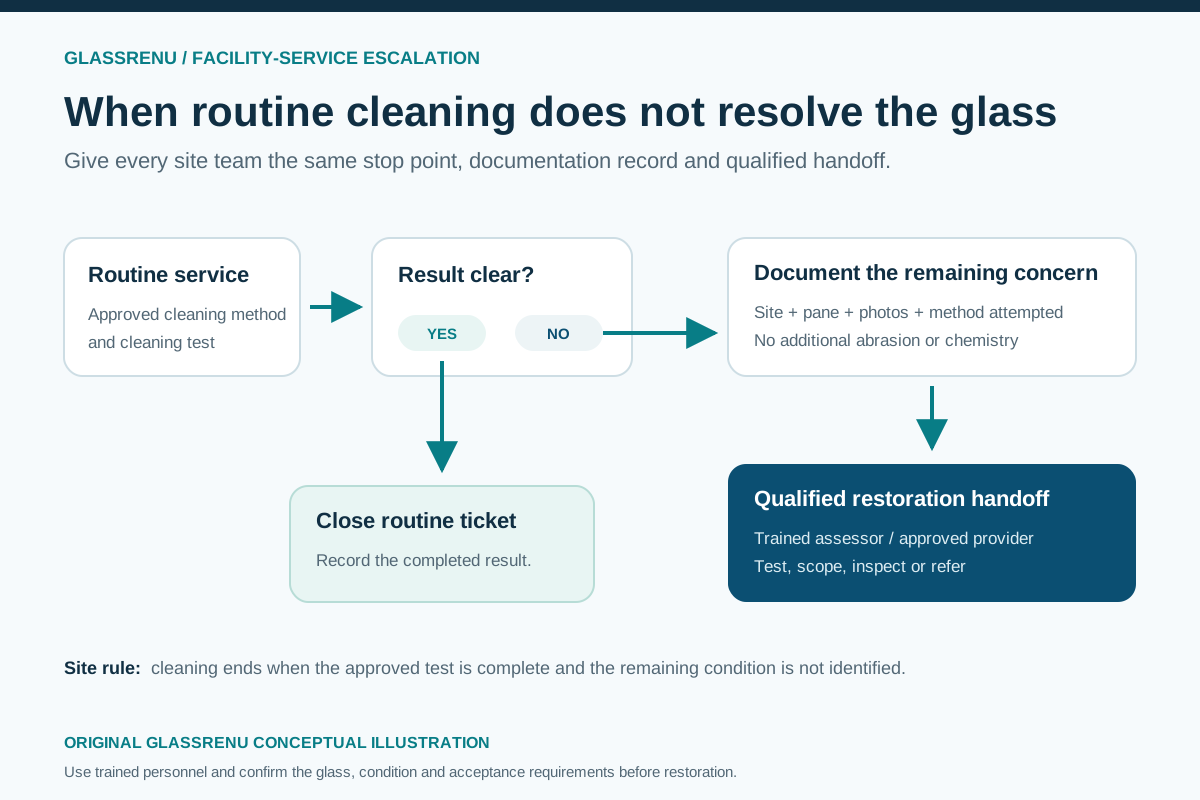
Give every site the same escalation path beyond routine cleaning
A repeatable handoff protects the client relationship and keeps unqualified glass work out of routine service.
- Complete the approved cleaning test and stop if the concern remains.
- Photograph the area and record site, pane and observed condition.
- Route the item to a trained restoration assessor or approved provider.
- Close the ticket with the selected scope, inspection result and next action.
TECHNICAL DETAIL
Use the decision model in this work environment
Define the cleaning stop point
Give site teams a clear test and escalation rule so they do not increase abrasion or chemistry on an unidentified condition.
Create a qualified handoff
The site record should show the glass location, the cleaning already attempted, photographs and the remaining appearance.
Scale capability deliberately
Use trained operators, a narrow starting service list and repeatable inspection before offering restoration across accounts.
CONNECTED REFERENCE
Continue with definitions, standards and guidance
Relevant terms
- Cleaning testGRK-147 · Core glossary
- Restoration feasibilityGRK-153 · Core glossary
- RepeatabilityGRK-150 · Core glossary
- Inspection protocolGRK-123 · Core glossary
- Stop-work conditionGRK-154 · Core glossary
- Post-restoration verificationGRK-160 · Core glossary
- Cost of QualityGRI-001 · Industry glossary
- Standardized WorkGRI-002 · Industry glossary
- ReworkGRI-003 · Industry glossary
Guides and pathways
External context
- NGA: Proper Procedures for Cleaning Architectural Glass Products, December 2023external contextual reading; not a GlassRenu endorsement or restoration approval
YOUR NEXT MOVE
Revenue pathway · Add a qualified specialty service
Define the site escalation rule first. GlassRenu can then help with operator training, equipment selection and a bounded pilot before the service is offered across accounts.
COMMON QUESTIONS
Before a pilot or project begins
How does restoration differ from routine cleaning?
Cleaning and restoration address different types of surface concern. Identify whether the issue is removable material or damage before choosing a method or describing the service to the client.
How should a multi-site rollout begin?
Start with a bounded pilot, designated operators and documented acceptance checks. Expand only after the organization has reviewed actual results and the training and support needed at each site.
READY TO CONTINUE?
Give site teams a reliable escalation path when routine cleaning cannot resolve the glass concern.
Build a trained restoration capability for glass concerns beyond routine cleaning.