
On this page
- Diagnosis summary
- Safety and classification scope
- Definition (Reference)
- Typical Presentation (Informative)
- Field Identification Cues (Normative)
- Classification Mapping (to VIS-DA) (Normative)
- Indicative Relief / Depth (Informative)
- Differentiation & False Positives (Informative)
- Evidence Package (Documentation Requirements) (Normative)
- Mis-ID Pitfalls (Informative)
- Reporting Language (Template)
- Related glossary terms
- Related DSS
- Source and version
DAMAGE SPECIFICATION STANDARD / METHOD-AGNOSTIC
DSS-A.01.02 — Moisture / Condensation Between Panes (#2 / #3)
Assembly / internal condition - typically CAT-5 by location; out of in-place scope
Diagnosis summary
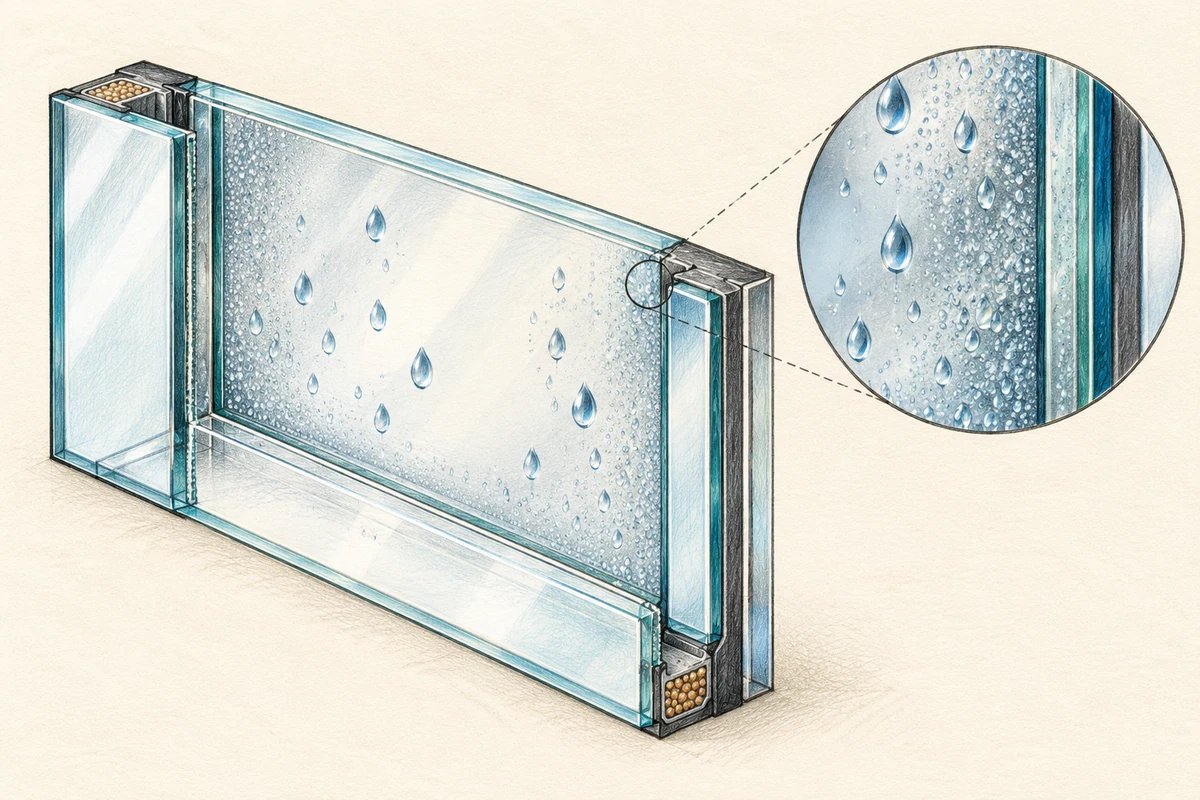
Between-pane condensation is liquid water or condensate films/droplets observed on IGU cavity faces (typically #2 / #3) due to moisture ingress, seal failure, or internal humidity/temperature cycling. Because the cue resides inside the sealed unit, it is not accessible to in-place restoration; classification is governed by location/condition rather than surface-catch.
Definition (Reference)
ReferenceBetween-pane condensation is liquid water or condensate films/droplets observed on IGU cavity faces (typically #2 / #3) due to moisture ingress, seal failure, or internal humidity/temperature cycling. Because the cue resides inside the sealed unit, it is not accessible to in-place restoration; classification is governed by location/condition rather than surface-catch. Identify cavity faces via surface numbering and verify between-pane status by fixed parallax.
Typical Presentation (Informative)
Informative- Discrete droplets, streaking, or a continuous wet film inside the unit that persists after reveal/dry of the exposed faces and does not respond to wiping #1/#4.
- Often angle-dependent and more obvious in oblique/raking views; may vary with time of day / weather, yet remains inaccessible.
Field Identification Cues (Normative)
NormativeLocation / access (primary):
- Confirm the condition is between panes using parallax: the feature’s apparent position is fixed relative to its reflection when the observer moves. Log as #2 / #3 per surface numbering. If between panes, classify CAT-5 by location.
Surface-catch class (MSRT):
- Not determinative for between-pane conditions; MSRT on #1/#4 cannot assess a cavity-face cue. CAT-5 is location/condition-driven.
Inspection environment / reveal controls:
- VIS requires clean, dry exposed faces before evaluation (Non-Invasive Reveal) and to avoid precipitation/condensation/wet surfaces on #1/#4. If the moisture is on #1/#4, dry/condition and re-inspect; if it remains between panes, treat as CAT-5.
Viewing / lighting:
- Apply VIS geometry: 12 / 36 / 72 in, normal incidence + oblique sweep (~60°-120°), with raking light; surfaces clean & dry.
Classification Mapping (to VIS-DA) (Normative)
Normative- CAT-5 - Out of scope for in-place restoration when between-pane (IGU cavity) or otherwise inaccessible. Document and refer per project protocol (e.g., replacement or manufacturer service).
- If the moisture proves to be on #1/#4 (responds to reveal / drying), it is an environmental condition and must be removed/controlled prior to classification; only residual cues on the exposed face (e.g., films/etch) are classified under R or Ch families by CAT.
Indicative Relief / Depth (Informative)
Informative- Between-pane condensation is a transient internal wetting; there is no accessible face-side relief for MSRT. Numeric depth is not applicable; location governs classification.
Differentiation & False Positives (Informative)
Informative- vs. Internal haze/volatile fogging (A.01.01): Haze appears as a dry veil/film and remains even when the cavity is not visibly wet. Condensation shows droplet/wet film morphology that may cycle with conditions, yet remains between panes. (Use parallax to confirm.)
- vs. Exterior/interior surface condensation (#1/#4): Disallowed by VIS environment controls; clears with dry/conditioning per §5.3. If it clears and no residue remains, no damage classification applies.
- vs. Coating rub/patchiness (Co.01/Co.03): Coating anomalies are worked-surface issues on an exposed coated face and are disallowed at acceptance on the worked surface (VIS §6.2.e); between-pane moisture shows fixed parallax and no worked perimeter.
Evidence Package (Documentation Requirements) (Normative)
Normative- Photo set (VIS): 12 / 36 / 72 in; normal + oblique; include raking frames. Capture paired frames (or a brief sequence) to demonstrate fixed parallax (feature position remains fixed relative to reflection as the observer moves). Note lighting/time and reveal status.
- Forms: Record pane ID; product family & surface numbering (#1-#4; laminate-internal if applicable); worked surface Y/N; functional coating present on worked surface? (Y/N/Unknown); environment checks (dry; no condensation).
- Acceptance split: CAT-5 conditions are not subject to in-place acceptance under VIS; document and refer. Do not conflate factory/system issues with VIS acceptance for restored faces.
Mis-ID Pitfalls (Informative)
InformativeAttempting to work #1/#4 to “remove” a between-pane wetting artifact will create a worked region with a visible transition edge, which VIS disallows at acceptance (CAT-0...CAT-4). Confirm parallax and environmental dryness before any action.
Reporting Language (Template)
Template- A.01.02 Moisture/Condensation Between Panes (#2/#3) - Between-pane wetting verified by fixed parallax; no change after Non-Invasive Reveal/dry of #1/#4; MSRT not applicable to internal cue. Logged as CAT-5 (out of in-place scope by location). Document per VIS (photos at 12/36/72 in; normal + oblique + raking; surface numbering recorded; forms per Appendix X3) and refer per project protocol.
Related glossary terms
- Raking lightGRK-129
- Coating rubGRK-115
Source and version
GlassRenu Damage Specification Sheets (DSS), DSS-A.01.02. Source revision and extraction date are recorded in the deployment manifest.
Open the complete published DSS with table of contents (PDF)
Normative and informative labels are preserved from the source. The downloadable one-sheet is a condensed classification aid; this web page retains the complete source-based specification content.