
On this page
RESOURCE CENTER / METHOD-AGNOSTIC DAMAGE DEFINITIONS
Damage Specification Standards
A searchable catalog of the 150 unique condition definitions in GlassRenu’s Damage Specification Standards. Each card opens a complete source-based reference page with an approved technical illustration and its own printable one-page classification sheet.
150 definitions
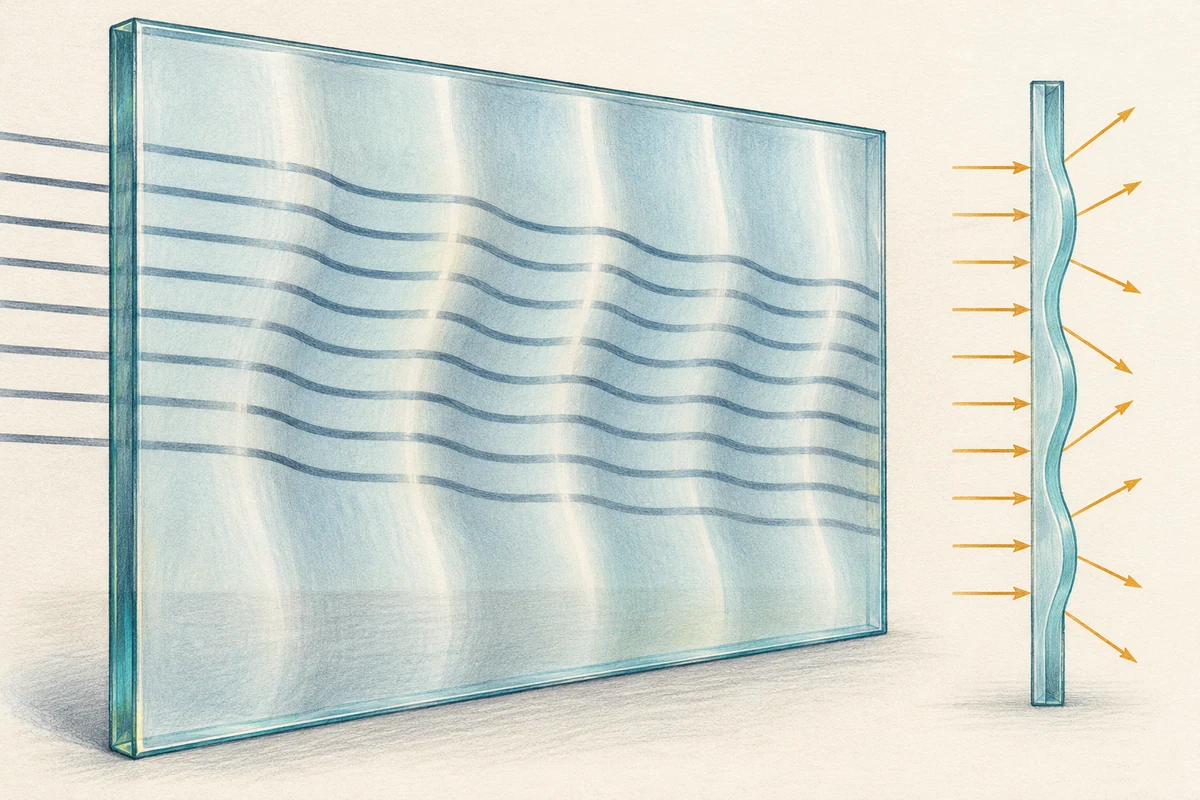
Roller Wave (Periodic Flatness Deviation)
Processing / Manufacturing Feature — reference; generally not damage
A periodic flatness deviation characteristic of heat-treated flat glass that appears as bands/undulations in reflection or transmission. It is a factory feature of the product, not a field-induced surface relief defect. For measurement background on optical/roll-wave distortion in heat-treated flat glass, see ASTM C1651 (informative reference noted in VIS).
Illustration, reference page, and PDF complete
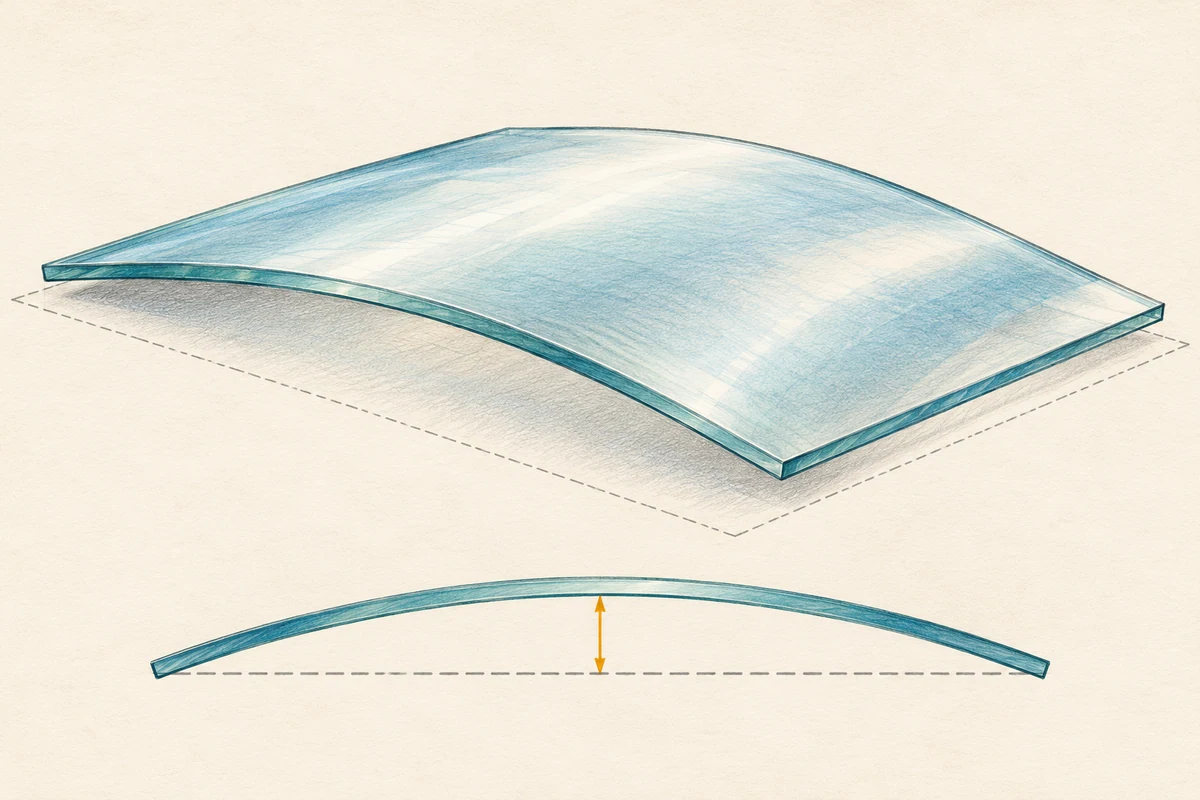
Bow / Warp (global shape)
Processing / Manufacturing feature — reference; generally not “damage”
A pane-scale departure from nominal flatness that manifests as gentle, global curvature (bow) or more complex global shape (warp). It alters the way straight lines reflect or transmit across the entire lite but does not present as localized surface relief at the exposed surface. Use of raking/oblique views and the VIS viewing geometry is for observation only;
Illustration, reference page, and PDF complete
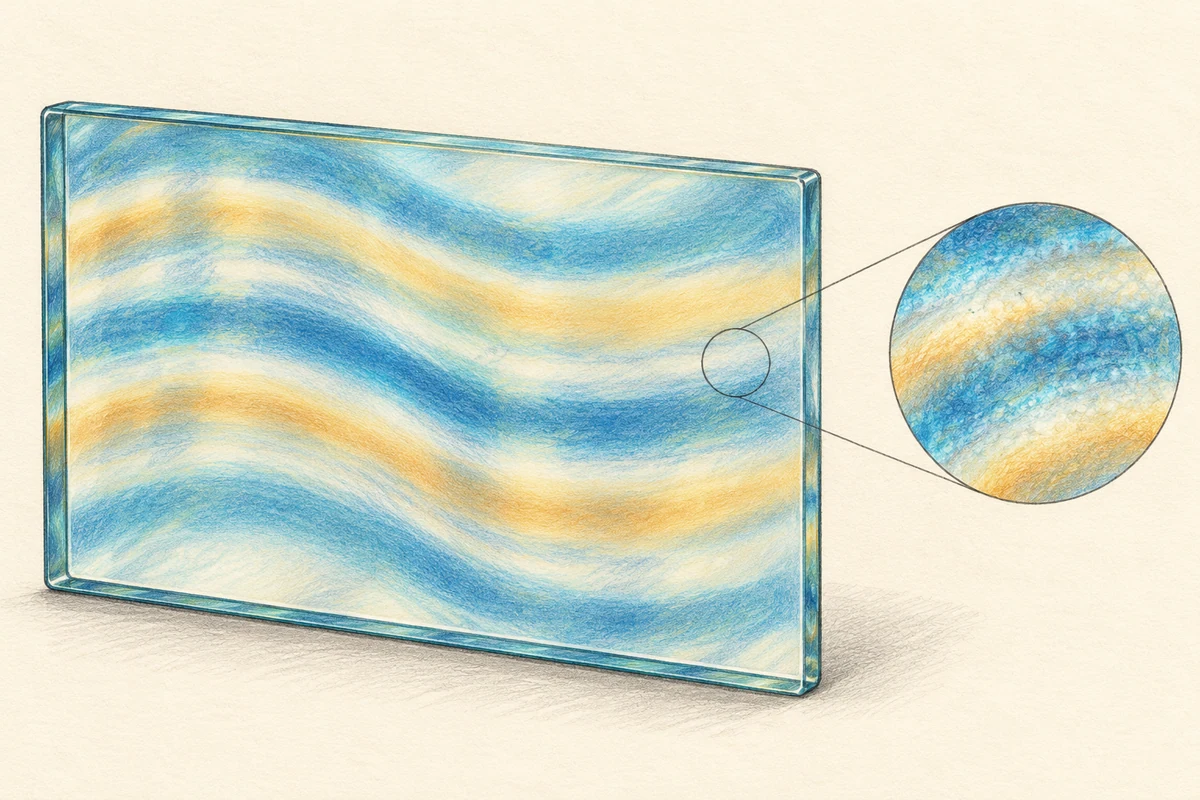
Quench / Anisotropy Patterning (polarization-visible)
Processing / Manufacturing feature — reference; generally not “damage”
A spatial variation in optical response (anisotropy) characteristic of heat-treated glass caused by non-uniform cooling in the quench. It presents as bands, mottling, or “zebra/leopard” tonal shifts that are most evident in reflection/transmission at oblique angles and may be accentuated by polarized viewing. It is a factory feature of the product—not a localized surface-relief defect.
Illustration, reference page, and PDF complete
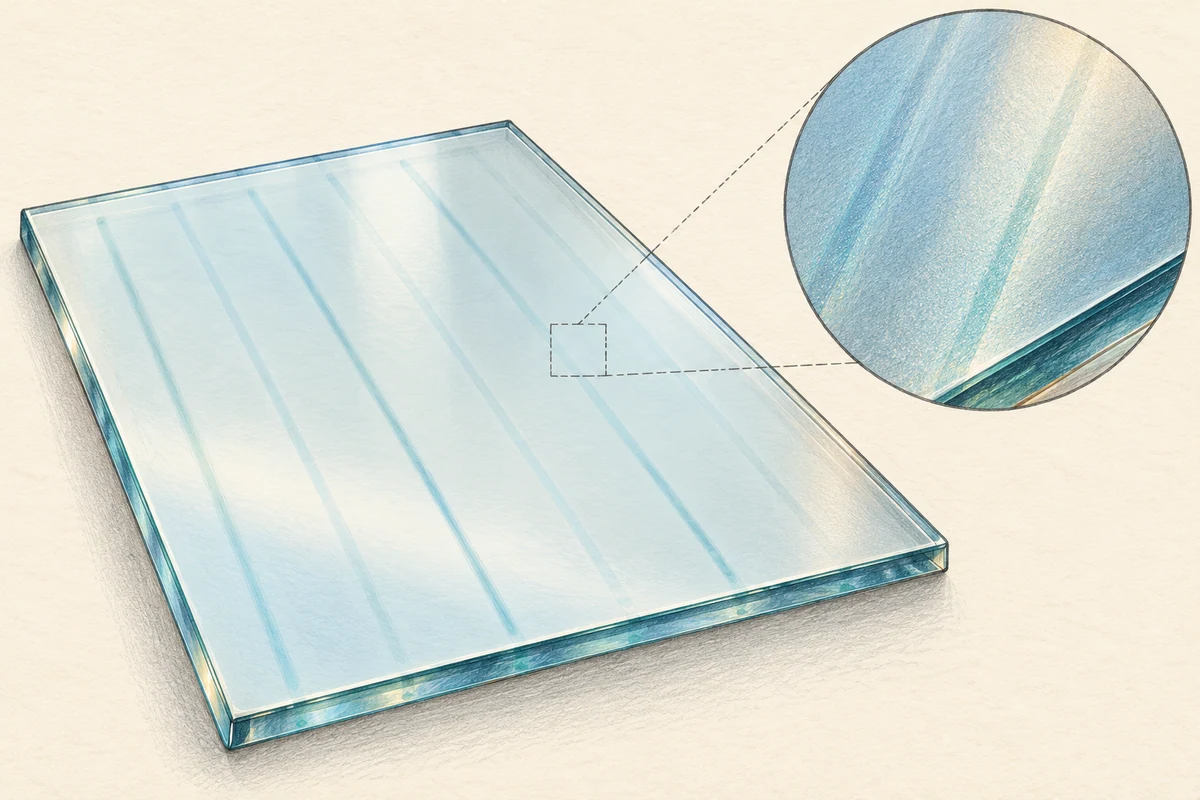
Roller Pickup / “Line Ghost” (pyrolytic line pattern)
Processing / Manufacturing feature — reference; generally not “damage”
A linear appearance feature associated with pyrolytic (hard-coat) deposition on the float line, observed as faint, conveyor-parallel lines or “ghosts” that repeat across a lite. It is a factory/processing signature of the coating run, not a localized surface-relief defect. For coating product context see the VIS normative references list (ASTM C1376).
Illustration, reference page, and PDF complete
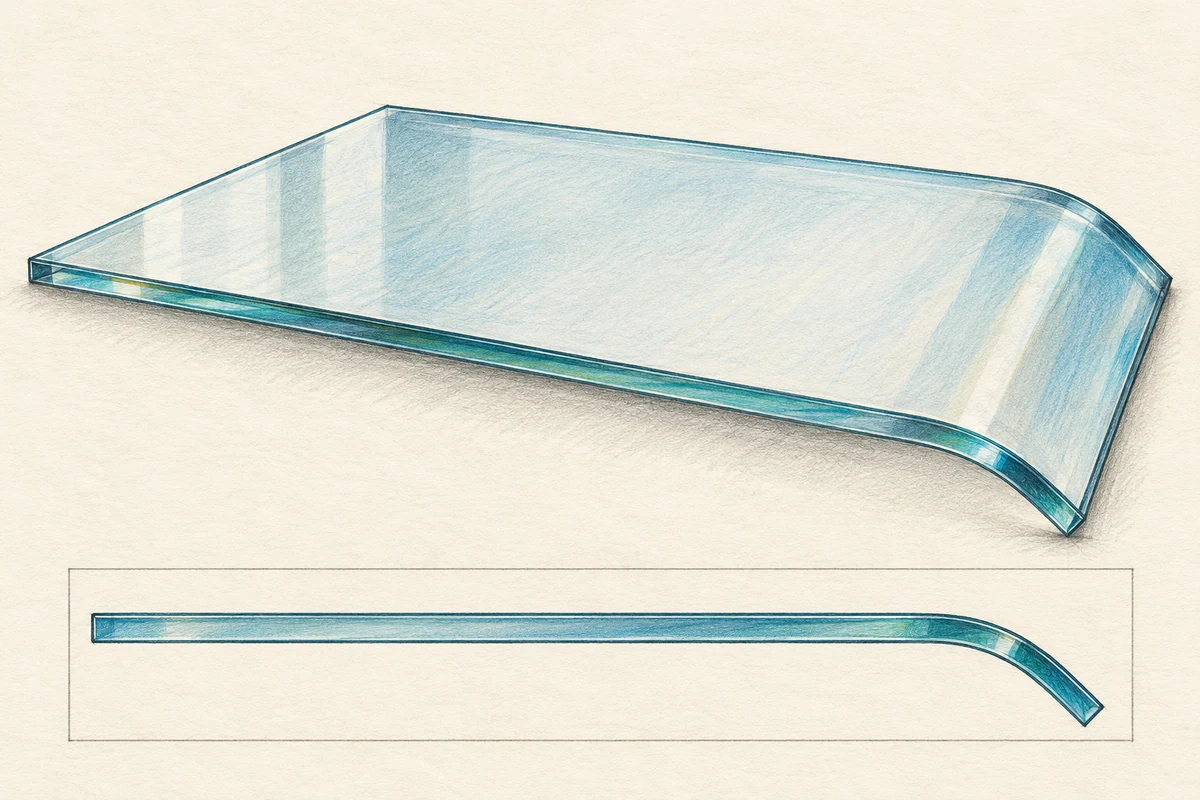
Edge Kink / Localized Warp
Processing / Manufacturing feature — reference; generally not “damage”
A localized departure from flatness concentrated near an edge or corner of a lite—commonly a small “kink” or short-wavelength warp attributable to manufacturing/handling processes (e.g., heat-treat cooling, conveyor/edge support, post-process handling). It alters straight-line reflections/transmission near the edge zone but does not present as a discrete surface-relief defect at the exposed surface.
Illustration, reference page, and PDF complete
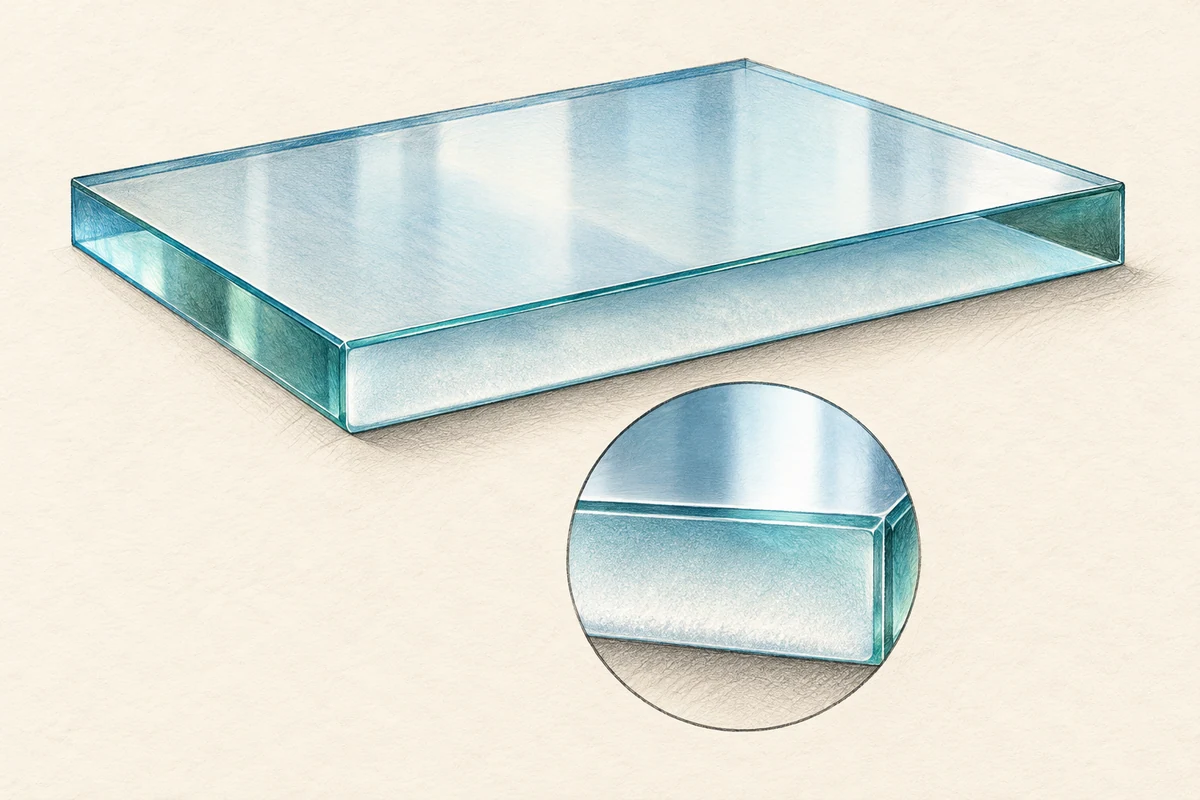
Tin-Side Haze / Surface “Side” Effects
Float & raw glass feature — reference; generally not “damage”
Subtle appearance differences between float-glass surfaces—commonly a faint haze/iridescence or slightly different “sheen” on the tin-side versus the air-side—arising from normal float manufacture. These are factory surface-side signatures, not field-induced surface-relief defects. Observe with VIS lighting and viewing geometry for consistency;
Illustration, reference page, and PDF complete
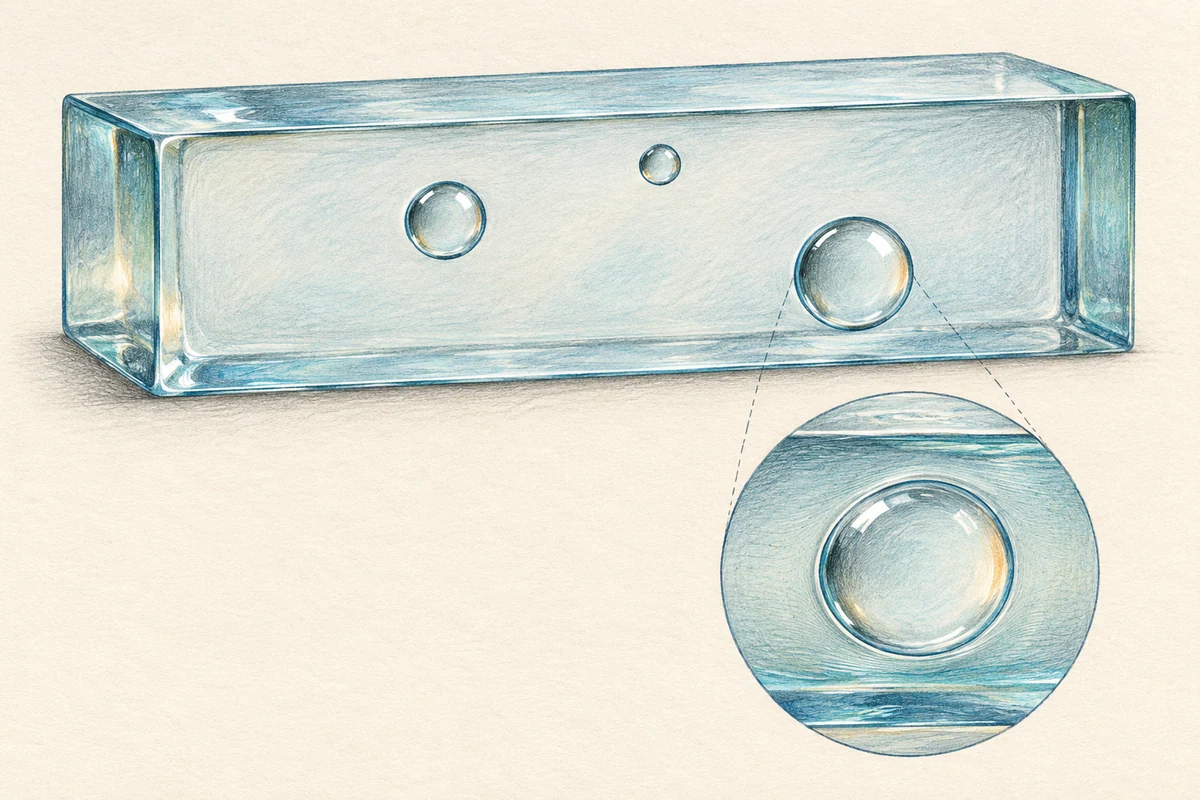
Seeds / Blisters (entrapped gas)
Float & raw glass feature — reference; generally not “damage”
Seeds/blisters are gas inclusions formed during melting/float manufacture, appearing as encapsulated bubbles within the glass body. When fully encapsulated, they are a manufacturing feature and not a surface-relief defect. Evaluate using VIS lighting and viewing geometry for observation consistency; product acceptance for factory inclusions is separate from post-restoration acceptance under VIS.
Illustration, reference page, and PDF complete
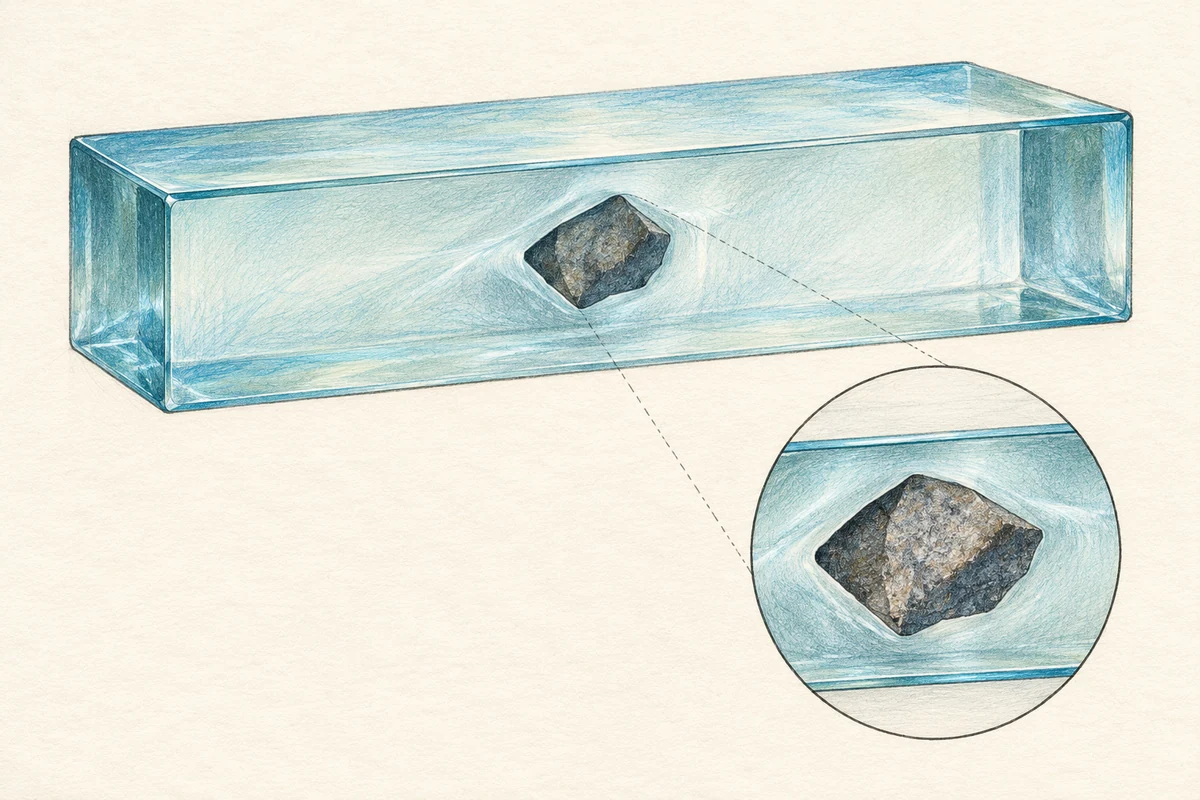
Stones / Knots (solid inclusions)
Float & raw glass feature — reference; encapsulated = factory feature; “open” = classify by surface morphology
Stones/knots are solid inclusions within the glass body (e.g., unmelted batch, refractory fragments) produced during glass manufacture. When fully encapsulated, they are manufacturing features (optical/appearance effects) rather than surface-relief defects. Evaluate with VIS lighting/geometry for consistency; product/factory acceptance is distinct from VIS post-restoration acceptance.
Illustration, reference page, and PDF complete
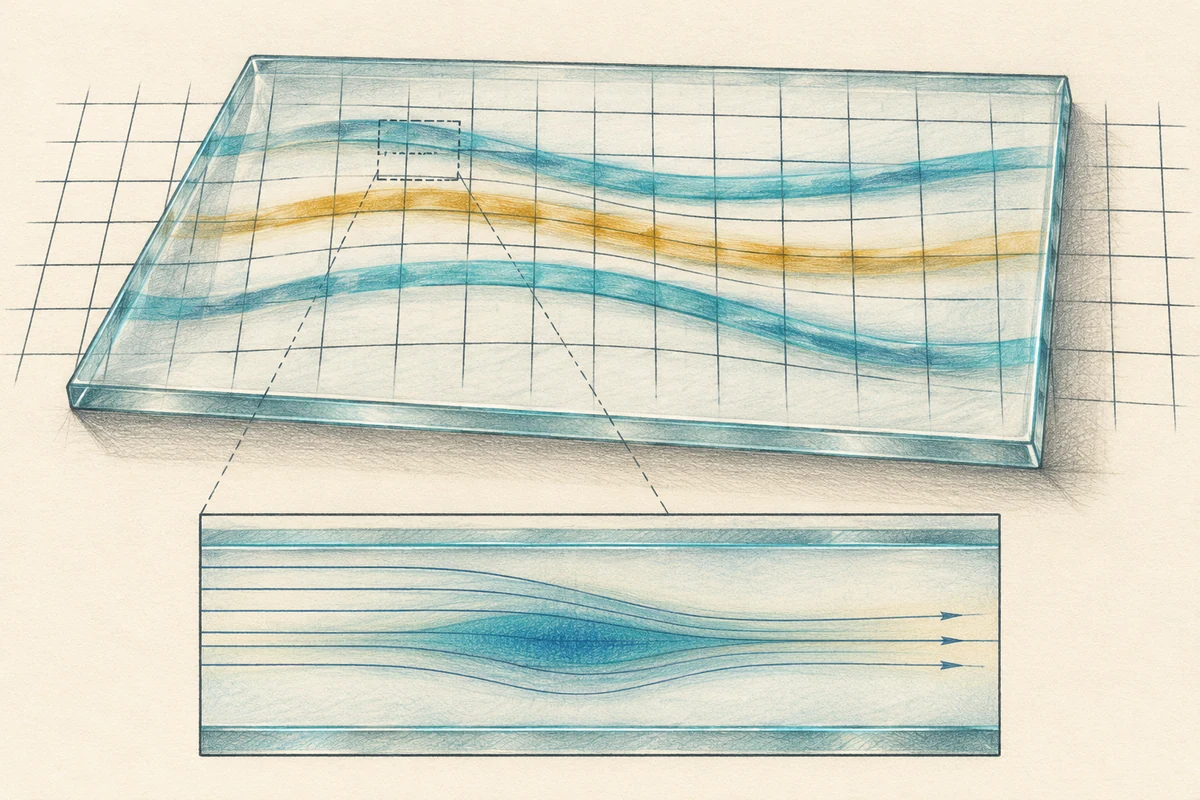
Ream / Cord / Striae (optical inhomogeneity)
Float & raw glass feature — reference; generally not “damage”
Ream/cord/striae are optical inhomogeneities in float glass arising from localized variations in composition/temperature during forming. They present as streaks, swirls, or ribbons that deflect straight-line reflections and alter transmitted/reflected imagery, most apparent at oblique angles. These are factory optical features rather than local surface-relief defects.
Illustration, reference page, and PDF complete
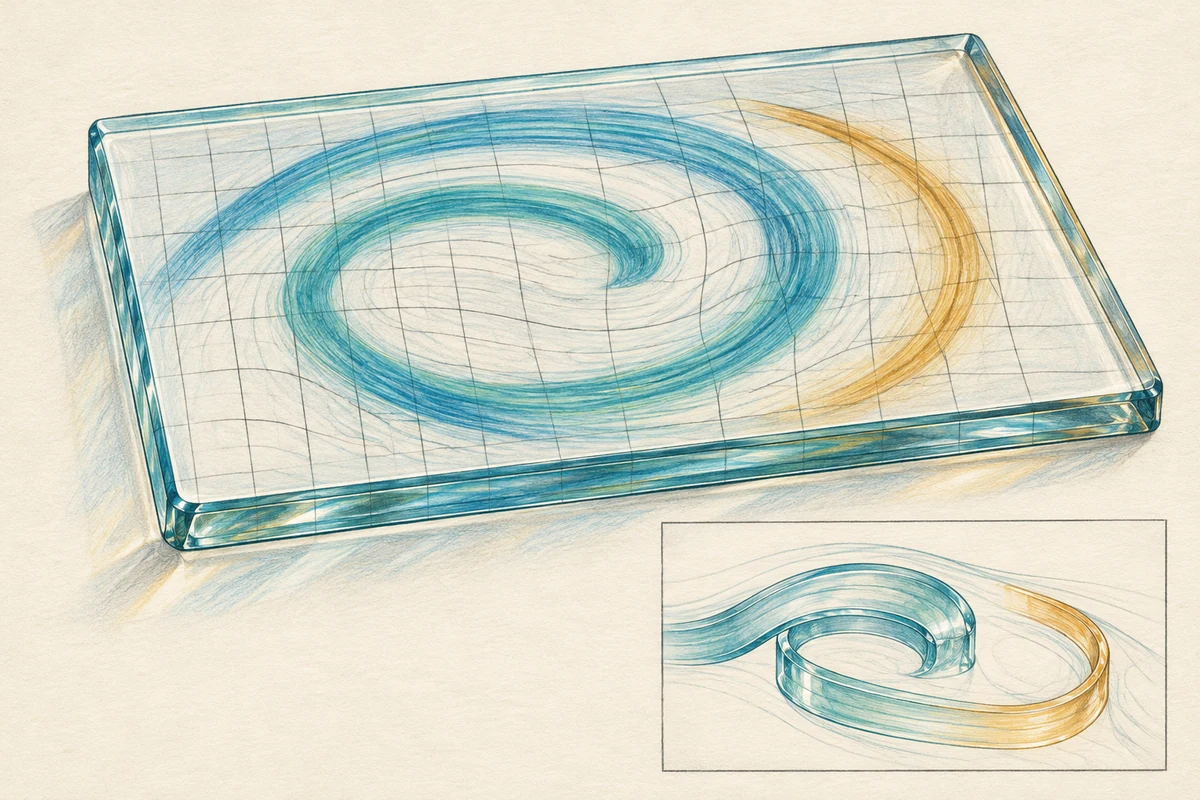
Draw / Float Swirl (optical patterning)
Float & raw glass feature — reference; generally not “damage”
Pane-scale optical flow patterning—subtle swirls/eddies formed by melt/float-bath flow and composition/temperature variations during manufacture. Presents as low-contrast swirl bands or gentle flow lines that bend straight reflections and modulate sheen, typically strongest at oblique angles/raking light. These are factory optical features, not local surface-relief defects.
Illustration, reference page, and PDF complete
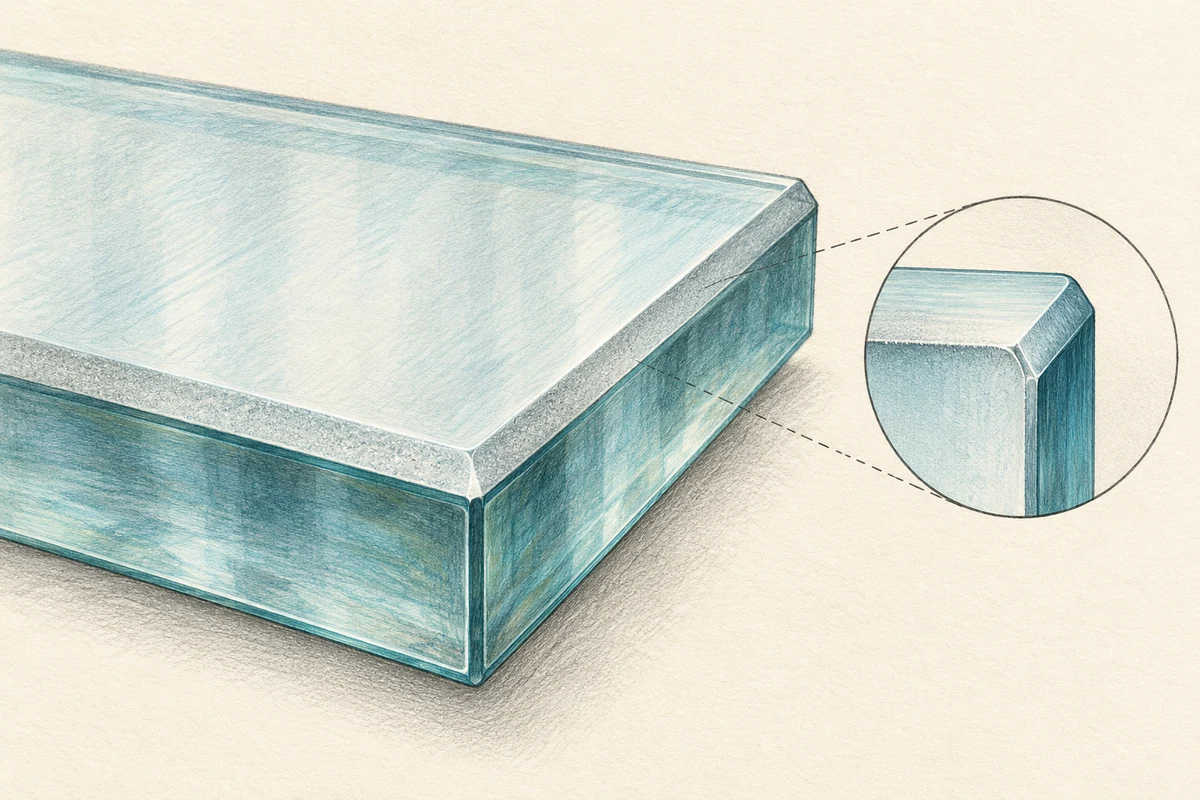
Seamed / Arris Edge Texture (as-processed edge finish)
Fabrication & finishing — reference; generally not “damage”
Seamed/arris edge texture is the factory edge finish produced by light grinding to remove sharpness after cutting. It may appear as a narrow frosted/ground band at the perimeter or as micro-striations normal to the edge. This is a manufacturing edge feature, not a worked-surface defect. Evaluate observations under VIS lighting/geometry;
Illustration, reference page, and PDF complete
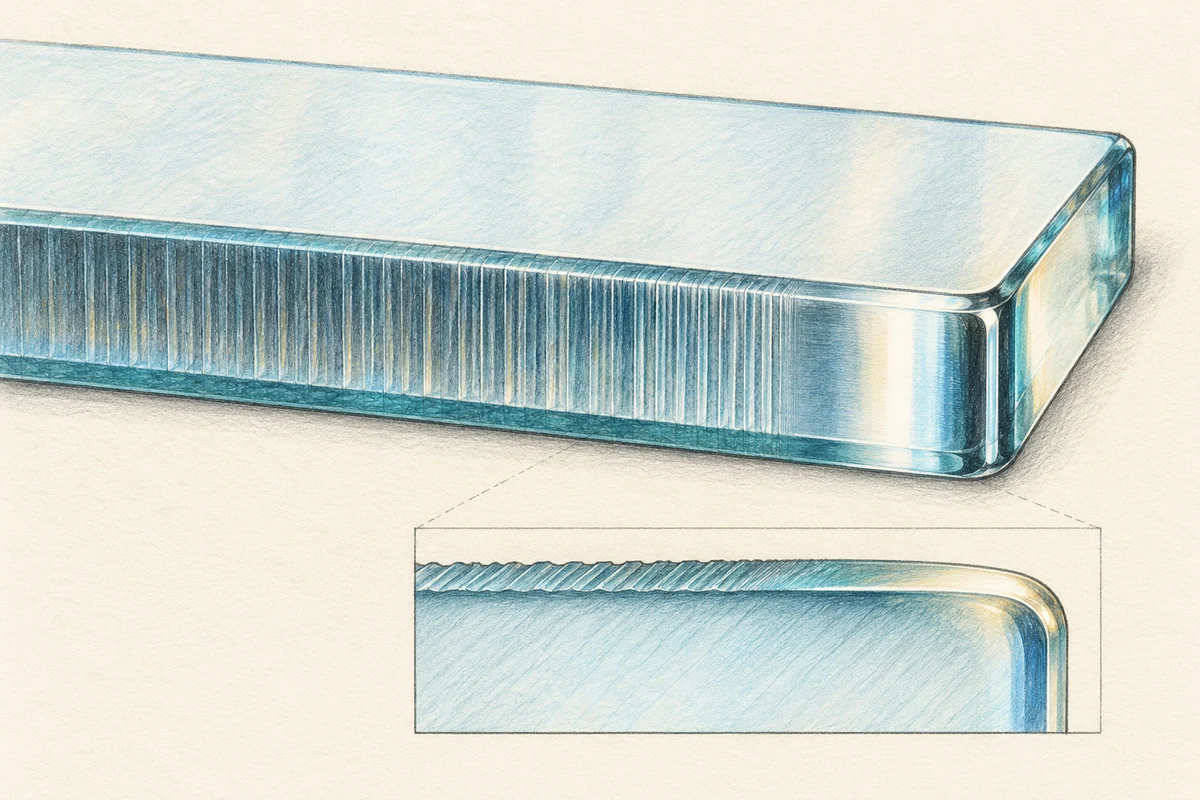
Edge Grind / Polish Pattern (factory)
Fabrication & finishing — reference; generally not “damage”
A factory edge-finish pattern produced by belt/diamond grinding and/or polishing after cutting. It can appear—when viewed from the face—as fine, parallel lineation or a narrow glossy/matte band immediately adjacent to the edge. This is a manufacturing edge feature, not a worked-surface defect on the face. Evaluate under VIS inspection lighting/geometry;
Illustration, reference page, and PDF complete
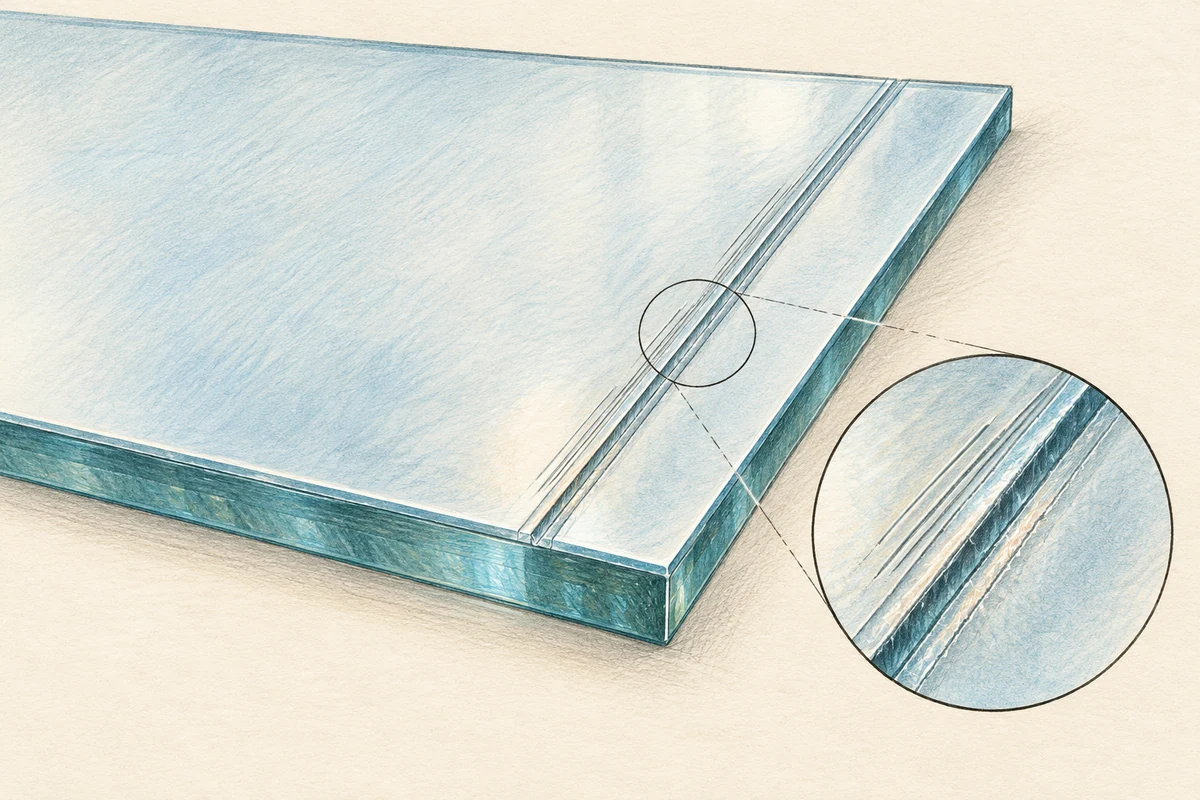
Cutting Skid Lines (factory micro-lines)
Fabrication & finishing — reference; generally not “damage”
Cutting skid lines are fine, short micro-lines generated during score-and-break cutting at the factory (wheel slip or micro-chatter just before/after the primary score). They are usually confined to the edge zone and appear only in raking/oblique views. As a manufacturing artifact, they are not, by themselves, a worked-surface defect on the face.
Illustration, reference page, and PDF complete
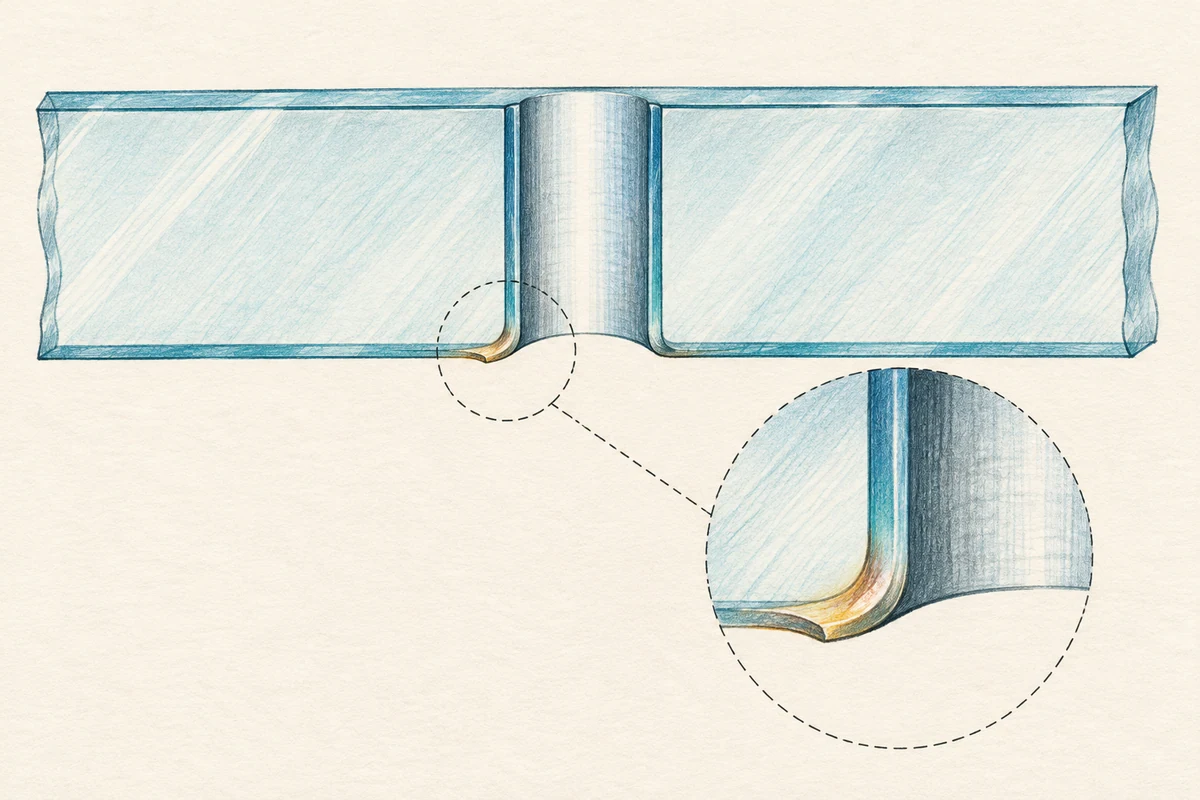
Drill/Slot “Exit Lip” (acceptable edge artifact)
Fabrication & finishing — reference; generally not “damage” unless it propagates onto the face
A localized burr/lip at the exit of a drilled hole or machined slot produced during fabrication when the tool breaks through the ply. Typically confined to the edge of the hole/slot or immediately adjacent edge land, not onto the visible face. Considered a factory edge artifact rather than a worked-surface defect when it does not create a face-side transition edge or chip-flank morphology.
Illustration, reference page, and PDF complete
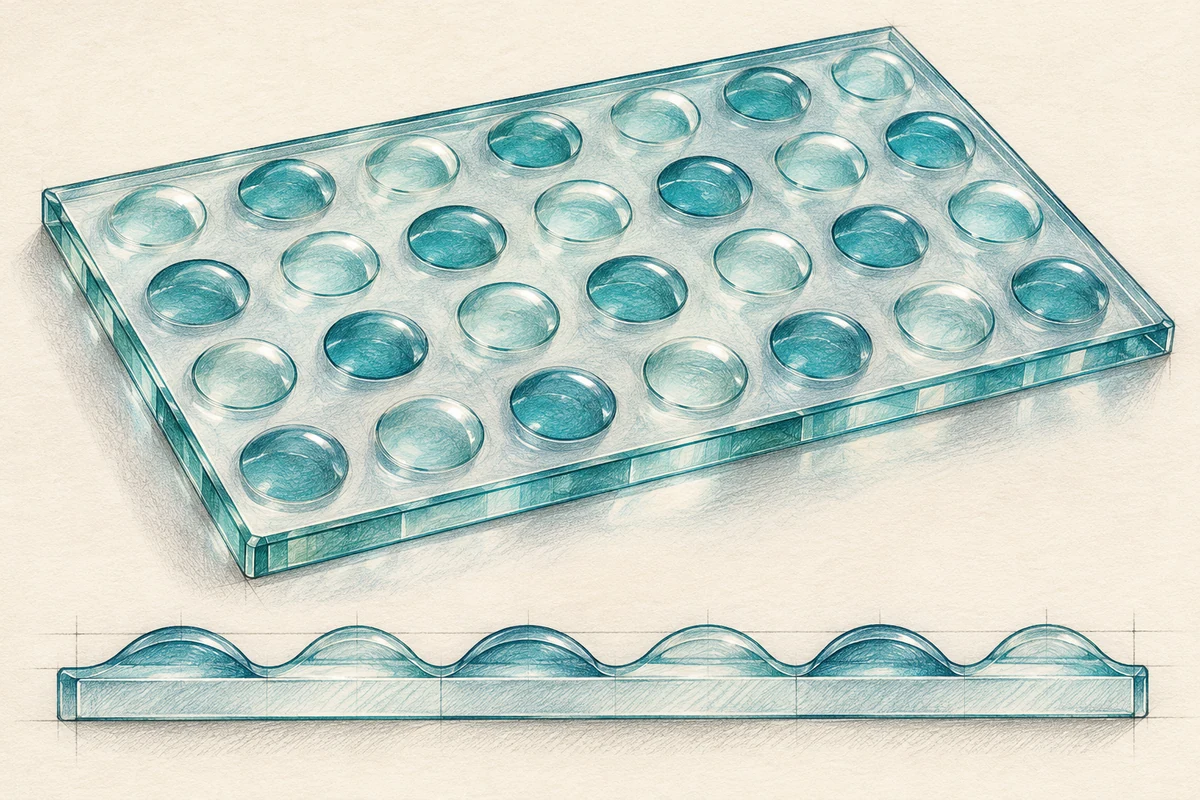
Patterned / Textured Glass Relief (design)
Specialty & decorative — reference; generally not “damage”
Patterned/textured glass is manufactured with intentional surface relief (e.g., flutes, prismatic or pebbled textures) as an aesthetic/functional design. The relief is inherent to the product, not a worked-surface defect. Evaluate observations under the VIS inspection lighting/geometry;
Illustration, reference page, and PDF complete
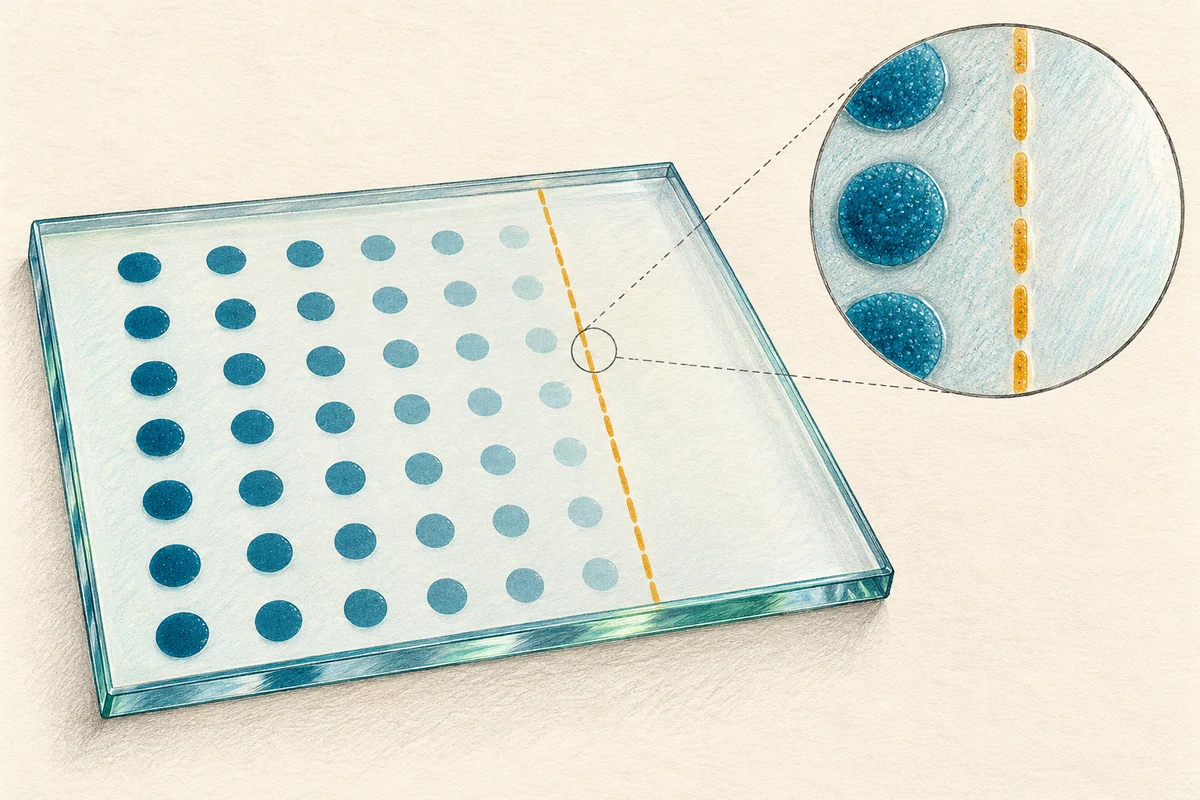
Ceramic Frit Pattern Boundaries (design)
Specialty / decorative system — reference; generally not “damage”
Ceramic frit (silk-screened/enamel) is a fired, glass-ceramic coating applied in controlled patterns (e.g., dots, lines, gradients, bands) for solar control, opacity, or aesthetics. Pattern boundaries (dot-matrix edges, band terminations, registration seams) are intentional design features, not worked-surface defects. Observation follows VIS inspection geometry;
Illustration, reference page, and PDF complete
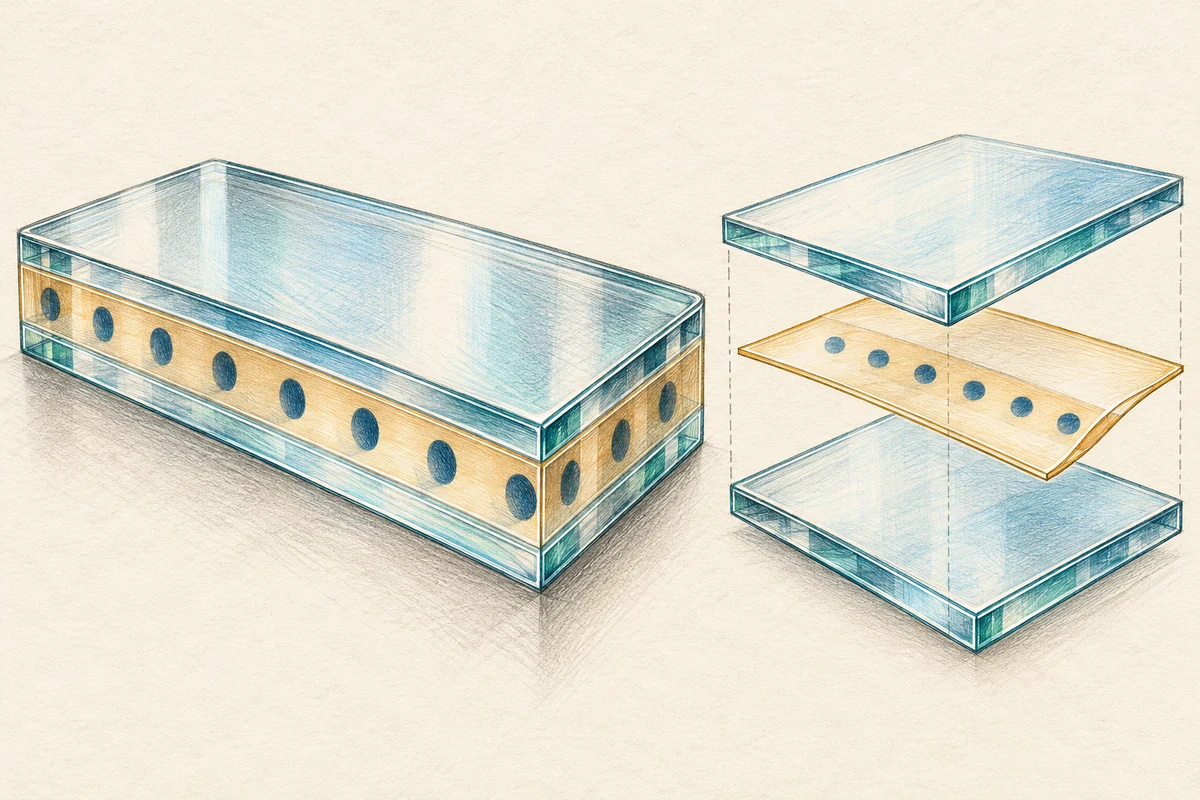
Laminated Interlayer Pattern / Print (design)
Specialty / decorative system — reference; generally not “damage”
Laminated glass can incorporate printed, patterned, or decorative interlayers (e.g., ceramic-ink prints on film, colored/gradient PVB/ionoplast, fabric meshes). These visuals reside within the laminate between plies and are intentional design attributes, not worked-surface defects on the exposed face.
Illustration, reference page, and PDF complete
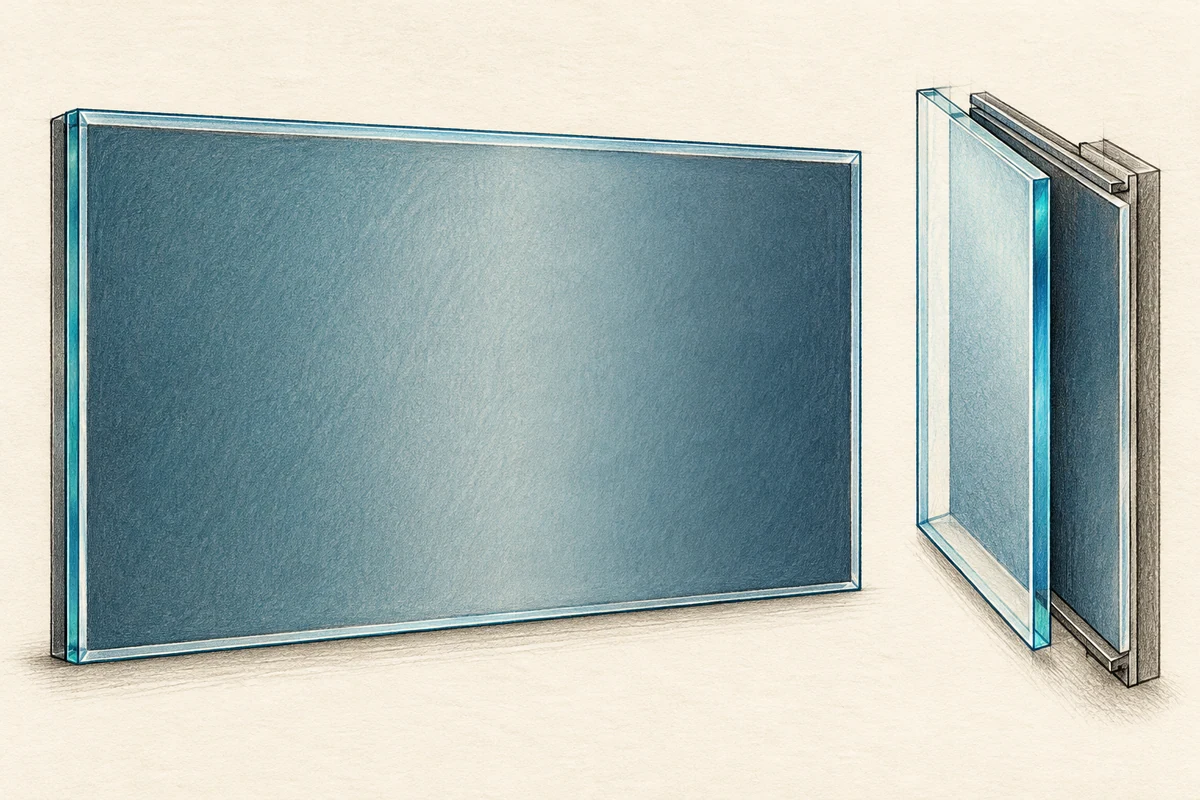
Spandrel Opacity Variation (system tolerance)
Specialty/Decorative Systems — reference; generally not “damage”
Spandrel glass uses an opaque back-paint or ceramic-frit system to mask building elements. Minor opacity/tonal variation is a system/production tolerance (paint film build, substrate/cavity effects) and is not a worked-surface defect. Evaluate using the VIS inspection lighting/geometry;
Illustration, reference page, and PDF complete
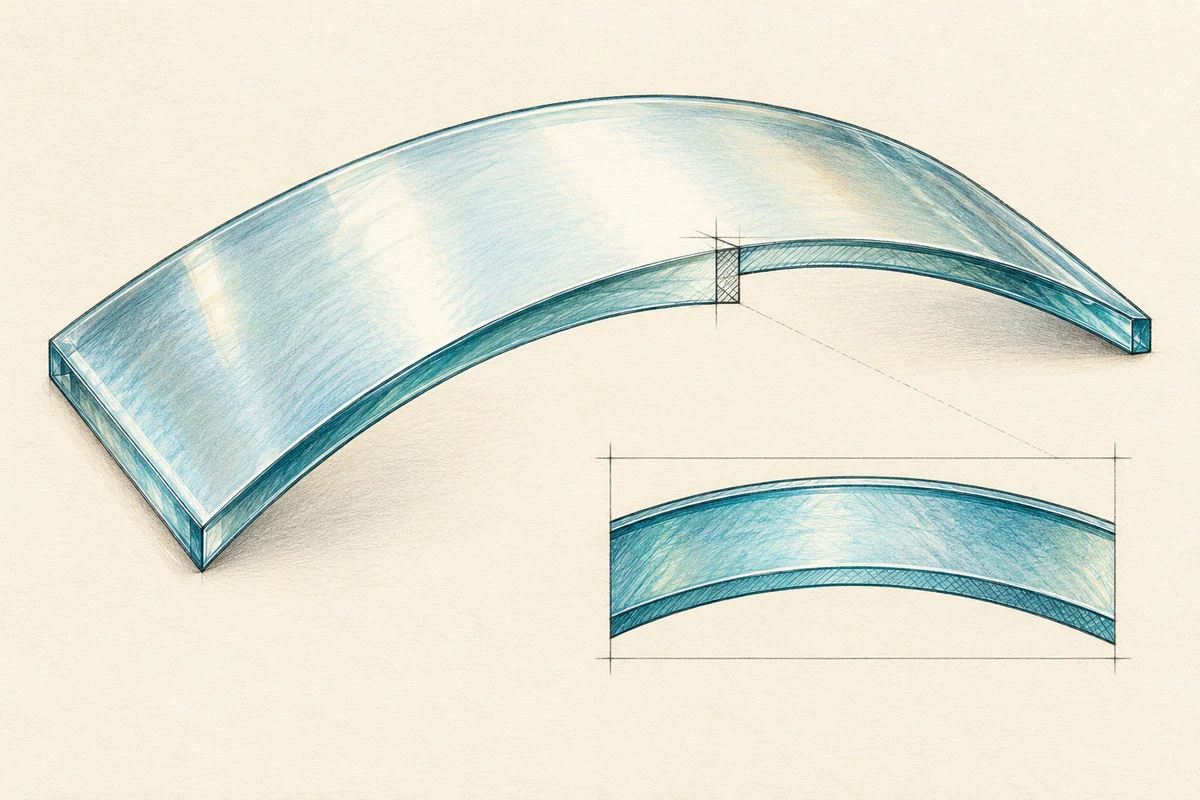
Curved/Bent Glass Local Thickness / Thinning Signatures
Specialty/Decorative systems — reference; generally not “damage”
Curved/bent glass local thickness/thinning signatures are pane-scale shape and thickness variations inherent to thermal bending/forming. They can present as subtle local thinning or thickening zones (e.g., at tight radii or near quench/bend tooling influence) that modulate reflections/transmission without forming a worked perimeter on the exposed face. These are manufacturing attributes observed under VIS geometry;
Illustration, reference page, and PDF complete
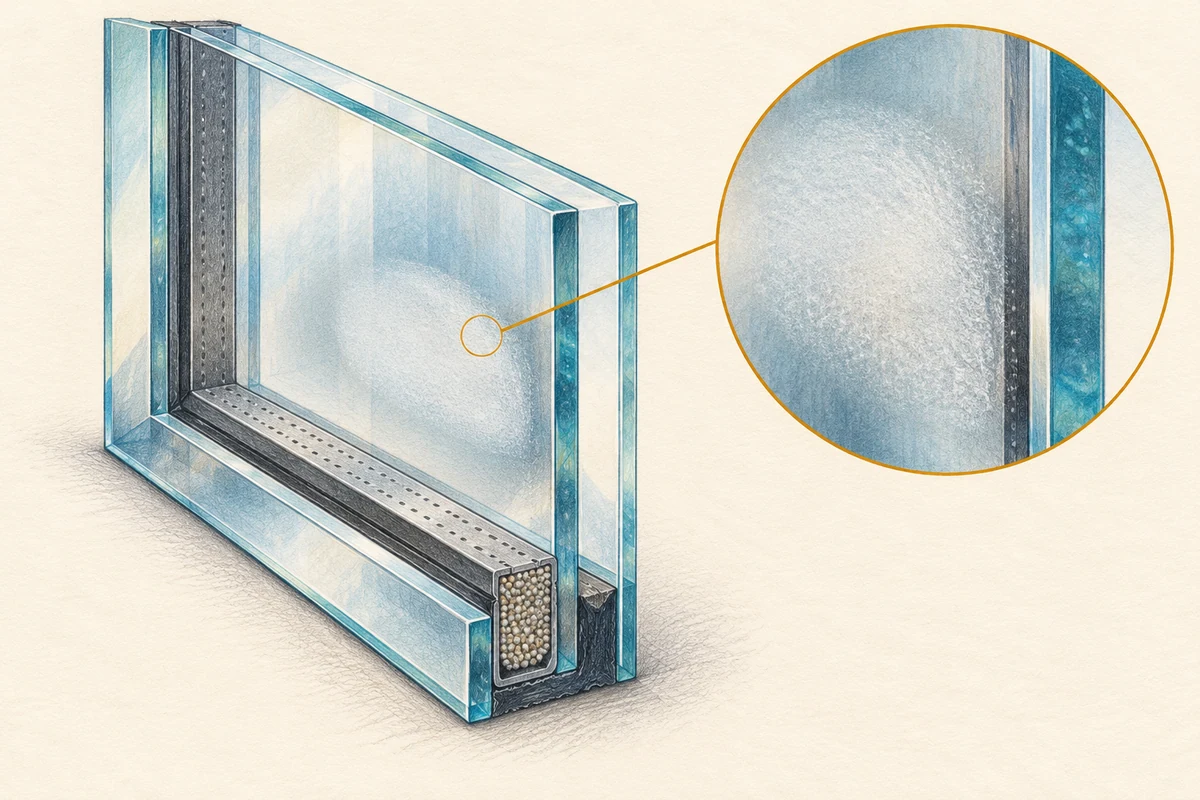
Internal Haze / Volatile Fogging (#2 / #3)
Assembly / internal condition — typically CAT-5 by location; out of in-place scope
Internal haze/volatile fogging is a diffuse film or whitish veil deposited on IGU cavity faces (usually #2 / #3), arising from outgassing or volatile transport within the sealed unit. Because the cue resides between panes, it is not accessible to in-place restoration; classification is driven by location/condition rather than surface catch.
Illustration, reference page, and PDF complete
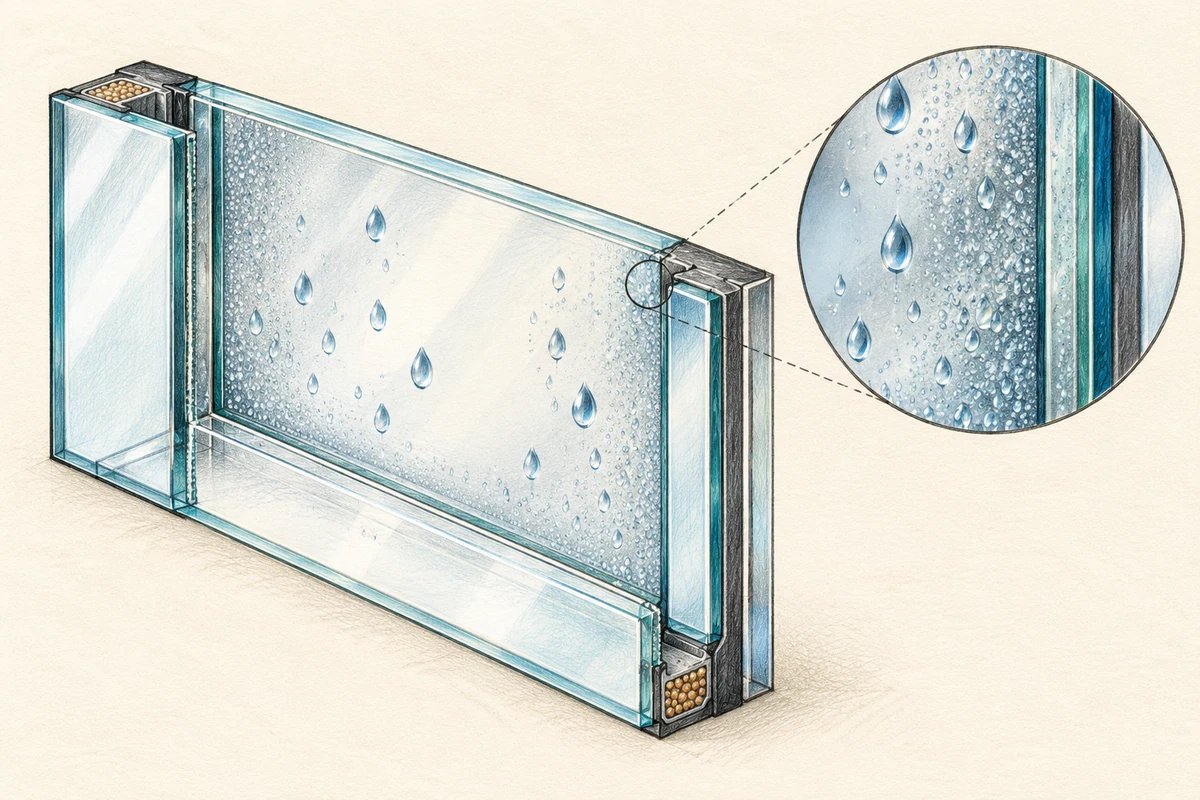
Moisture / Condensation Between Panes (#2 / #3)
Assembly / internal condition — typically CAT-5 by location; out of in-place scope
Between-pane condensation is liquid water or condensate films/droplets observed on IGU cavity faces (typically #2 / #3) due to moisture ingress, seal failure, or internal humidity/temperature cycling. Because the cue resides inside the sealed unit, it is not accessible to in-place restoration; classification is governed by location/condition rather than surface-catch.
Illustration, reference page, and PDF complete
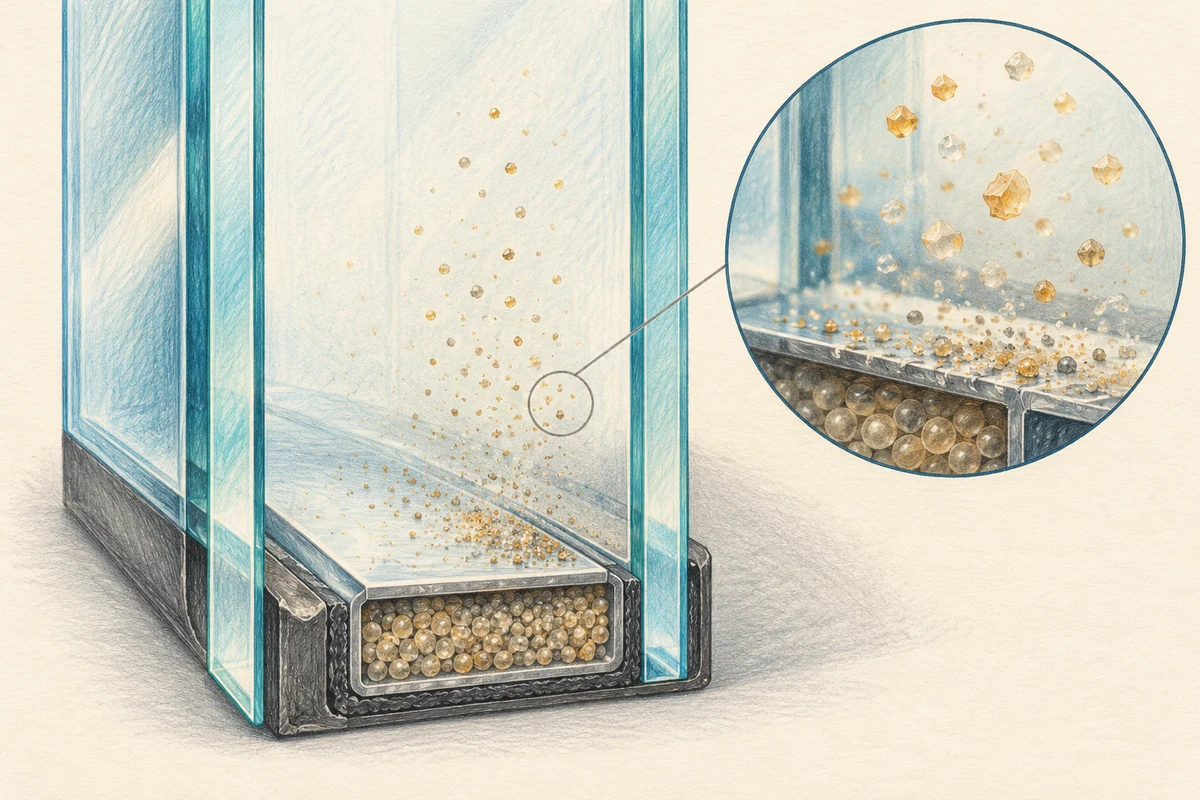
Desiccant Dust / Fines in IGU Cavity
Particulate fines (typically white/gray) released from or tracked by the spacer/desiccant system within an insulating glass unit (IGU) cavity. Presents on cavity faces (#2 and/or #3) and is not accessible in-place. IGU surface numbering and “between-pane” determination follow the VIS conventions.
Illustration, reference page, and PDF complete
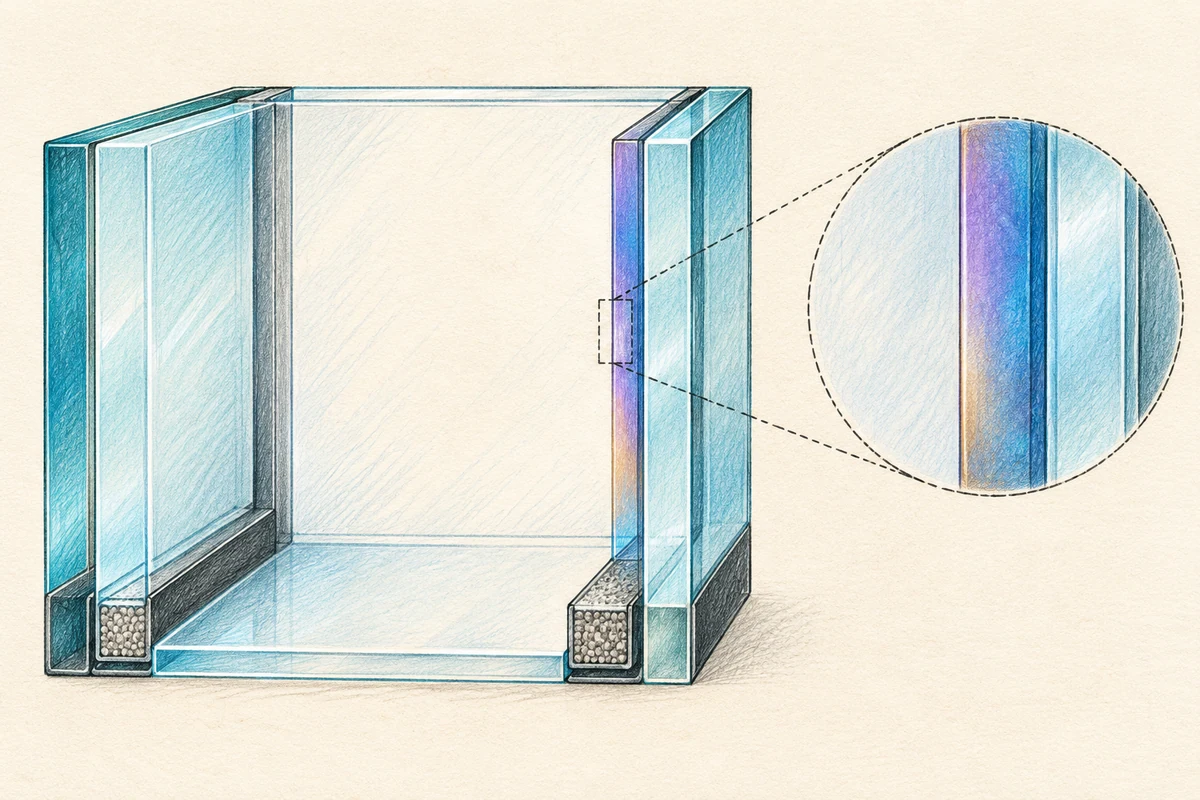
Low-E / Functional-Coating Appearance Change Inside Cavity (#2 / #3)
Assembly / internal condition — typically CAT-5 by location; out of in-place scope
Non-uniform appearance change (e.g., patchiness, color shift/iridescence, fine “islands”/pinholes, micro-mottle) on a functional coating located on IGU cavity faces (#2 or #3). Because the affected face is between panes, it is not an exposed worked surface and is not addressable in-place; classification is governed by location/condition.
Illustration, reference page, and PDF complete
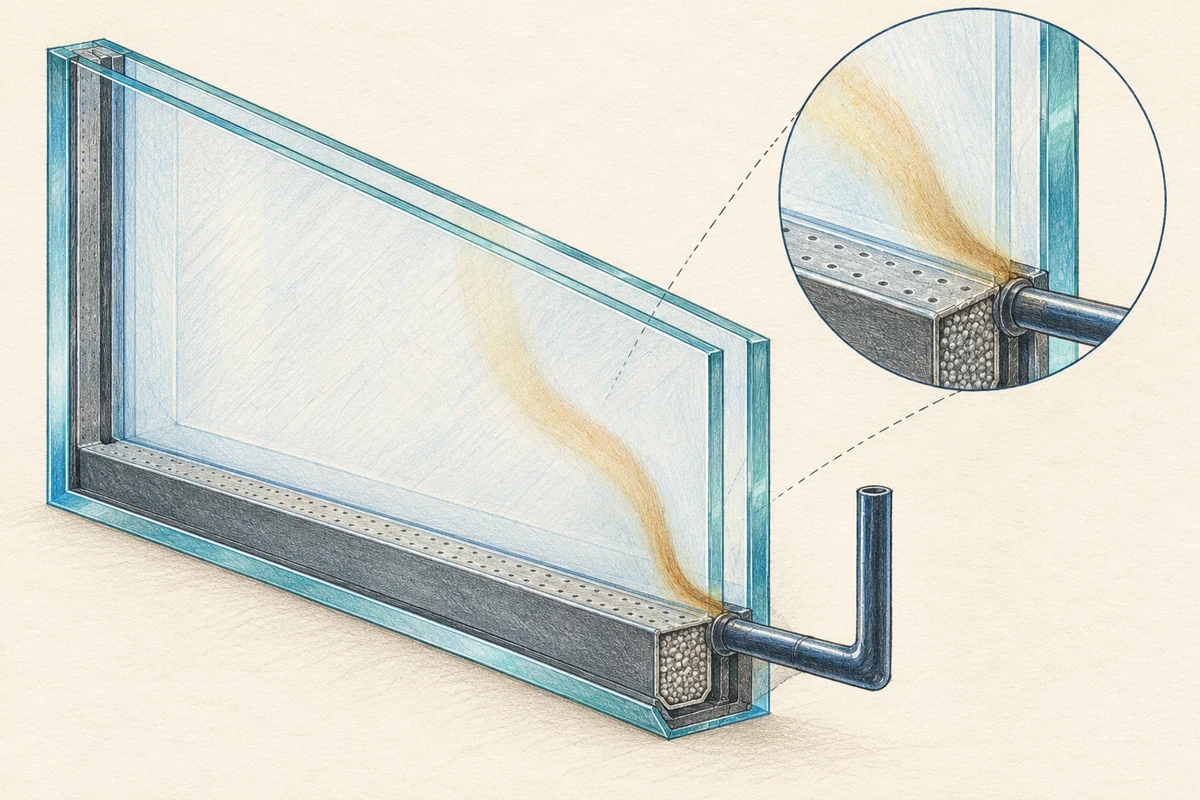
Breather / Altitude-Tube Staining Pattern (#2 / #3)
Assembly / internal condition — typically CAT-5 by location; out of in-place scope
Characteristic staining or streaking patterns deposited on IGU cavity faces (usually #2 / #3) associated with breather/altitude-tube ports used during fabrication/shipping/altitude equalization. By location (between panes), these cues are not on an exposed worked face and are not addressable in place; classification is therefore location/condition-driven.
Illustration, reference page, and PDF complete
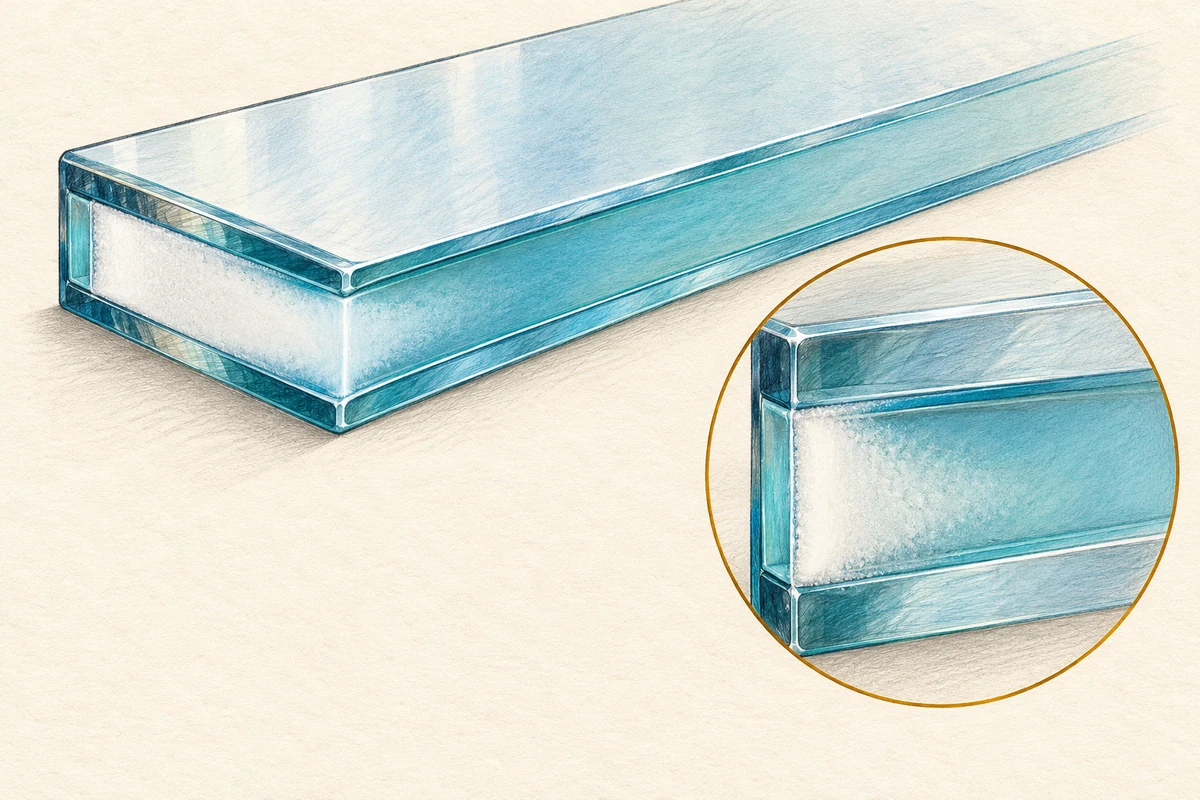
Edge haze / whitening (laminated interlayer; PVB / ionoplast)
A milky, desaturated band or clouding that develops within the laminated interlayer zone near the perimeter, typically within a few millimeters to several centimeters of the edge. It is an internal condition (between glass plies) of laminated glass and not a worked-surface defect. Because it is laminate-internal, it is generally out of in-place restoration scope; document and refer.
Illustration, reference page, and PDF complete
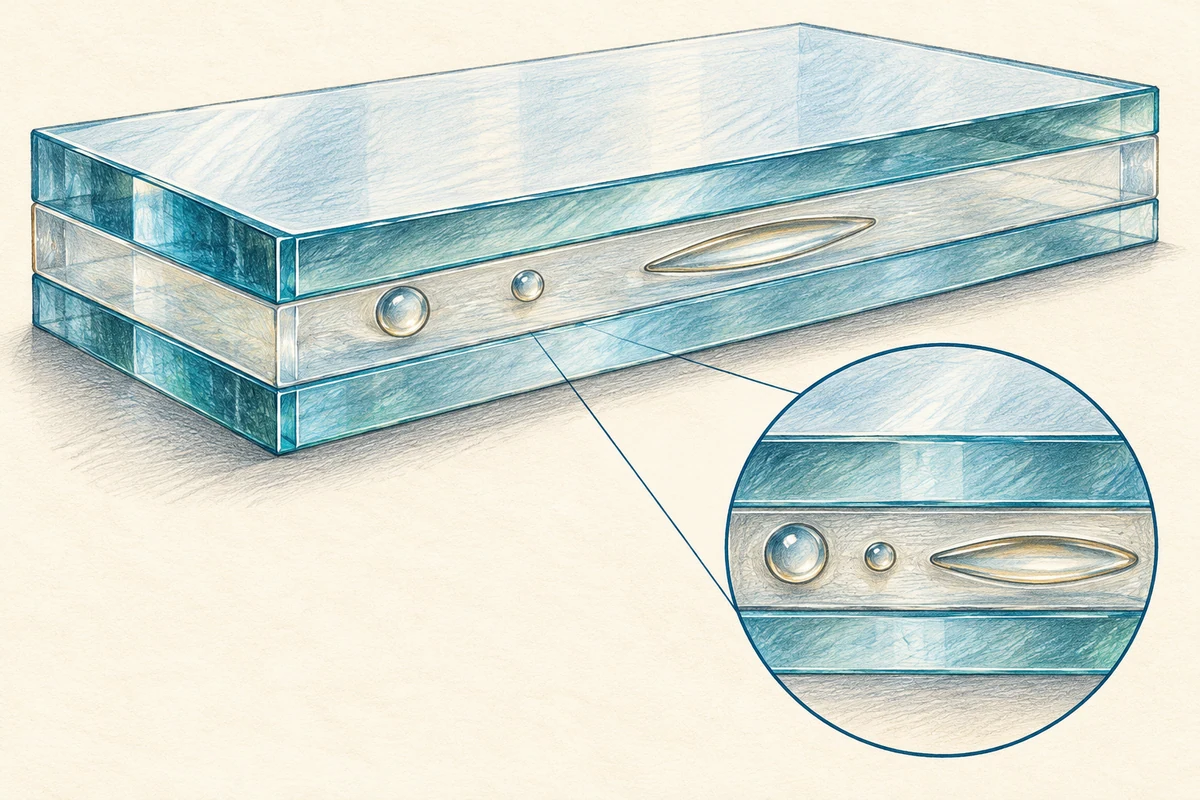
Bubbles / Stringers (entrapped gas/voids in laminated interlayer)
Assembly / internal condition — typically CAT-5 by location; out of in-place scope
Discrete bubbles (rounded voids) or stringers (elongate/filamentary voids) within the laminated interlayer (between plies). These are laminate-internal features—not on an exposed worked face—and are therefore not addressable in place; classification is location/condition-driven. Product/spec context for laminated glass: ASTM C1172; ISO 12543.
Illustration, reference page, and PDF complete
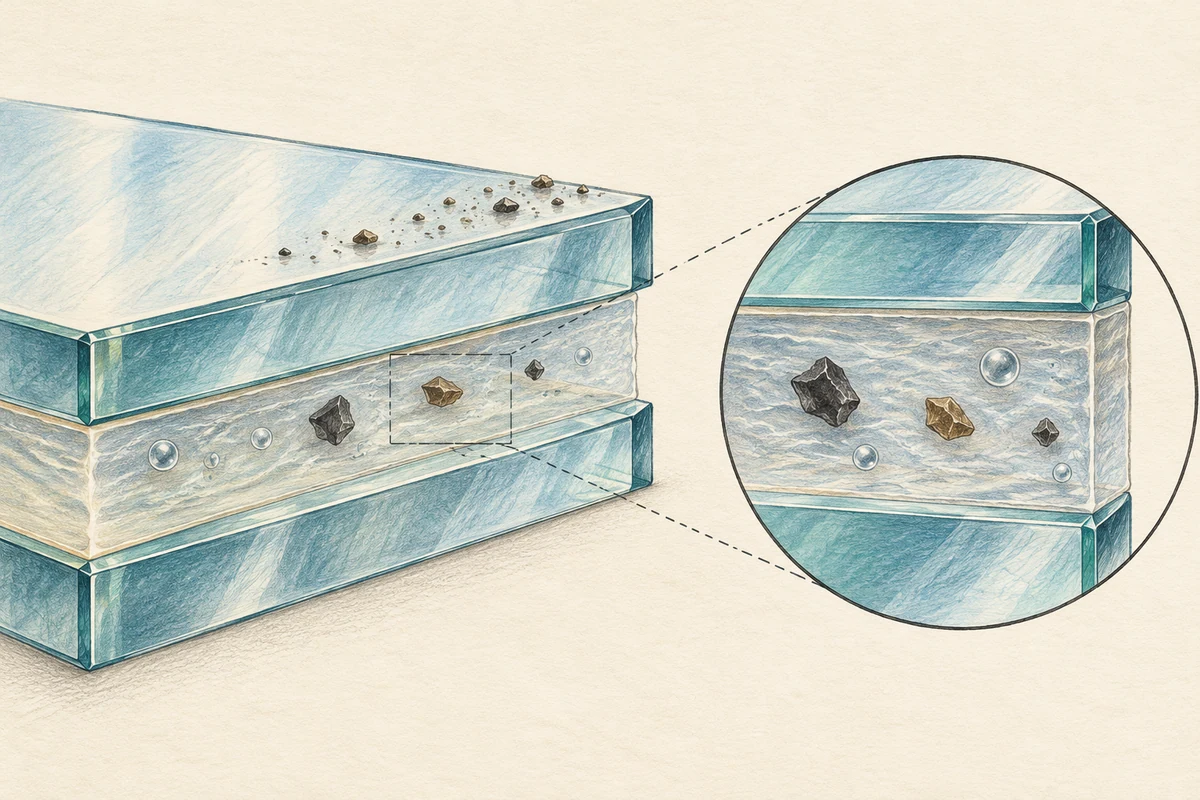
Contamination Inclusions (foreign matter within laminated interlayer)
Assembly / internal condition — typically CAT-5 by location; out of in-place scope
Discrete foreign particles/fibers/particulates encapsulated within the laminated interlayer between glass plies (e.g., dust, fabric lint, granules, hairline fibers). These are laminate-internal features—not on an exposed worked face—and are therefore not addressable in place; classification is location/condition-driven. Product/spec context for laminated glass: ASTM C1172 and ISO 12543 (normative in VIS).
Illustration, reference page, and PDF complete
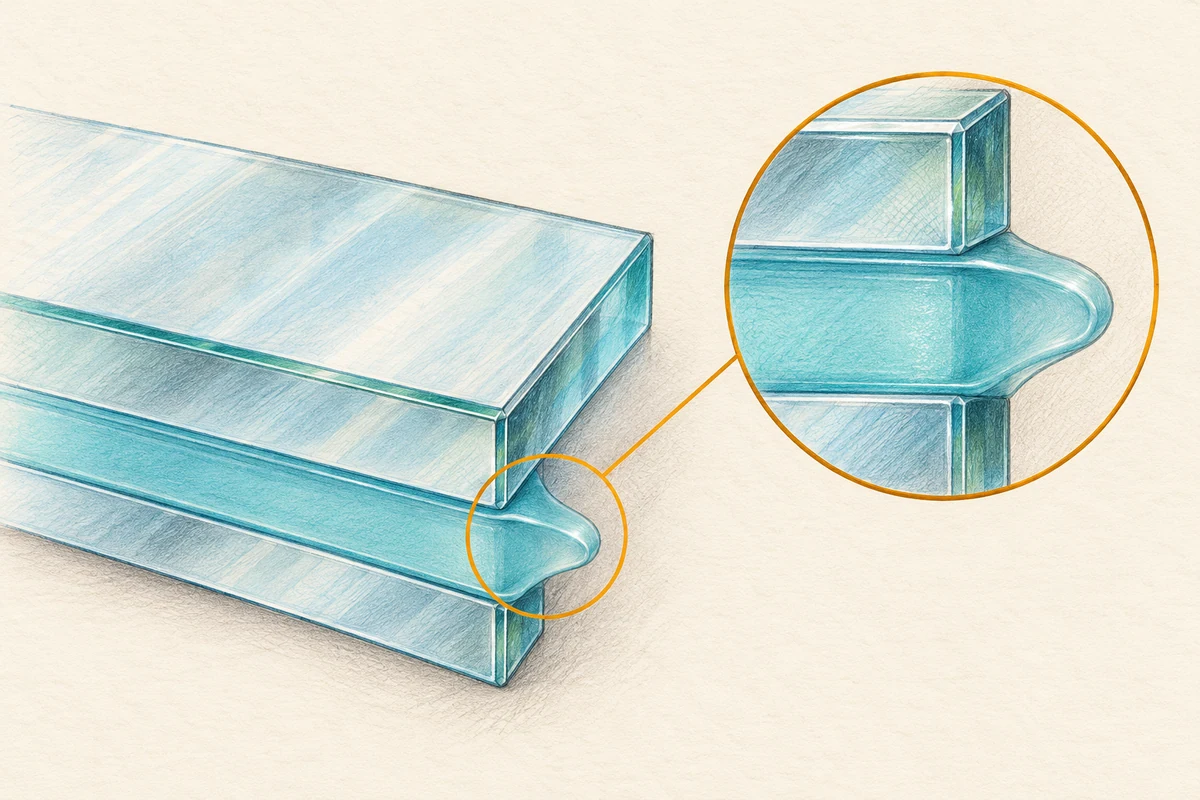
Interlayer Creep / Exudation at Edge
edge ooze; interlayer flow/exposure; location/condition = laminate-internal; typically CAT-5 by location/inaccessibility
Localized flow, squeeze-out, or exposure of the laminated interlayer at or near the laminate edge. Presents as soft or glossy interlayer material visible at the ply edges; may wet adjacent components or leave a faint transfer on adjacent framing or gaskets. Because the condition originates within the laminate stack (between plies), it is not a face-side glass surface defect.
Illustration, reference page, and PDF complete
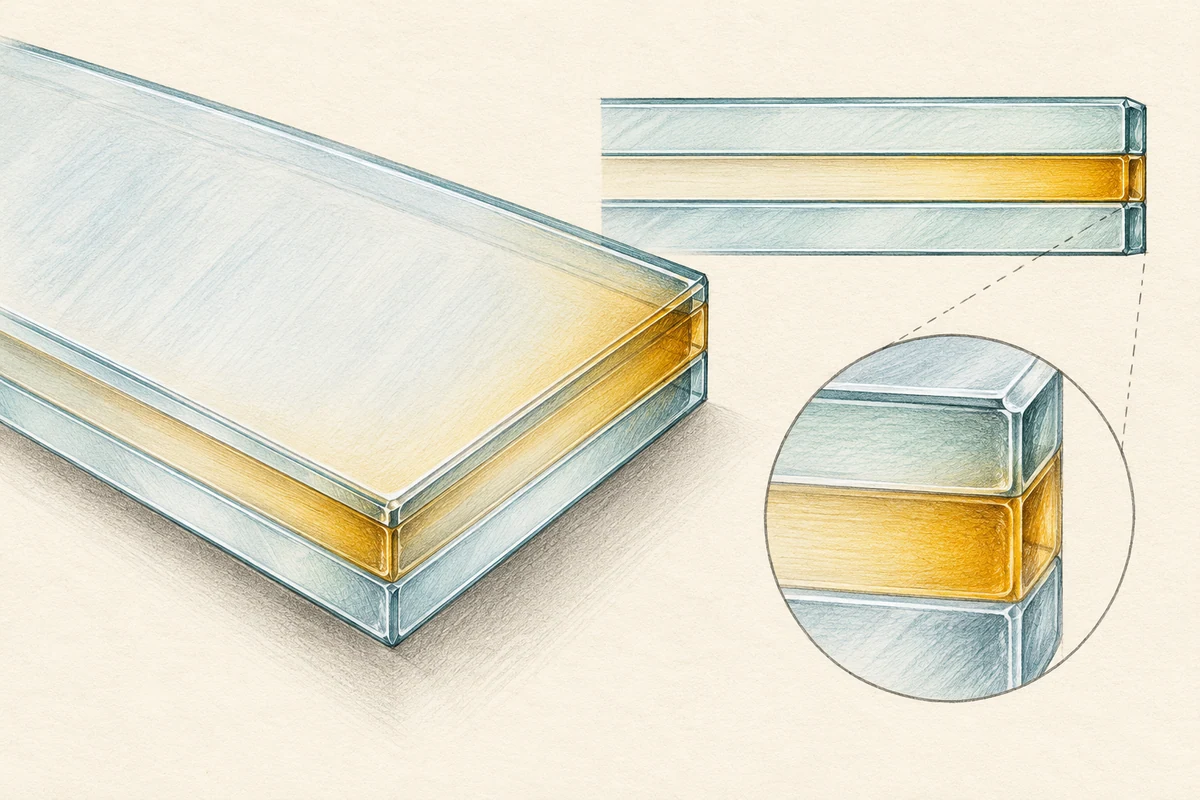
Interlayer Discoloration / Yellowing (UV/thermal aging; laminated interlayer)
Assembly / internal condition — typically CAT-5 by location; out of in-place scope
A gradual color shift (amber/yellow/brown) occurring within the laminated interlayer (PVB/ionoplast, etc.) due to UV exposure, thermal load, or aging, observed between the plies. This is a laminate-internal appearance condition (not on an exposed worked face) and is generally not addressable in place; classification is location/condition-driven.
Illustration, reference page, and PDF complete
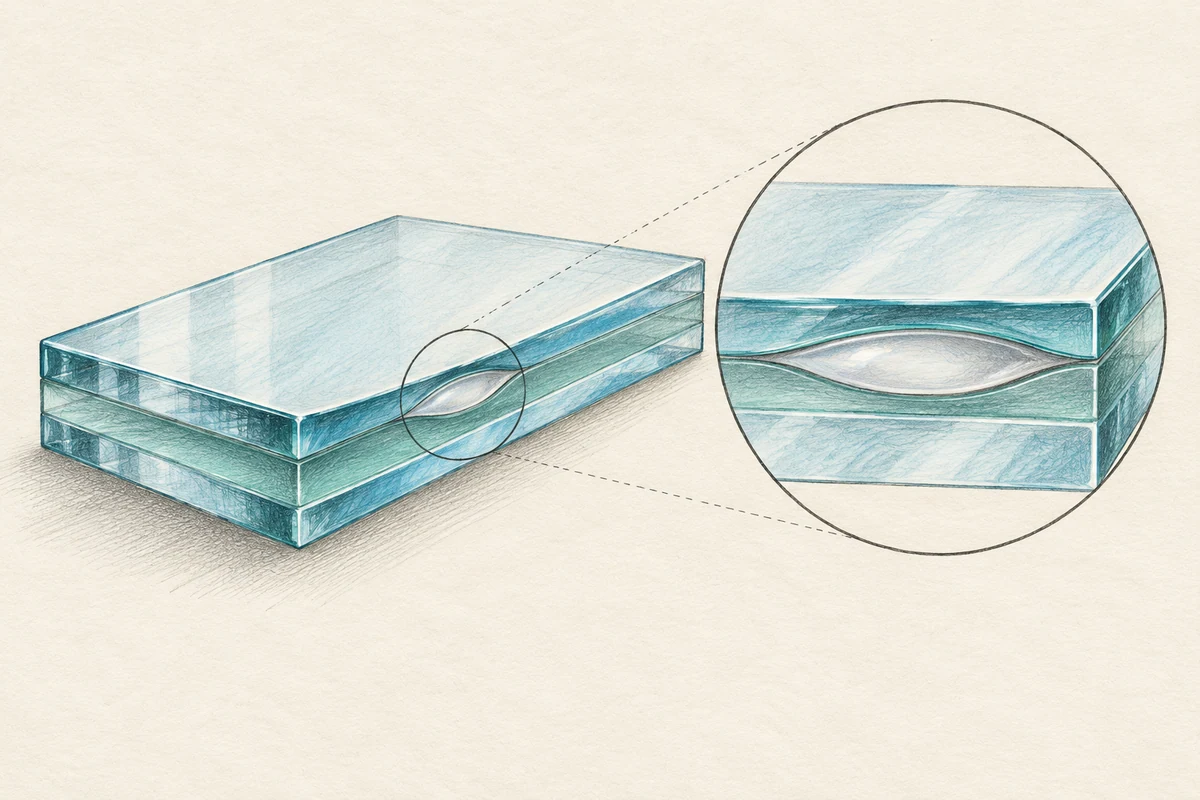
Local Delamination (ply/interlayer separation; laminated glass)
Assembly / internal condition — typically CAT-5 by location; out of in-place scope
Local delamination is a separation between a glass ply and the interlayer (or between interlayers) creating a void/air interface within the laminate stack. Presents as silvering, Newton-fringe iridescence, or a defined lens-like boundary inside the laminate. Because the cue is laminate-internal (between plies), it is not on an exposed worked face and is not addressable in place;
Illustration, reference page, and PDF complete
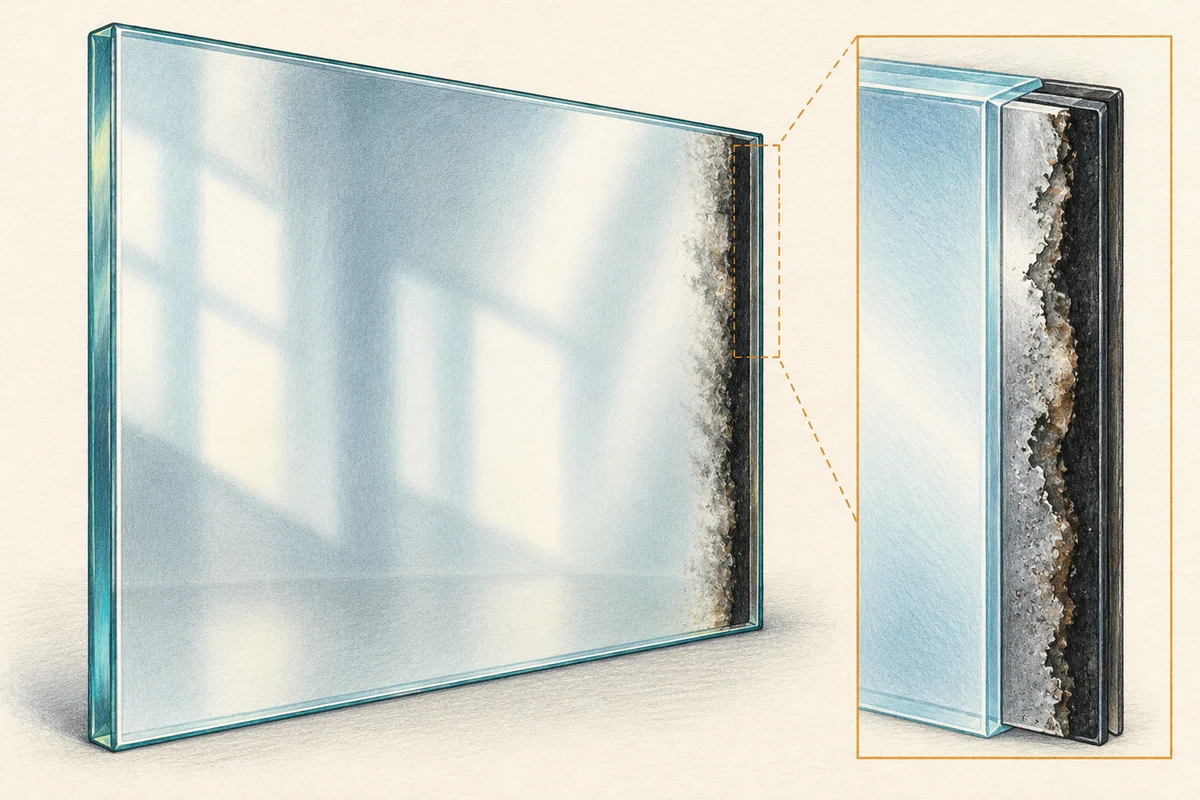
Mirror Edge Blackening (back-coating corrosion)
Assembly / back-coated products — typically out of in-place scope
Localized darkening/blackening that initiates at the perimeter of a silvered mirror and advances inward beneath the protective paint (back-coating). The phenomenon results from moisture/chemical ingress at edges or penetrations, leading to corrosion of the reflective metal layer. Appearance is behind the glass substrate (back side), not on the exposed viewing face.
Illustration, reference page, and PDF complete
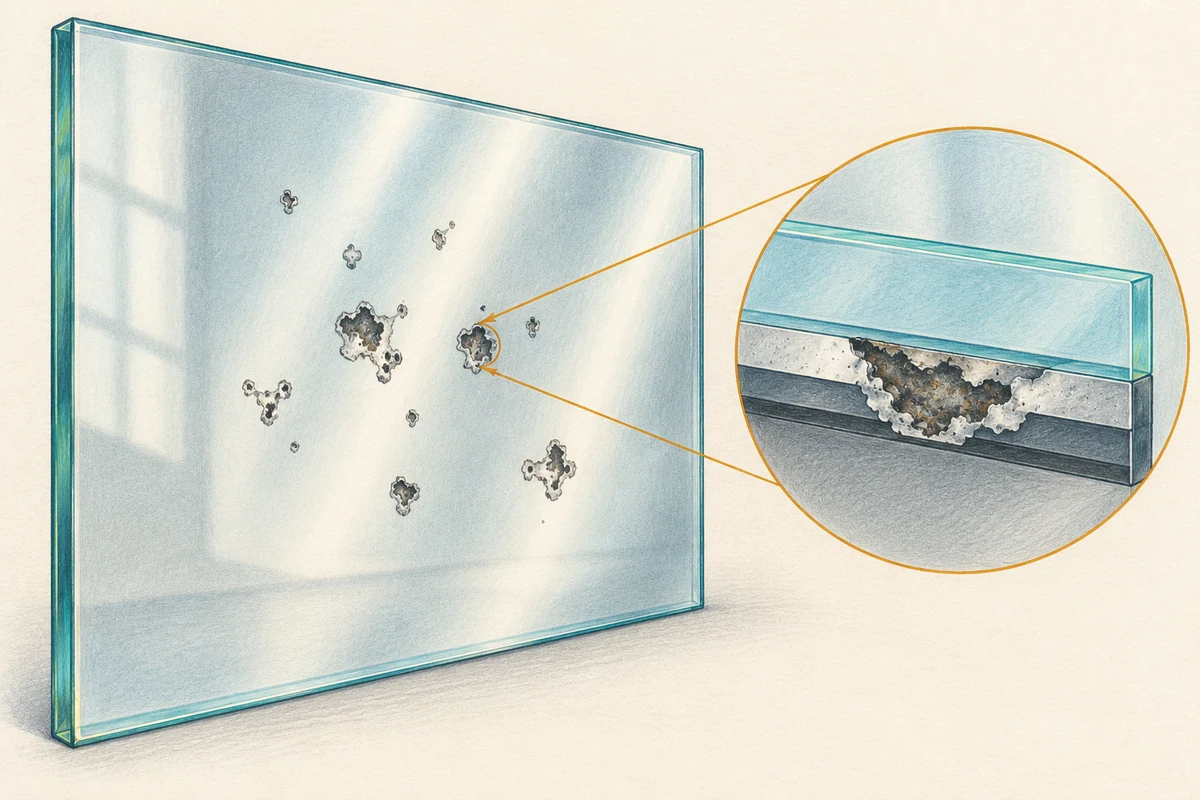
Spot Corrosion Behind Mirror (localized back-coating failure)
Assembly / back-coated products — typically CAT-5 by location; out of in-place scope
Discrete under-glass spots (darkening, brown/black dots, or small blooms) caused by localized corrosion of the reflective layer behind the glass where the protective back-paint/edge seal has been compromised (pinholes, scratches, clip pressure, moisture/chemical ingress). The phenomenon is behind the viewing surface (back-coating system), not on the exposed face. VIS acceptance pertains to the exposed face;
Illustration, reference page, and PDF complete
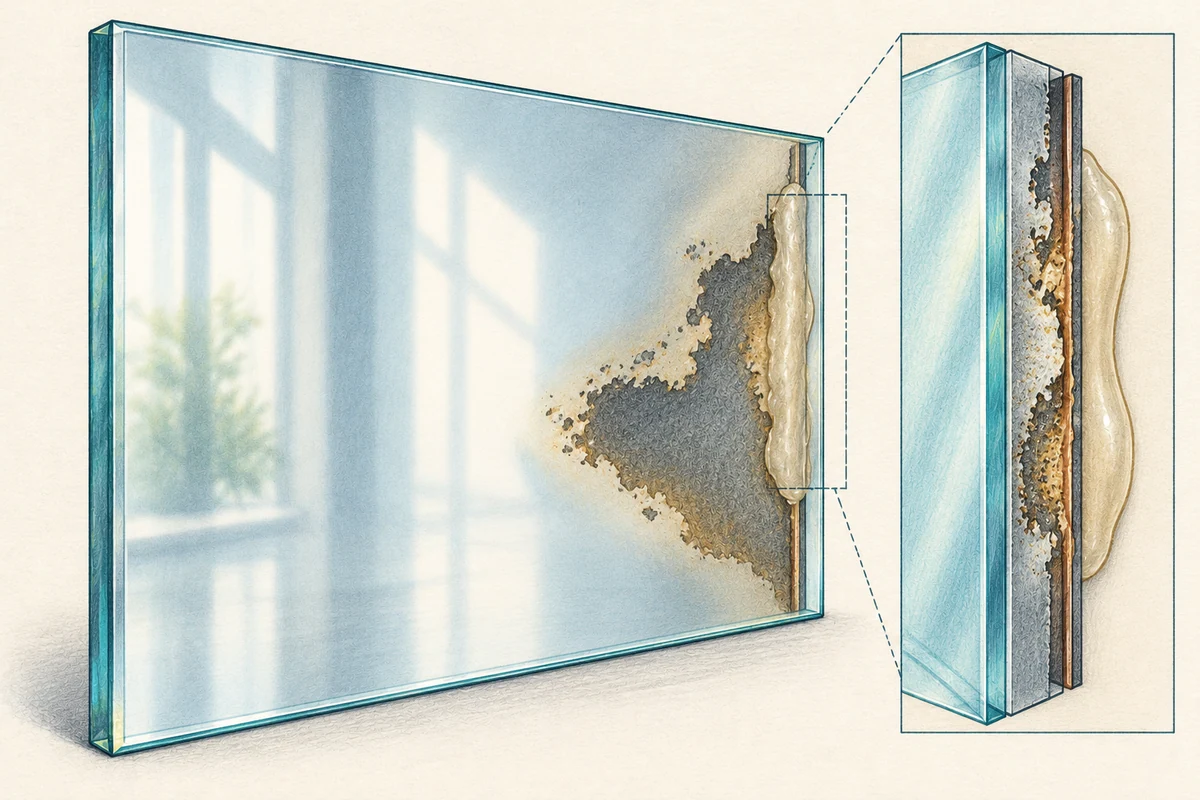
Adhesive / Chemical Attack from Behind (mirror back-coating)
Assembly / back-coated products — typically CAT-5 by location; out of in-place scope
Localized under-glass staining, bloom, or matting visible through the mirror that originates from adhesives, mounting compounds, cleaners, or chemicals acting on the back-coating/reflective layer (behind the glass). The cue is not on the exposed viewing face and therefore is not addressable in place; classification is location/condition-driven.
Illustration, reference page, and PDF complete
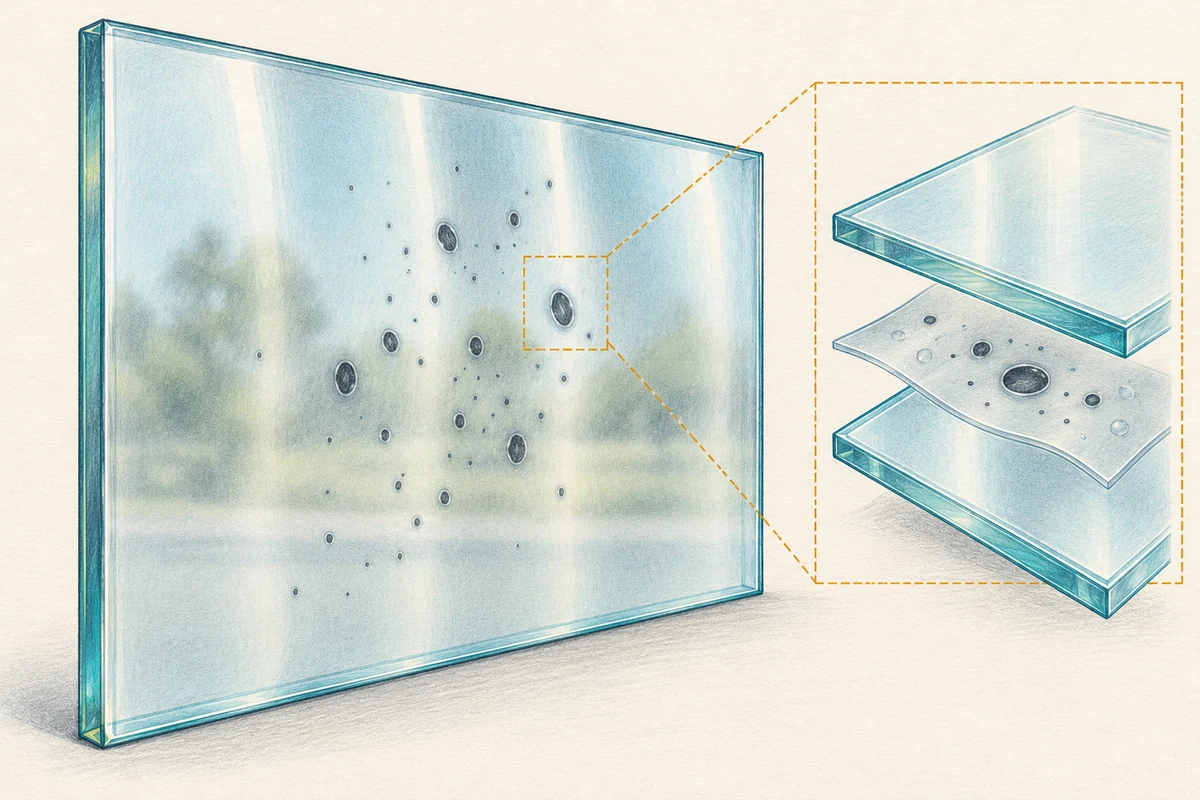
Black Spots / Voids in Active Layer (PDLC / EC; switchable glazing)
Assembly / internal condition — typically CAT-5 by location; out of in-place scope
Discrete dark “black” spots, pin-voids, or small opaque islands occurring within the active switchable layer (e.g., PDLC or electrochromic stack) of a smart-glazing lite. Because the cue resides within the laminate or device stack (not on an exposed worked face), it is not addressable in place; classification is governed by location/condition under VIS rules.
Illustration, reference page, and PDF complete
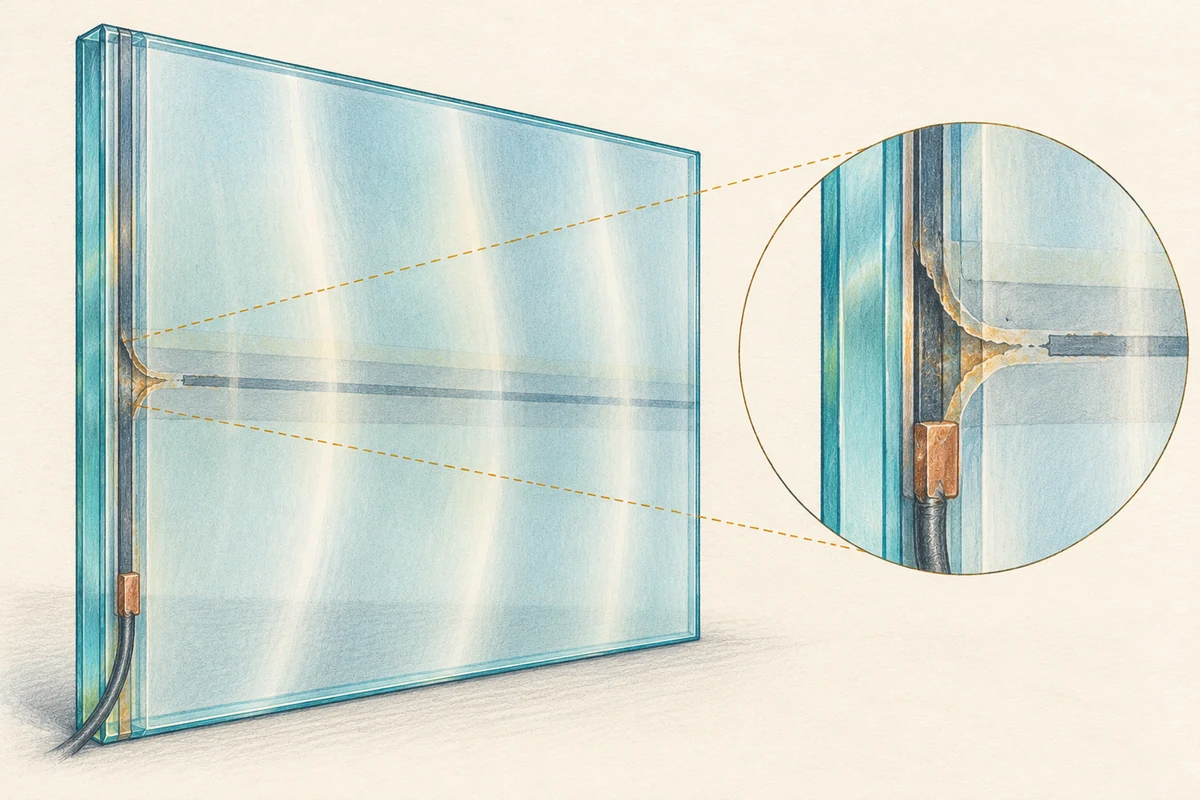
Busbar / Lead Defects Visible Through Lite (PDLC / EC; switchable glazing)
Assembly / internal device condition — typically CAT-5 by location; out of in-place scope
Visible anomalies associated with busbars, printed/laminated leads, or current-distribution traces within a switchable glazing device (e.g., PDLC or electrochromic). Typical cues include misalignment/print-through, discontinuities, smears, voids, corrosion/discoloration along the busbar edge, or local opacity near conductors.
Illustration, reference page, and PDF complete
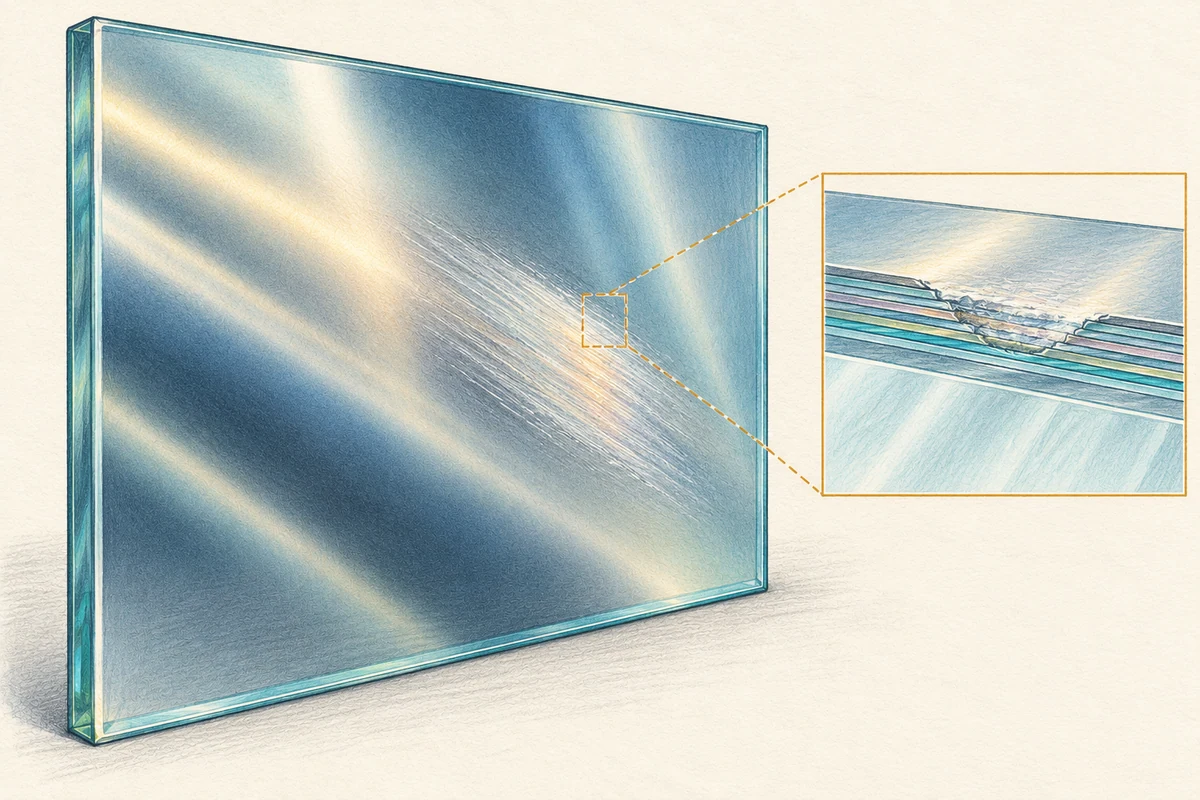
Abrasion Sheen Shift / Rub Marks (sputtered low-E & multilayer films)
Coating anomaly on the worked surface — face-side condition; acceptance constrained by VIS §6.2 “Coatings”
A localized change in sheen, luster, or color cast on a sputtered low-E or other multilayer functional coating, typically caused by contact, friction, or over-working at the exposed coated face (#1 or #4, as applicable). Presents as a rubbed patch, streak, or directional band without discrete chip flanks.
Illustration, reference page, and PDF complete
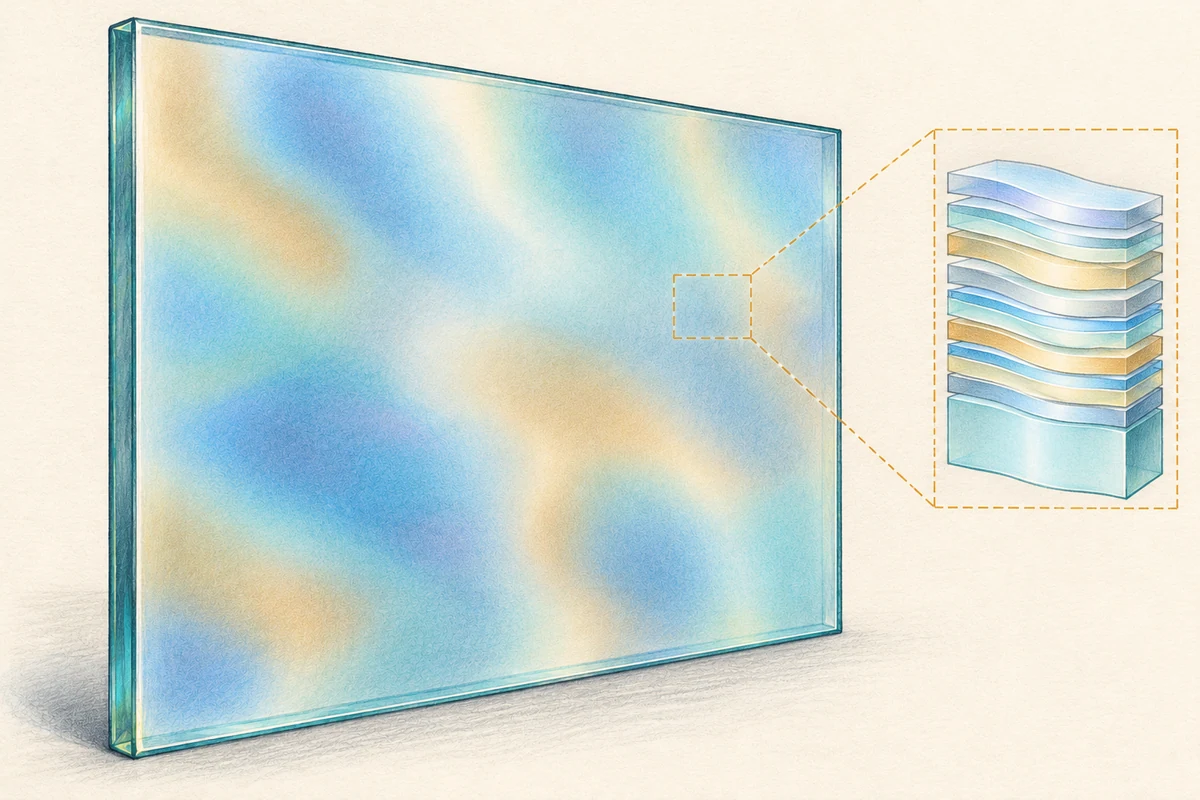
Color Non-Uniformity / Patchiness (sputtered low-E & multilayer films)
Coating anomaly on the worked surface — face-side condition; acceptance constrained by VIS §6 “Coatings”
A localized change in color cast, tone, or optical density within a sputtered low-E or other multilayer functional coating on an exposed face (#1 or #4, as applicable). Presents as patchy zones, clouds, or bands without chip-flank fracture morphology. Under VIS, such coating anomalies are “coating anomalies (visual)” and are treated as appearance cues on the worked surface—not between-pane/system features.
Illustration, reference page, and PDF complete
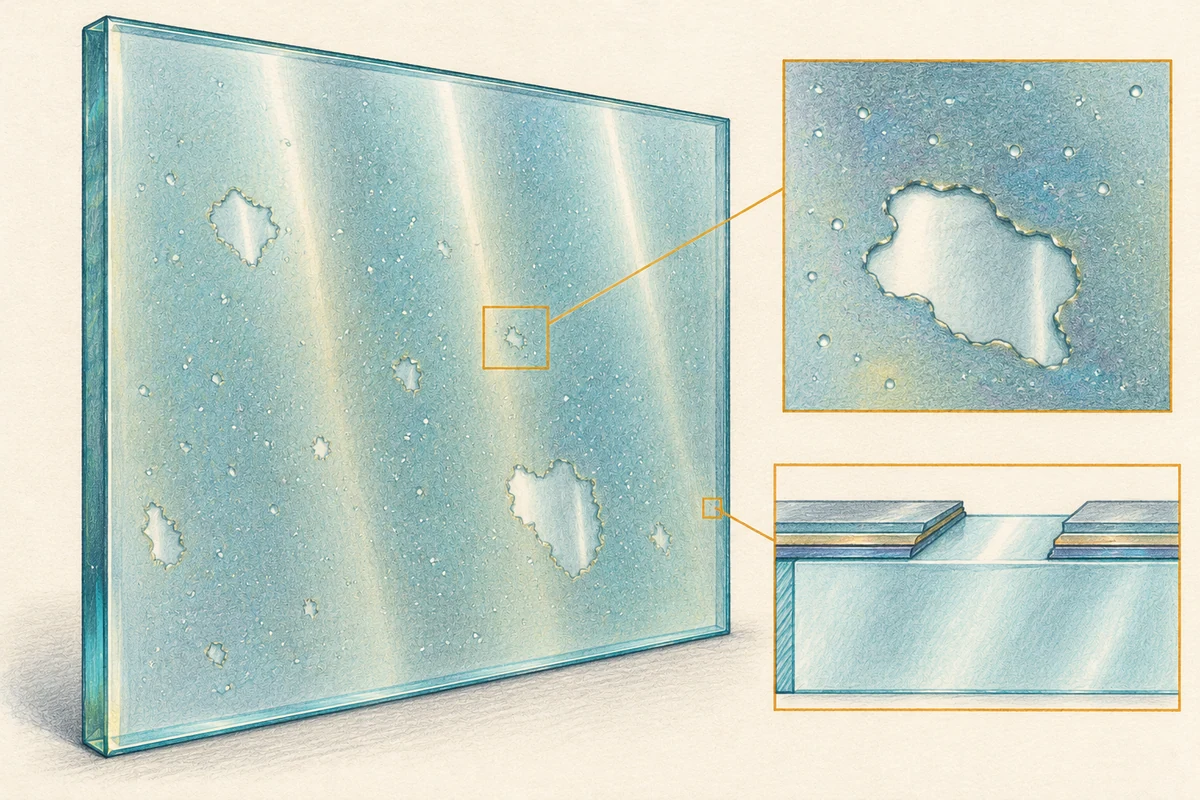
Pinholes / Islands (localized coating loss; sputtered low-E & multilayer films)
Coating anomaly on the worked surface or within cavity; acceptance constrained by VIS §6 “Coatings”
Discrete clear points (“pinholes”) or small bare-glass islands within a sputtered low-E / multilayer functional coating. On exposed coated faces (#1 or #4, as applicable) these present as local loss of optical density (often brighter/clearer) without chip-flank fracture morphology. On cavity faces (#2/#3), they are between-pane and thus not addressable in-place; classification is then governed by location/condition.
Illustration, reference page, and PDF complete
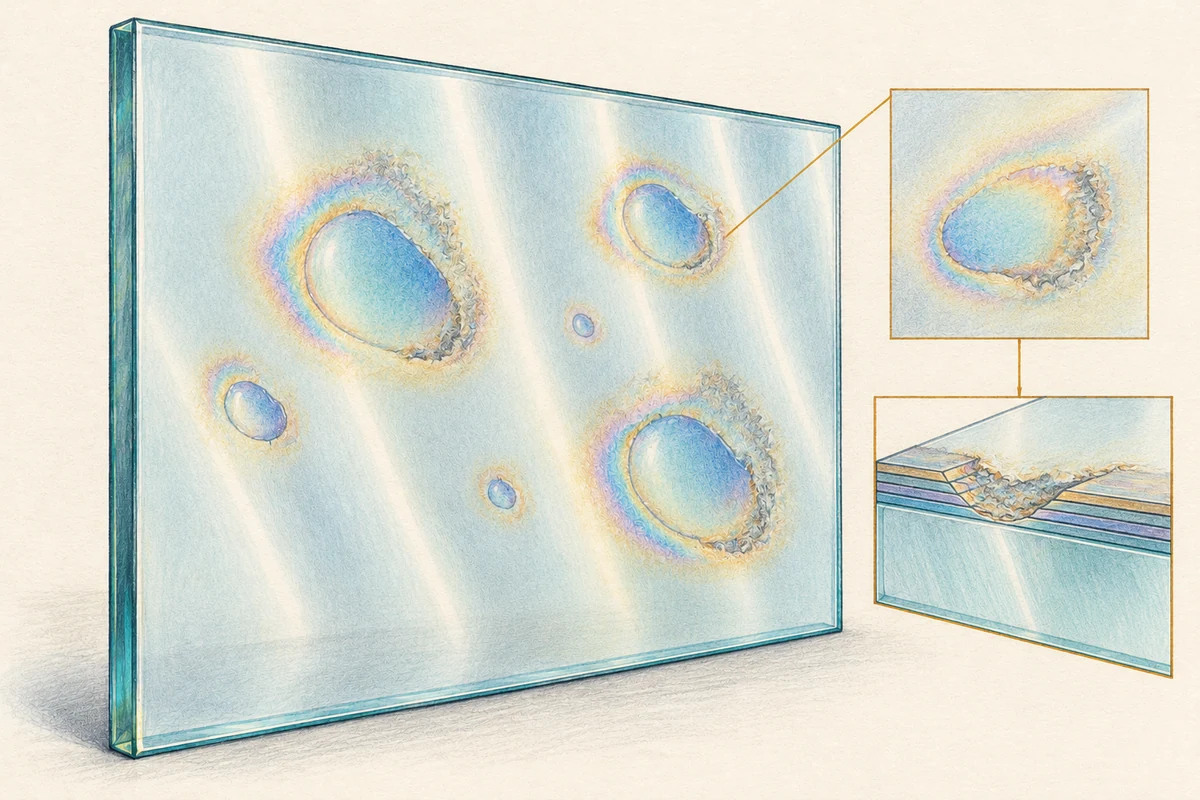
Chemical Attack Spots (cleaner/acid/alkali on sputtered stacks)
Coating anomaly on the worked surface or on a cavity face; acceptance constrained by VIS §6 “Coatings”
Localized appearance changes (spots, rings, blooms) on a sputtered low-E / multilayer functional coating caused by chemical interaction (e.g., acidic brick wash, alkaline cleaners, aggressive solvents). On exposed coated faces (#1 or #4, as applicable), these present as sheen/colour/density shifts or matte “burns” without chip-flank fracture morphology.
Illustration, reference page, and PDF complete
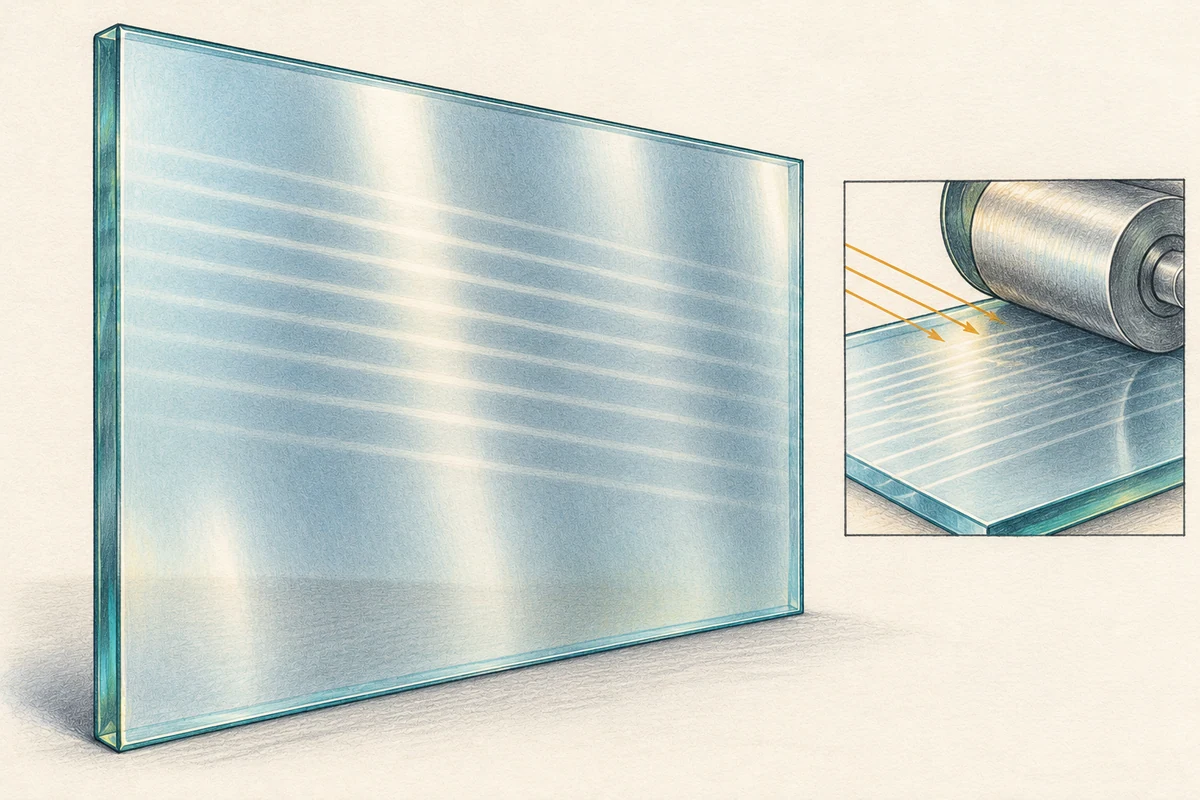
Roller Pickup / Line Ghosting (Pyrolytic Line)
Pyrolytic [hard-coat] low-E anomaly — transport/handling imprint during high-temperature deposition or subsequent hot processing; quasi-parallel sheen-shift bands at roller pitch; generally planar, film-level optical variation; typically SC-0, occasionally SC-1 at lightly textured pickup
Roller pickup/line ghosting (pyrolytic line) is an appearance change confined to pyrolytic (hard-coat) low-E or comparable high-temperature functional coatings. It presents as quasi-parallel, longitudinal bands (machine/transport direction) at spacings consistent with support/transport rollers, with subtle sheen or color shift (ghosting). The phenomenon is planar within the coating and usually non-tactile.
Illustration, reference page, and PDF complete
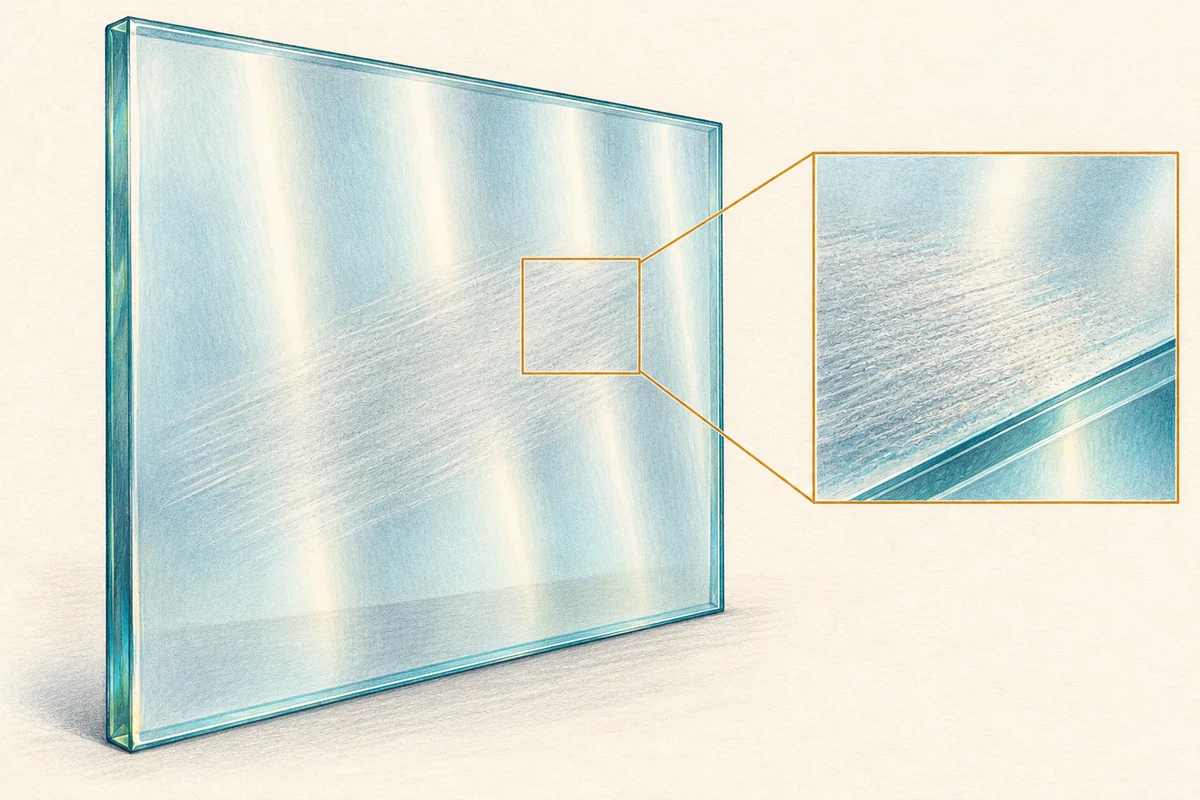
Surface Rub / Scuff (Pyrolytic Hard-Coat Appearance Change)
Pyrolytic [hard-coat] low-E anomaly — contact/rub during handling/cleaning producing localized sheen shift or faint mottle on the coated face; generally planar optical change in the coating; typically SC-0, occasionally SC-1 where micro-imprint exists; confirm coated face before attribution
Surface rub / scuff (pyrolytic) is an appearance change confined to pyrolytic (hard-coat) functional coatings where contact, wiping, or pad/roller kiss produces localized sheen shift or faint mottle without discrete linear chip flanks or pits. The effect is planar within the coating and is usually non-tactile. Classification is appearance-only per VIS (method-agnostic).
Illustration, reference page, and PDF complete
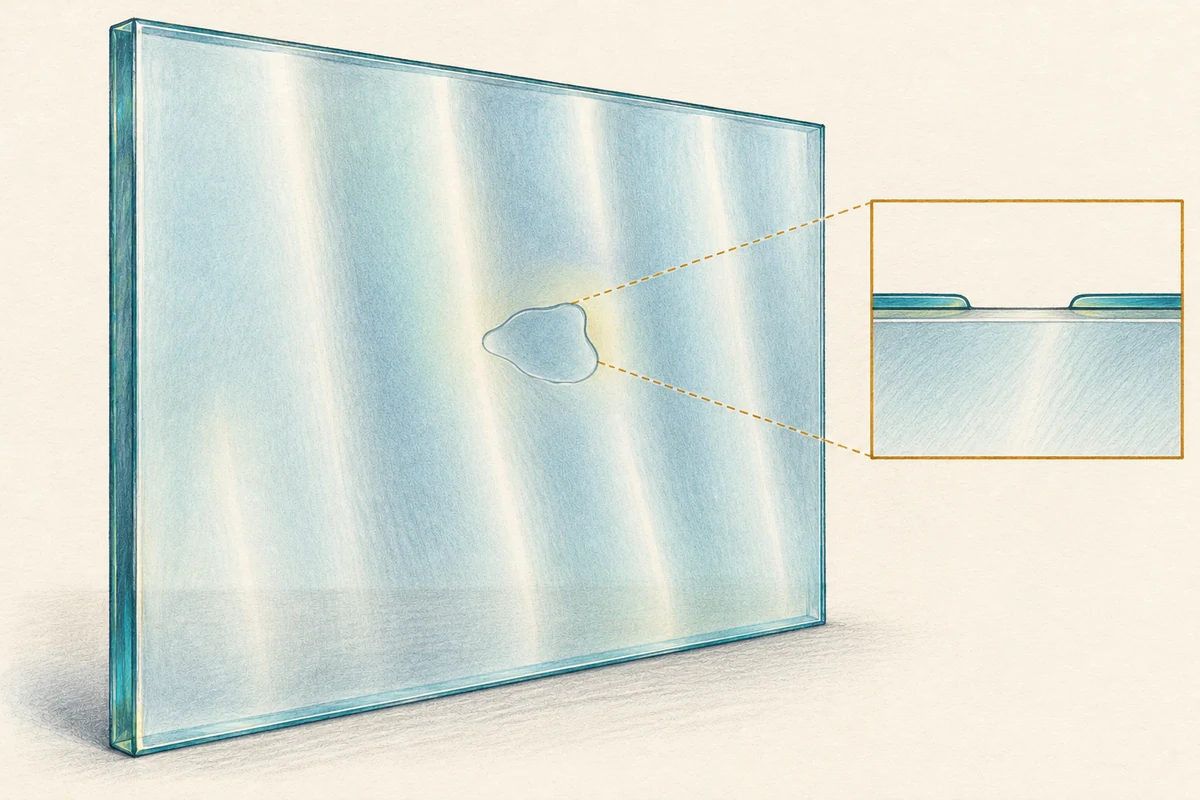
Local Coating Discontinuity (Pyrolytic Hard-Coat)
Pyrolytic [hard-coat] low-E anomaly — localized thin/void spot, streak, or island within the deposited film; planar optical discontinuity often with sharp or feathered boundary; typically SC-0, occasionally SC-1 at minute imprint; confirm coated face before attribution
Local coating discontinuity (pyrolytic) is an appearance change confined to pyrolytic (hard-coat) functional coatings where the deposited film exhibits a localized reduction in thickness, skip/void, or density change. It presents as a spot, small island, short streak, or patch with distinct sheen/color shift relative to surrounding coated areas.
Illustration, reference page, and PDF complete
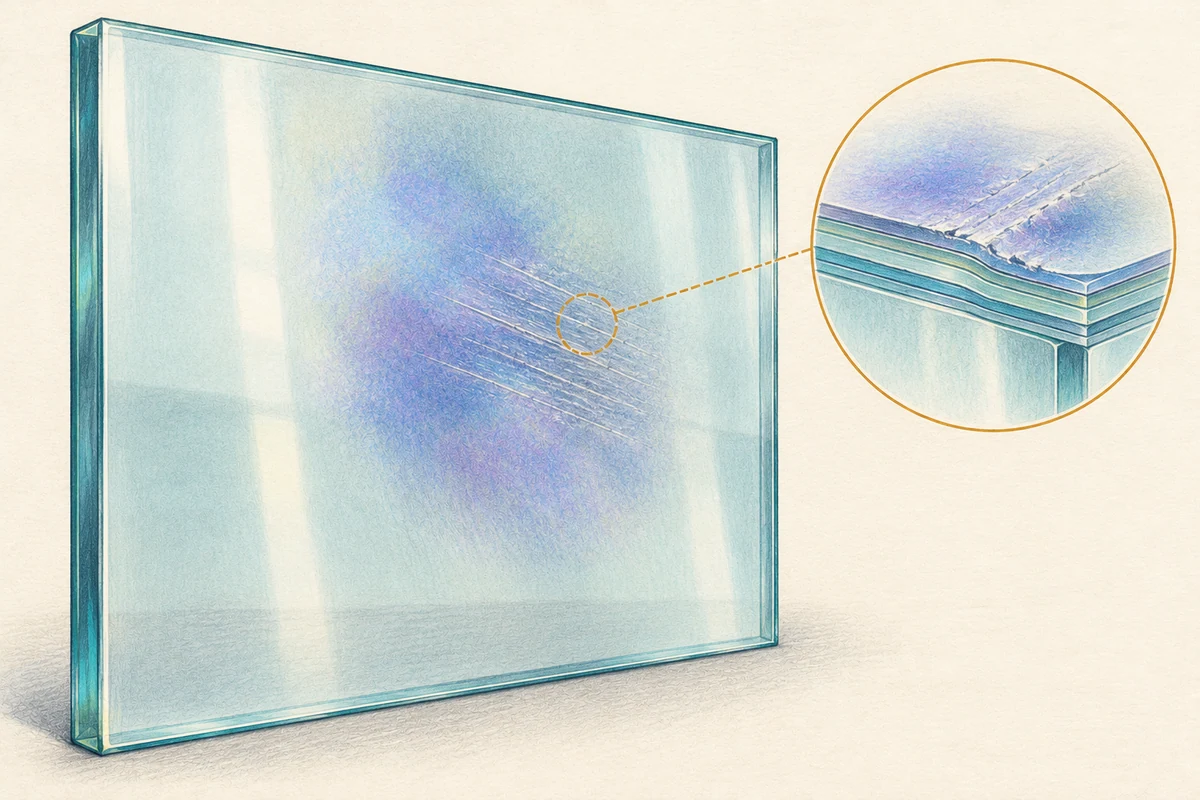
AR Bloom / Scuff (Anti-Reflective & Other Optical Films)
Thin-film optical stack anomaly — localized sheen/color shift or “bloom” on anti-reflective (AR) / IR-control / glare-reduction films; typically planar, non-tactile; SC-0, occasionally SC-1 where micro-imprint exists; confirm coated face before attribution
AR bloom/scuff is an appearance change confined to thin-film optical coatings (anti-reflective, IR, glare-reduction). It manifests as localized increases in reflectivity (“bloom”), haze, or color cast shift relative to adjacent areas. Effects are planar within the coating and usually non-tactile. Classification is appearance-only per VIS (method-agnostic).
Illustration, reference page, and PDF complete
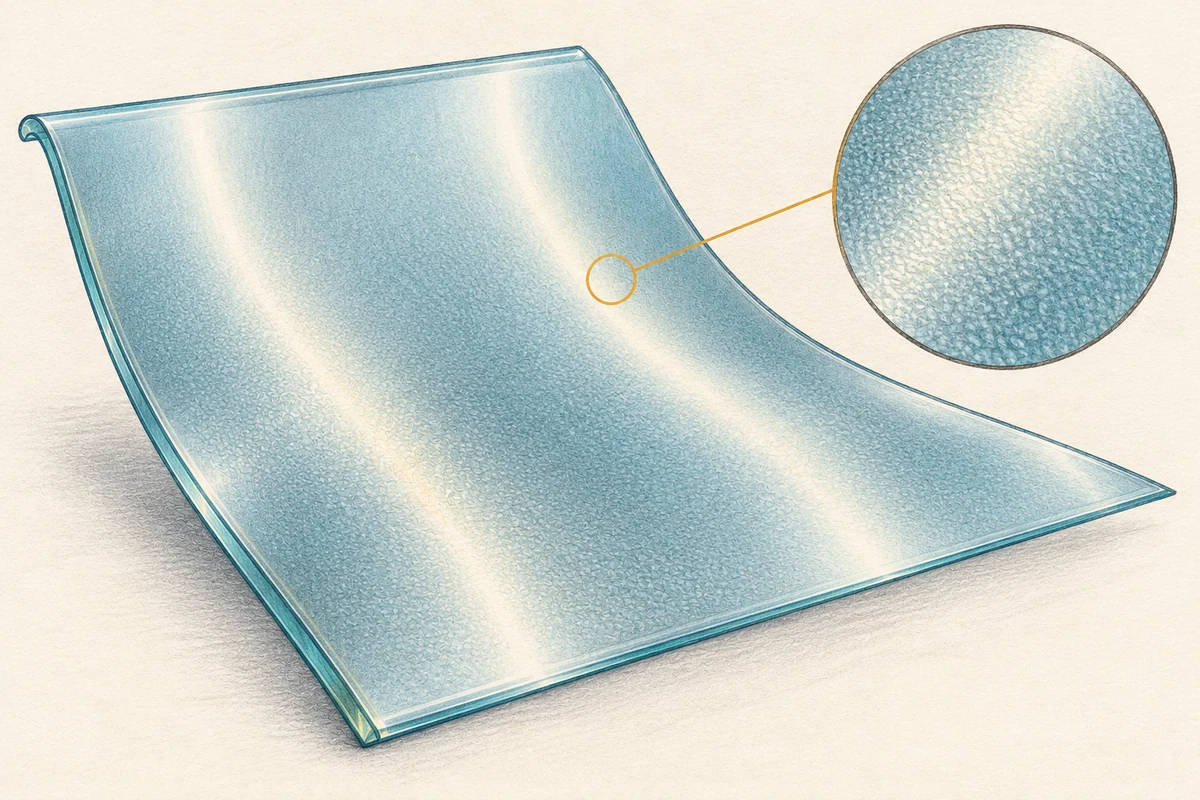
Hard-Coat Micro-Mottle (Other Functional Films)
Thin/“hard” functional films other than low-E—e.g., AR hybrids, IR-control, solar-control, anti-glare—showing fine planar mottle/texture in the coating; non-directional, patchy reflectance or color micro-variation; typically SC-0, rarely SC-1 where minute imprint exists; confirm coated face before attribution
Hard-coat micro-mottle is an appearance change confined to functional hard films (non-pyrolytic low-E alternatives, AR/IR hybrids, solar/anti-glare coatings) presenting as fine, non-directional mottle—a subtle patchwork of reflectance or color within the coated area. The effect is planar within the coating and usually non-tactile. Classification is appearance-only per VIS (method-agnostic).
Illustration, reference page, and PDF complete
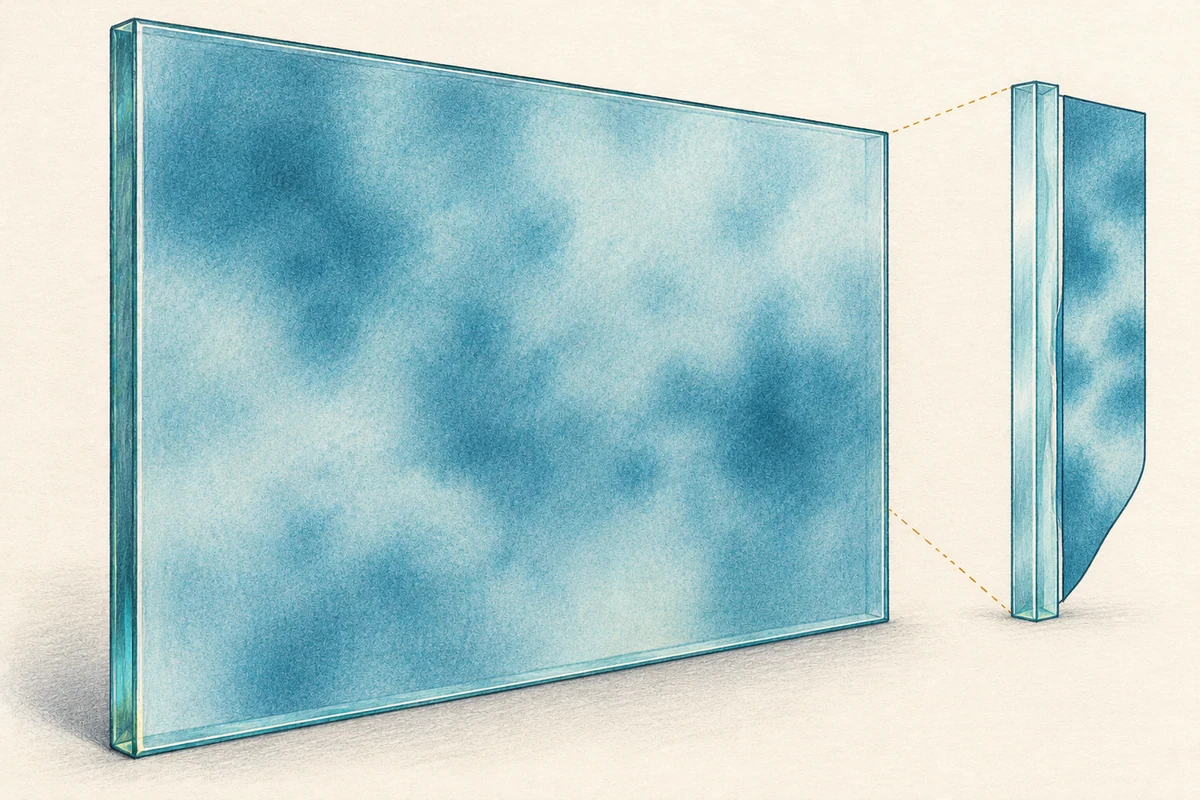
Mottle / Cloudiness (Spandrel & Back-Paint Systems)
Back-paint/ceramic-coated opacity system anomaly — non-uniform opacity or “clouding” visible in reflection/transmission (as designed); planar within paint/frit layer on non-viewable side; typically SC-0 from glass side; confirm system build and coated face before attribution
Mottle/cloudiness (spandrel/back-paint) is an appearance change confined to opaque or semi-opaque coatings applied to the non-viewable side of glass (e.g., spandrel back-paint, ceramic frit behind glass, back-coated vision bands). It presents as patchy opacity/density variation, clouding, or tone shifts that are planar within the back-coating and typically non-tactile from the glass side.
Illustration, reference page, and PDF complete
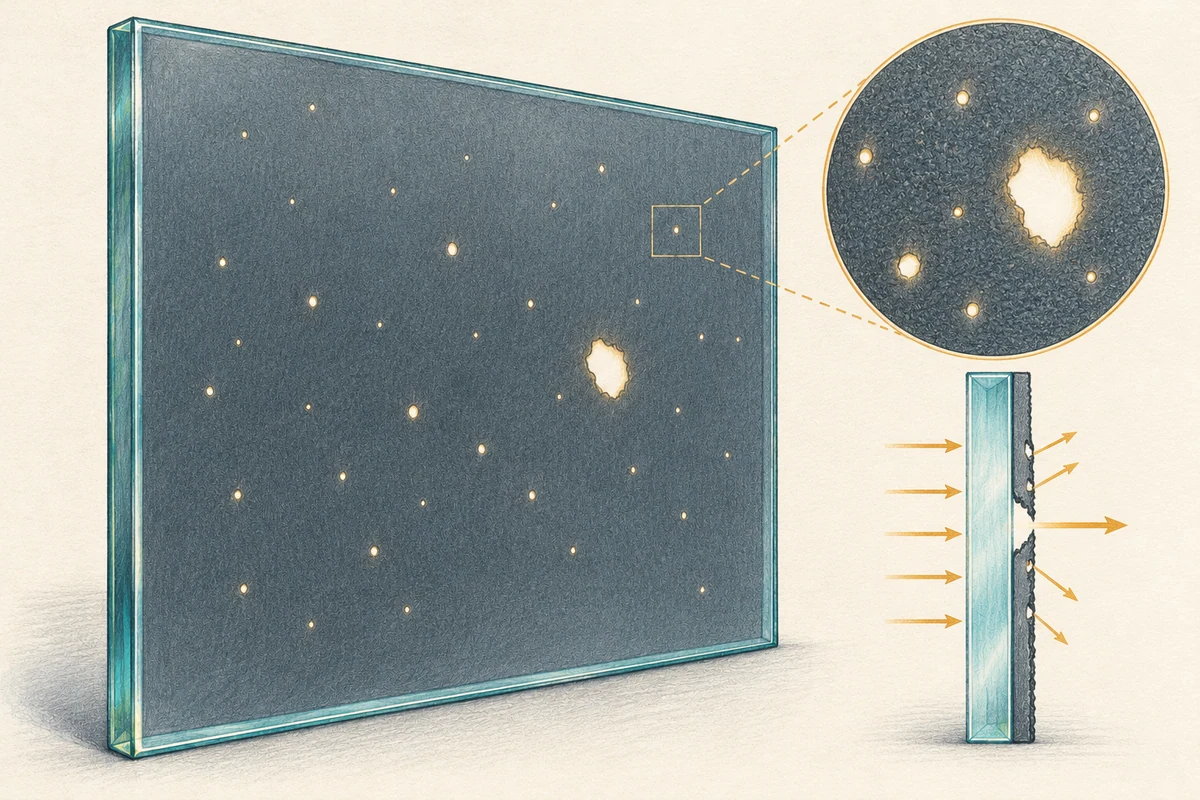
Pinholes / Holidays (Spandrel & Back-Paint Systems)
Back-paint/ceramic-frit opacity system anomaly — discrete clear points/voids or ultra-thin spots within the opaque layer; reads through glass from viewing side; planar from glass surface; SC-0 at viewing face; confirm system build and coated face before attribution
Pinholes/holidays (spandrel/back-paint) are discrete, point-like voids or ultra-thin spots in an opaque or semi-opaque coating applied to the non-viewable side of the glass (e.g., spandrel back-paint, ceramic frit). From the viewing face they present as tiny bright/clear dots (transmission) or high-reflectance specks (reflection). The defect is planar behind the glass and non-tactile at the viewing surface.
Illustration, reference page, and PDF complete
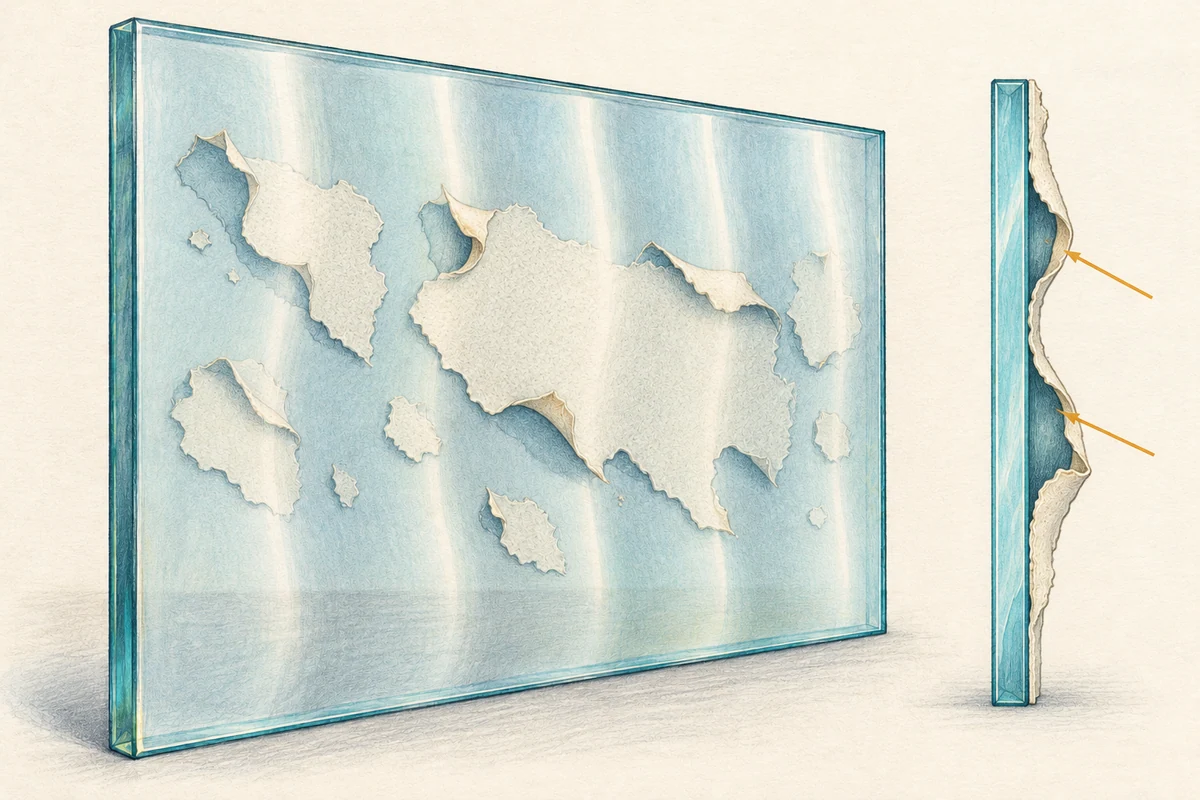
Back-Paint Adhesion Loss Islands
Back-paint/ceramic-frit opacity system anomaly — localized loss of adhesion or cohesive failure within the back-coating forming “islands,” blisters, or lift at edges; reads through glass from viewing side; typically SC-0 at viewing face; confirm system build and coated face before attribution
Back-paint adhesion loss islands are localized detachments (adhesive or cohesive) within an opaque/semi-opaque back-coating on the non-viewable side of glass (e.g., spandrel paint, back-coated vision bands, ceramic frit overcoats). From the viewing face they present as duller/darker or brighter windows, contour-edged islands, or blisters;
Illustration, reference page, and PDF complete
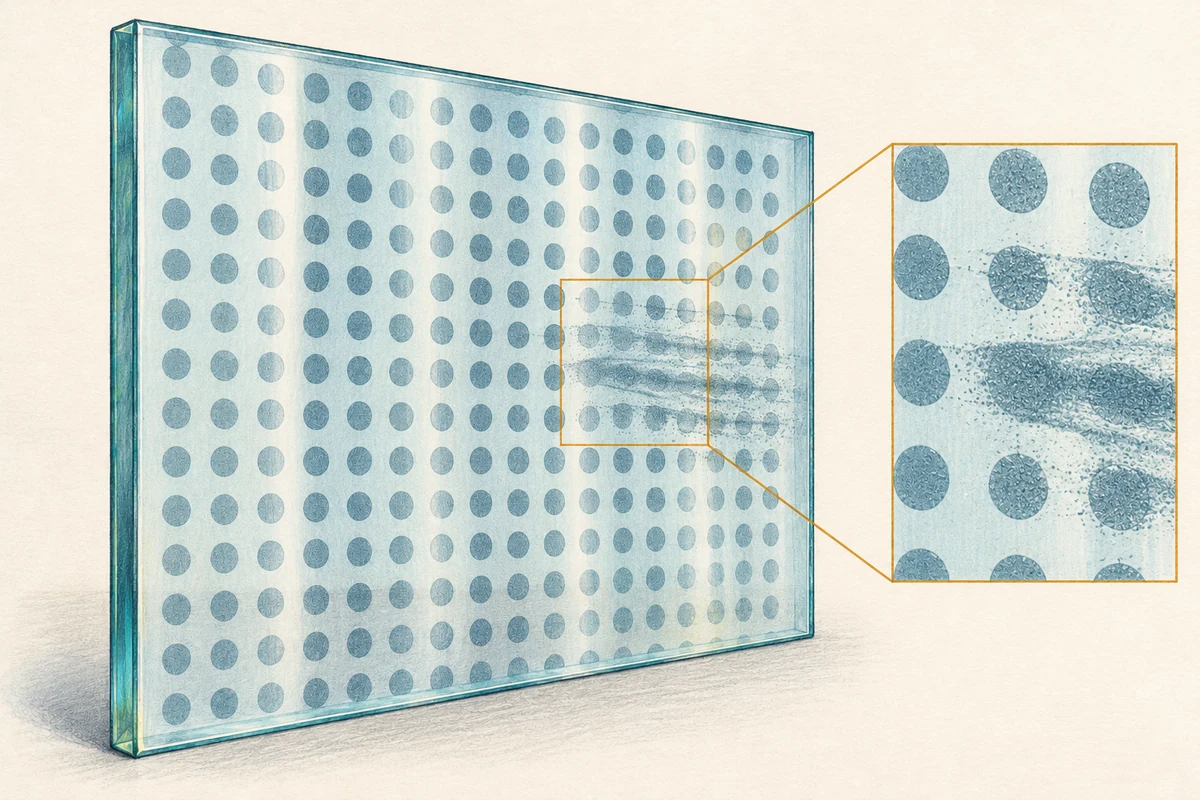
Frit Smears / Offset
Ceramic frit anomaly — directional “drag,” smudge, or registration shift of the fired frit pattern; planar behind the viewing surface; typically SC-0 at the viewing face. Confirm frit face, artwork intent, and location before attribution.
Frit smears/offset are appearance changes within a fired ceramic frit pattern (dots/lines/graphics) where the intended edges are dragged, feathered, or shifted relative to the artwork. The anomaly is planar in the frit layer (usually on a non-viewing face such as #2 or #4) and non-tactile from the viewing surface. Classification is appearance-only per VIS (method-agnostic).
Illustration, reference page, and PDF complete
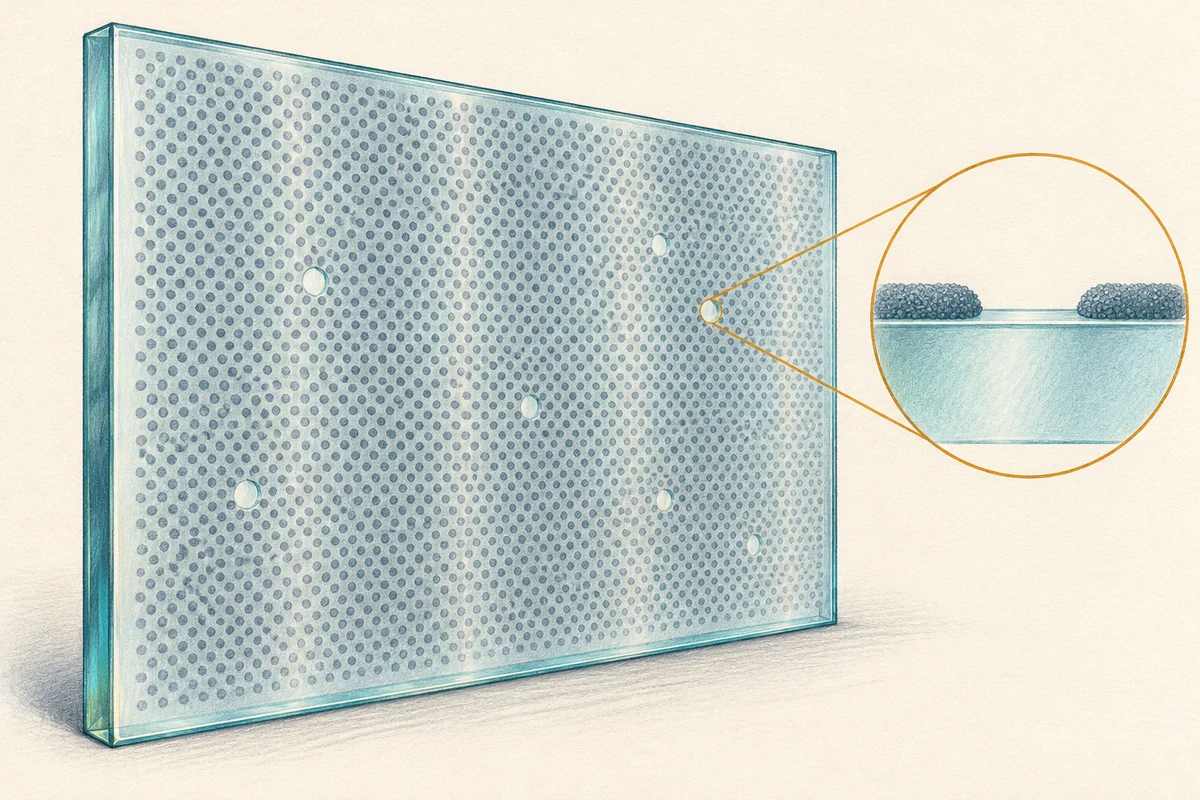
Pinholes / Voids (Ceramic Frit)
Ceramic frit anomaly — discrete clear points or micro-voids within the fired frit field; reads through glass from the viewing side; typically SC-0 at the viewing face. Confirm frit face, artwork intent, and location before attribution.
Frit pinholes/voids are discrete, point-like clearings or ultra-thin spots occurring within a fired ceramic frit pattern (dots/lines/solid fields). From the viewing face they appear as tiny bright/clear points in transmission or sparkle points in reflection. The defect is planar within the frit layer (commonly on #2 or #4) and non-tactile at the viewing surface.
Illustration, reference page, and PDF complete
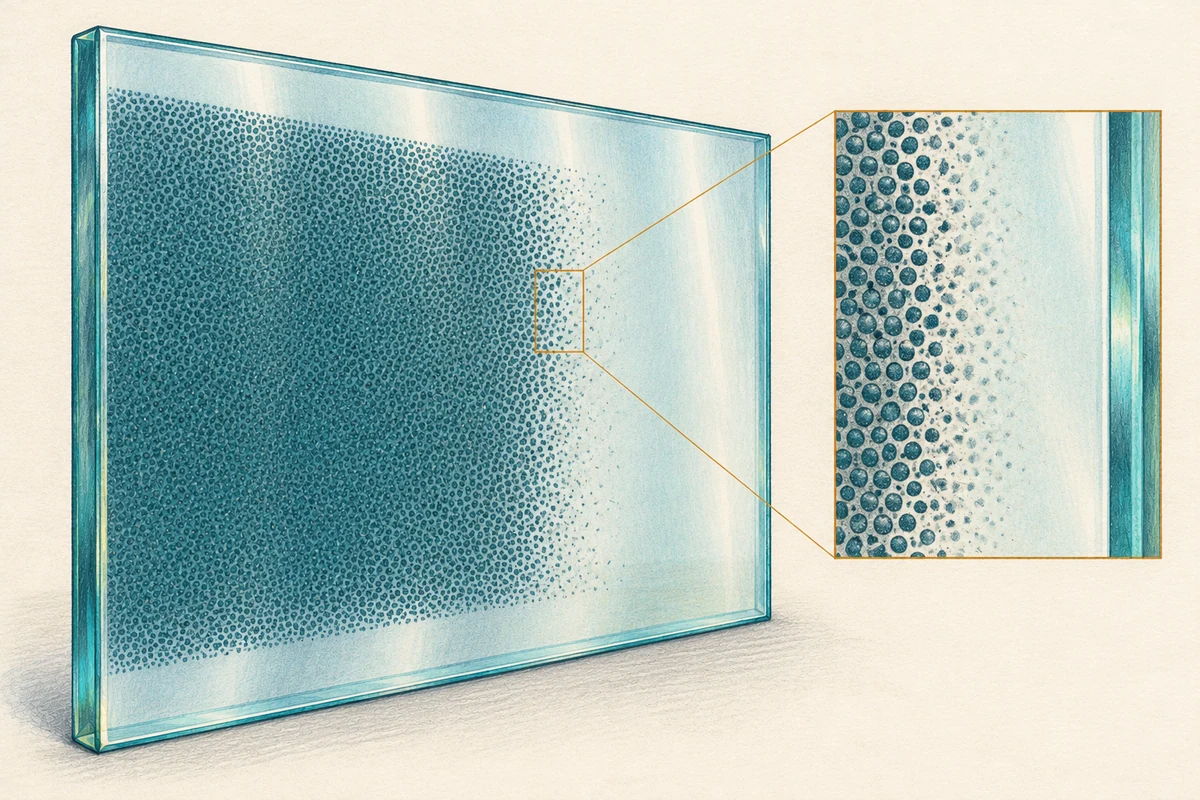
Frit Over-Spray / Edge Ghost
Ceramic frit anomaly — faint halo, fog, or particulate fringe extending beyond the intended frit boundary after application/firing; reads through glass from the viewing side; typically SC-0 at the viewing face. Confirm frit face, mask lines, and artwork intent before attribution.
Frit over-spray / edge ghost is an appearance change where fine frit particulates or mist extend just outside the intended frit edge (mask/screen boundary), producing a narrow, edge-parallel halo or ghost fringe after firing. The condition is planar within the fired frit layer (usually on #2 or #4) and non-tactile from the viewing surface. Classification is appearance-only per VIS (method-agnostic).
Illustration, reference page, and PDF complete
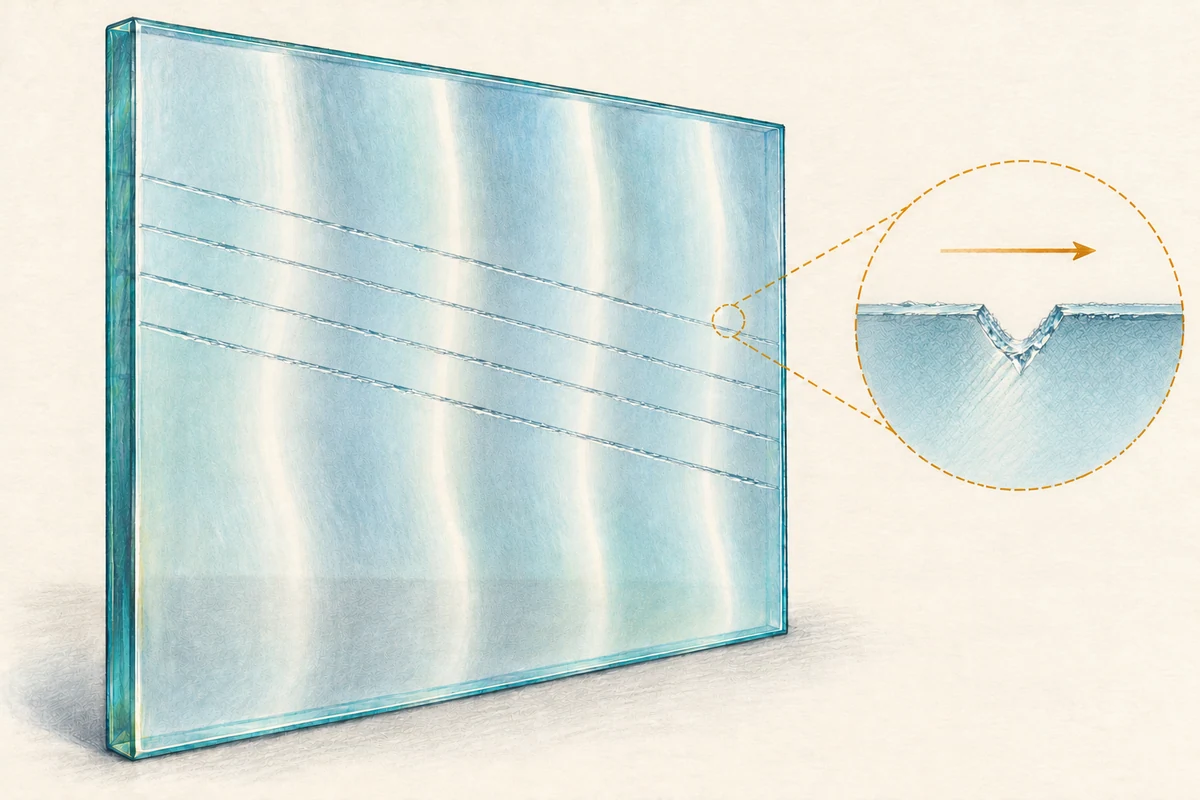
Scraper/Razor Scoring
Mechanical scoring on the worked surface — appearance-based classification; acceptance per VIS §6
Linear score(s) produced by blades/scrapers/razors or sharp edges contacting the glass face, typically presenting bright “chip flanks”/micro-chipping along the line in raking light. Distinct from coating anomalies (area sheen/colour change) and from non-directional residue films. Terminology for micro-chipping and chip flank follows VIS §3;
Illustration, reference page, and PDF complete
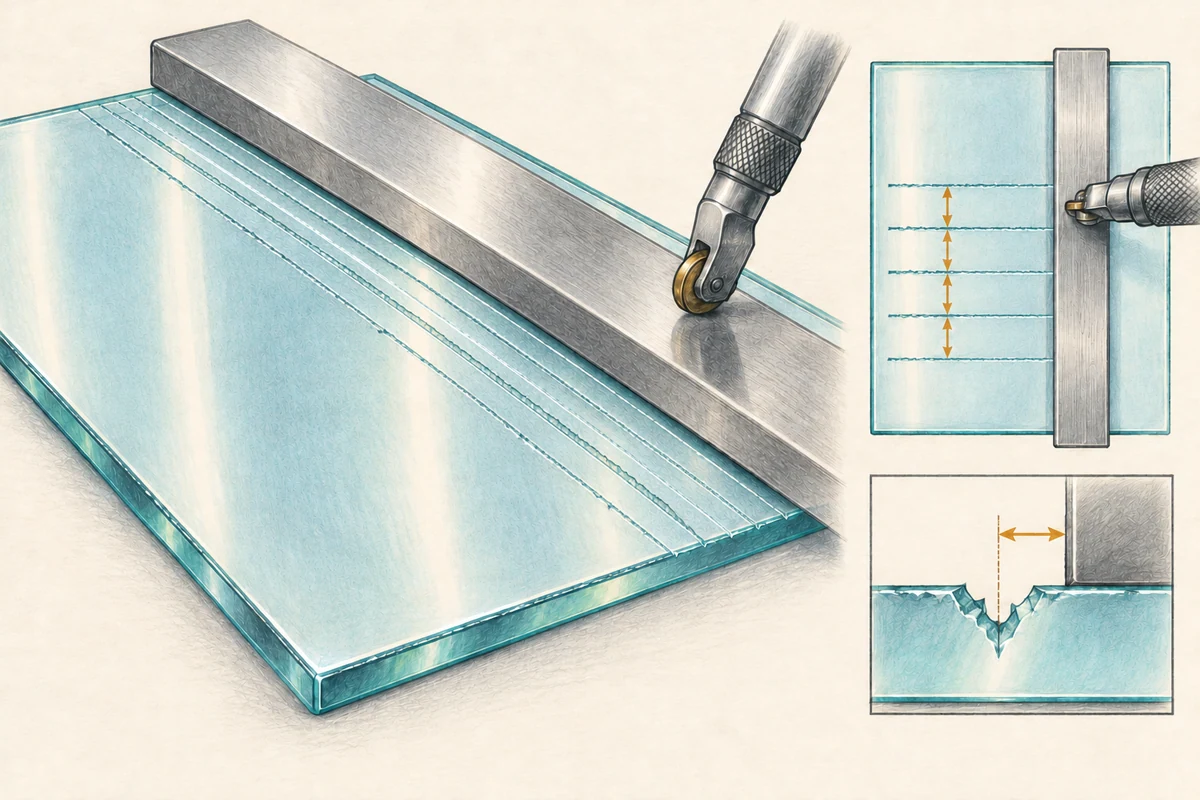
Straightedge / Metal-Guide Scoring
Mechanical scoring on the worked surface — appearance-based classification; acceptance per VIS §6
Long, ruler-straight linear score(s) produced when a scraper/razor or other hard edge rides along a metal straightedge/guide on the glass face. Typically presents bright “chip flanks” / micro-chipping along the line in raking light; persists after reveal and does not behave like a residue film. Terminology for micro-chipping and chip flank per VIS §3;
Illustration, reference page, and PDF complete
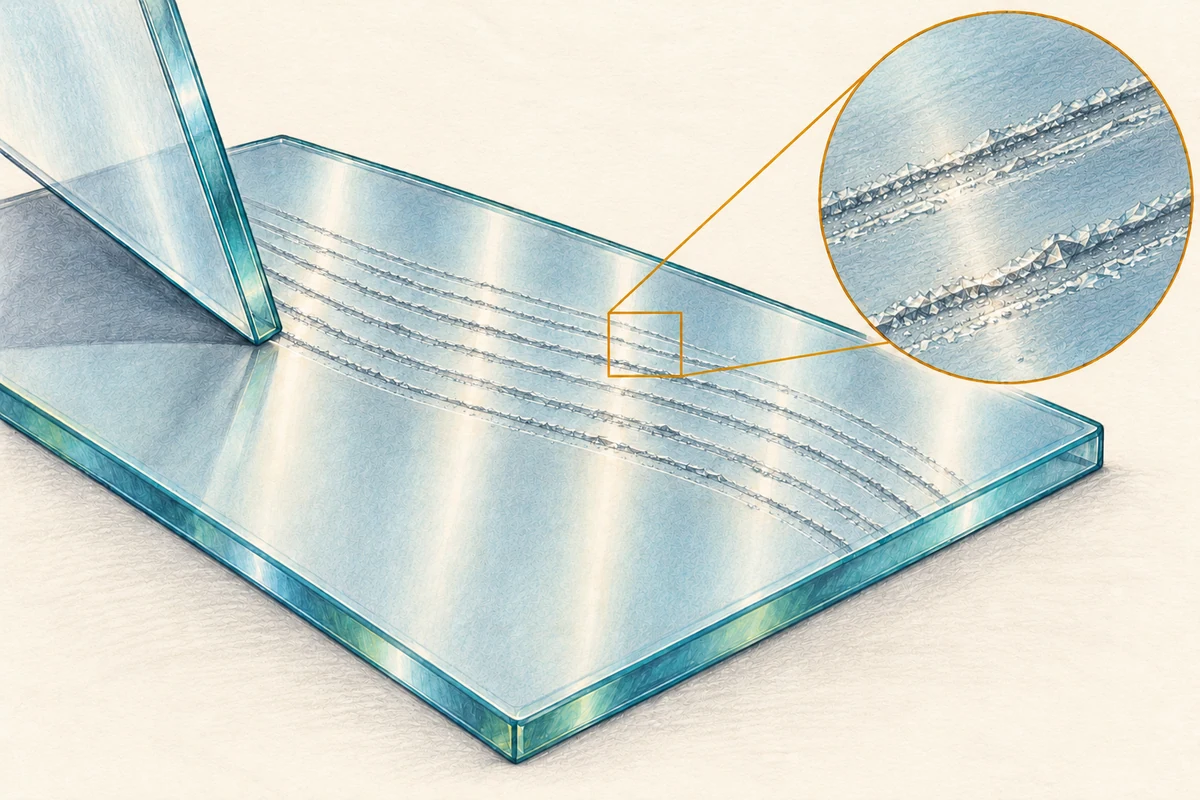
Glass-on-Glass Track (paired arcs/lines)
Mechanical tracking on the worked surface — appearance-based classification; acceptance per VIS §6
Paired, often parallel arcs or lines produced when a glass lite contacts/moves against another glass surface or a similarly hard, smooth element (e.g., stacked lite, cart rail with glass contact). Presents as directional linear paths; depth may range from faint polish disturbance to tactile scoring with micro-chipping (“chip flanks”) visible in raking light.
Illustration, reference page, and PDF complete
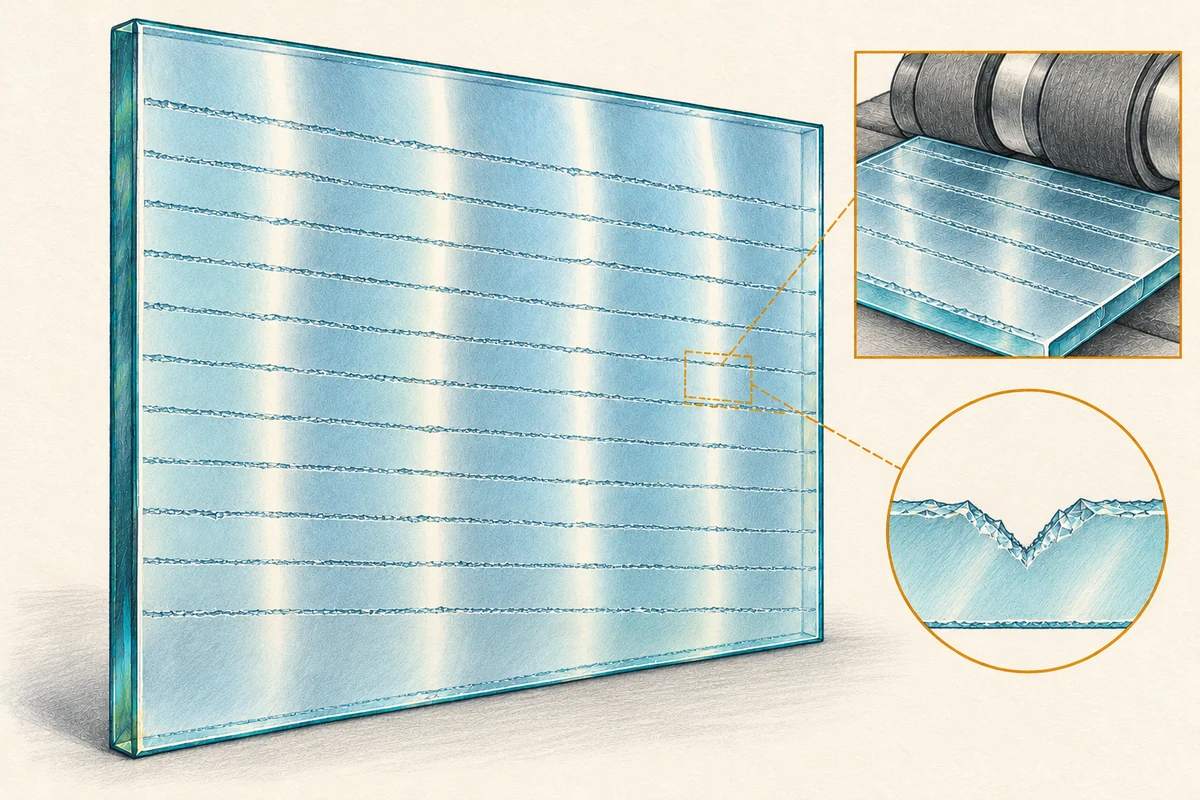
Conveyor/Belt Line Scoring (handling line)
Mechanical scoring on the worked surface — appearance-based classification; acceptance per VIS §6
Long, transport-direction linear lines/bands produced when a lite slides or oscillates on a conveyor/belt/handling rail during fabrication, glazing, or site handling. Presents as directional linear scoring that is often bay-to-bay continuous, sometimes in parallel sets at consistent spacing; in raking light, edges can show bright “chip-flanks”/micro-chipping when depth increases.
Illustration, reference page, and PDF complete
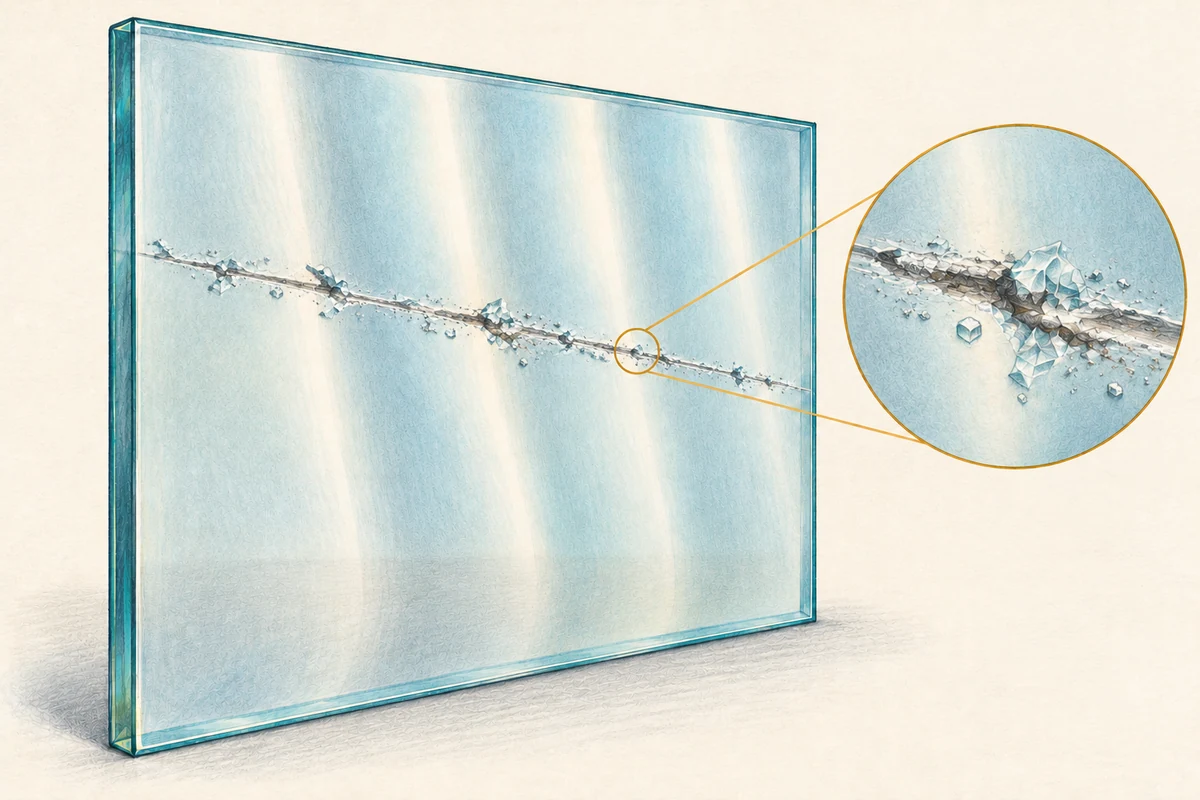
Hardware / Fastener Drag Line
Mechanical scoring on the worked surface — appearance-based classification; acceptance per VIS §6
Localized, directional linear line(s) or short runs created when hardware/fasteners/metal fittings (e.g., screw heads, rail/spider fittings, brackets) contact and move across the glass face, leaving a mechanical score. In raking light the line often exhibits bright “chip-flanks” / micro-chipping where depth increases; it persists after Non-Invasive Reveal (clean & dry) and is not a removable film.
Illustration, reference page, and PDF complete
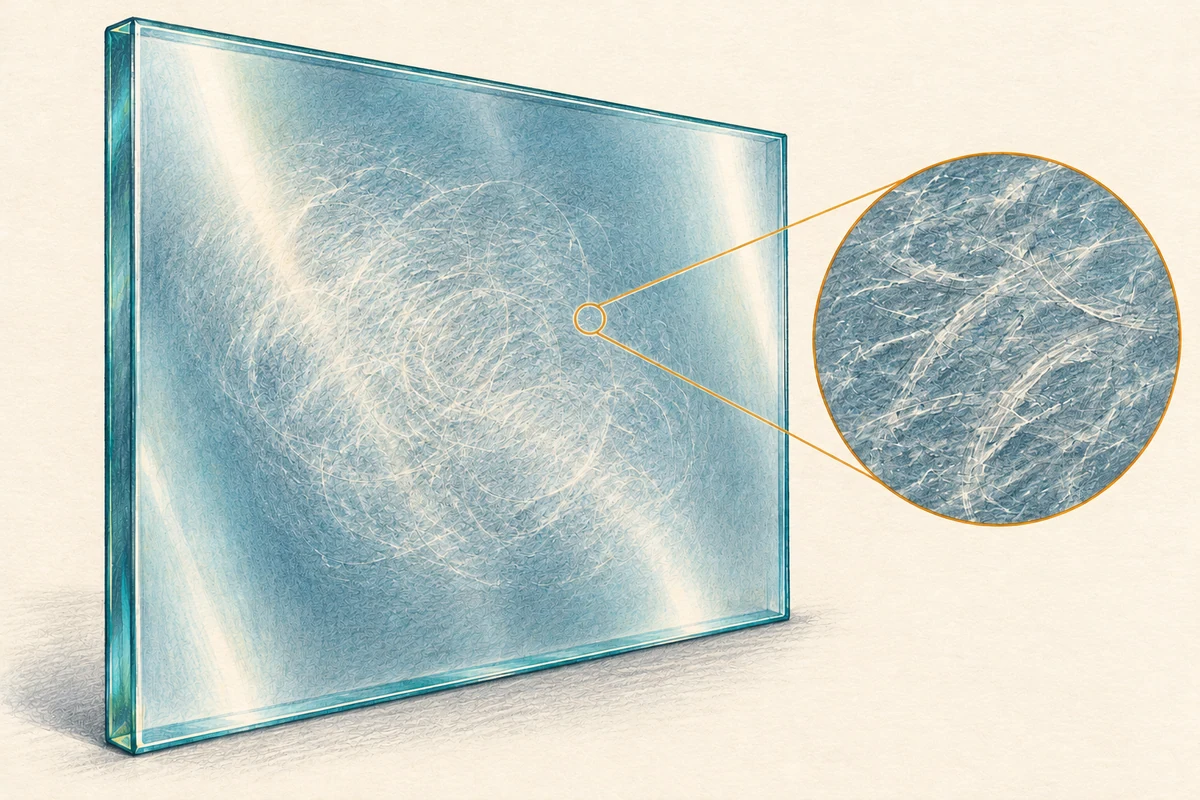
Micro-Abrasion Swirls / Pad Trails (non-linear)
Mechanical abrasion field on the worked surface — appearance-based classification; acceptance per VIS §6
A non-linear, repetitive swirl or looping trail produced by contact pads, cloths, or small tools traversing the glass face, leaving a fine, directional micro-abrasion field. Under raking light, the field reads as swirls/arcs and may present “modeled micro-texture” (subtle milky relief) when depth increases.
Illustration, reference page, and PDF complete
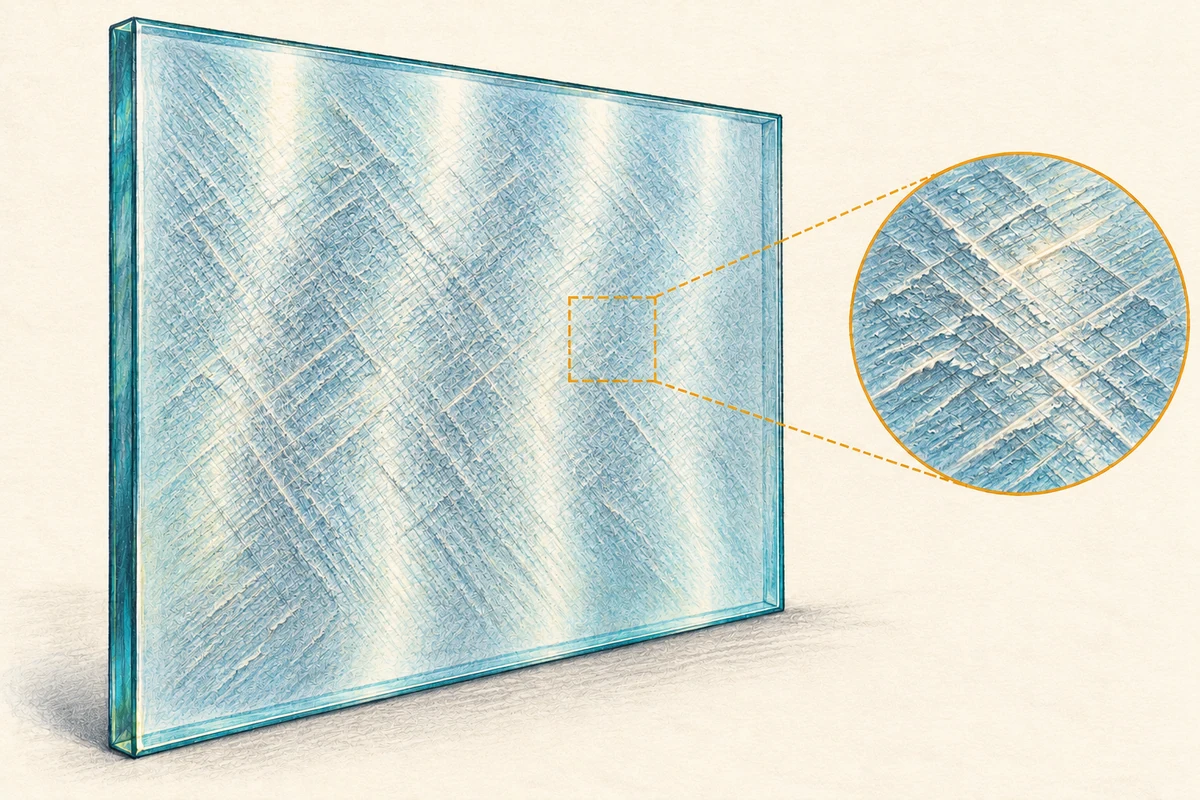
Cross-Hatch Scuffing / Sanding Pattern (non-linear)
Mechanical abrasion field on the worked surface — appearance-based classification; acceptance per VIS §6
A non-linear, intersecting lattice of fine lines produced by hand pads, sanding media, or abrasive cloths moving in overlapping, multi-directional passes, leaving a cross-hatched abrasion field. In raking light the field reads as criss-crossed micro-lines; with increasing depth, portions show modeled micro-texture (subtle milky relief) and may include micro-chipping (“chip flanks”) on some strokes.
Illustration, reference page, and PDF complete
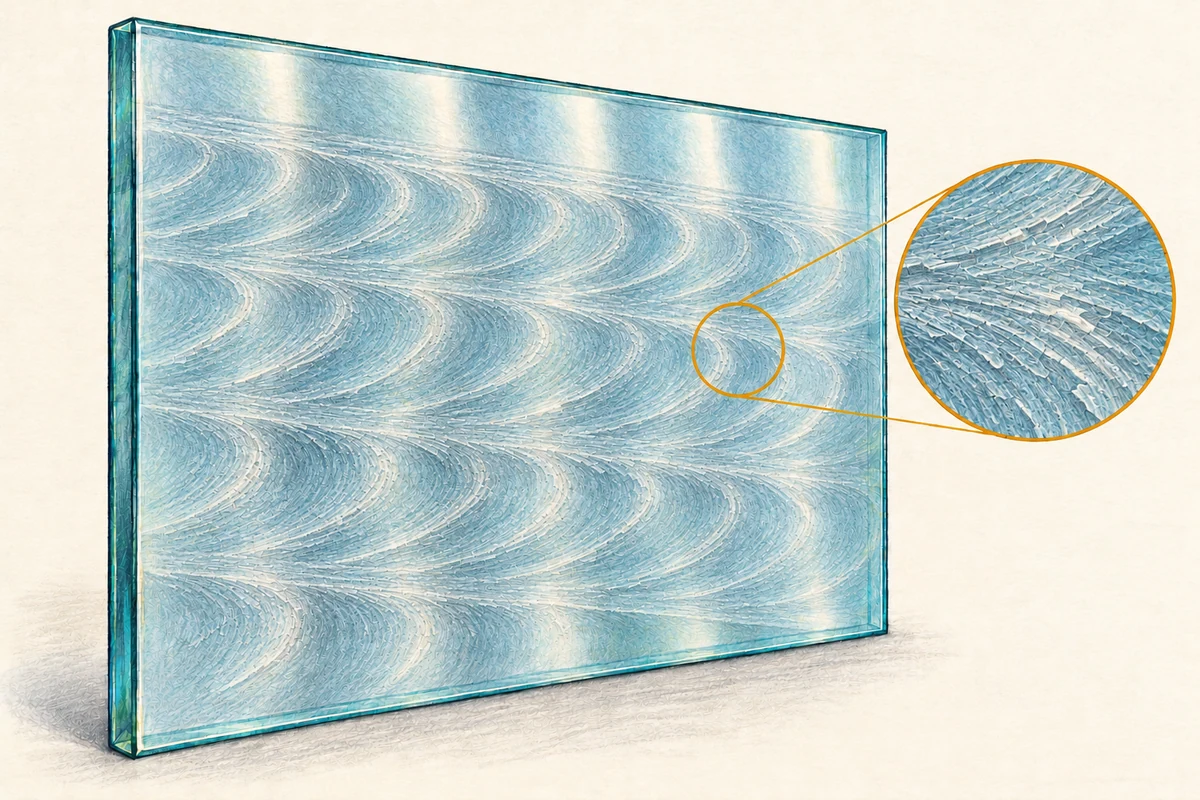
Directional Webbing (repetitive paths)
Mechanical abrasion field on the worked surface — appearance-based classification; acceptance per VIS §6
A repeating, directional network of fine lines formed by a tool, pad, or abrasive traversing the glass in overlapping, semi-regular paths, producing a “spider webbed” pattern (linear/curvilinear strands with recurring orientation). Under raking light, strands may show edge sparkle; at higher severity, portions exhibit modeled micro-texture (subtle milky relief) and chip-flanks on some strokes.
Illustration, reference page, and PDF complete
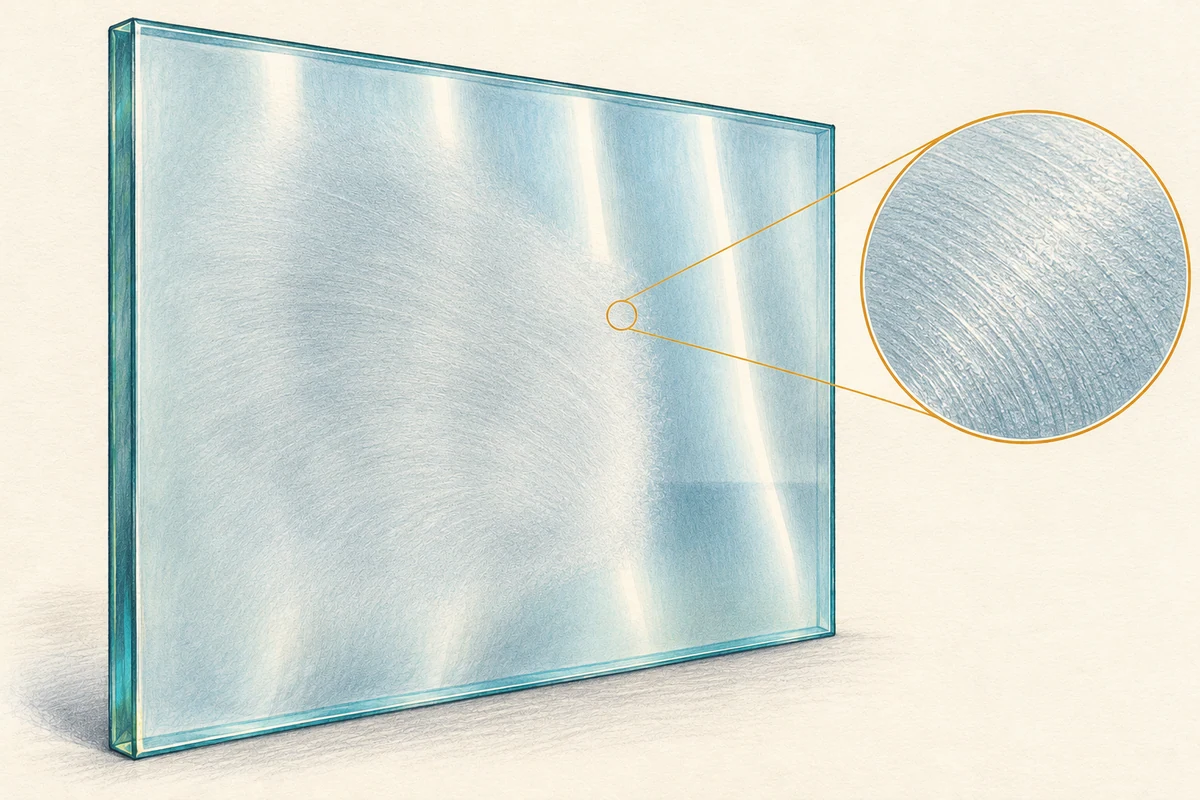
Burnish / Haze Field (localized over-polish)
Mechanical abrasion field on the worked surface — appearance-based classification; acceptance per VIS §6
A localized, non-uniform change in sheen/clarity produced by over-refinement or frictional over-polish (pad/cloth/tool held and worked in place), creating a subtle micro-texture that scatters light. Under raking light, the area reads as a matte or milky field (modeled micro-texture) that persists after Non-Invasive Reveal (clean & dry).
Illustration, reference page, and PDF complete
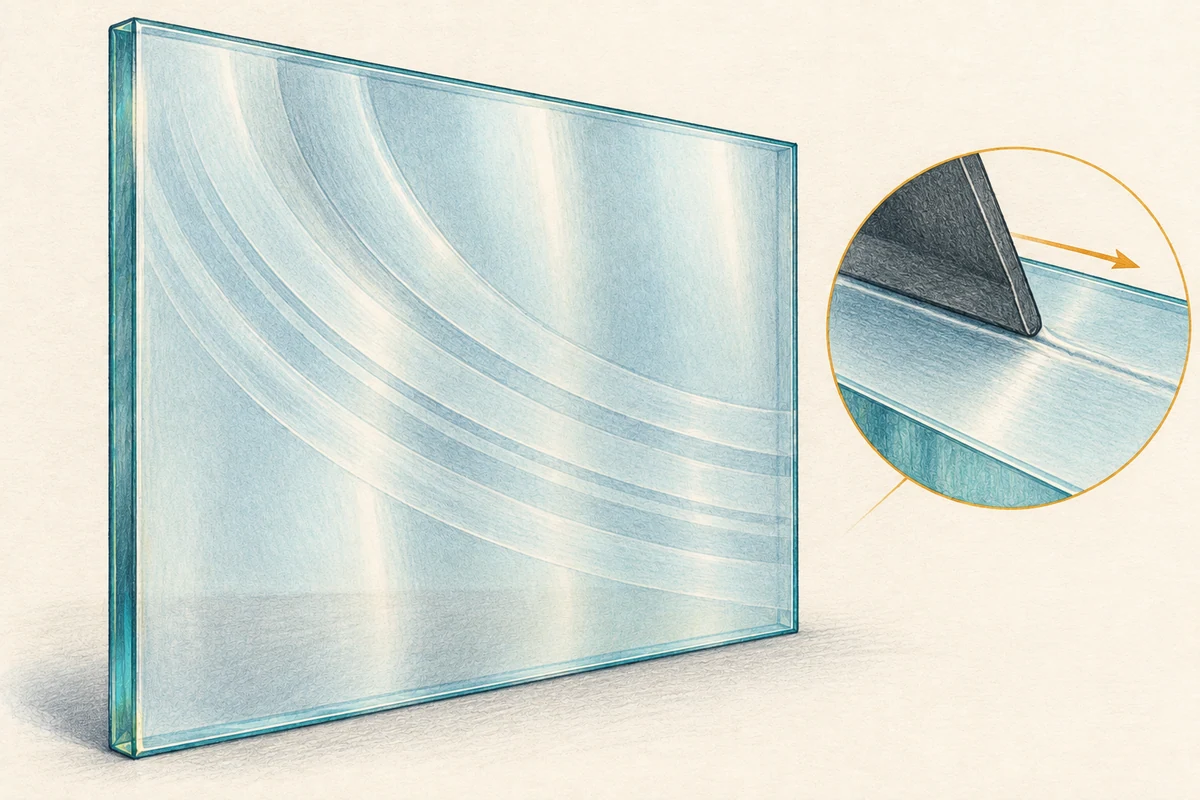
Squeegee Burn Lines (Friction Film)
Mechanical / Abrasion Fields — Non-linear; often residue-assisted friction mark rather than true relief
Narrow, linear or banded appearance change that follows squeegee travel paths during window cleaning. Typically a friction-film or light burnish produced by dry/dirty rubber, residue-lubricant mismatch, or excessive pressure. Presents primarily as a visibility cue under raking/oblique light; may be non-tactile (film) or show trace relief where the surface has been lightly burnished.
Illustration, reference page, and PDF complete
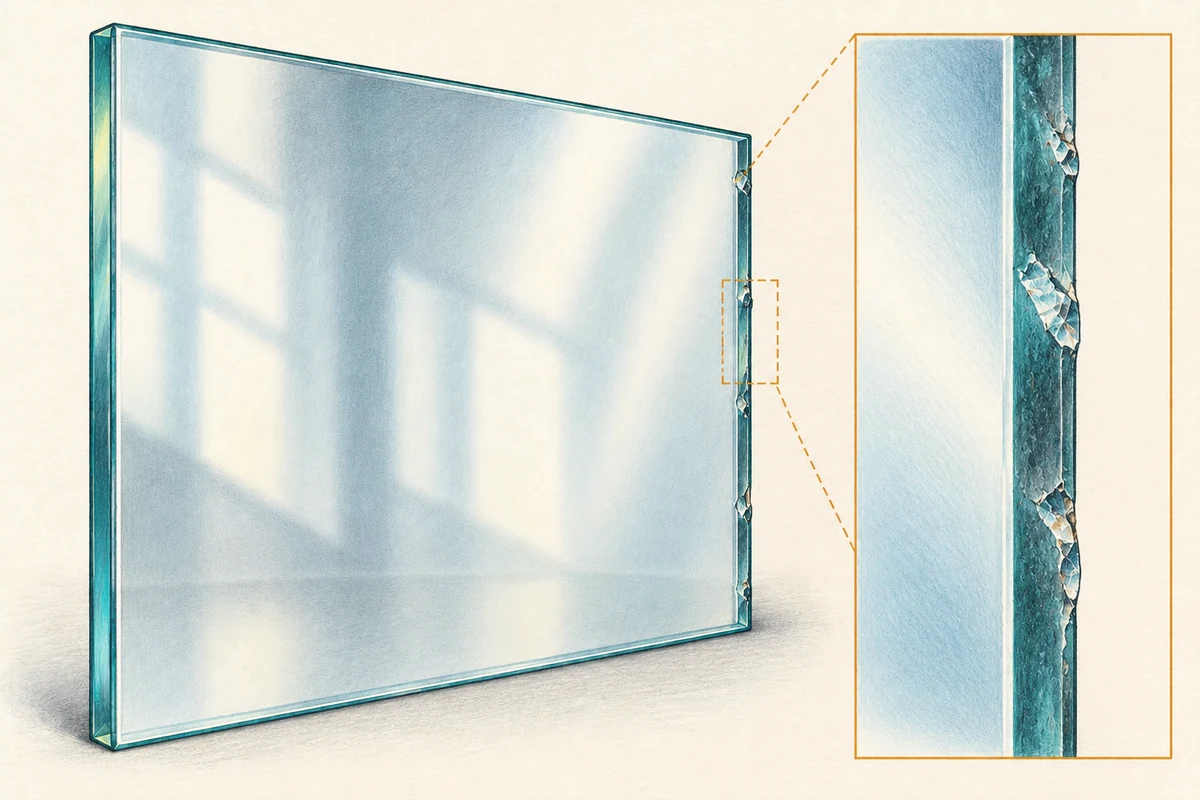
Edge Micro-Chipping (minor)
Mechanical — perimeter/arris
Small, bright edge fractures or “nicks” at or just inside the perimeter arris. Under raking light they present as sparkly facets; at higher severities they may form short “chip flanks” pointing into the face. “Micro-chipping” and “chip flank” are defined in VIS terminology and used here strictly as appearance/morphology cues (classification is appearance-only).
Illustration, reference page, and PDF complete
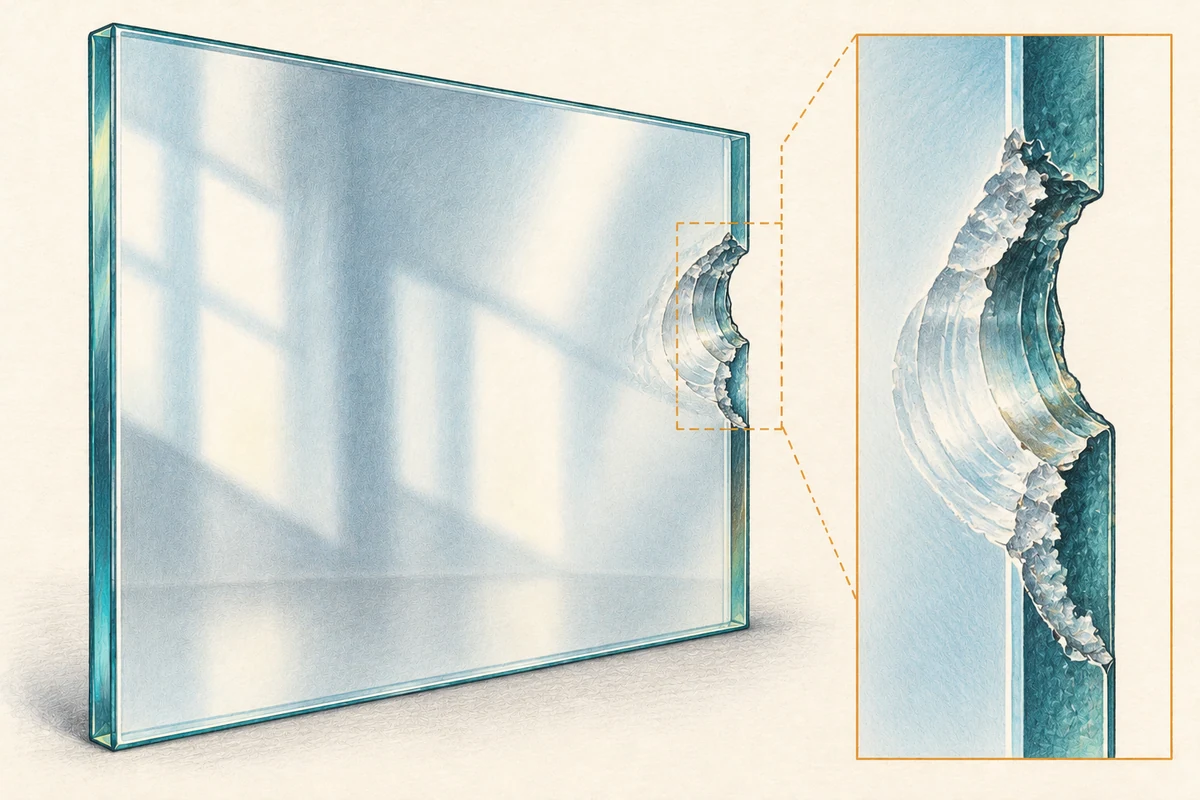
Edge Gross Chipping / “Clamshell”
Mechanical — edge & corner damage
Gross edge chipping (“clamshells”) are discrete, larger shell-type fractures at or near the perimeter, typically from impact, improper handling, or stress at drilled/notched features. Classification is appearance-only per VIS; restoration methodology is out of scope. Inspect under VIS lighting/geometry and record surface numbering and worked-surface status on Forms:
Illustration, reference page, and PDF complete
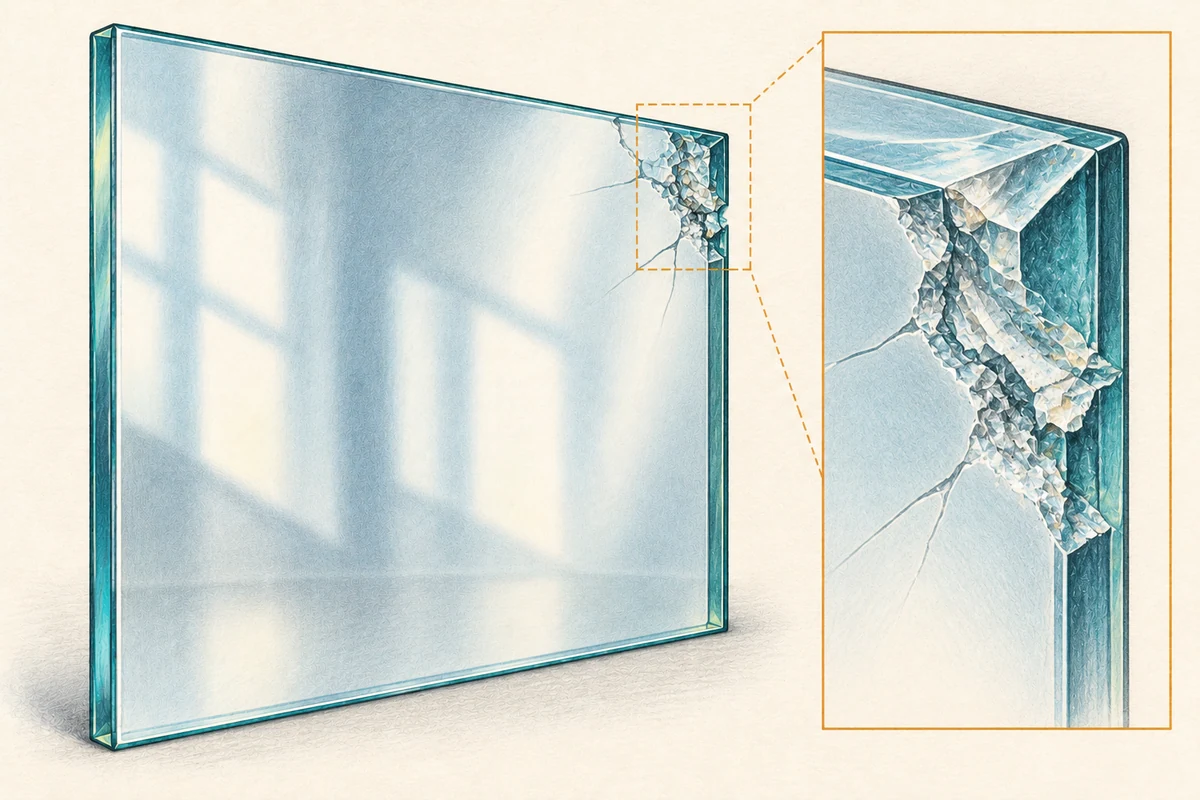
Corner Crush / Corner Spall
Mechanical — edge & corner damage
Corner crush / corner spall are localized, shell-type losses at the glass corner/near-corner arris caused by impact, handling, or bearing stress. They present as irregular clamshells and faceted fracture surfaces; short, radial micro-cracks may be present. Classification here is appearance-only per VIS (method-agnostic).
Illustration, reference page, and PDF complete
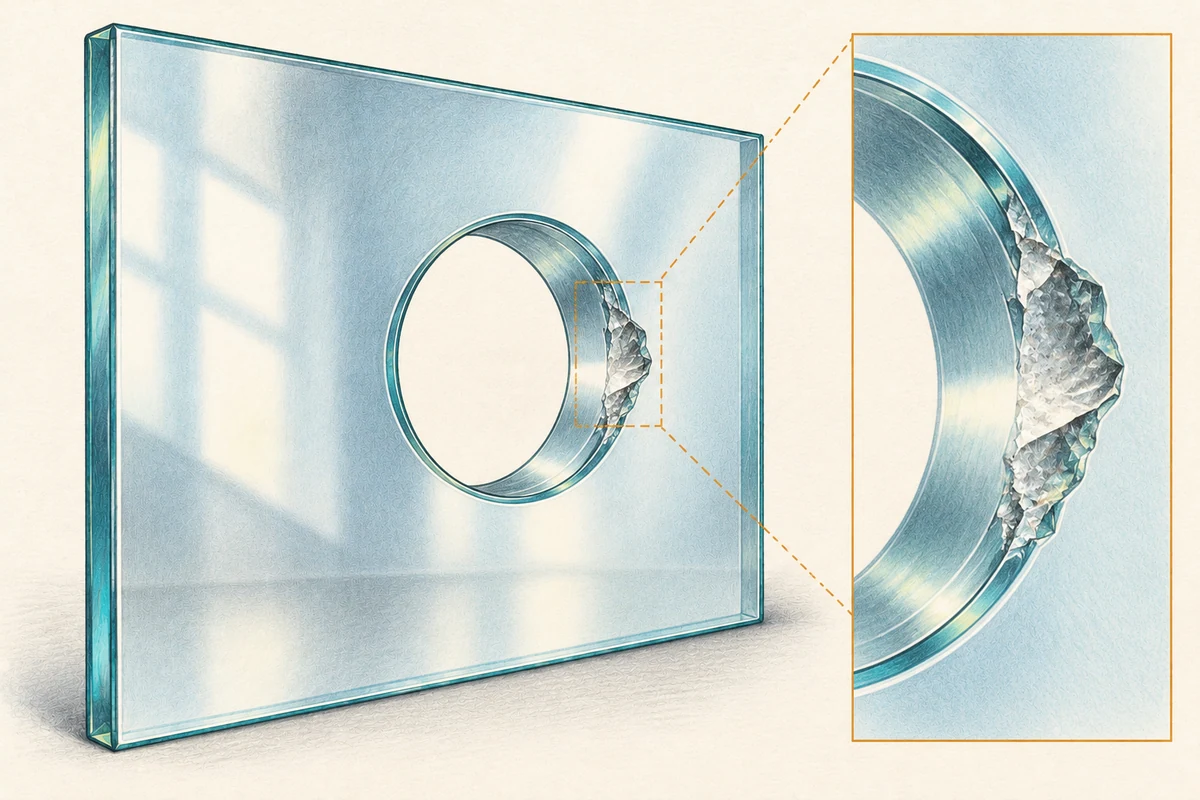
Edge “Shelling” at Hardware Holes/Slots
Mechanical — edge & corner damage at penetrations
Edge “shelling” at hardware holes/slots is a localized shell-type loss that originates at the perimeter of a drilled hole or machined notch and intrudes onto the exposed face. It is distinct from a factory exit-lip (a uniform burr confined to the hole/slot perimeter that reads SC-0 on the face and is not damage). Classification here is appearance-only per VIS; restoration methodology is out of scope.
Illustration, reference page, and PDF complete
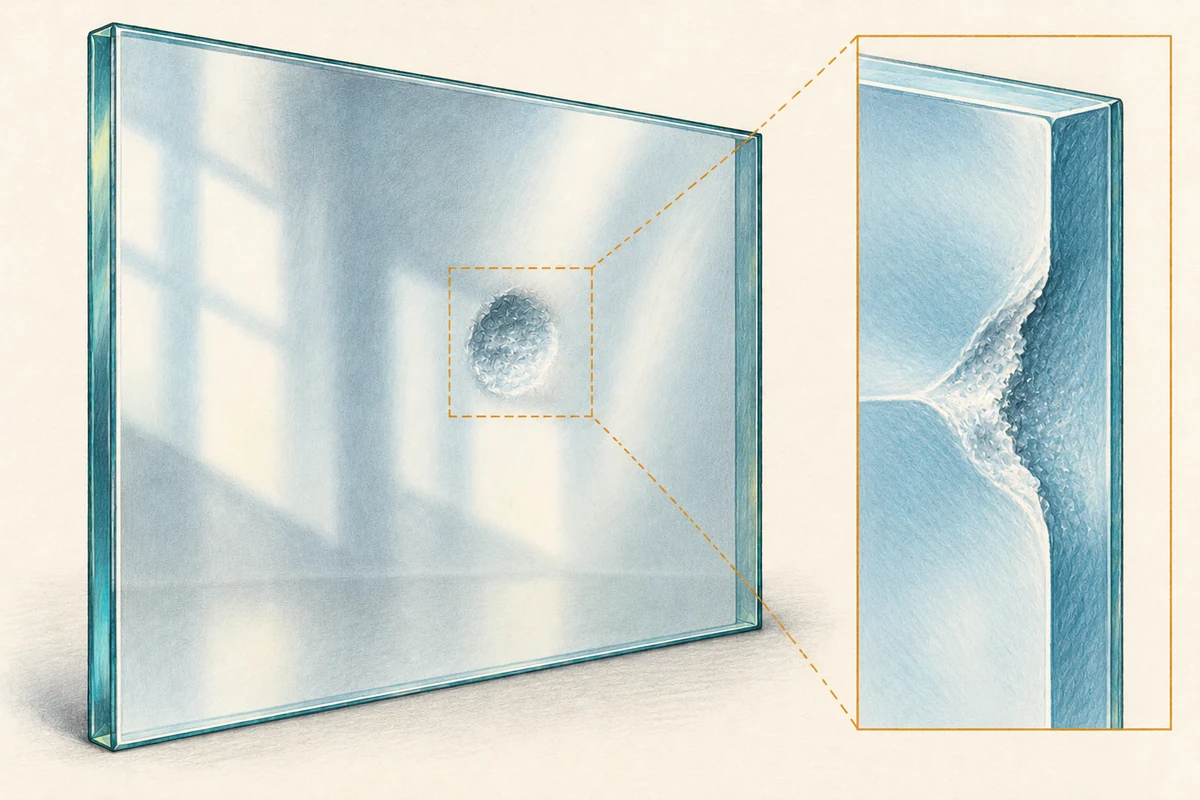
Impact Divot (non-through)
Mechanical — localized contact/impact; no through-thickness break
A non-through impact divot is a localized indentation/pit on the exposed surface caused by a blunt contact or small projectile that does not result in a through-thickness crack or star-break. Classification here is appearance-only per VIS (method-agnostic). Inspect under VIS lighting/geometry, after Non-Invasive Reveal, and record surface numbering and worked-surface status on Forms
Illustration, reference page, and PDF complete
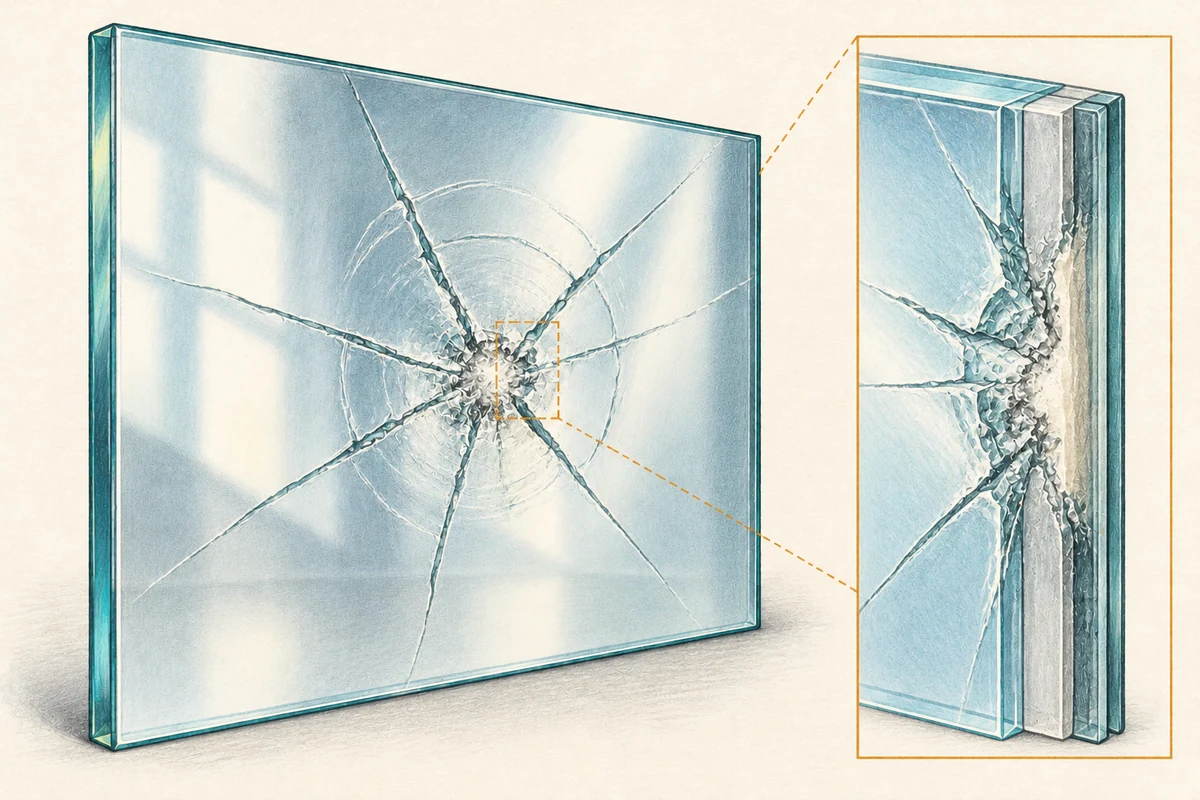
Star Break / Bullseye Initiation (annealed/laminated)
Mechanical — impact-initiated fracture pattern
Star breaks / bullseye initiations are impact-origin fracture patterns characterized by a central origin with radial and/or circumferential cracking. For annealed or laminated architectural glass, the presence of active cracks or a star-type network constitutes an integrity indicator and is out of in-place restoration scope under VIS (CAT-5). Classification here is appearance-only; methodology is out of scope.
Illustration, reference page, and PDF complete
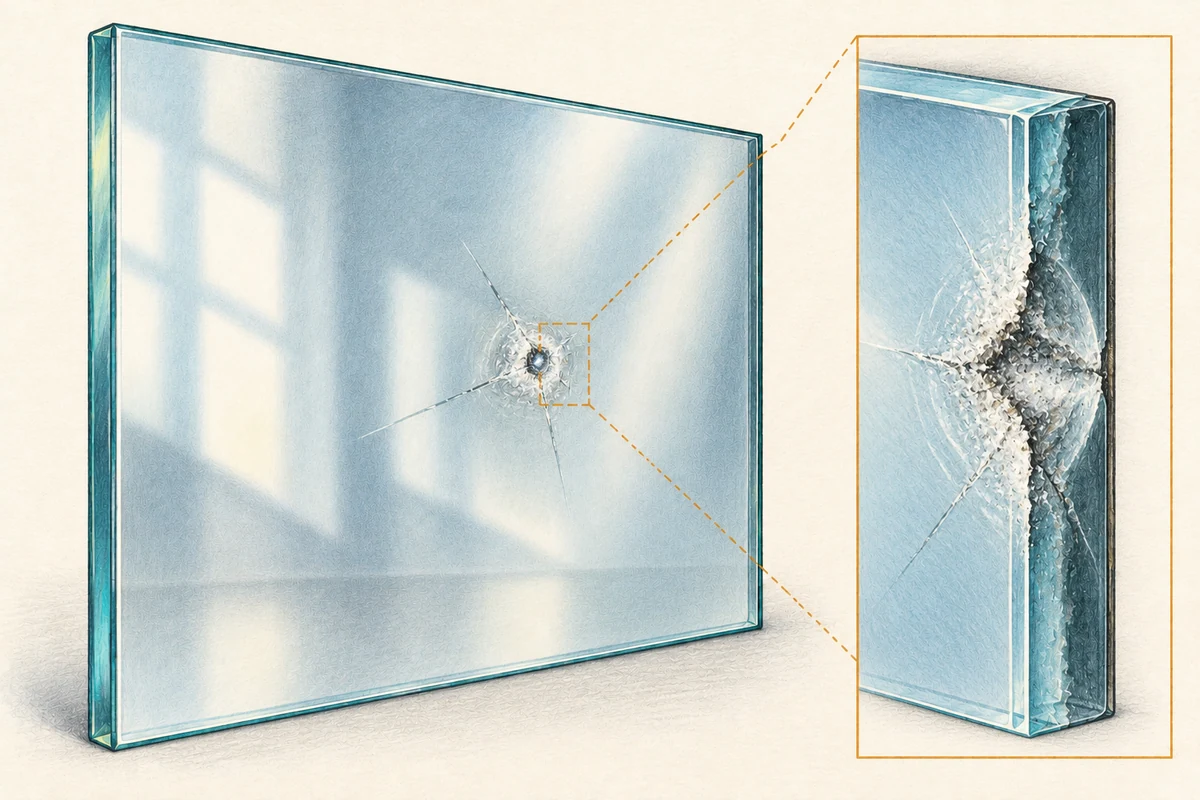
Pellet / BB Impact Signature
Mechanical — high-velocity localized impact
A pellet/BB impact is a high-velocity, localized strike that produces a central crater/divot and may initiate radial cracking or a bullseye/star pattern depending on glass type and energy. Classification here is appearance-only per VIS (method-agnostic).
Illustration, reference page, and PDF complete
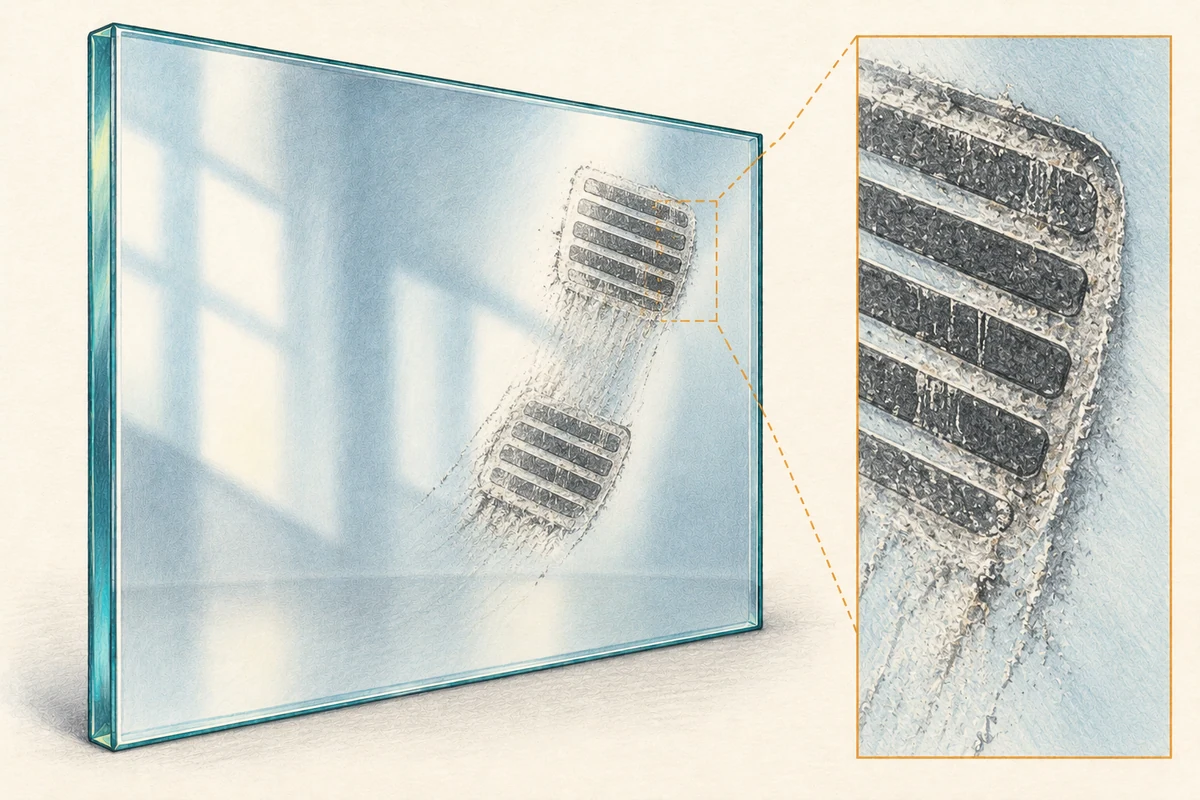
Tool Strike / Ladder Foot Imprint
Mechanical — localized contact/press/drag imprint; may include abrasion + transfer
A tool strike / ladder foot imprint is a localized contact mark on the exposed surface produced by pressed/dragged equipment (e.g., ladder feet, tool bodies, scaffold components). It may present as rectilinear pad outlines, paired tread prints, or blunted arcs consistent with press-and-slide. Classification is appearance-only per VIS (method-agnostic). Inspect under VIS lighting/geometry after Non-Invasive Reveal;
Illustration, reference page, and PDF complete
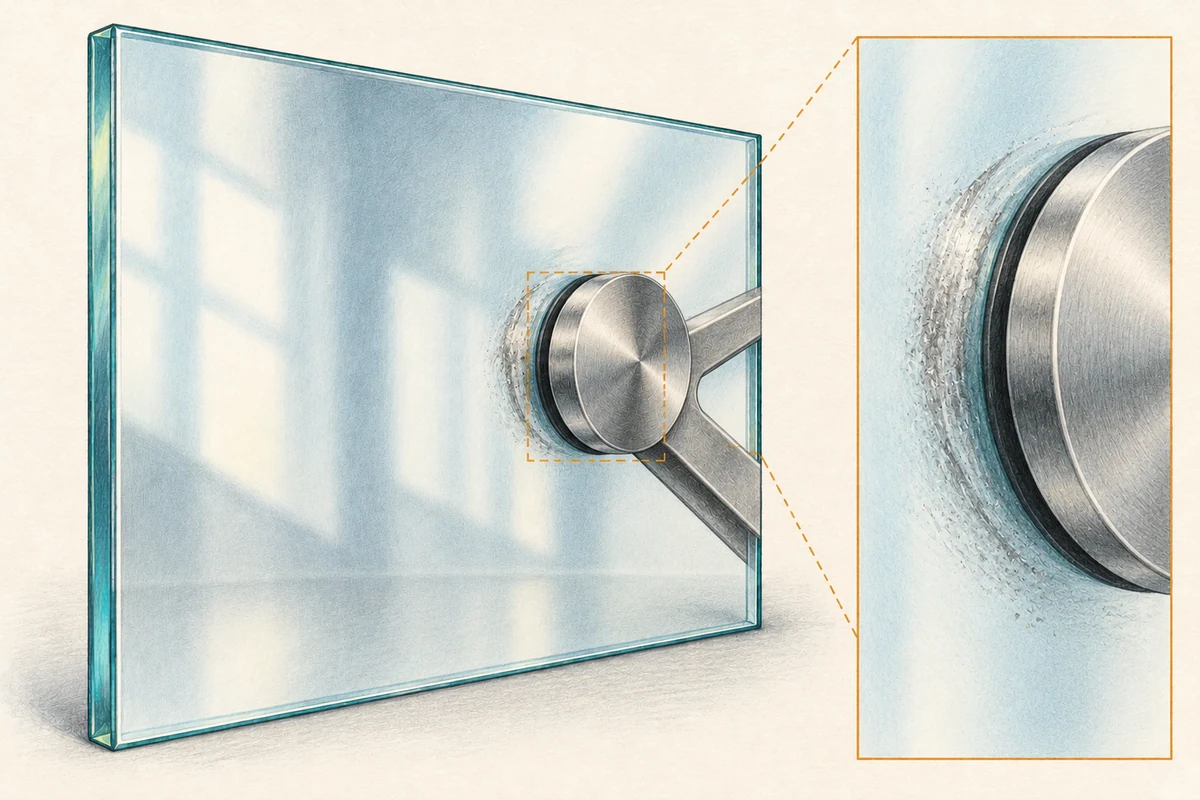
Hardware Contact Rub (spider/rail fittings)
Mechanical — localized abrasion + possible metallic transfer adjacent to hardware
A hardware contact rub is a localized surface scuff/abrasion (often with metallic transfer) produced where point-supported fittings (e.g., spider arms, standoff discs) or rail clamps/brackets contact or are dragged across the lite. Classification here is appearance-only per VIS (method-agnostic). Inspect after Non-Invasive Reveal and under VIS lighting/geometry;
Illustration, reference page, and PDF complete
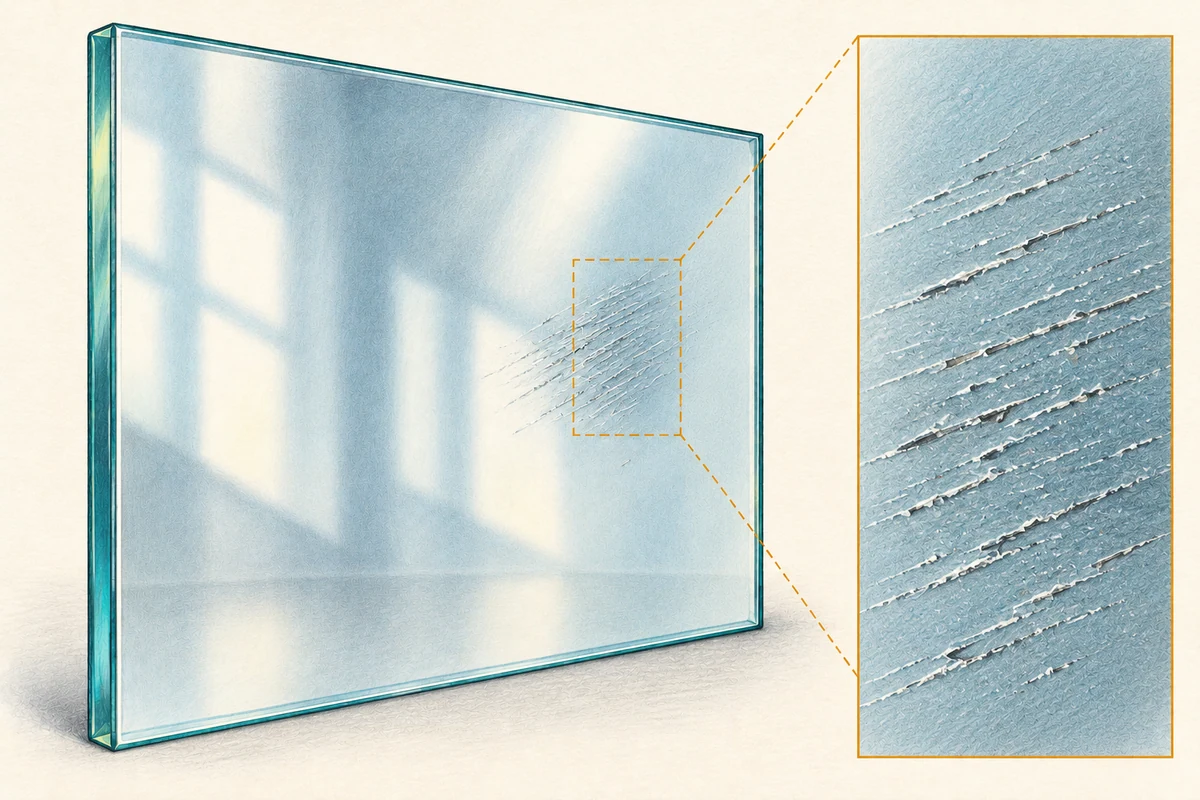
Short FD Scratch Cluster
Mechanical — factory handling/wash-induced; multiple short, parallel lineations
A short FD scratch cluster is a localized patch (typically hand-sized or smaller) of multiple short, generally parallel fine scratches produced by entrained grit/debris during factory washing/handling. Lines are co-oriented, often confined to a narrow zone, and persist after Non-Invasive Reveal. Classification is appearance-only per VIS (method-agnostic).
Illustration, reference page, and PDF complete
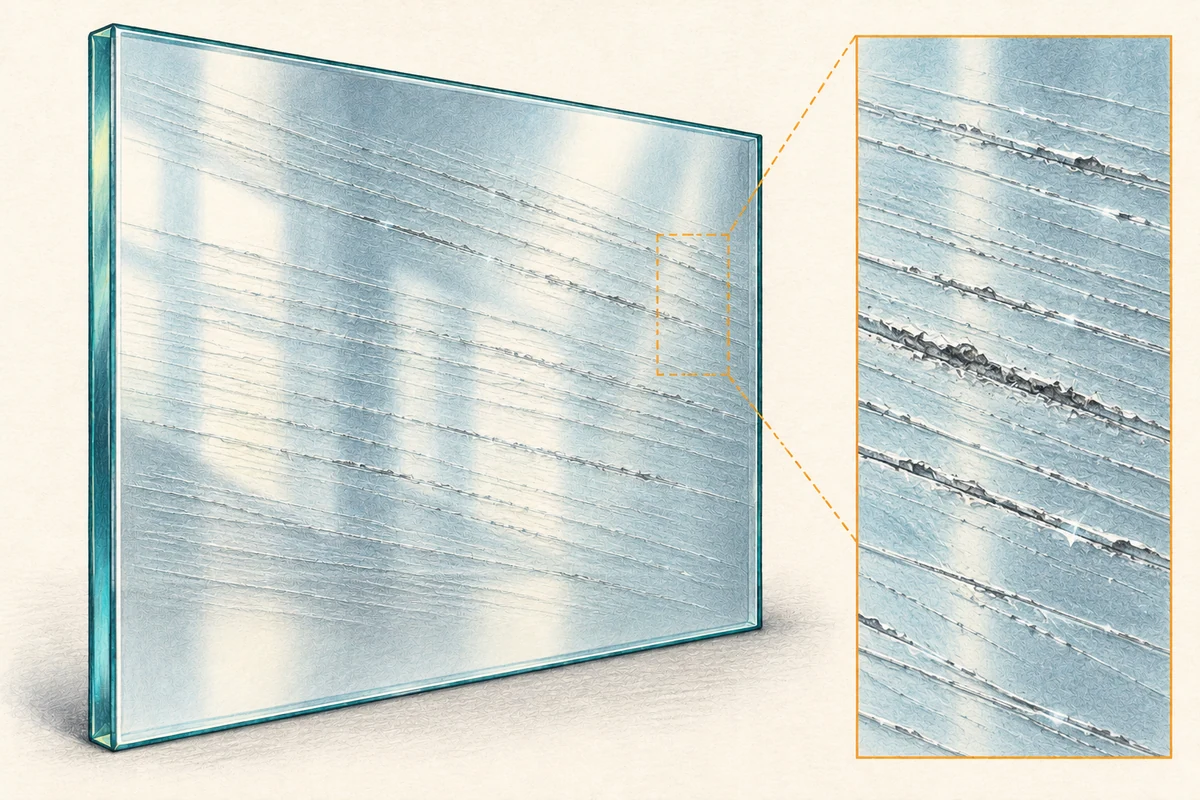
Long FD Scratch Field
Mechanical — Fabrication Debris Scratches
Pane-scale, predominantly parallel lineations caused by trapped/dragged fabrication debris during washing/handling, typically extending across large regions (often banded) rather than isolated short clusters. Classified by visual morphology and surface-catch response; methods of removal are outside scope.
Illustration, reference page, and PDF complete
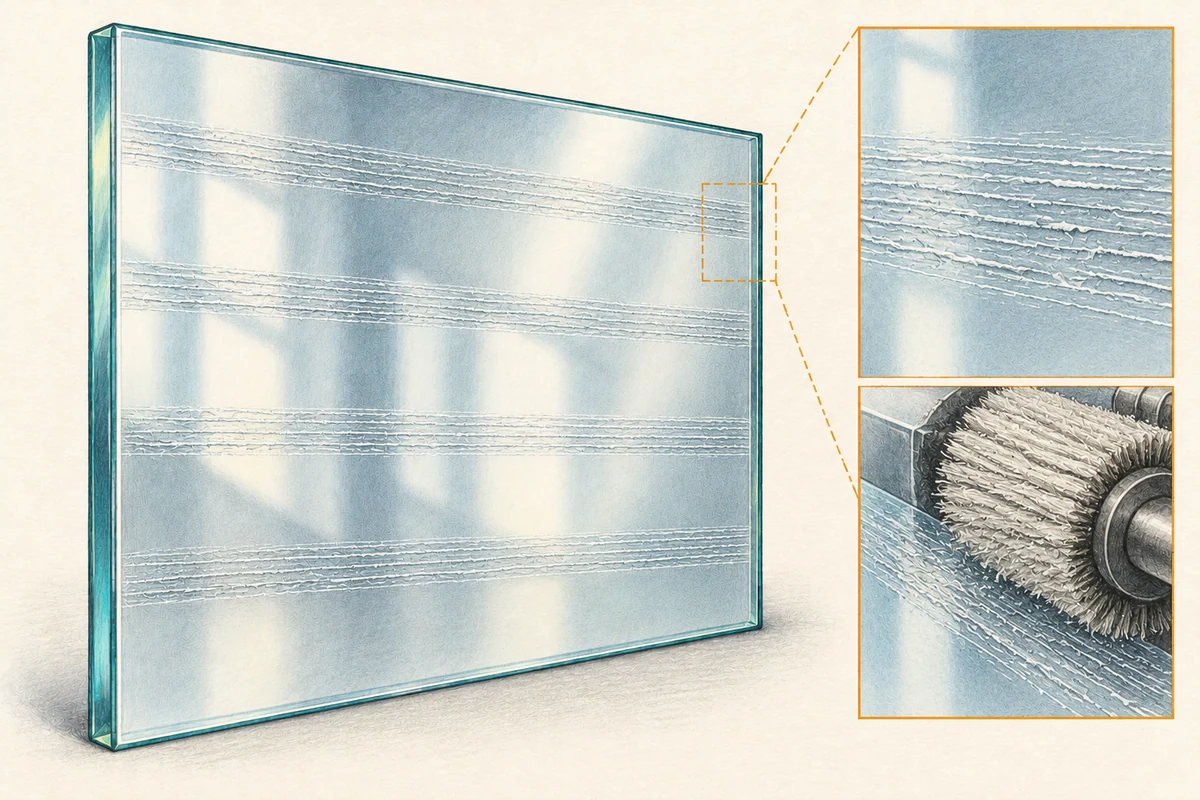
Wash-Line Scratch Bands
Fabrication Debris / factory wash handling lines
Parallel, height-consistent bands of linear surface scoring produced when particulates or trapped fines are carried across the lite by factory washing/handling equipment prior to or after heat-treating. Bands typically align perpendicular to glass travel and traverse significant widths of the face. Classification is appearance-based under VIS inspection conditions; acceptance is governed separately by VIS-A.
Illustration, reference page, and PDF complete
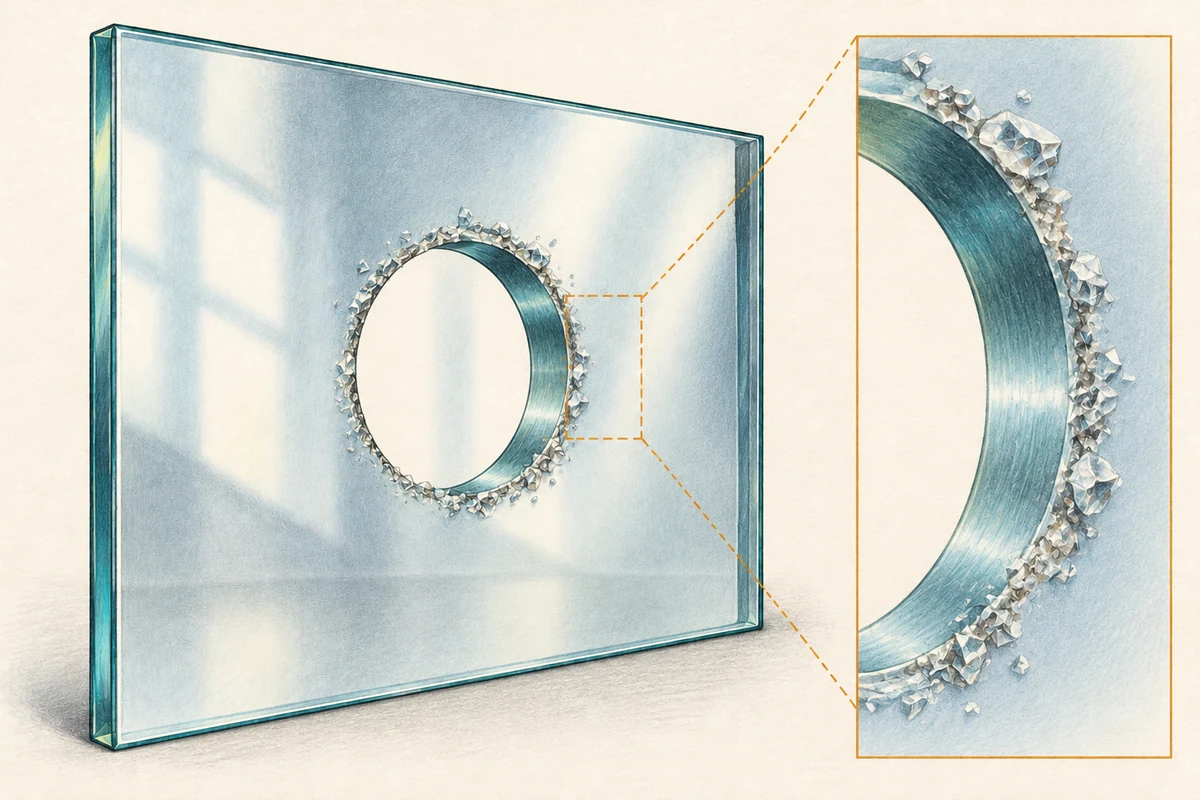
Hole Edge Micro-Chips (excess)
Mechanical — drilling/notching-related; perimeter of penetrations
Hole edge micro-chips (excess) are small, discrete chiplets at the perimeter of a drilled hole or machined slot that exceed normal manufacturing artifacts and/or intrude onto the exposed face. They present as bright faceted nicks; at higher severities, short chip flanks point inward from the perimeter. Classification is appearance-only per VIS (method-agnostic).
Illustration, reference page, and PDF complete
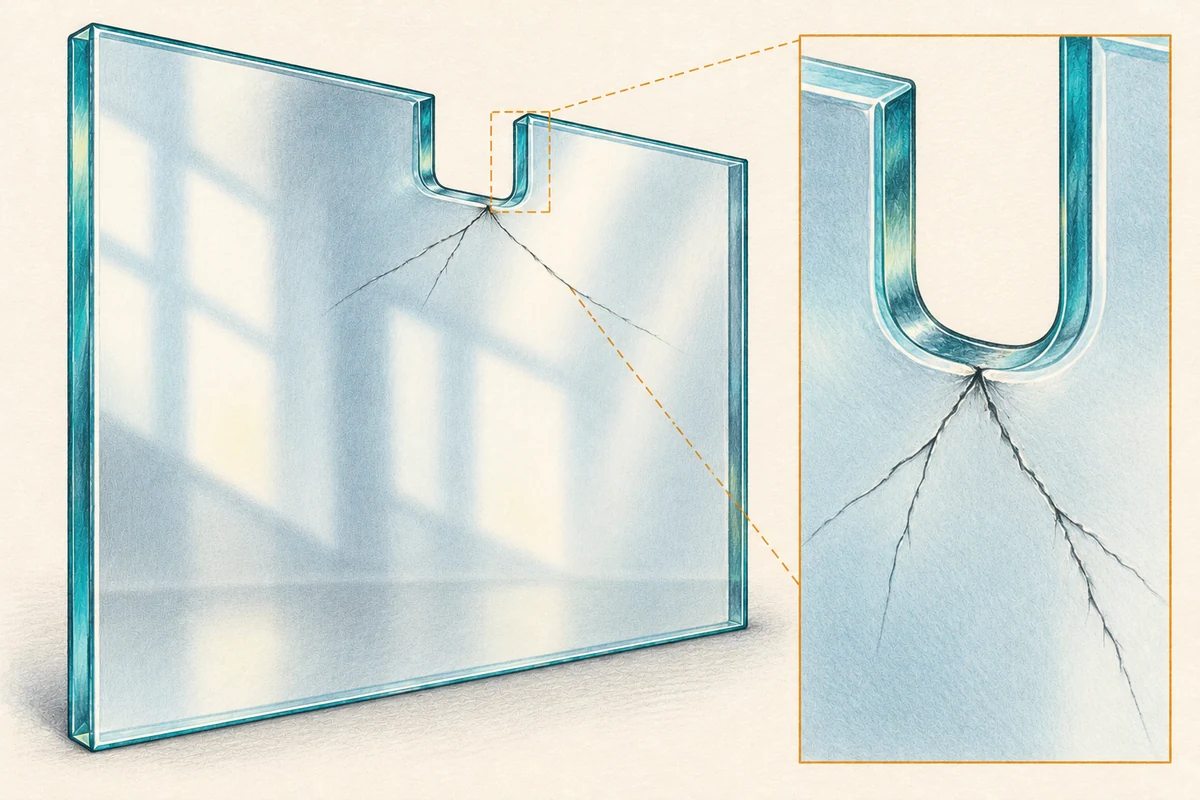
Notch Root Micro-Cracks
Mechanical — drilling/notching-related; integrity cue
Notch root micro-cracks are fine, crack-like fissures emanating from the root (inside radius) of a notch or cutout. They are integrity indicators: any confirmed cracking (even hairline) places the lite out of in-place restoration scope under VIS (CAT-5 by condition/location). Classification here is appearance-only; methodology is out of scope. Inspect under VIS lighting/geometry after Non-Invasive Reveal;
Illustration, reference page, and PDF complete
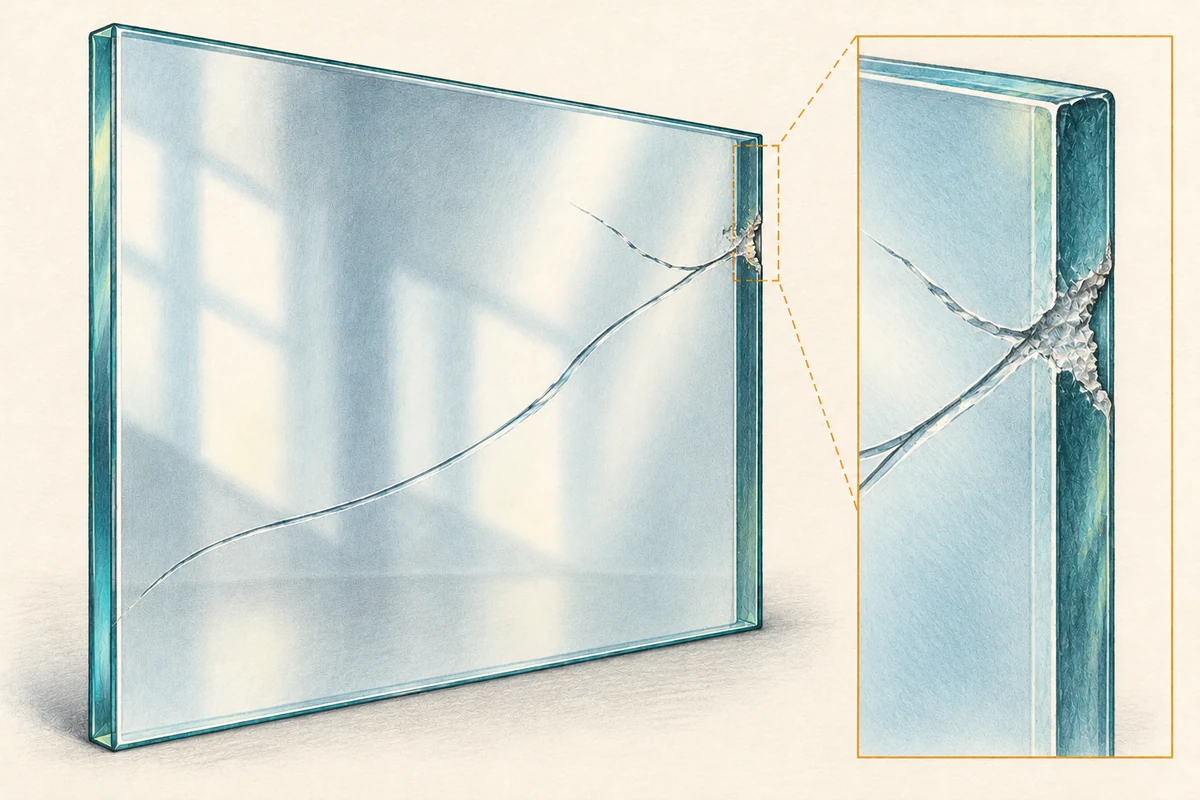
Edge-Origin Stress Crack (chip origin)
Mechanical — fracture initiating at edge/arris or at an edge chip
An edge-origin stress crack is a through-thickness (or developing) crack that initiates at the edge/arris—often from a pre-existing edge chip (“origin chip”)—and propagates inward under mechanical or handling stress. Any confirmed crack is an integrity indicator and lies out of in-place restoration scope under VIS (CAT-5 by condition/location). Classification is appearance-only; methodology is out of scope.
Illustration, reference page, and PDF complete
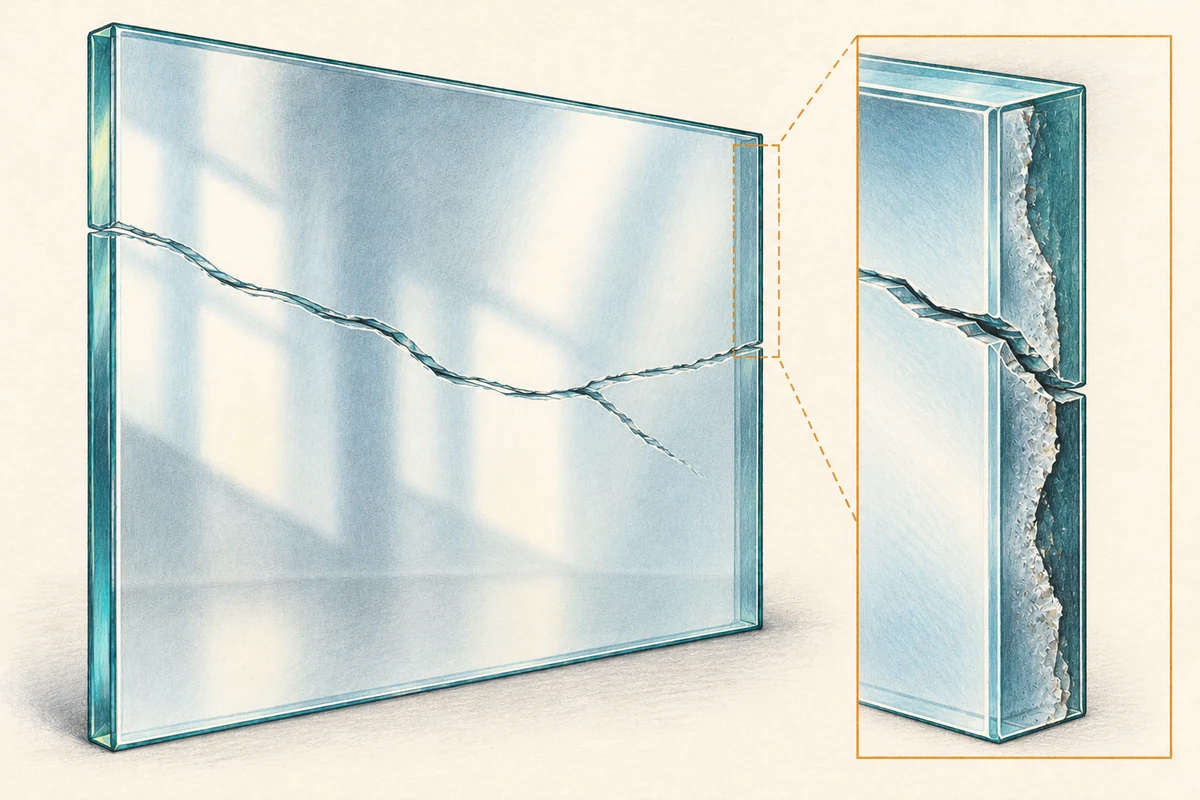
Through-Thickness Crack Propagation
Mechanical — fissure extending through the lite; integrity cue
A through-thickness crack is a continuous fissure that extends through the glass thickness (or is actively propagating toward full depth) and may branch, curve, or run under residual/operational stress. Any confirmed crack is an integrity indicator and is out of in-place restoration scope under VIS (CAT-5 by condition/location). Classification here is appearance-only; methodology is out of scope.
Illustration, reference page, and PDF complete
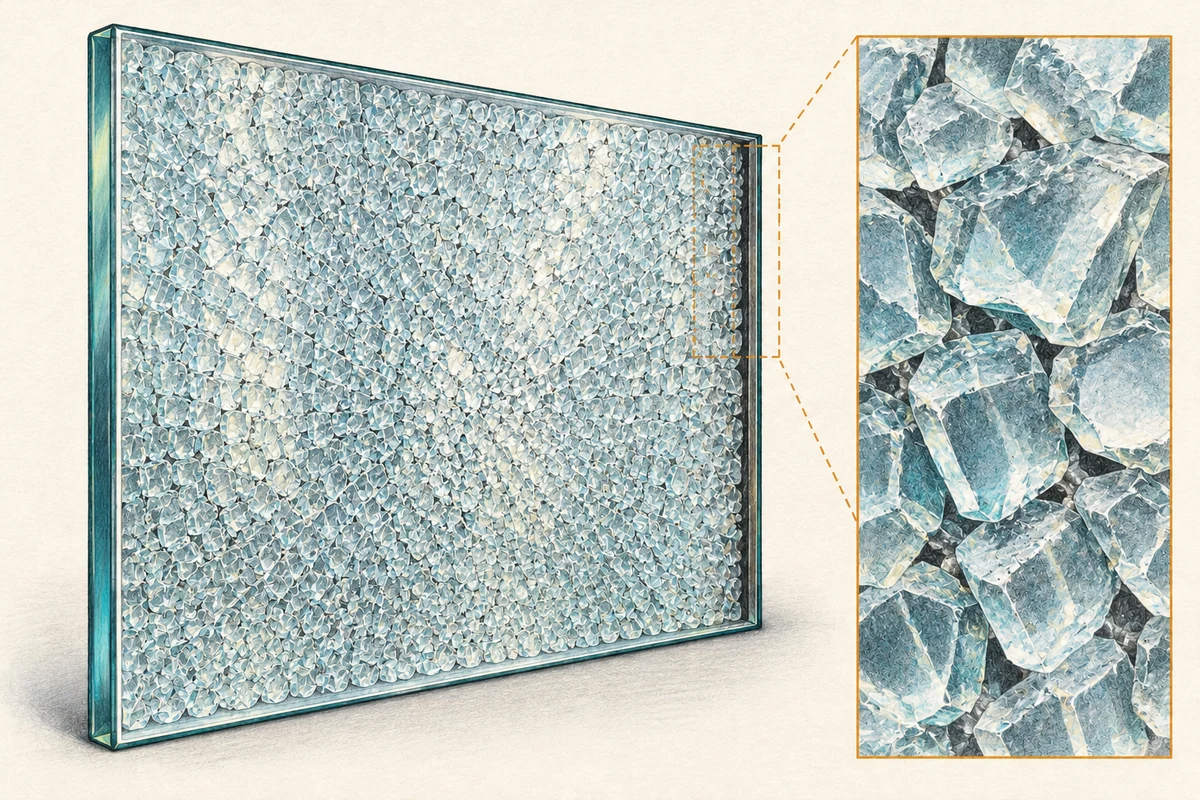
Fragmentation Pattern (tempered fracture documentation)
Mechanical / integrity — safety glass “dice” pattern; out-of-scope for in-place restoration
A fragmentation pattern documents the post-break state of a fully tempered (or heat-strengthened) lite that has fractured. Tempered fracture produces characteristic small, interlocking “dice”; heat-strengthened fracture produces larger, irregular islands with longer cracks. Any fractured lite is an integrity condition and is out of in-place restoration scope under VIS (CAT-5 by condition/location).
Illustration, reference page, and PDF complete
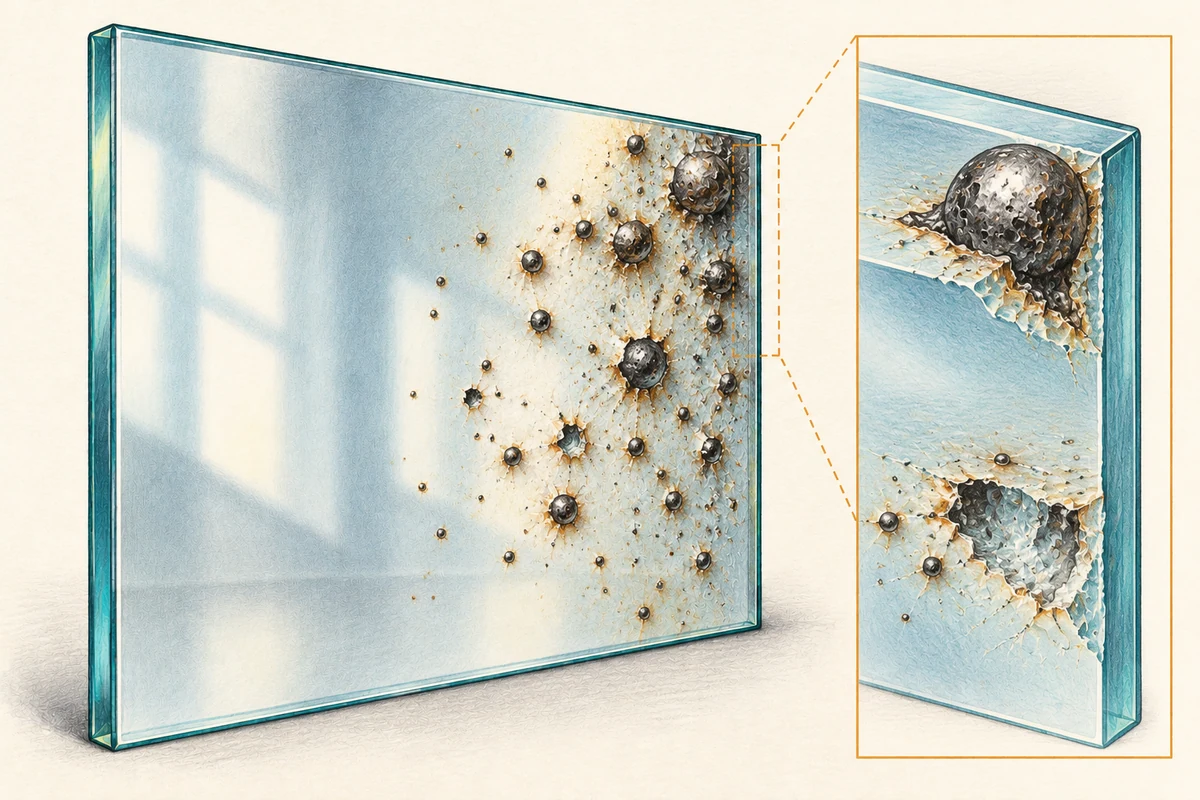
Welding Slag Spatter (fused nodules/pits)
Thermal / hot-particle impingement — fused metallic droplets and resultant pits
Welding slag spatter presents as fused metallic nodules and/or resultant pits/craters formed when hot particles (weld spatter) impact and partially fuse to the glass, often followed by detachment leaving a pitted field. Classification is appearance-only per VIS; methodology is out of scope. Inspect under VIS lighting/geometry after Non-Invasive Reveal;
Illustration, reference page, and PDF complete
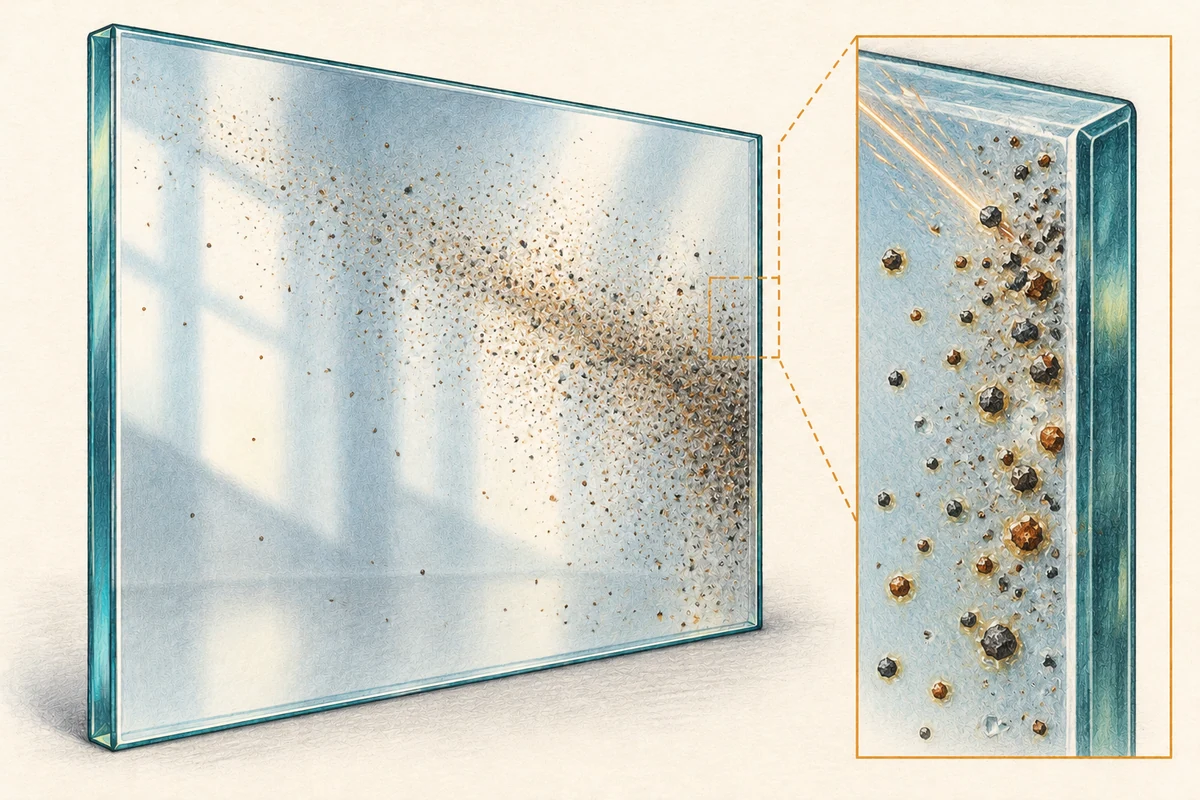
Grinder Spark Embed (ferrous peppering)
Thermal / hot-particle impingement — fine ferrous particles embedded and/or pitting
Grinder spark embed presents as a fine “peppered” field of ferrous particles ejected from metal grinding/cutting that impact, fuse, and/or oxidize on the glass. Some particles remain proud/fused; others detach leaving micro-pits. Classification is appearance-only per VIS; methodology is out of scope. Inspect under VIS lighting/geometry after Non-Invasive Reveal;
Illustration, reference page, and PDF complete
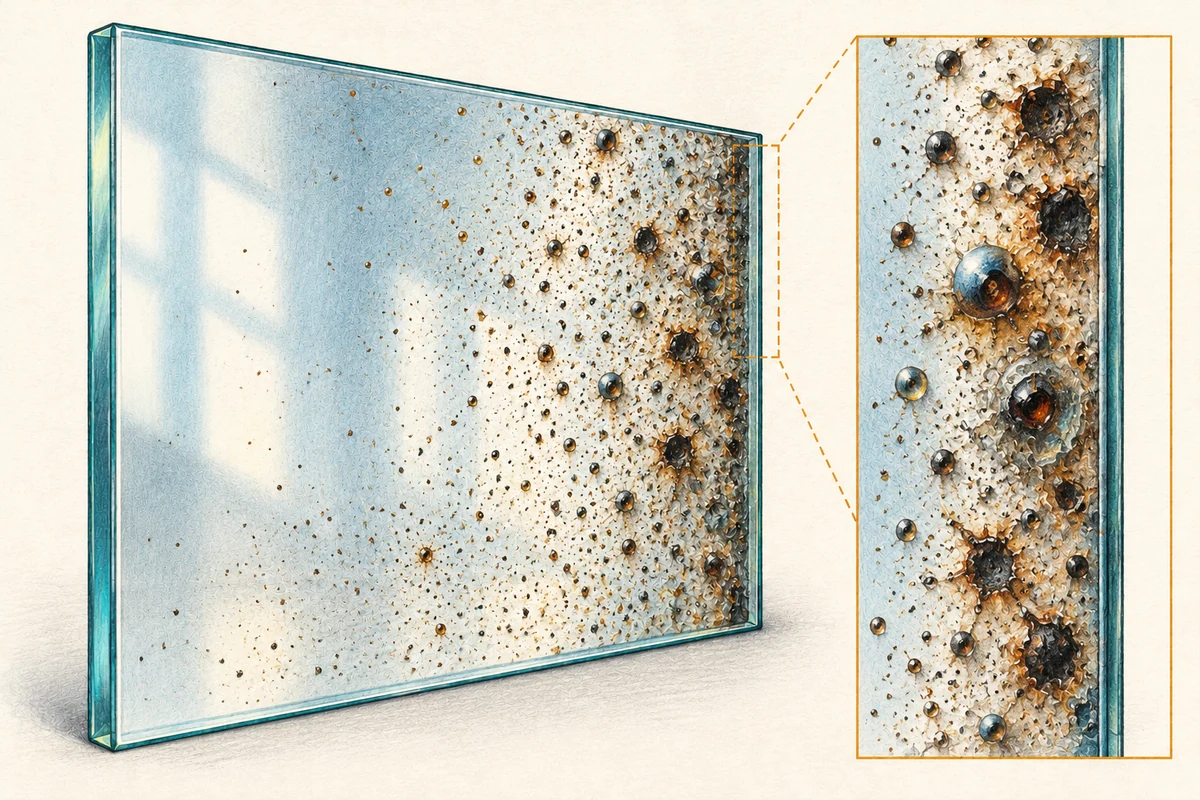
Oxy-Fuel / Plasma Specking
Thermal / hot-particle impingement — oxidized micro-spatter and crater specks
Oxy-fuel/plasma specking presents as fine to mixed-size hot-particle spatter from flame-cutting or plasma-cutting operations that impact and partially fuse to the glass, often oxidizing (dark/brown/blue tones) and/or detaching to leave micro-craters. Classification is appearance-only per VIS (method-agnostic). Inspect under VIS lighting/geometry after Non-Invasive Reveal;
Illustration, reference page, and PDF complete
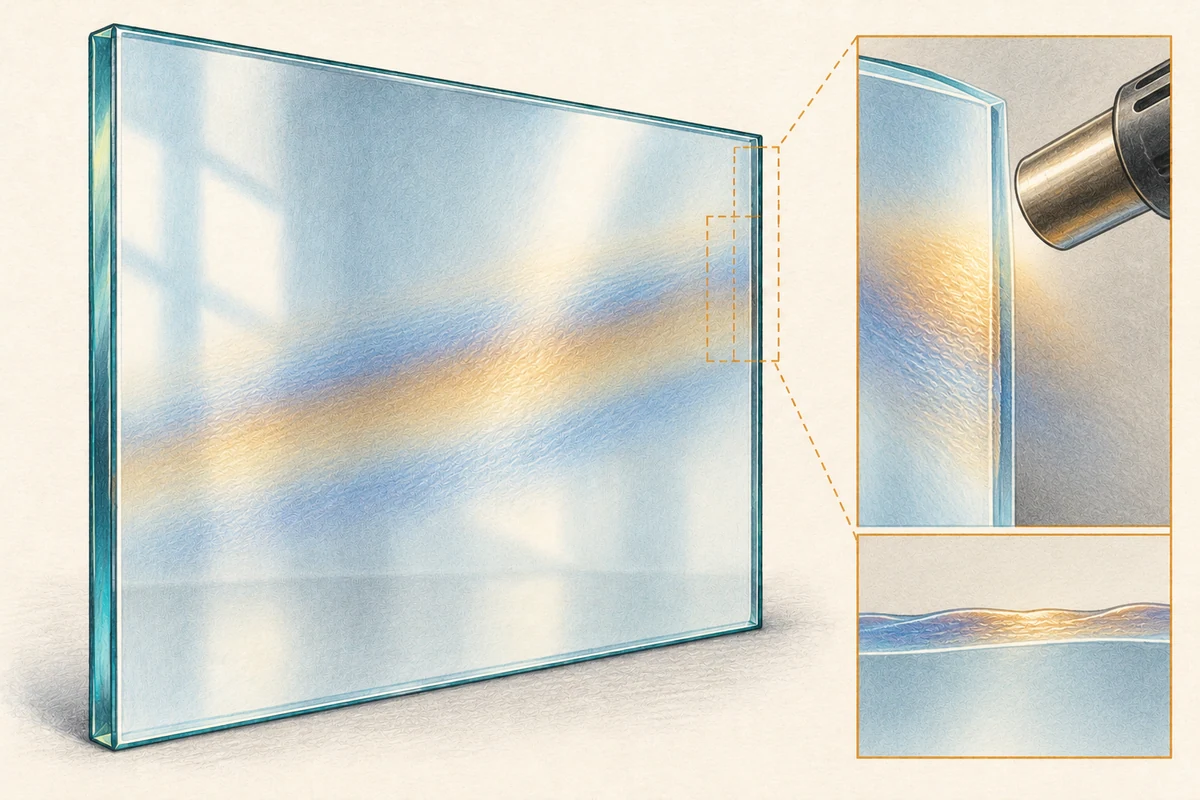
Torch Proximity Streaking (Heat Skid / Thermal Streaks)
Thermal — localized heat exposure; elongated tone/shine change ± shallow micro-texture
Torch proximity streaking is a localized, elongated appearance change on the exposed face caused by nearby torch/heat tool use (e.g., soldering, brazing, roofing/flashing work). It presents as a streak or band of tone/shine shift and may include modeled micro-texture when the surface has been thermally softened. Classification is appearance-only per VIS (method-agnostic).
Illustration, reference page, and PDF complete
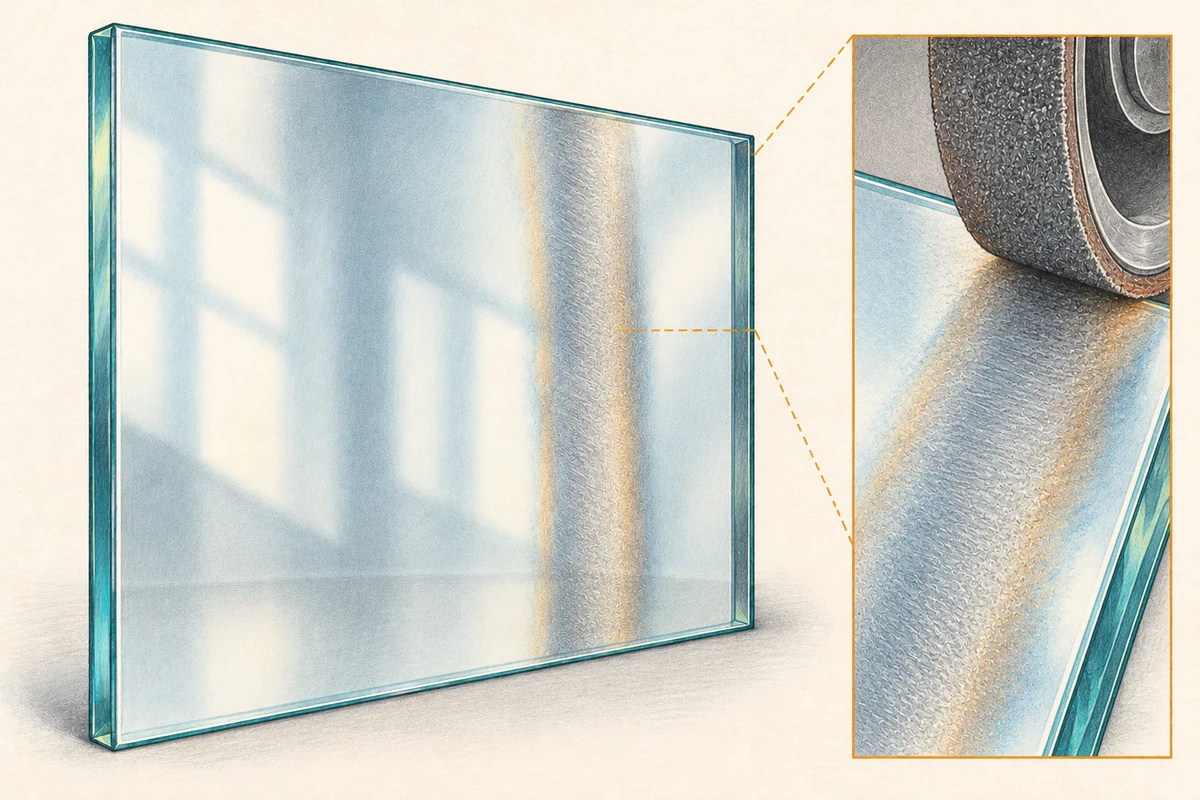
Overheated Grinder/Belt Burn Line
Thermal + mechanical — friction heat band with gloss shift and possible shallow micro-texture
An overheated grinder/belt burn line is a localized, elongated band produced when a powered abrasive (grinder, belt, pad, or wheel) is run against the glass (often inadvertently) long enough to generate frictional heat. The result is a tone/shine shift (and, at higher severities, modeled micro-texture/matte) along the tool path. Classification is appearance-only per VIS (method-agnostic).
Illustration, reference page, and PDF complete
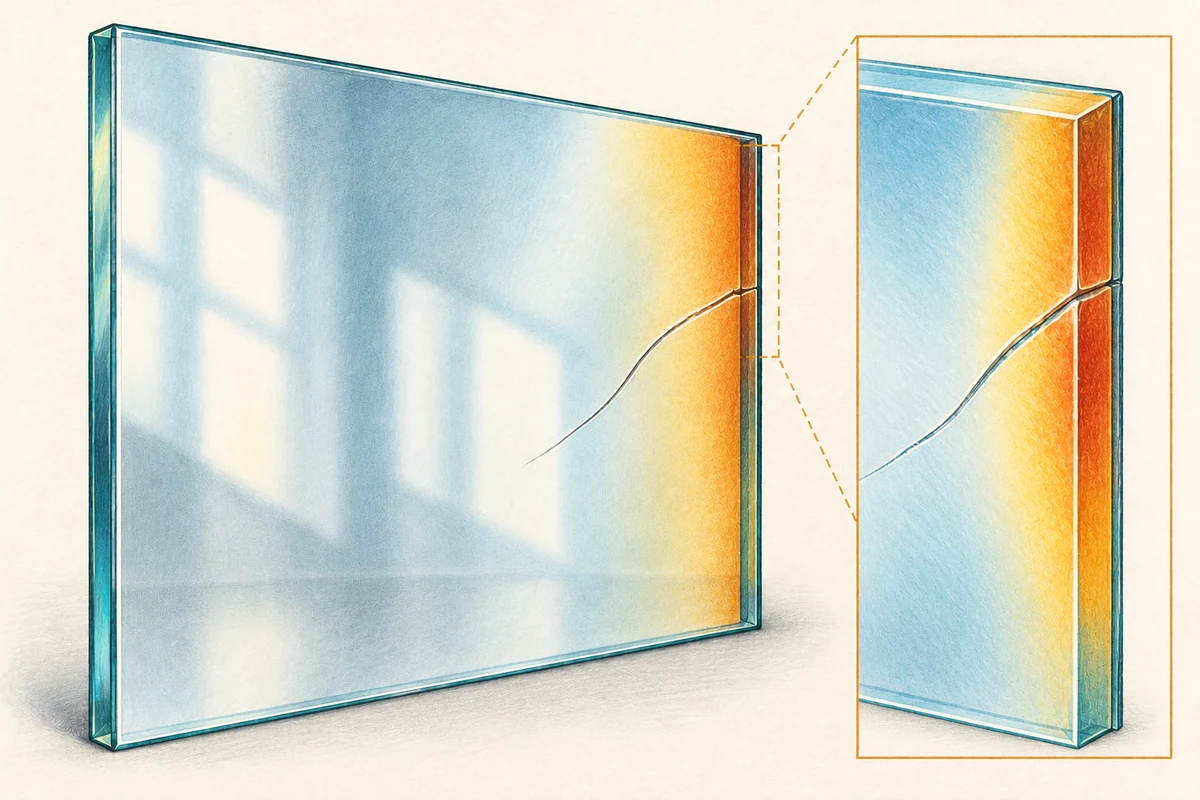
Differential Heating Stress Crack (edge origin)
Thermal stress/shock — integrity cue; out of in-place scope
A differential heating stress crack is a through-thickness (or actively propagating) fissure that initiates when nonuniform heating/cooling creates thermal stress exceeding glass strength, commonly at edges/corners or hardware penetrations. Any confirmed crack is an integrity condition and is out of in-place restoration scope (CAT-5 by condition/location). This DSS defines identification and documentation;
Illustration, reference page, and PDF complete
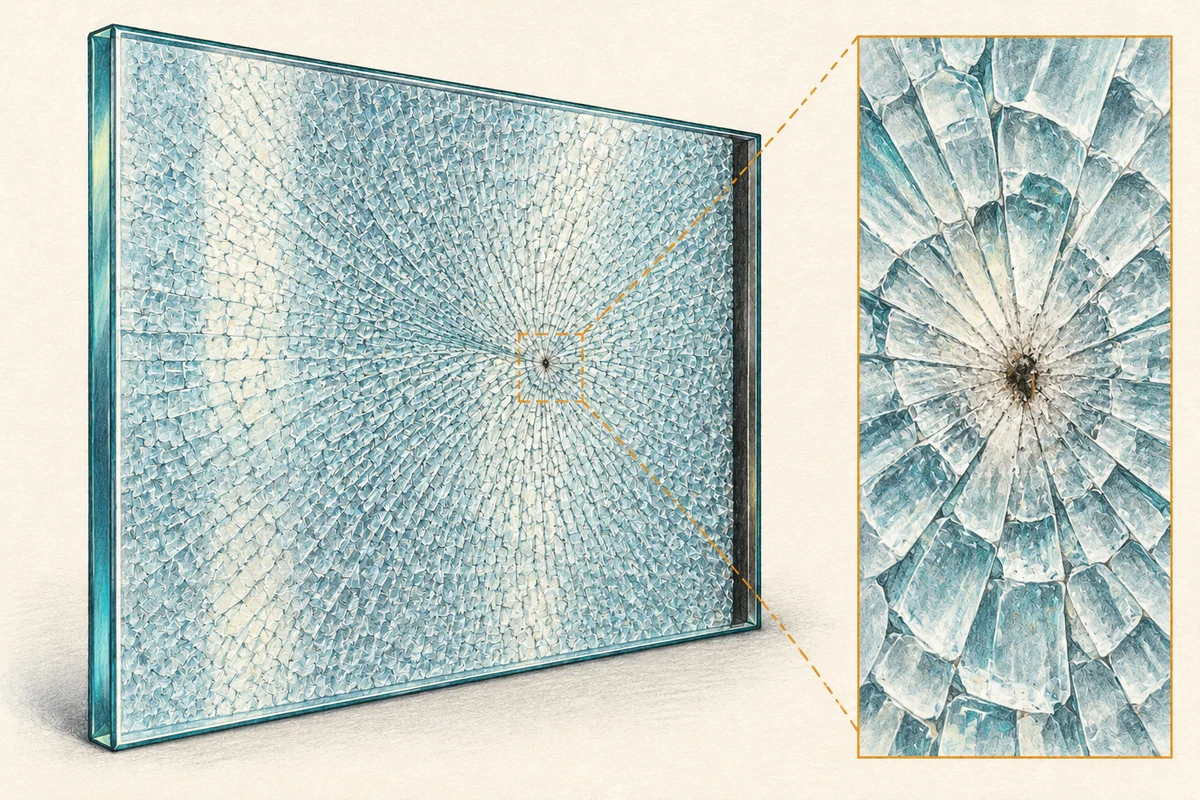
Spontaneous Tempered Break (NiS-related; documentation)
Thermal stress / material inclusion — post-fracture condition; out of in-place scope
A spontaneous tempered break is a sudden fracture of fully tempered glass with no evident external impact, commonly associated with nickel sulfide (NiS) inclusions or residual/internal stresses. Result is the characteristic fine “dice” fragmentation. Any fractured lite is an integrity condition and is out of in-place restoration scope (CAT-5 by condition/location).
Illustration, reference page, and PDF complete
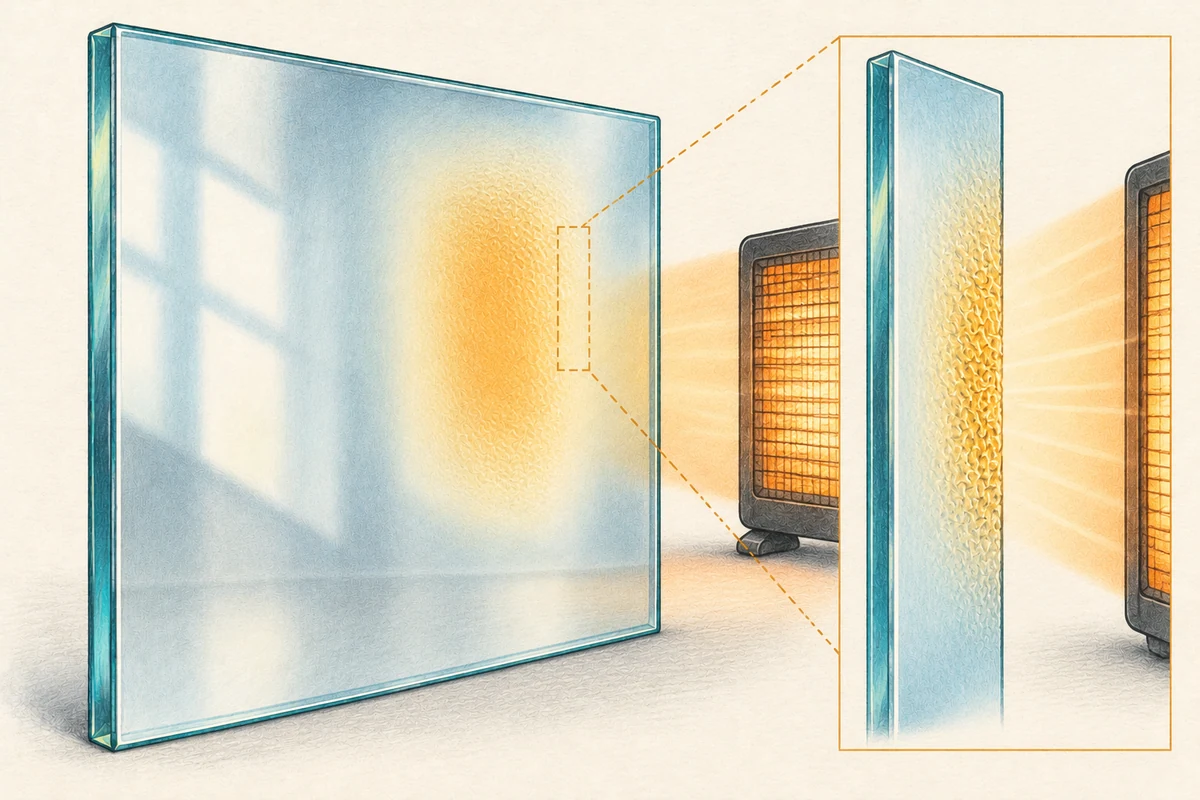
Local Heat Source Imprint (heaters / IR)
Thermal stress / localized radiant loading — appearance change ± integrity risk
A local heat source imprint is a localized appearance change or crack initiation caused by near-field radiant or convective heating focused on the glass (e.g., space heaters, heat lamps, IR emitters, sun-facing radiant panels). It may present as a tonal/shine shift band or patch, a hot-spot nucleus, or—at higher severities—thermal stress cracking emanating from the heated locus.
Illustration, reference page, and PDF complete
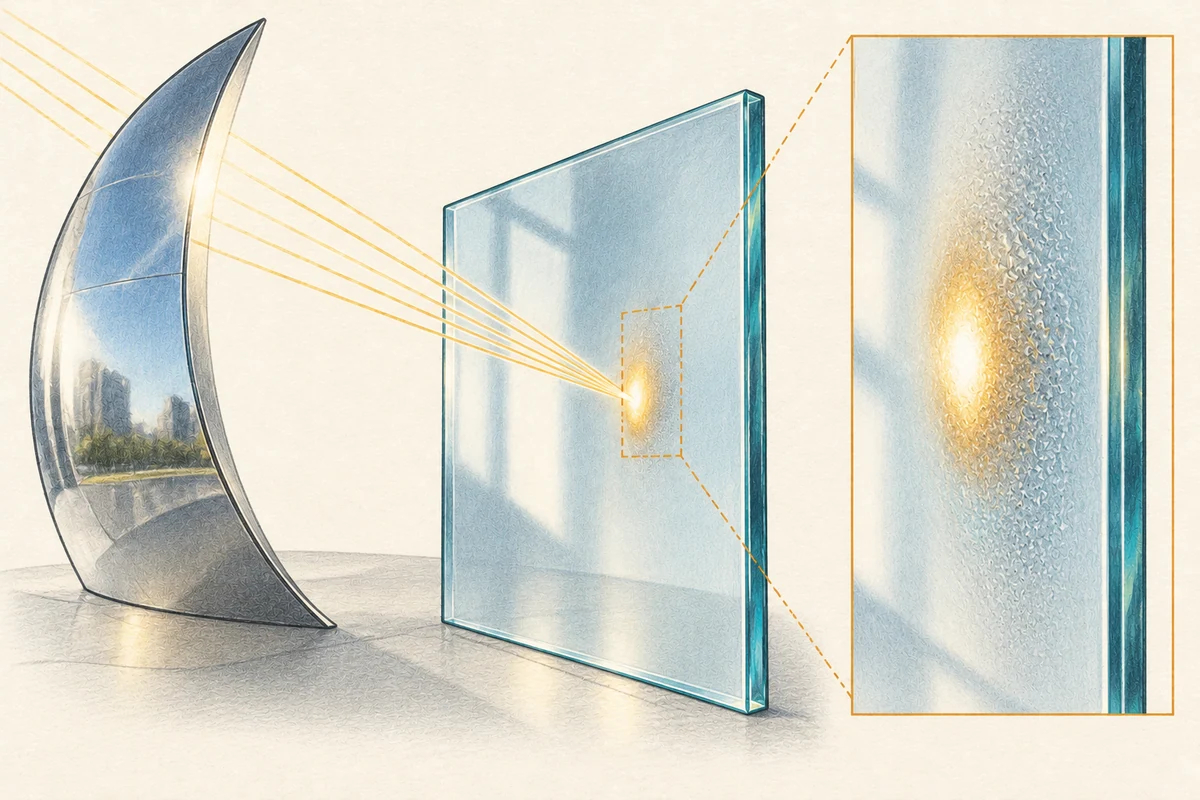
Localized Thermal “Hot Spot” Imprint (Solar Concentration / Reflective Interactions)
Thermal — envelope interaction; localized radiant focus from adjacent surfaces
A localized thermal “hot spot” imprint is a compact patch or band of appearance change (and, at higher severities, stress damage) produced when reflected or concentrated solar radiation from adjacent surfaces (e.g., concave façades, mirrored fins, metal panels, light shelves, vehicles) focuses on the glass. The result is a tone/shine shift ± modeled micro-texture within the focal footprint;
Illustration, reference page, and PDF complete
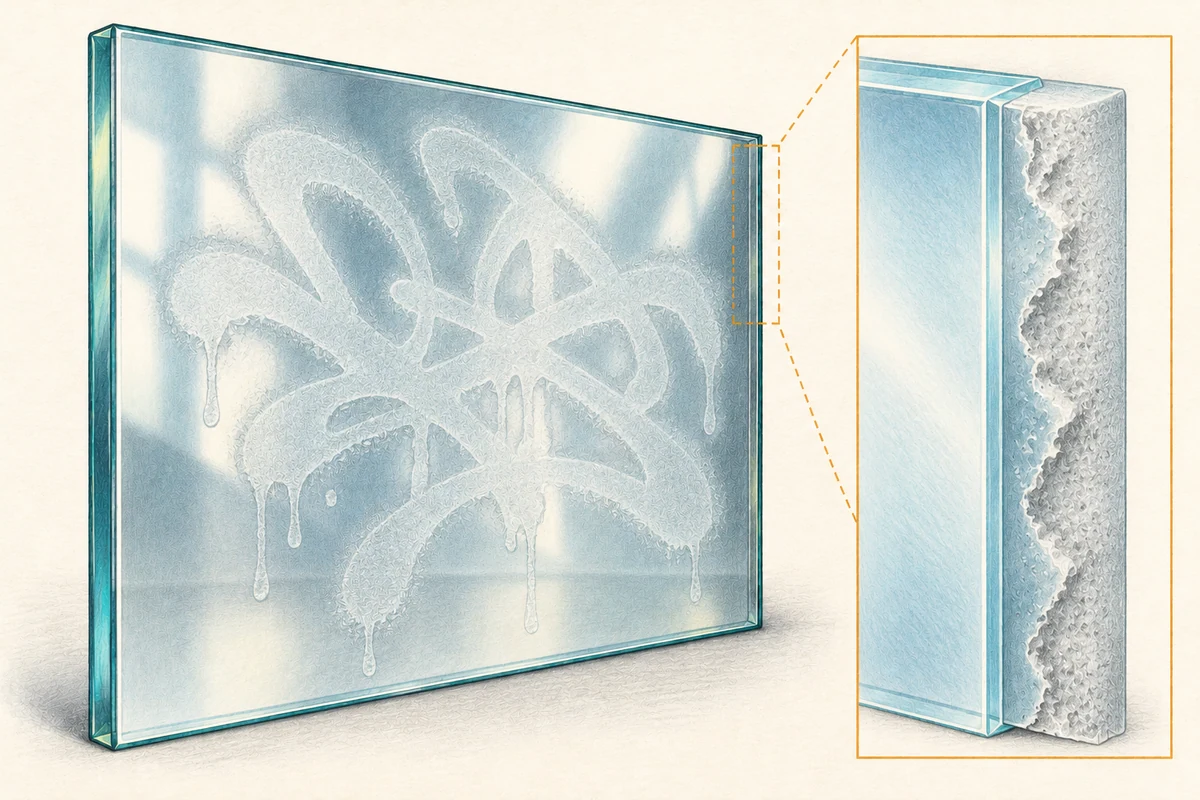
Acid-Etch Graffiti (HF / BOE)
Chemical — hydrofluoric/fluorosilicate attack; subsurface micro-texture “frost” with runs/lettering
Acid-etch graffiti is a chemically etched pattern (letters, tags, symbols, swirls) produced by hydrofluoric-bearing agents (e.g., HF gels, Buffered Oxide Etch/BOE). Reaction dissolves silica, leaving subsurface micro-texture (“frost”) and often drip legs or pooling halos. Classification is appearance-only per VIS (method-agnostic). Inspect after Non-Invasive Reveal under VIS lighting/geometry;
Illustration, reference page, and PDF complete
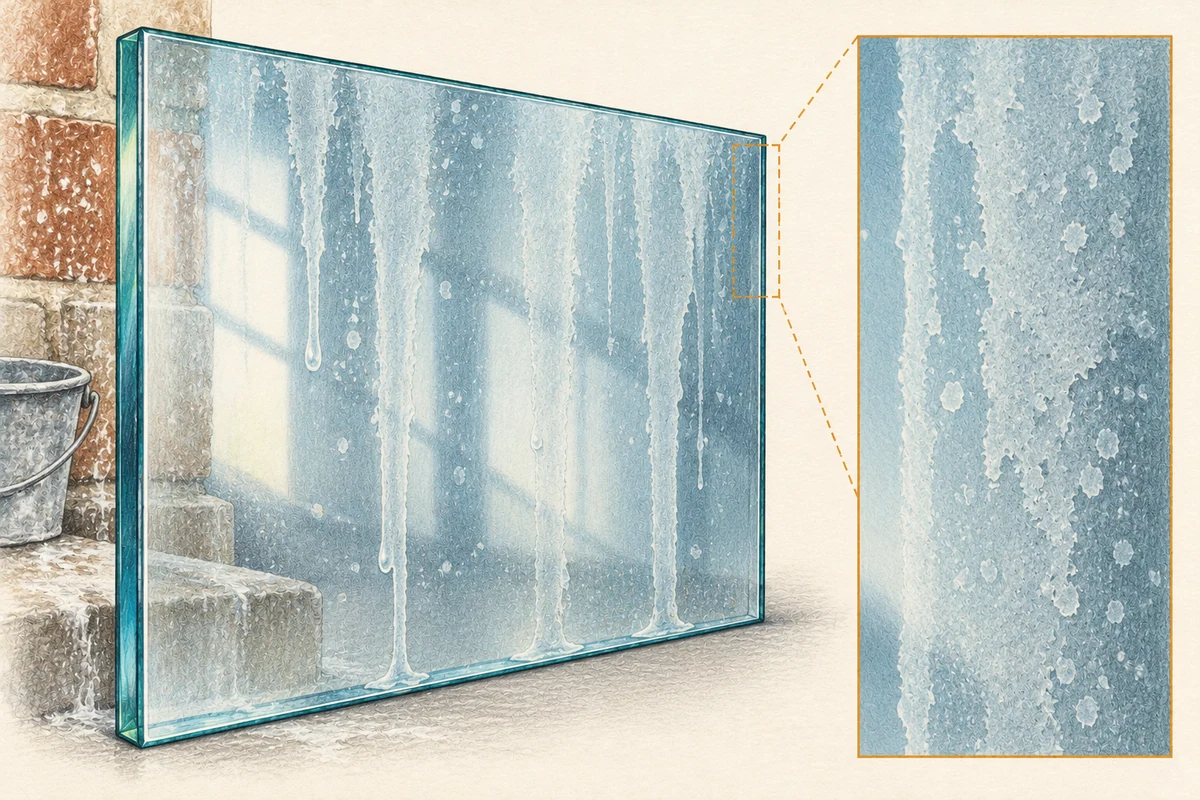
Muriatic / Brick-Wash Fallout (HCl)
Chemical — hydrochloric acid splash/mist/runoff; etched flow films and drip legs
Muriatic/brick-wash fallout is acid exposure from hydrochloric acid (HCl) solutions used for masonry cleaning or concrete etch. It typically presents as flow films, drip legs, and splash constellations that leave etched micro-texture and tone/shine shift on the exposed face. Classification is appearance-only per VIS (method-agnostic). Inspect after Non-Invasive Reveal under VIS lighting/geometry;
Illustration, reference page, and PDF complete
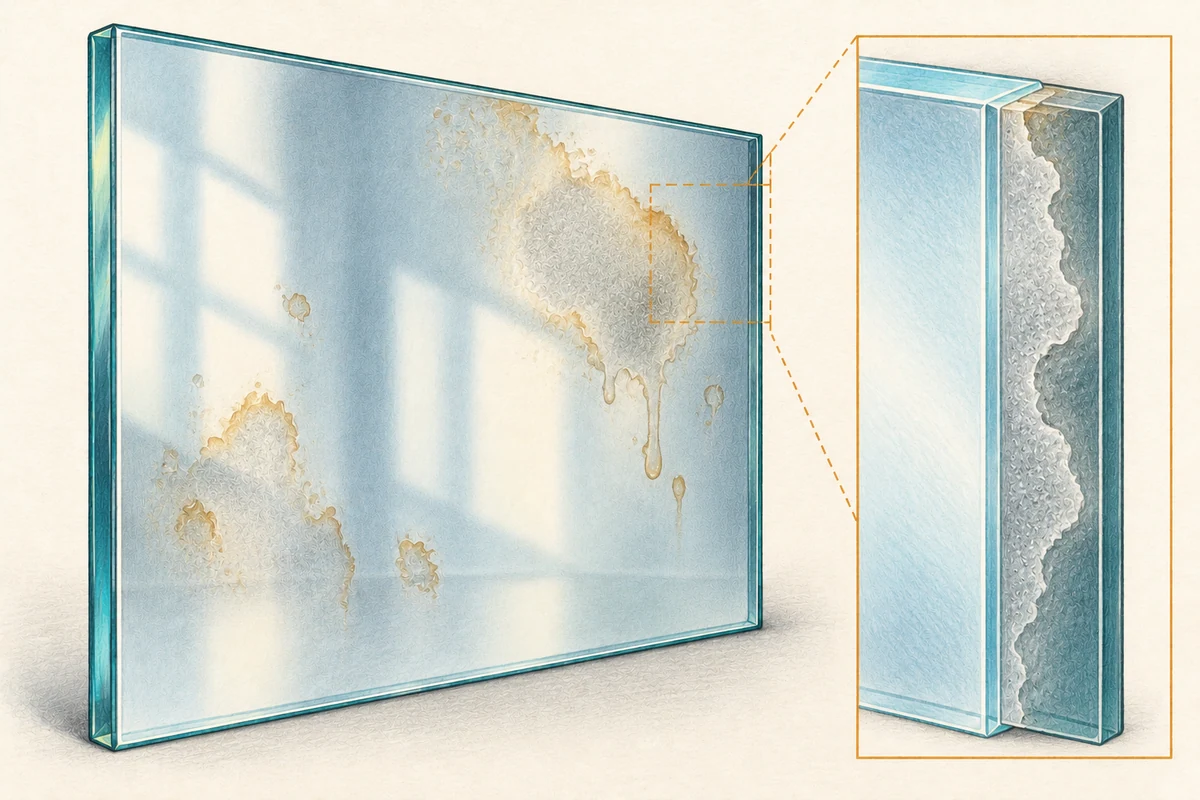
Organic-Acid Residues (avian/biogenic high acidity)
Chemical — localized biogenic acid attack; subsurface micro-texture “frost” with runs/pools
Organic-acid residues (e.g., avian droppings, certain plant/biogenic exudates) can produce localized chemical attack on glass, especially under heat + dwell (sun-exposed façades). Resulting appearance ranges from tone/shine shift to subsurface micro-texture (“frost”) with run/pool edges. Classification is appearance-only per VIS (method-agnostic). Inspect after Non-Invasive Reveal under VIS lighting/geometry;
Illustration, reference page, and PDF complete
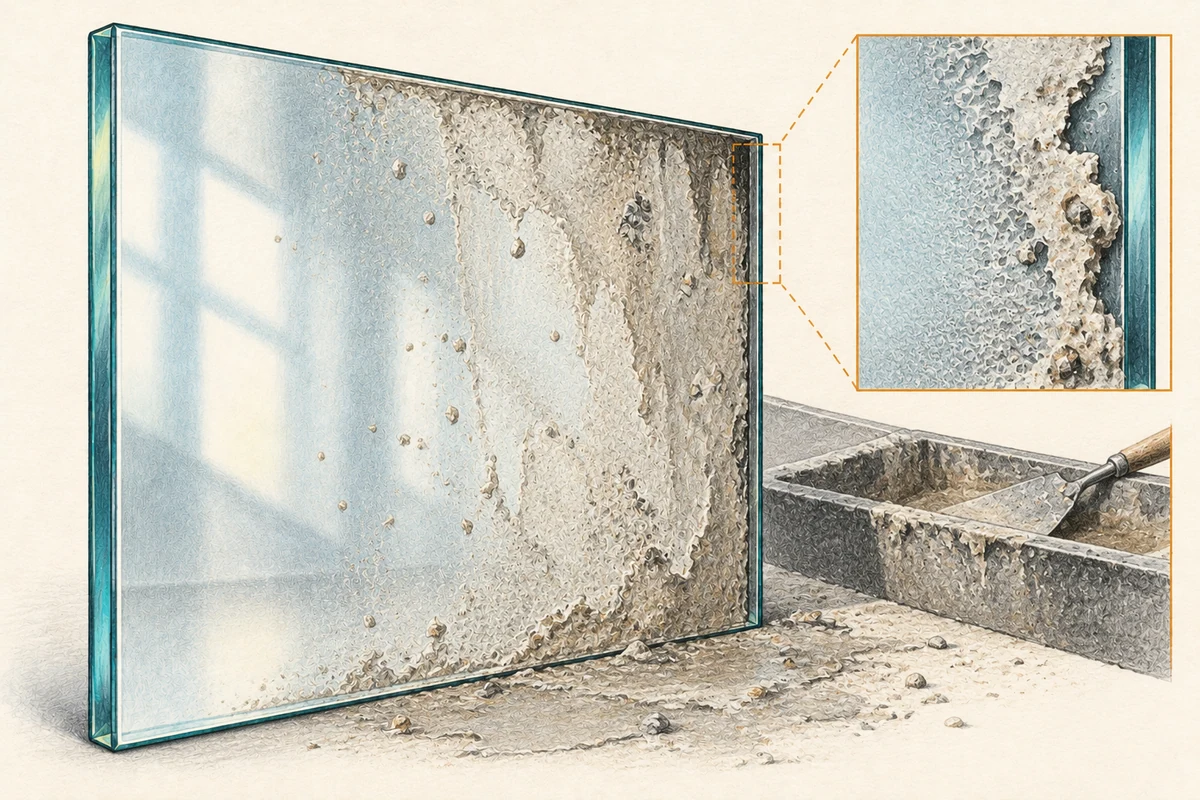
Cement / Mortar Slurry Etch (high pH)
Chemical — alkaline attack; flow sheets, splash constellations, chalky crusts
Cement/mortar slurry etch is alkaline (high-pH) attack on the exposed glass surface from wet cement, mortar, grout, or concrete slurry. It presents as flow-organized films, splash/fleck constellations, and, after drying, may leave alkali/silicate reaction haze or chalky crusts; prolonged dwell can produce subsurface micro-texture (etch). Classification is appearance-only per VIS (method-agnostic).
Illustration, reference page, and PDF complete
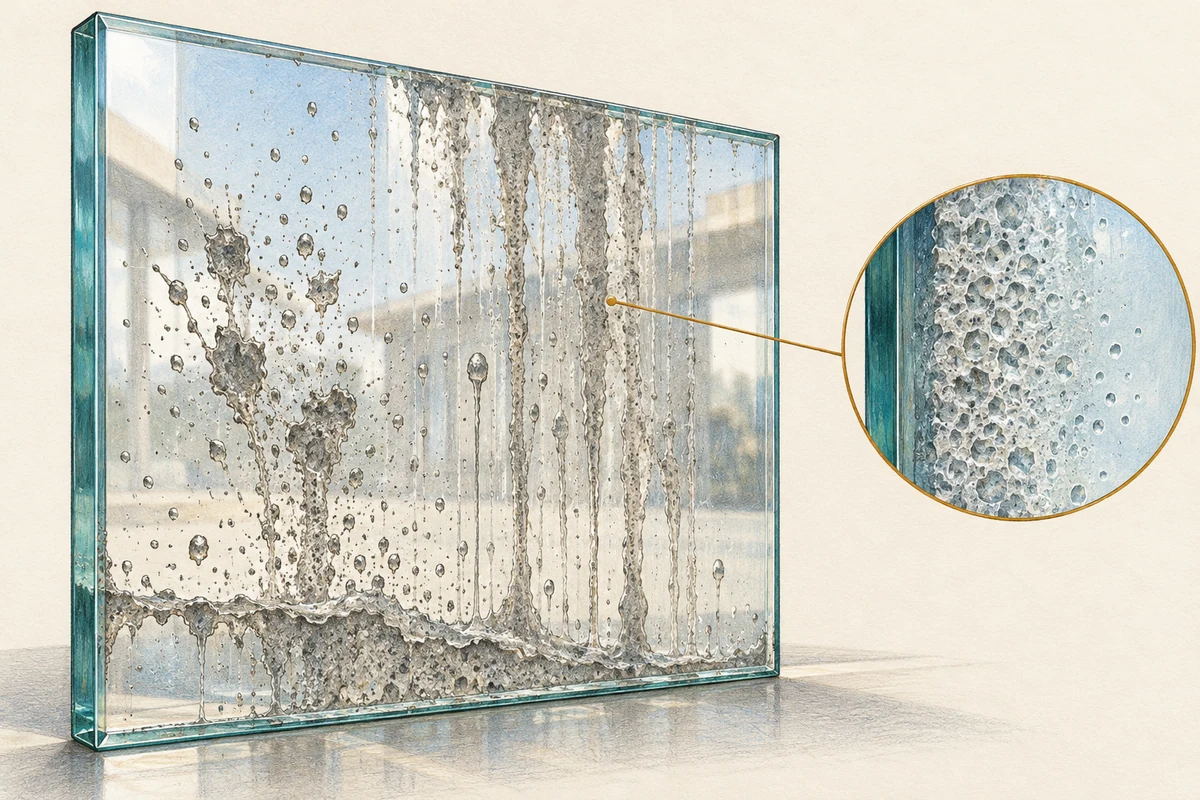
Concrete Splash / Run-Off Etch Pattern
Chemical — alkaline attack; splash constellations, curtain-run bands, pooling shelves
Concrete splash/run-off etch is alkaline (high-pH) attack on the exposed glass surface resulting from fresh concrete wash-out, saw-cut slurry, or rain-driven run-off carrying cement fines. It presents as splash constellations, vertical curtain-run bands, and pooling shelves that can leave grainy micro-texture (etch) after residues are removed. Classification is appearance-only per VIS (method-agnostic).
Illustration, reference page, and PDF complete
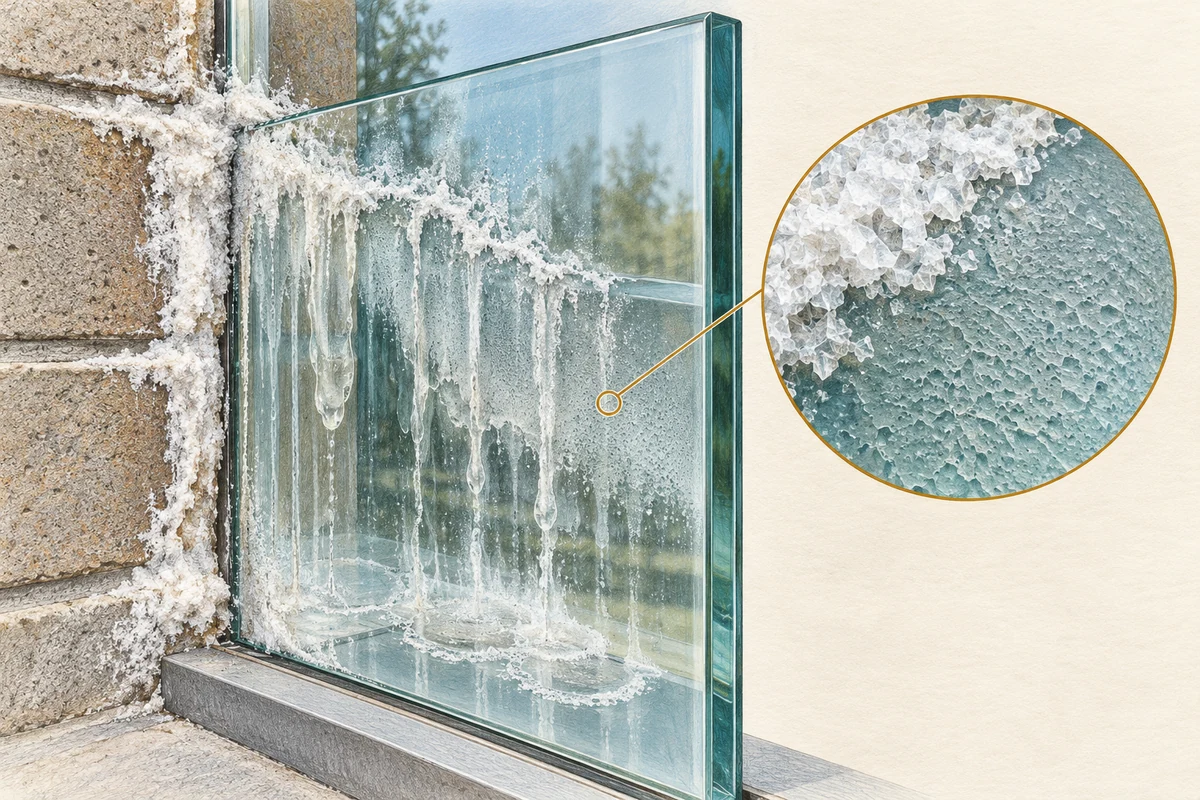
Efflorescence-Associated Surface Attack
Chemical — alkaline salts/waterborne alkali; run-bloom halos, crust islands, grainy micro-texture
Efflorescence-associated surface attack is alkaline exposure of glass from waterborne salts and pore solutions migrating out of concrete/masonry. As moisture evaporates, alkali-rich films and salt blooms at the glass interface can etch the exposed face, leaving grainy micro-texture and run/pool halos after residues are removed. Classification is appearance-only per VIS (method-agnostic).
Illustration, reference page, and PDF complete

Mineral Deposits (removable)
Chemical/mineral — bonded surface deposits; no subsurface attack when fully removed
Mineral deposits (removable) are bonded surface residues from hard water, irrigation overspray, construction rinse, or marine aerosol that sit on the glass and do not produce subsurface attack when promptly addressed. After a proper Non-Invasive Reveal (neutral pH/distilled water + lint-free microfiber) deposits may partially or fully clear;
Illustration, reference page, and PDF complete
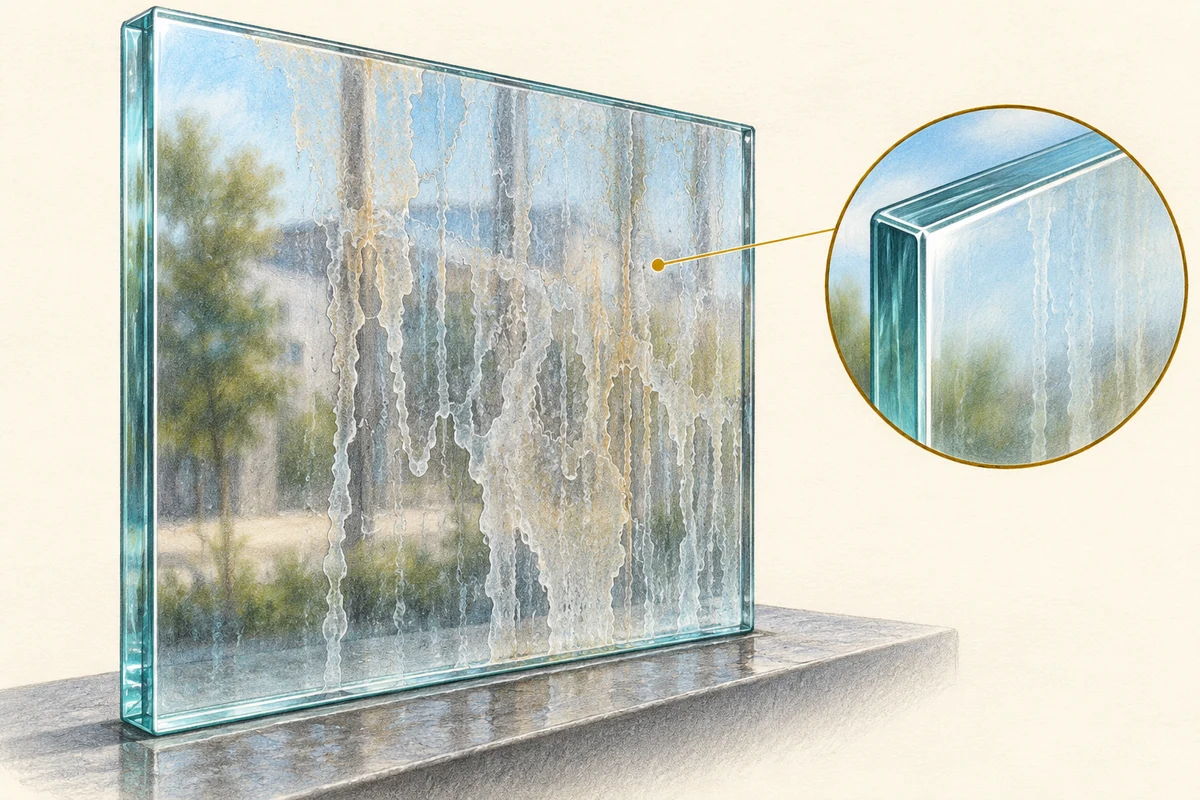
Mineral Staining (persistent film/discoloration, non-etch)
Chemical/mineral — tenacious surface film or color shift that persists after reveal; substrate remains SC-0
Mineral staining (non-etch) is a tenacious surface film or color shift caused by hard-water minerals/salts (often with organic/soiling binders) that persists after a proper Non-Invasive Reveal yet does not produce subsurface attack. Under magnification/raking, the glass substrate shows no modeled micro-texture when the stain is fully lifted—MSRT on clean substrate = SC-0.
Illustration, reference page, and PDF complete
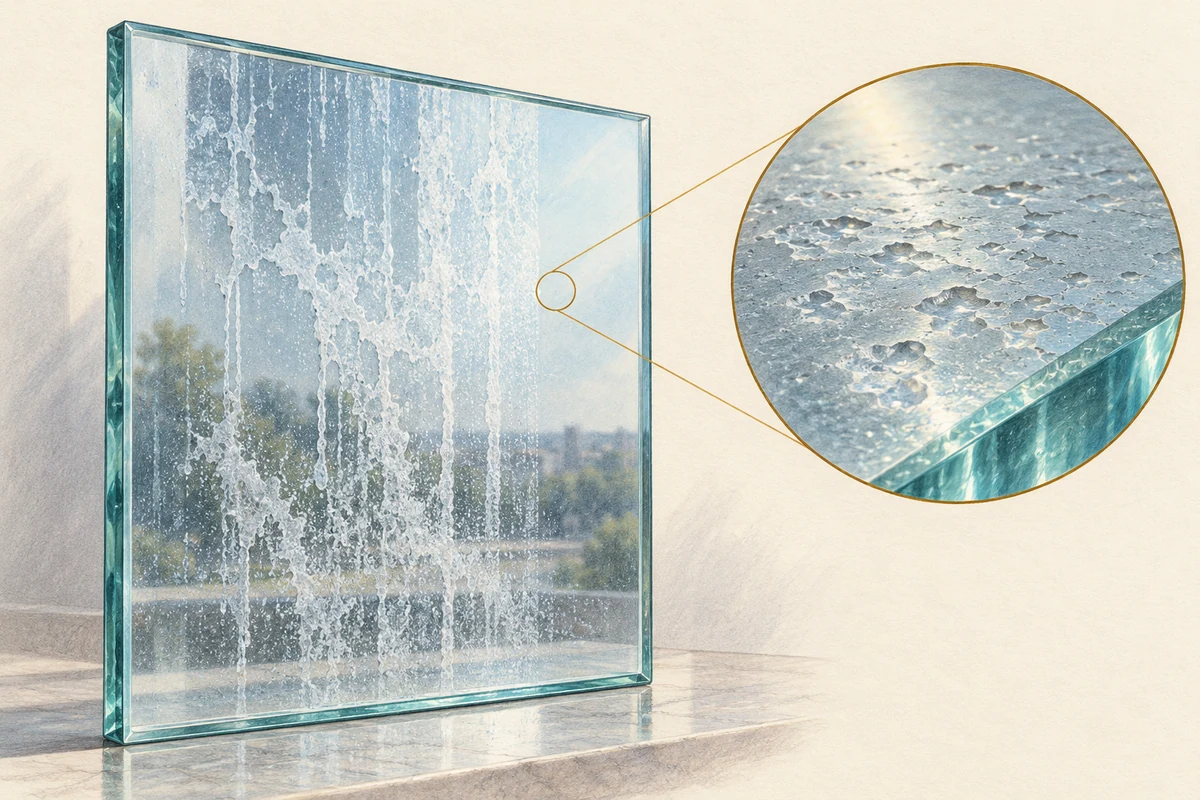
Mineral Etching (subsurface micro-texture)
Chemical/mineral — dissolution of silica by mineral/alkaline films; modeled micro-texture “frost” within prior deposit/run footprints
Mineral etching is subsurface attack of the glass network produced by persistent mineral films (e.g., hard-water salts with alkaline bias) and wet/dry cycling that chemically dissolves silica at the surface. After a proper Non-Invasive Reveal, etched areas remain as modeled micro-texture (“frost”) that modifies tone/shine and specular clarity. Classification is appearance-only per VIS (method-agnostic).
Illustration, reference page, and PDF complete
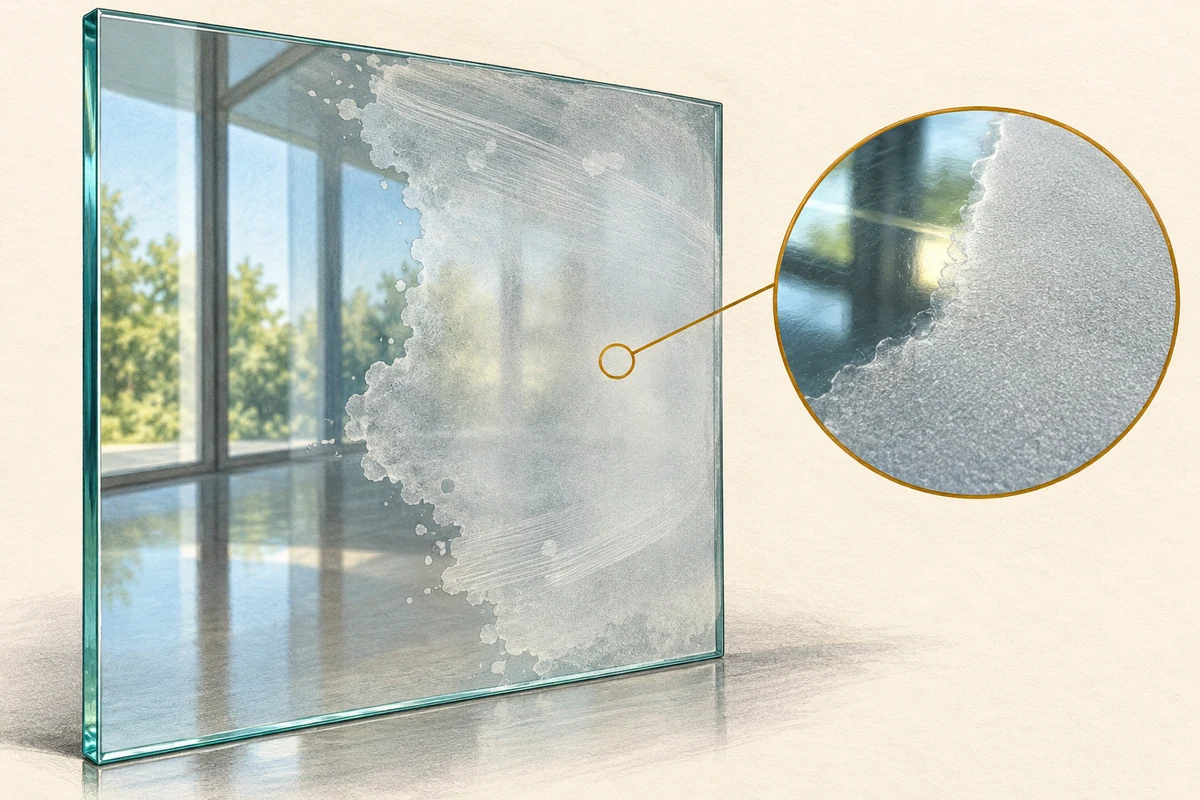
Paint Remover / Solvent Bloom (matting / sheen loss)
Chemical — solvent exposure; optical matting or non-directional micro-texture within spill/wipe footprints
Paint remover/solvent bloom is an appearance change caused by solvent-based strippers, thinners, or hot solvents contacting glass. Depending on chemistry, dwell, and heat, it presents as optical matting (sheen loss) and—in stronger cases—subtle non-directional micro-texture within a spill/wipe footprint. Classification is appearance-only per VIS (method-agnostic).
Illustration, reference page, and PDF complete
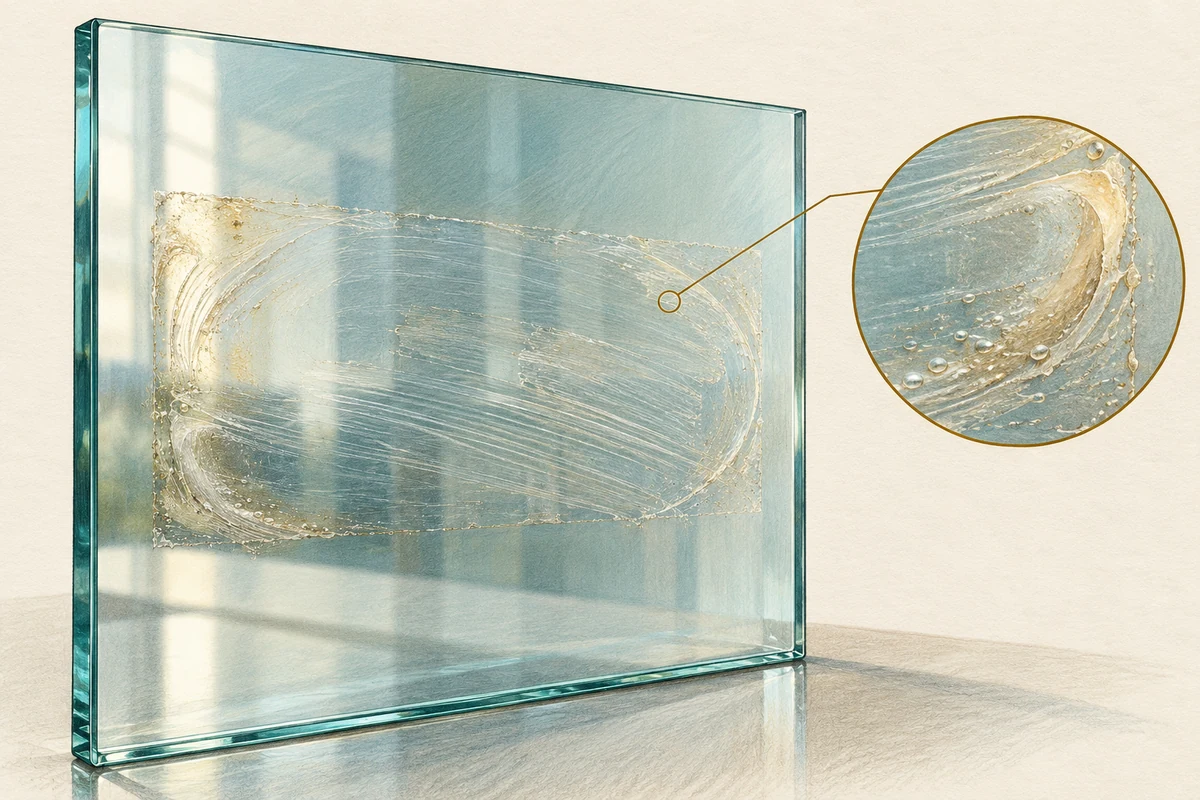
Adhesive Remover Staining Pattern
Chemical — solvent/citrus/amine blends lifting PSA binders; directional wipe veils, halos, overlap lines
Adhesive remover staining is an appearance change produced when label/film/PSA residue is treated with adhesive removers (e.g., citrus terpenes, glycol ethers, amines, mixed solvents). Incomplete lift and smear leave directional wipe veils, halos, and overlap lines; substrate may remain non-etched (often), but prolonged dwell/hot application can yield very shallow micro-texture.
Illustration, reference page, and PDF complete
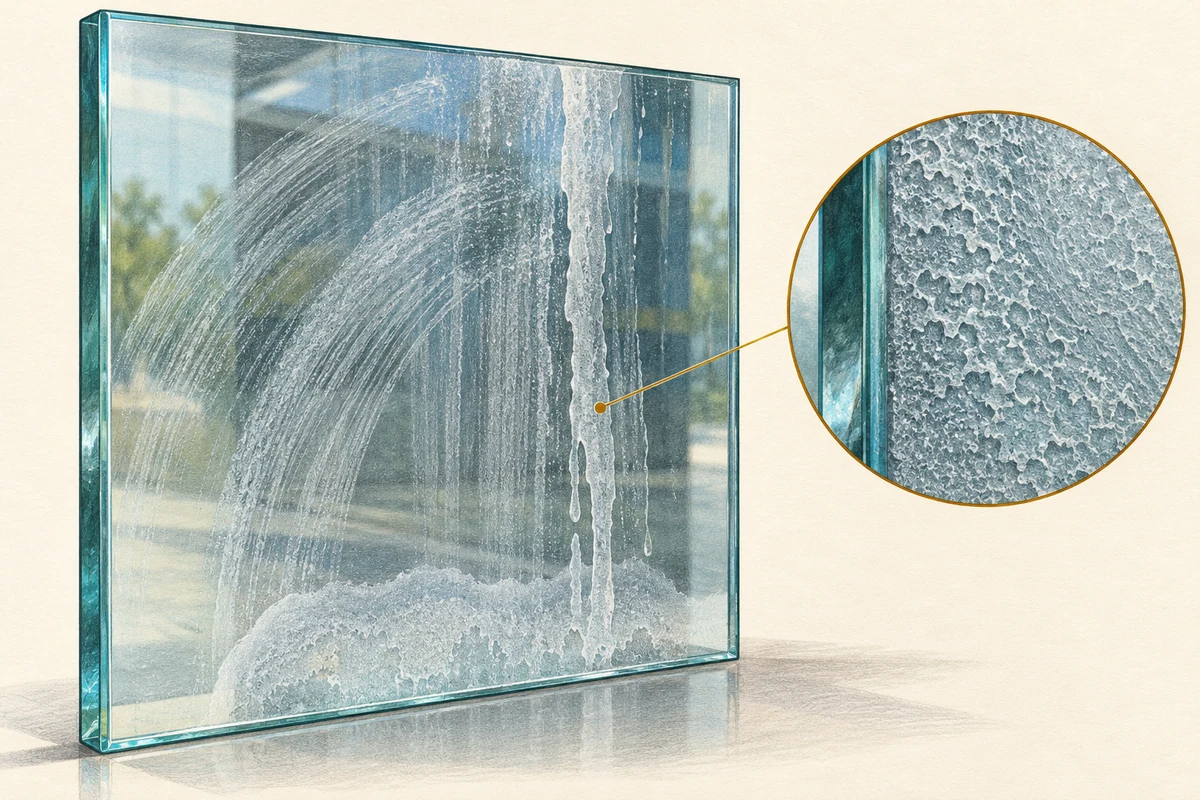
Degreaser / Alkaline Cleaner “Burn”
Chemical — high-pH cleaner exposure; grainy/milky micro-texture in wipe/run geometries
Degreaser/alkaline cleaner “burn” is an appearance change or etch caused by high-pH cleaners (e.g., strong degreasers, builders, ammonia/amine blends) contacting glass and dwell/drying on the surface. It presents as milky/grainy micro-texture in wipe vectors, sheeted runs, or pool halos. Classification is appearance-only per VIS (method-agnostic). Inspect after Non-Invasive Reveal under VIS lighting/geometry;
Illustration, reference page, and PDF complete
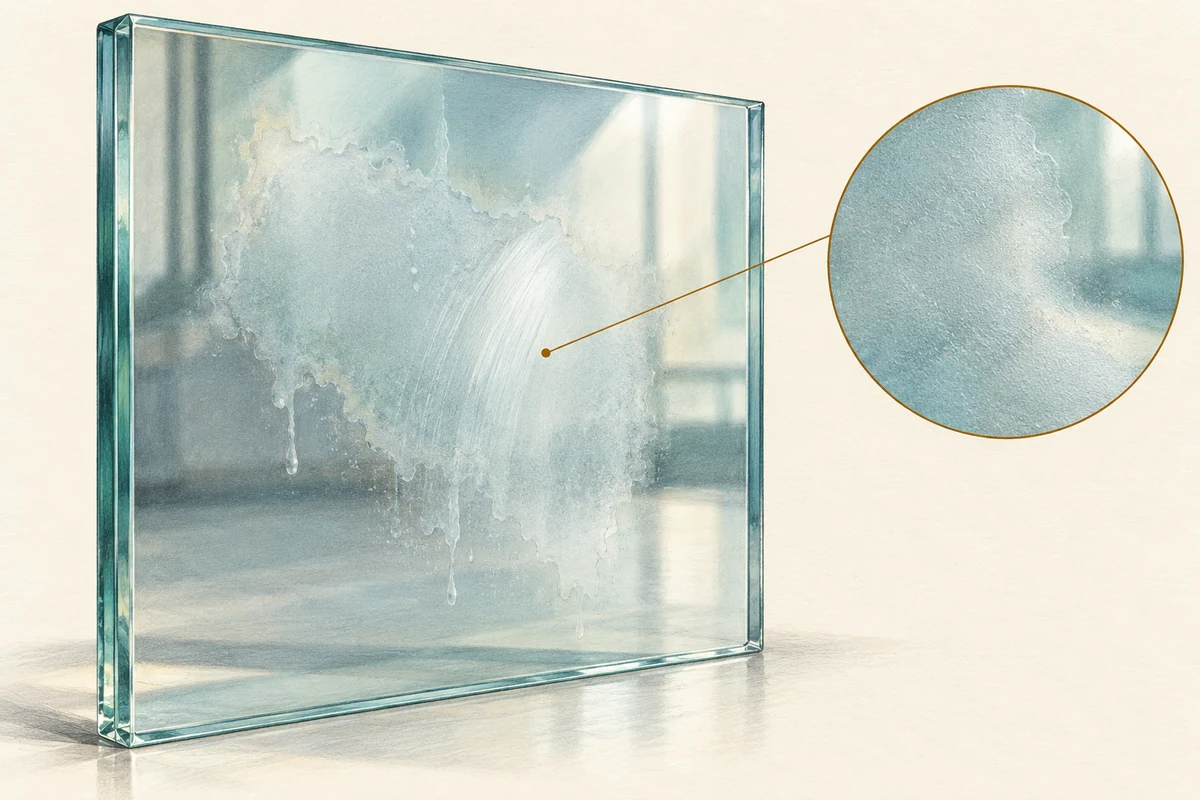
Bleach / Peroxide Shadowing
Chemical — oxidizer exposure; optical tone shift ± very shallow micro-texture within spill/wipe footprints
Bleach/peroxide shadowing is an appearance change caused by oxidizing agents (e.g., sodium hypochlorite bleach, hydrogen peroxide cleaners) contacting glass and drying/dwelling on the surface, sometimes in sunlight/heat. It presents as optical tone/contrast shift and, in stronger cases, very shallow, non-directional micro-texture within a spill/wipe footprint.
Illustration, reference page, and PDF complete
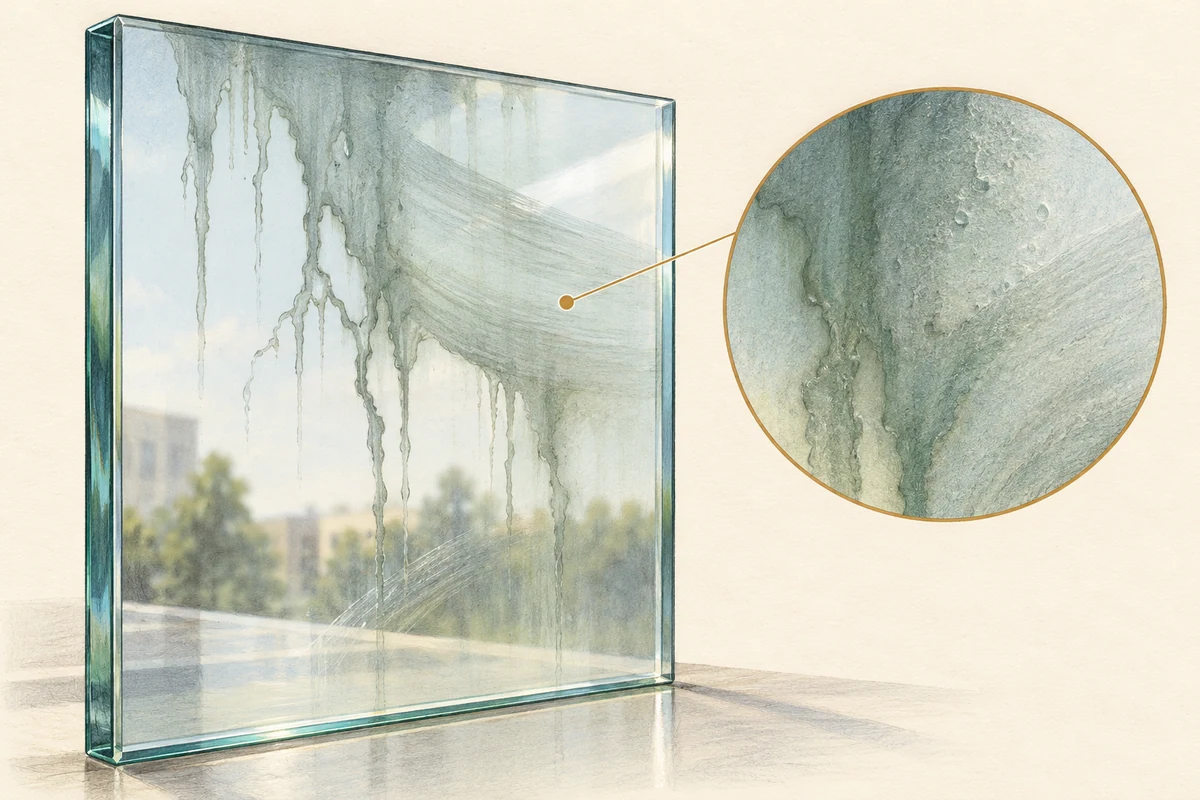
Reducing Agent Discoloration
Chemical — reducers/neutralizers; optical tone shift ± very shallow micro-texture within wipe/run footprints
Reducing agent discoloration is an appearance change caused by reducing chemicals (e.g., bisulfites/metabisulfites, thiols, ammonia-based reducers/neutralizers, specialty graffiti/bleach neutralizers) contacting glass and dwelling/drying on the surface. Outcomes range from optical tone/contrast shift to very shallow, non-directional micro-texture within wipe or run geometries.
Illustration, reference page, and PDF complete
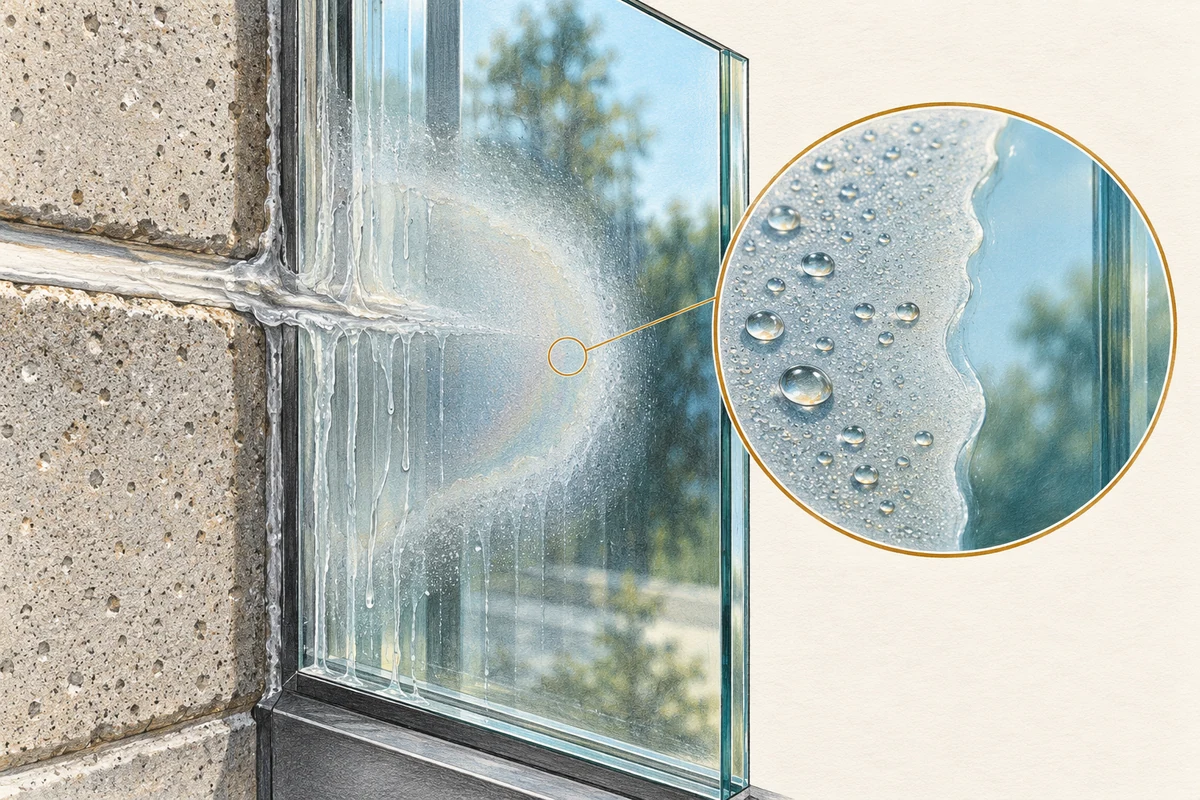
Silane / Siloxane Migration Halo
Chemical/interaction — penetrating water-repellent from adjacent porous substrates; optical halos/veils, transfer films ± shallow micro-texture
Silane/siloxane migration halo is an appearance change on glass resulting from penetrating water-repellent treatments (silane/siloxane) applied to adjacent porous materials (masonry/concrete/stone). During application, overspray, vapor phase, or capillary contact/weep can deposit organosilicon films on the glass, producing optical halos/veils and, with UV/heat/soiling, tenacious films that may leave very shallow micr…
Illustration, reference page, and PDF complete
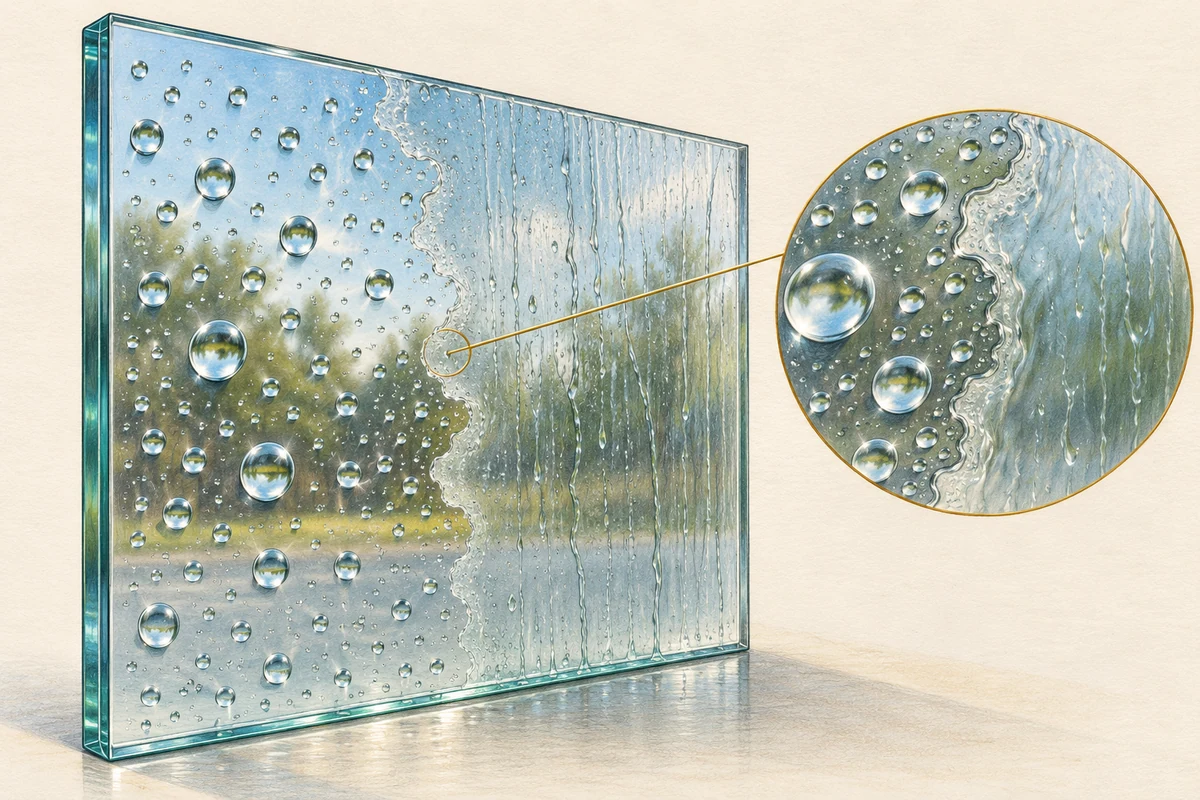
Hydrophobic Coating Mismatch Halo
Chemical/interaction — on-glass hydrophobic coating applied/removed unevenly; water-behavior edge, optical halo/veil ± shallow micro-texture
Hydrophobic coating mismatch halo is an appearance change caused by uneven application, partial removal, or edge-lap of an on-glass hydrophobic coating (e.g., rain-repellent, DIY nano-sealant). The result is a water-behavior discontinuity and an optical halo/veil at the boundary between coated and uncoated (or differently coated) zones; long UV/soil exposure may leave very shallow micro-texture at the boundary.
Illustration, reference page, and PDF complete
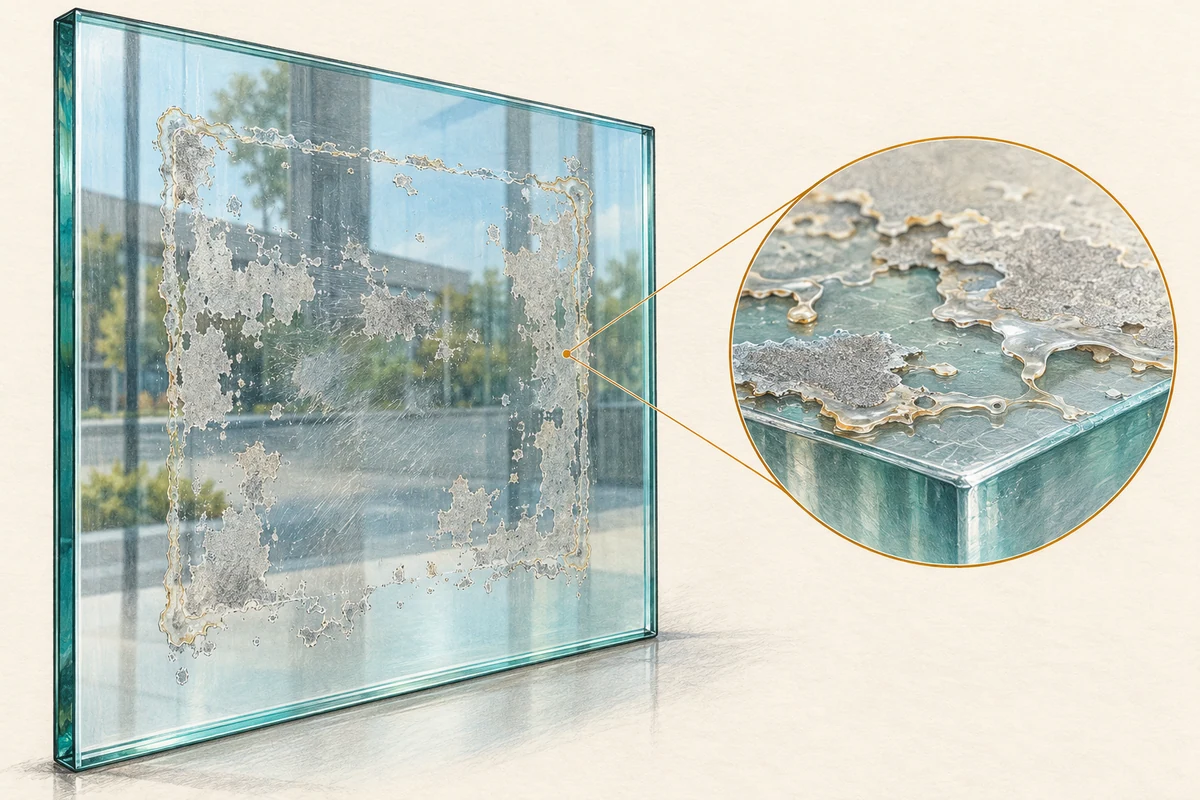
Anti-Graffiti Coating Ghost (chemically altered)
Chemical/interaction — altered or partially removed sacrificial/permanent barrier; optical veil/patchiness ± shallow micro-texture, boundary lap lines
Anti-graffiti coating ghost is an appearance change on glass resulting from application, partial removal, or chemical alteration of anti-graffiti barrier products (sacrificial wax/polymer films or “permanent” polysiloxane/fluoropolymer systems).
Illustration, reference page, and PDF complete
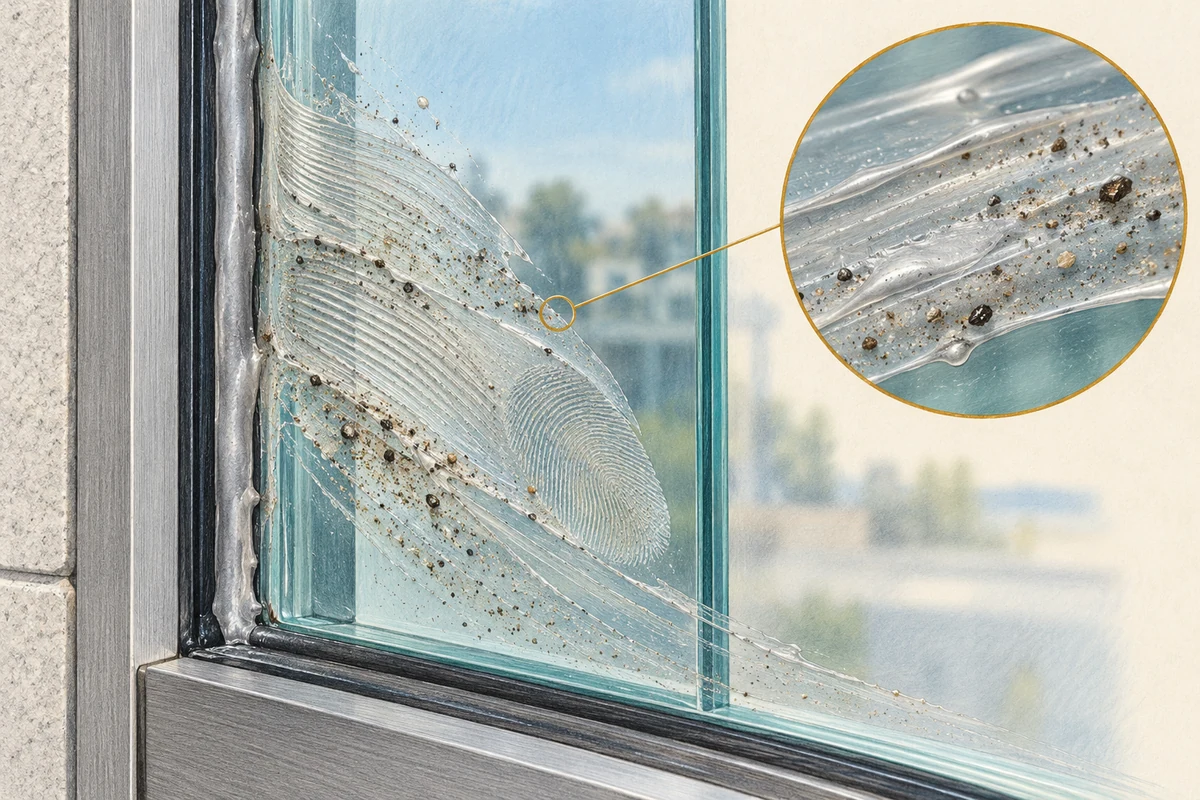
Silicone Smear / Tool-Mark Film
Residue/film — uncured or partially cured silicone transfer from sealant tooling; optical veil, print, or drag; typically SC-0
Silicone smear / tool-mark film is an appearance change on glass from uncured/partially cured silicone (or siloxane-rich by-products) deposited during sealant application and tooling at adjacent joints. It presents as optical veils, drag/corduroy tool lines, or finger/pad prints, often with preferential soil capture over time. Classification is appearance-only per VIS (method-agnostic).
Illustration, reference page, and PDF complete
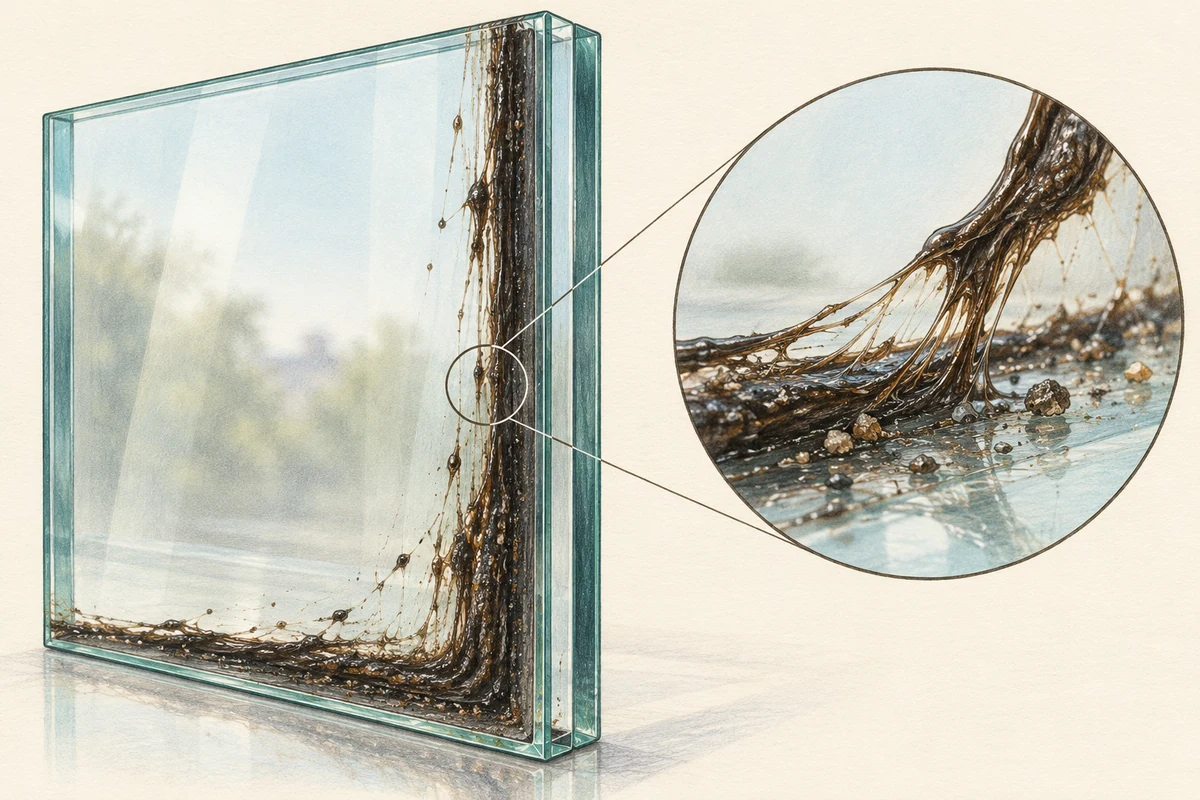
Butyl / PIB / IG Sealant Smear
Residue/film — butyl/PIB/IG edge-seal transfer; dark tacky smear, stringing, edge-adjacent bands; typically SC-0
Butyl/PIB/IG sealant smear is an appearance change on glass from polyisobutylene (PIB) primary seal or butyl-based edge sealants transferred during IGU handling, glazing, or service. It presents as dark, tacky smears/bands, often edge-parallel, with possible stringing and particulate catch. Classification is appearance-only per VIS (method-agnostic). Inspect after Non-Invasive Reveal under VIS lighting/geometry;
Illustration, reference page, and PDF complete
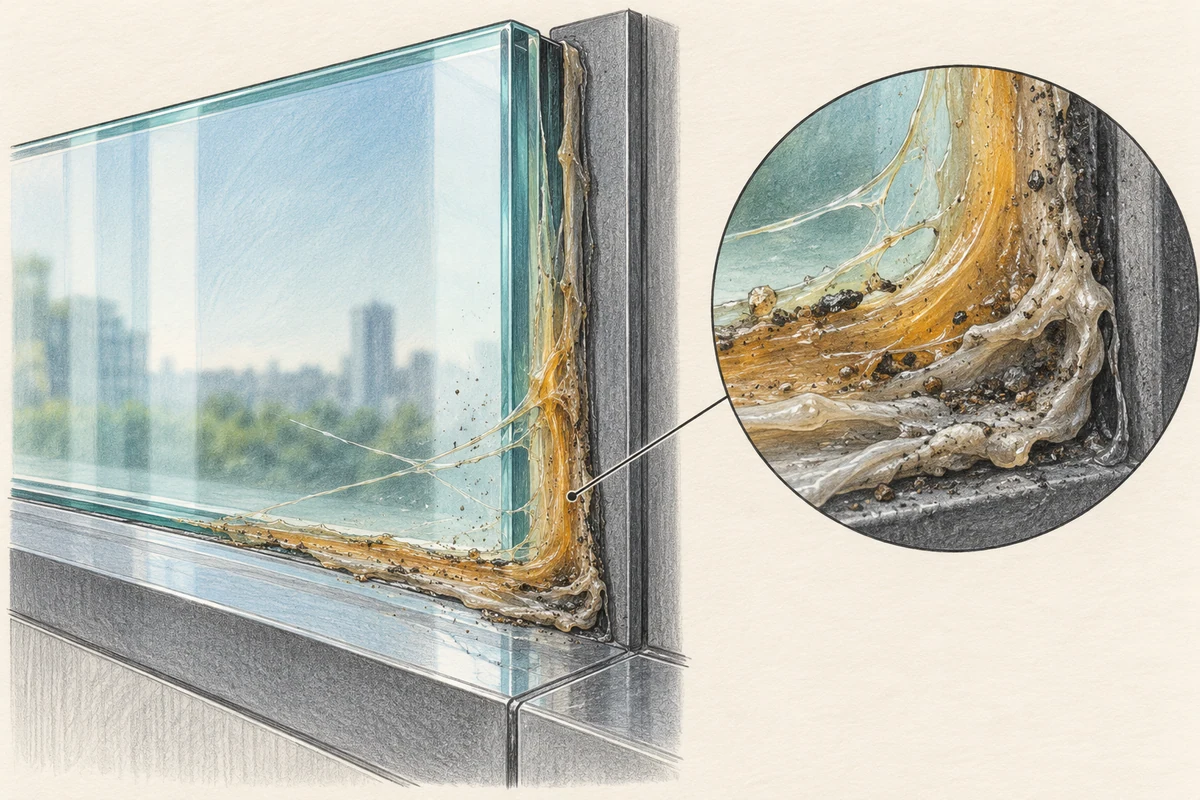
Polysulfide / Polyurethane Smear
Residue/film — glazing/sealant transfer; amber/grey smear, elastic “drag tails,” soil-laden bands; typically SC-0
Polysulfide/polyurethane smear is an appearance change on glass from two-part polysulfide or moisture-cure polyurethane (PU) glazing/sealants transferred during application, tooling, masking removal, handling, or squeeze-out. It presents as amber-to-grey translucent veils, elastic drag tails/strings, and soil-laden bands adjacent to joints and corners. Classification is appearance-only per VIS (method-agnostic).
Illustration, reference page, and PDF complete
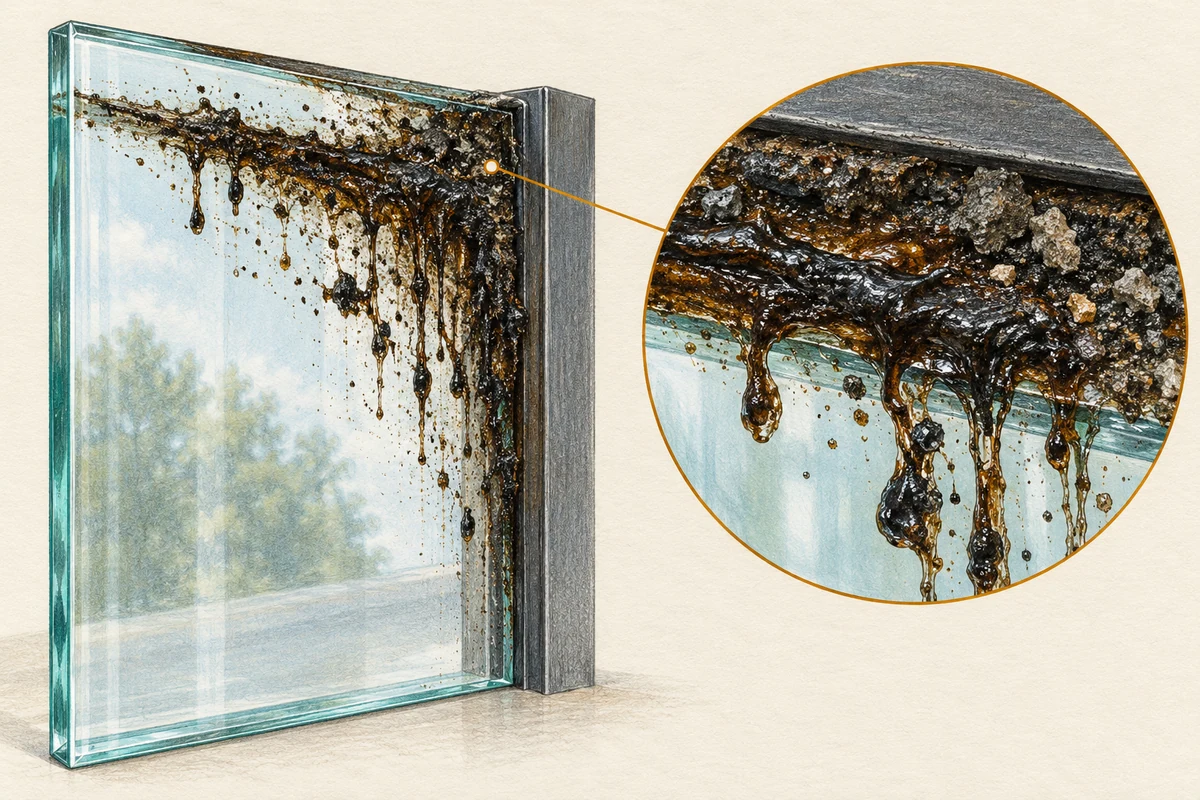
Mastic / Bitumen / Tar Transfer
Residue/film — roofing/asphalt/bituminous adhesives; dark brown–black tacky smear, drag strings, soil-loaded bands; typically SC-0
Mastic/bitumen/tar transfer is an appearance change on glass from bituminous products (roofing asphalt, waterproofing mastics, tar-based adhesives/primers) contacting the surface during construction, roofing, façade waterproofing, or logistics. It presents as dark brown–black, tacky smears/bands, often edge- or frame-adjacent, with drag strings and heavy particulate/soot capture.
Illustration, reference page, and PDF complete
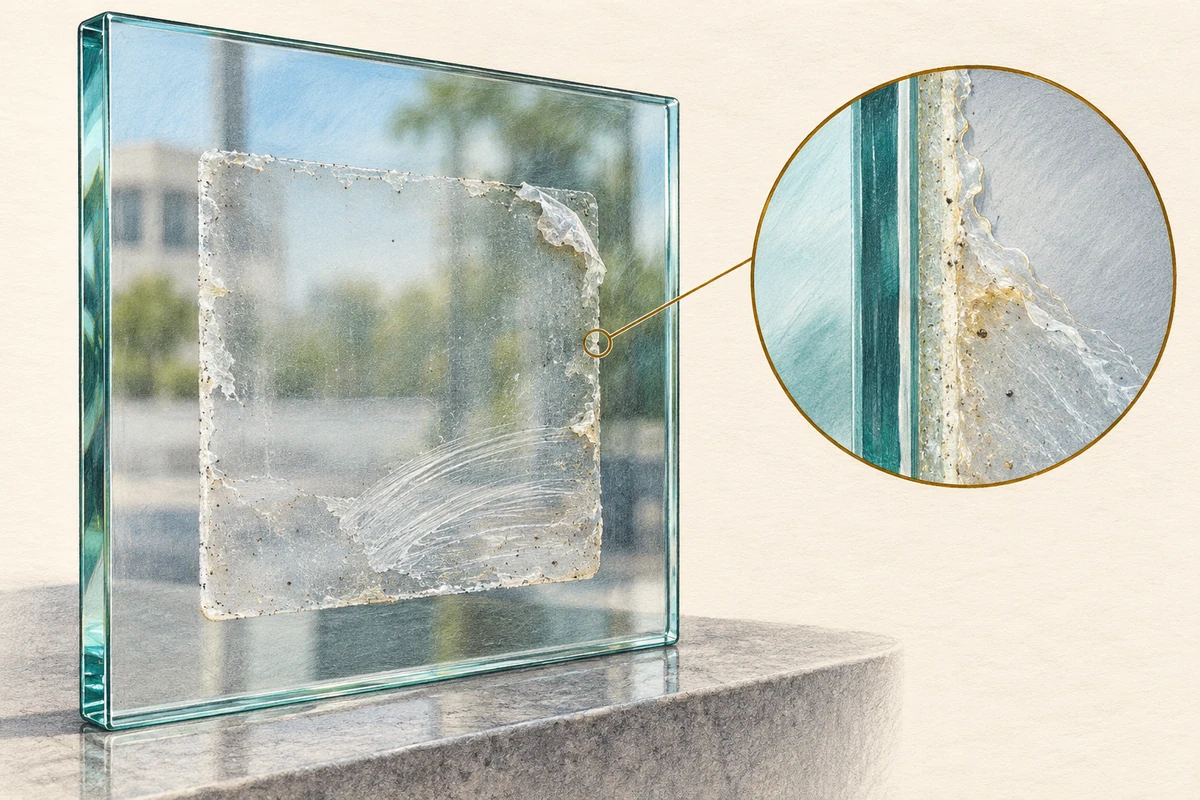
Adhesive Label / Sticker Ghost
Residue/film — pressure-sensitive adhesive (PSA) imprint after label removal; lens-shaped halo, wipe-edge overlaps; typically SC-0 on clean substrate
Adhesive label/sticker ghost is an appearance change on glass caused by pressure-sensitive adhesive (PSA) remnants or plasticizer transfer that remain after label/tape/film removal. It presents as a lens-shaped halo or rectilinear patch at the former label footprint, often with wipe-edge overlaps from attempted cleanups. Classification is appearance-only per VIS (method-agnostic).
Illustration, reference page, and PDF complete
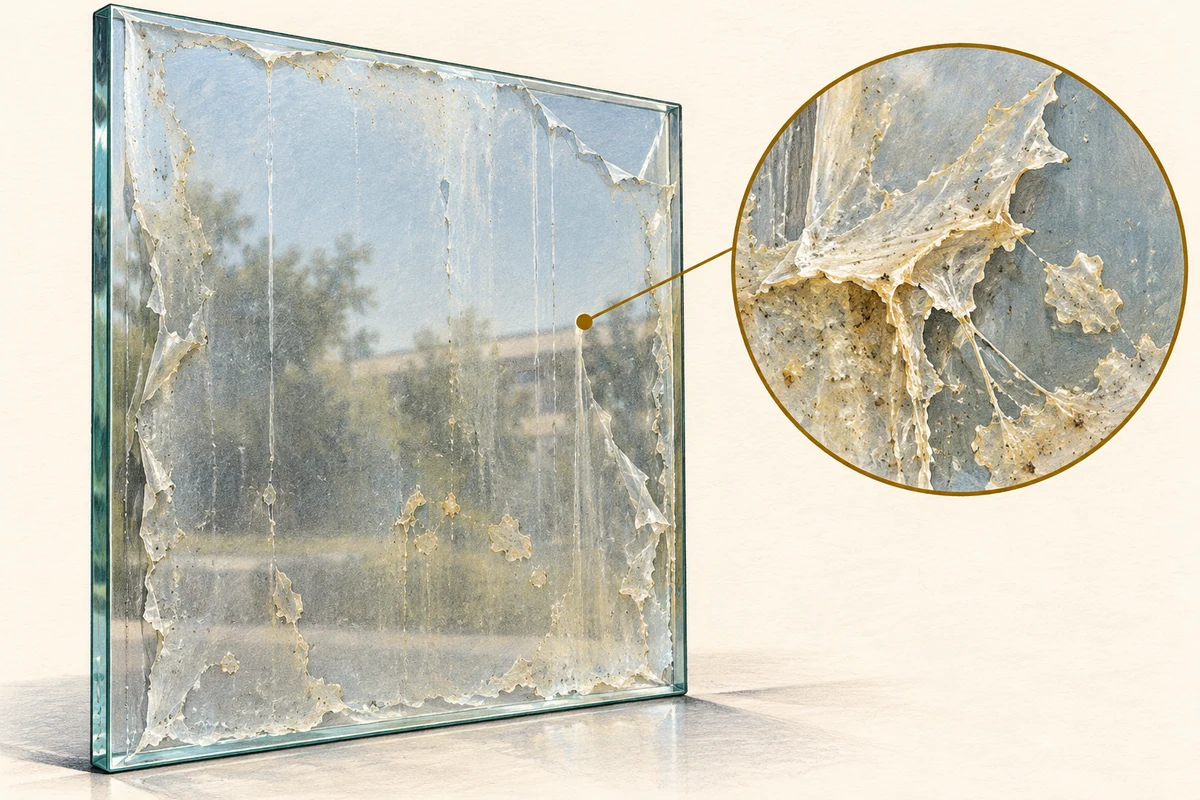
Protective Film Adhesive Residue (aged)
Residue/film — construction protection films; edge-peel scallops, panel-wide haze, adhesive islands; typically SC-0 on clean substrate, SC-1 possible in aged conversions
Protective film adhesive residue (aged) is an appearance change on glass from construction/transport protection films whose pressure-sensitive adhesive (PSA) or plasticizers remain after removal—especially when films were over-aged, UV/heat exposed, or removed in cold. It presents as broad veils, edge-peel scallops, adhesive islands/strings, and tide-line halos matching the former film footprint.
Illustration, reference page, and PDF complete
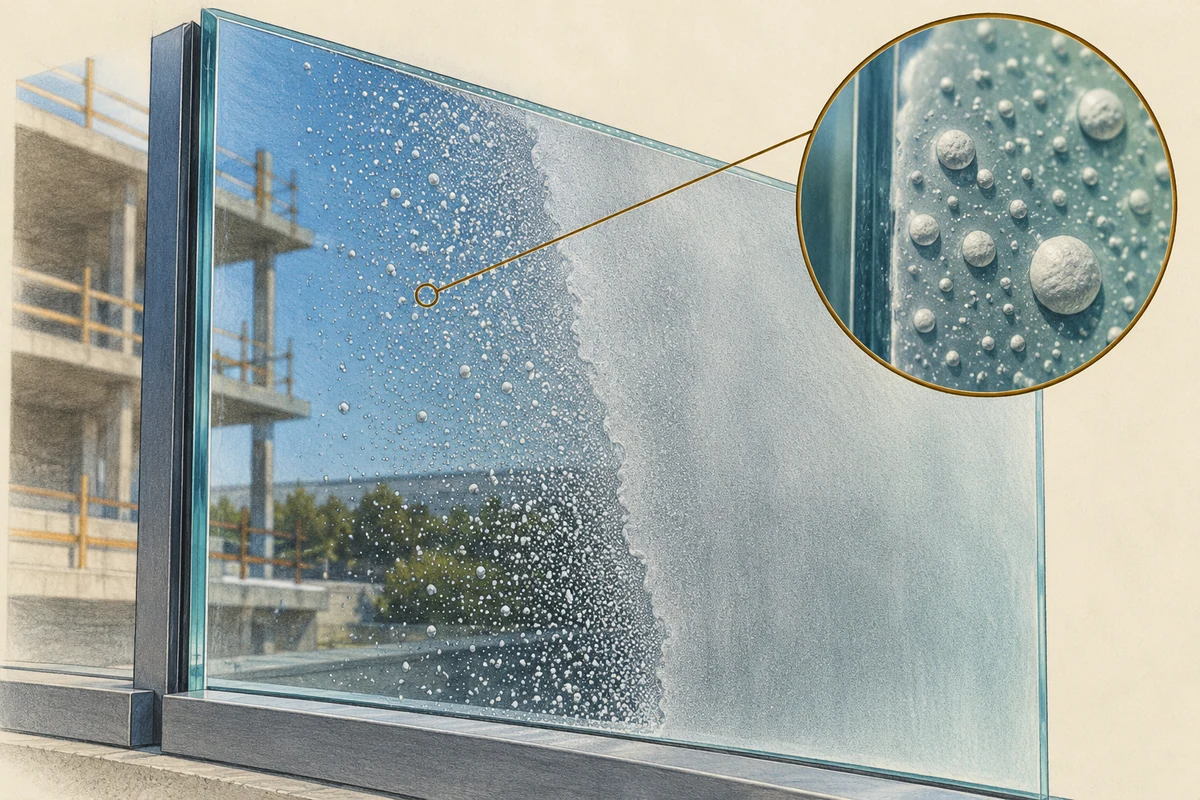
Paint Overspray Film
Residue/film — aerosolized paint/primer droplets; speckled film to misted veil; typically SC-0, SC-1 if binder cross-linking + soil
Paint overspray film is an appearance change on glass from aerosolized paint/primer (airless/spray-can/HVLP) depositing as micro-droplets that coalesce into a speckled film or misted veil. It ranges from discrete dots to a uniform haze and may exhibit tide lines where masking failed or wind drifted plume edges. Classification is appearance-only per VIS (method-agnostic).
Illustration, reference page, and PDF complete
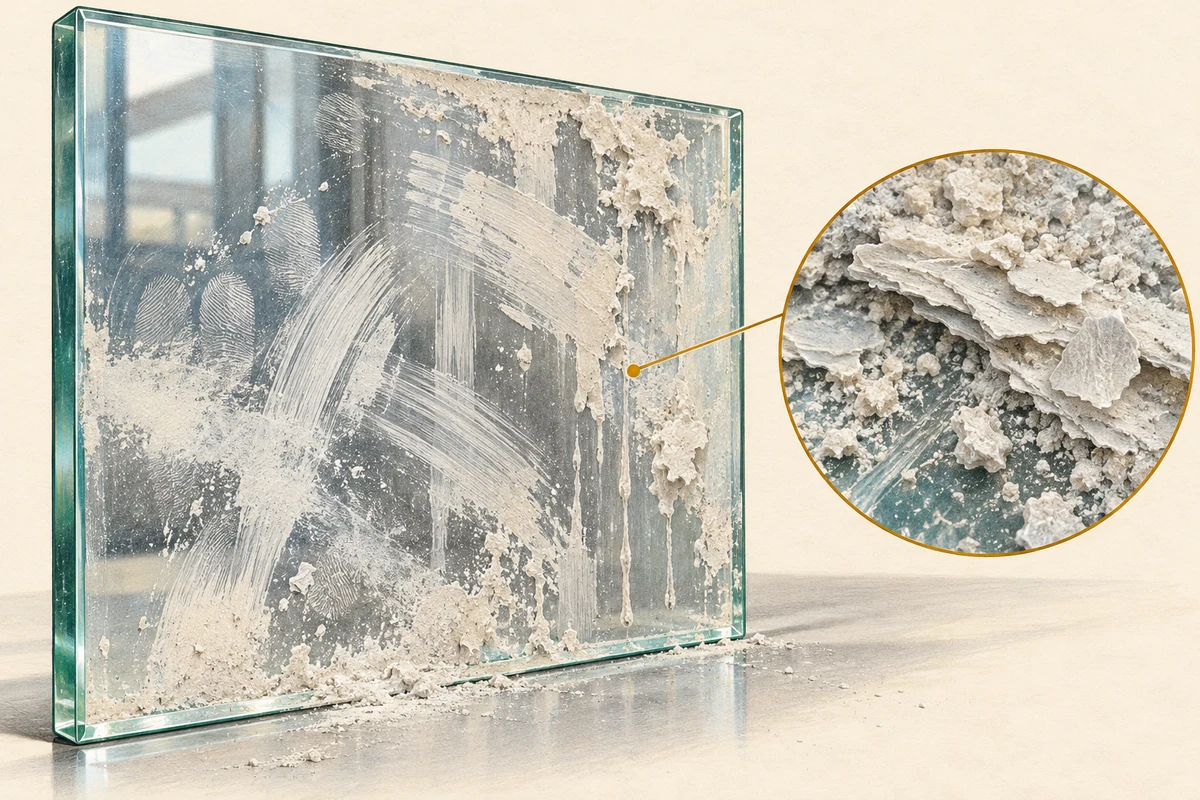
Drywall Mud / Plaster Film
Residue/film — gypsum/setting compound particulate; chalky veil, drag wipes, particulate halos; typically SC-0, SC-1 if abrasion occurred during attempts to clean
Drywall mud/plaster film is an appearance change on glass caused by gypsum-based joint compound or plaster particulates/binders deposited during taping, sanding, feathering, or cleanup. It presents as a chalky veil with drag wipes, finger/pad prints, and particulate halos, sometimes consolidated by moisture. Classification is appearance-only per VIS (method-agnostic).
Illustration, reference page, and PDF complete
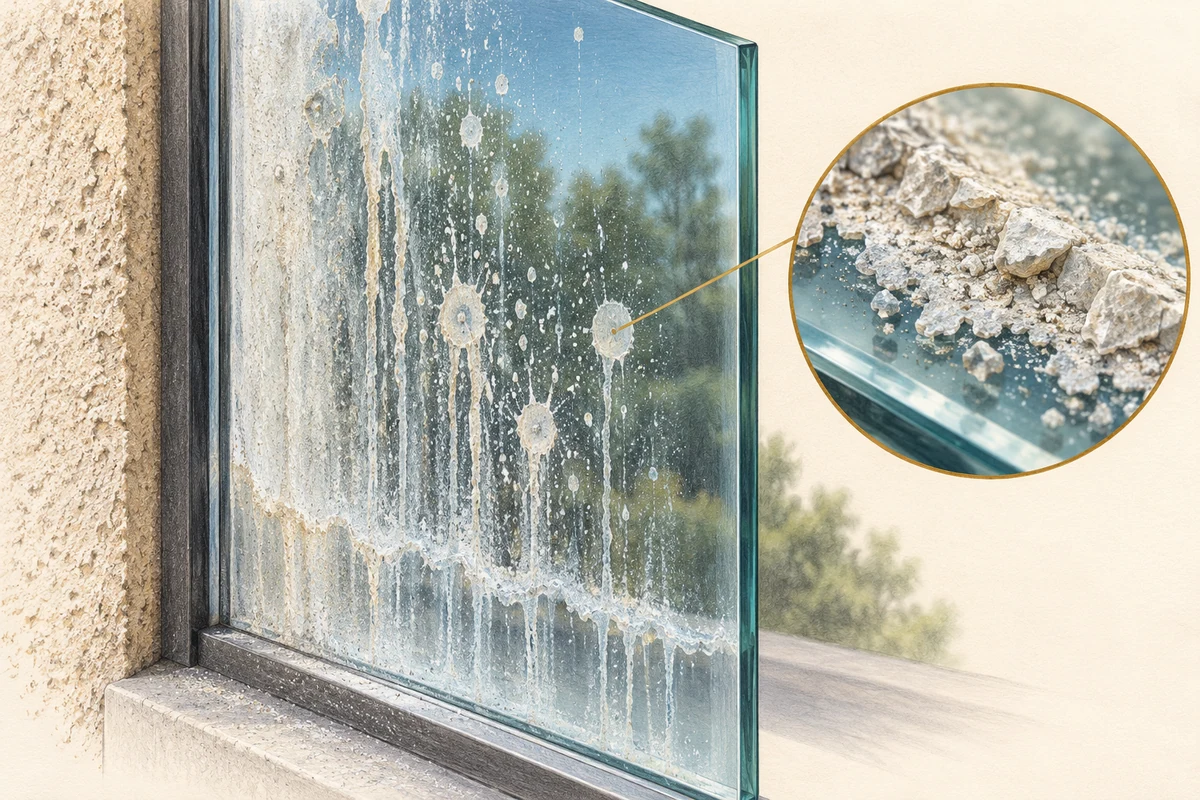
Stucco / Lime Film (residue)
Residue/film — cementitious/stucco/lime splash or wash-down; chalk–grain veil, runs/rings, alkaline footprint; typically SC-0, SC-1 if consolidated or lightly abraded
Stucco/lime film (residue) is an appearance change on glass from cementitious or lime-rich materials (stucco brown/finish coats, scratch coats, slurry, limewashes) deposited during application, float/rod work, cutting/grinding, or cleanup/rinse-downs. It presents as a chalk–grain veil with runs/rings and tide-line halos that follow gravity paths and splash footprints.
Illustration, reference page, and PDF complete
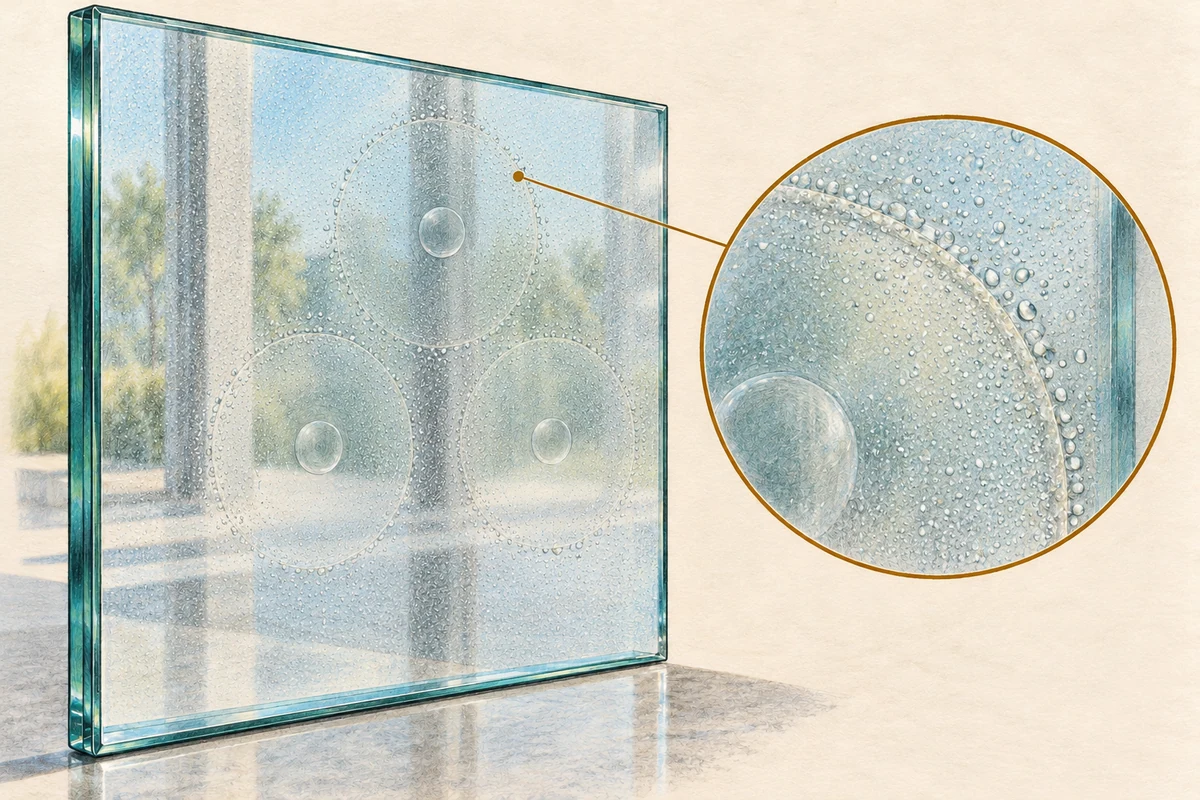
Suction Cup Rings (residue / pressure mark)
Residue/film / pressure artifact — lifting cup contact; circular/oval rings, center pucks, tri-lobe clusters; typically SC-0, SC-1 if aged film or slight micro-texture
Suction cup rings are appearance changes on glass caused by vacuum lifter cups or manual suction tools during fabrication, transport, or install. They present as circular/oval rings, center pucks, or tri-/quad-lobe clusters reflecting multi-pad frames. Artifacts include transfer films (plasticizer, rubber, dust-print), pressure marks, or moisture halos; heavy dwell/heat can leave persistent veils.
Illustration, reference page, and PDF complete
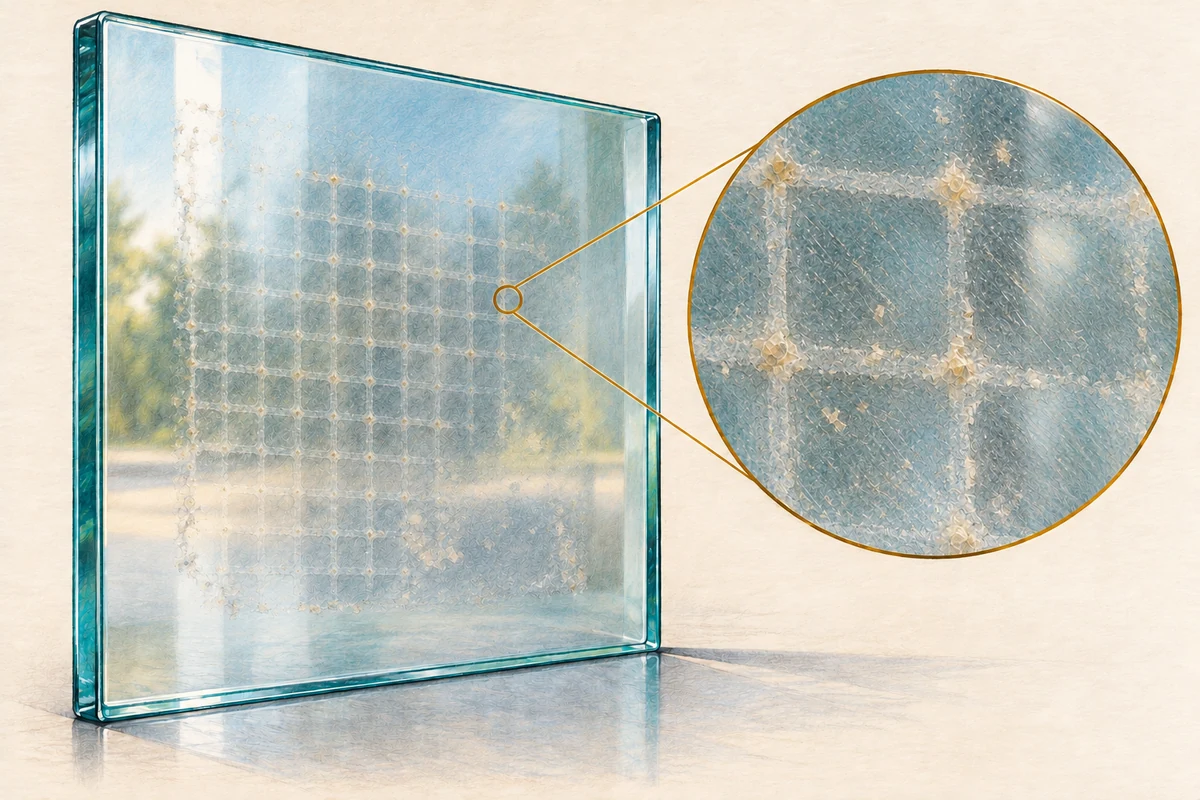
Separator Pad Ghost / “Waffle” Print
Residue/pressure artifact — packaging separators/pads; grid/waffle imprint, pad-outline veils, adhesive specks; typically SC-0, SC-1 if aged conversion or light micro-texture
Separator pad ghost / “waffle” print is an appearance change on glass caused by packaging/separator pads (foam, corrugated, felt, polymer “waffle” grids) used in racks/crates between lites. It presents as grid or checker imprints, pad-outline veils, or speck/adhesive islands coincident with pad contact zones. Artifacts may include plasticizer/adhesive transfer and pressure marks from long dwell, heat, or vibration.
Illustration, reference page, and PDF complete
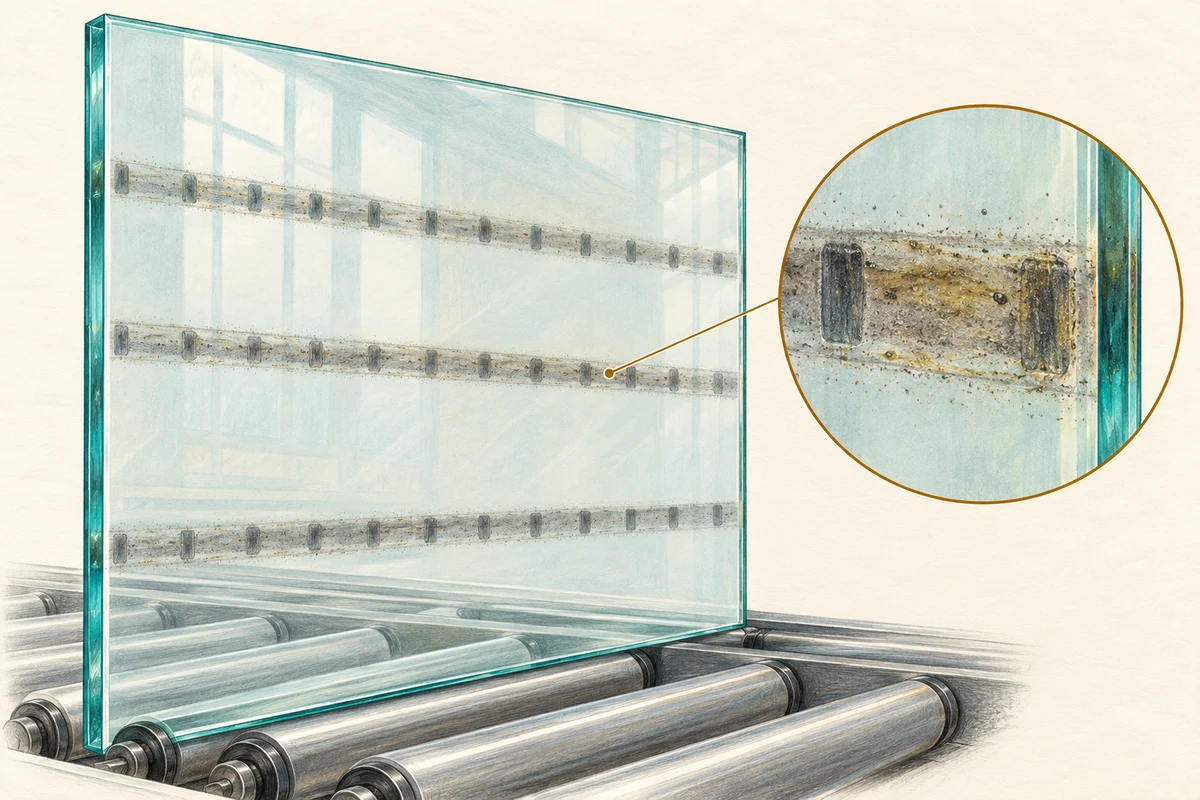
Roller / Handling Rail Transfer
Residue/film / pressure artifact — contact with conveyor rollers, handling rails, rack rails; linear bands, repeating pitch marks, soil-laden streaks; typically SC-0, SC-1 if aged film or light micro-texture
Roller/handling rail transfer is an appearance change on glass from contact with conveyor rollers, storage/handling rails, truck/rack rails, or in-plant guides during fabrication, transport, or staging. It presents as linear bands (often horizontal), repeating pitch marks matching roller spacing, or soiled streaks at consistent heights.
Illustration, reference page, and PDF complete
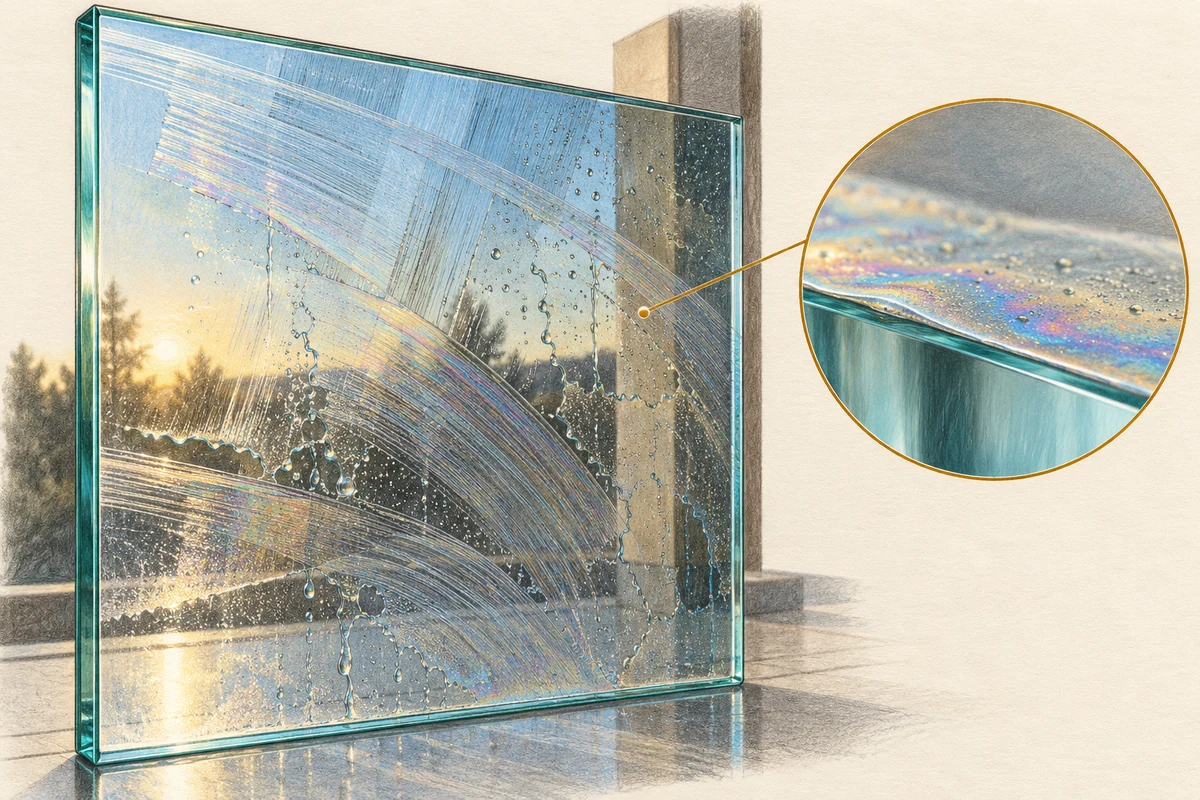
Detergent / Surfactant Film
Residue/film — cleaning solution residue; streaks, shear marks, rainbowing/iridescence in raking; typically SC-0, SC-1 if micro-texture from abrasive wiping
Detergent/surfactant film is an appearance change on glass from leftover cleaning agents (surfactants, wetting agents, soaps) due to incomplete rinse, over-concentration, hard-water mixing, or re-deposition from tools. It presents as shear streaks, drag/wipe overlaps, rainbow/iridescent sheens in low-angle light, and re-wet spotting. Classification is appearance-only per VIS (method-agnostic).
Illustration, reference page, and PDF complete
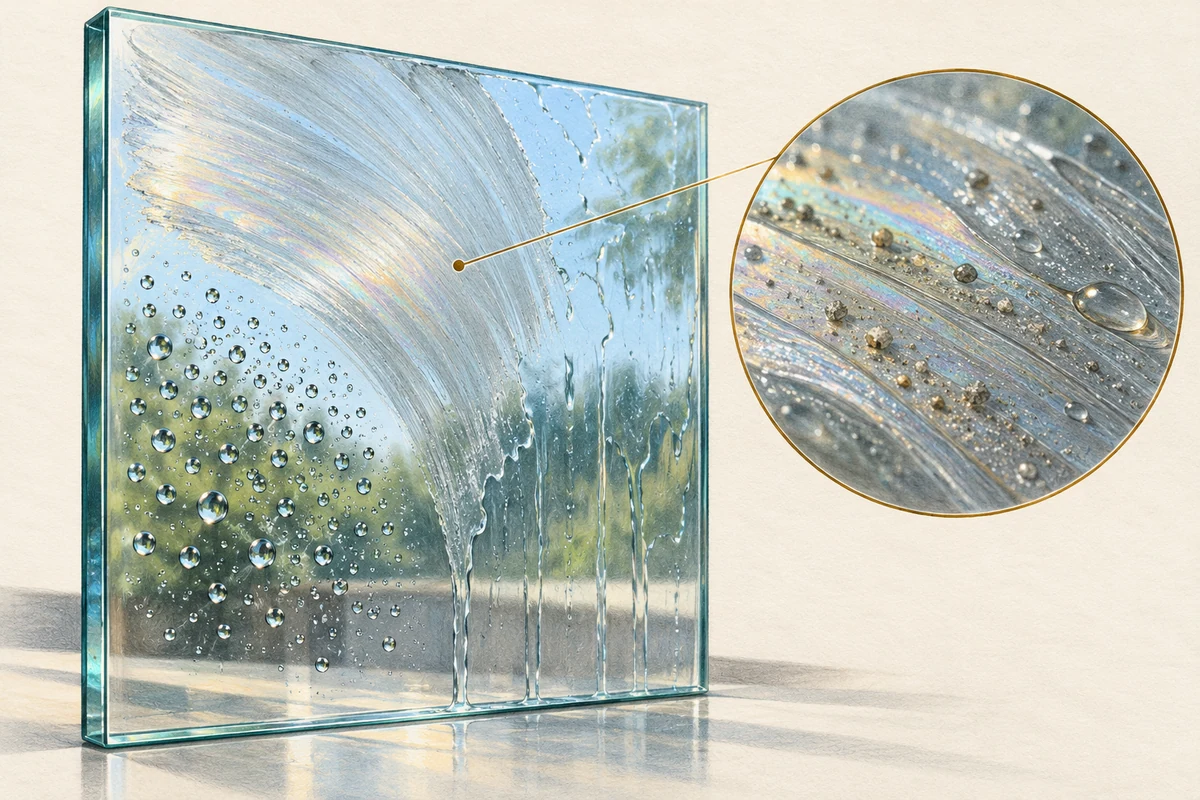
Fabric Softener / Cleaner Additive Film
Residue/film — cationic/siloxane additives from laundry/cleaners or treated towels; strong wetting anomalies, smeary glow, fragrance cue; typically SC-0, SC-1 if light micro-texture from improper wiping
Fabric softener / cleaner additive film is an appearance change on glass caused by transfer of conditioning agents (e.g., cationic quaternary compounds, siloxanes, fragrances, optical brighteners) from laundered towels or multi-purpose cleaners containing “leave-behind” additives. It presents as smeary glow/halo, strong wetting anomalies (persistent beading/sheeting contrast), and directional wipe geometry.
Illustration, reference page, and PDF complete
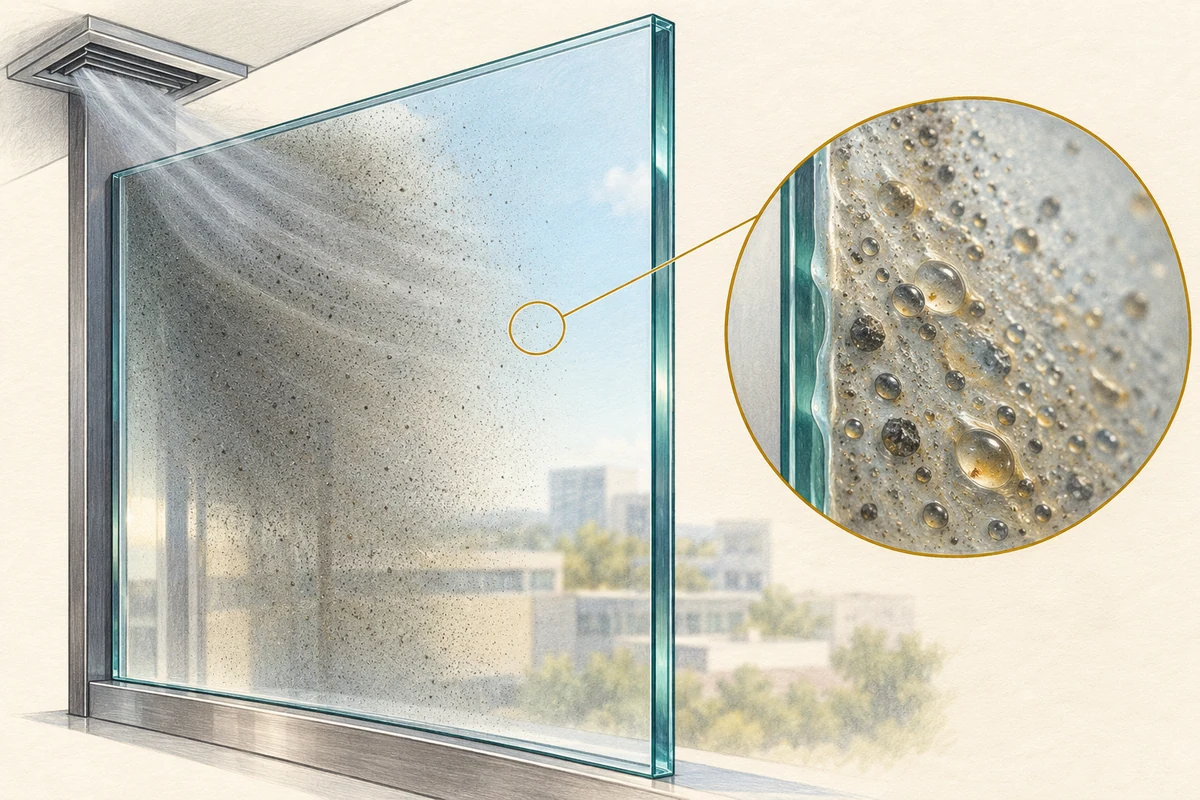
HVAC Aerosol / Oil Film
Residue/film — airborne oils/plasticizers from HVAC/mechanical systems; uniform smeary veil, dust capture, grille-aligned gradients; typically SC-0, SC-1 where abrasion occurred
HVAC aerosol / oil film is an appearance change on glass from airborne oils, plasticizers, and fine condensables emitted or entrained by HVAC systems, kitchens, shop floors, or mechanical rooms, depositing as a uniform, slightly tacky veil that captures dust. It often shows gradients aligned to supply/return paths or equipment proximity. Classification is appearance-only per VIS (method-agnostic).
Illustration, reference page, and PDF complete
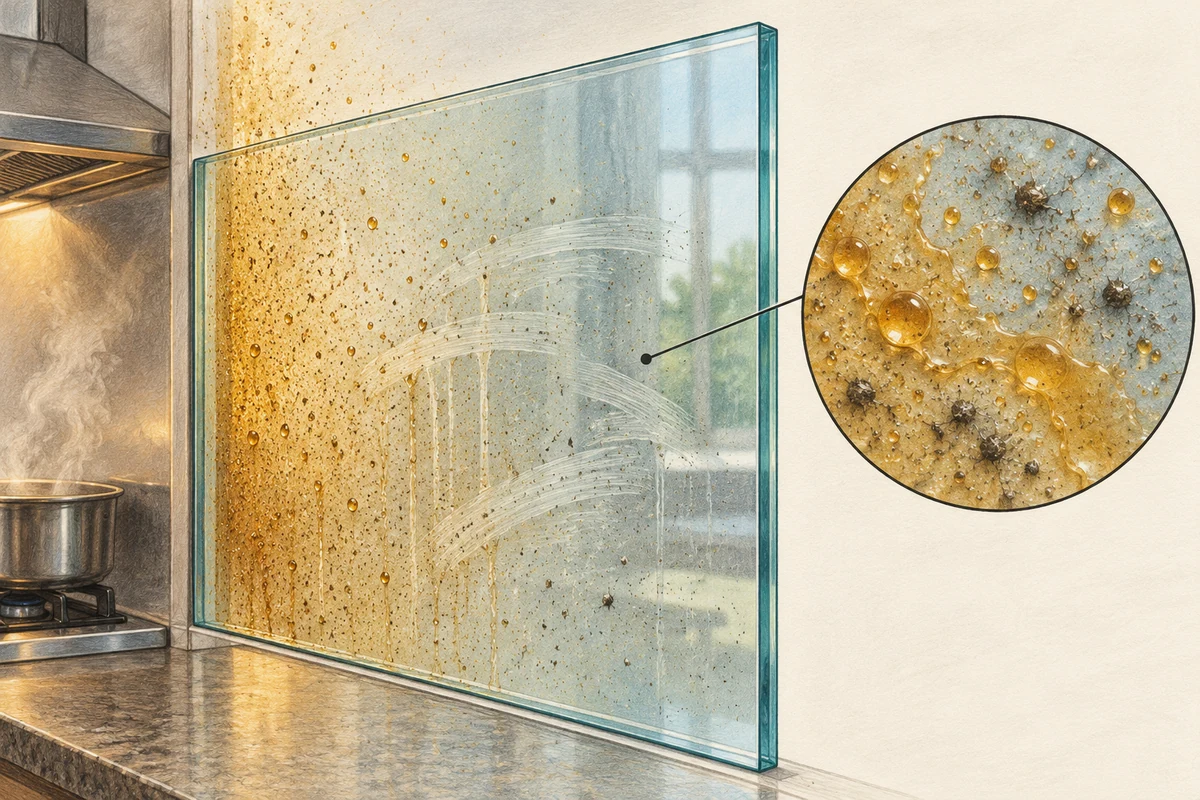
Kitchen Grease / Aerosol Film
Residue/film — cooking aerosols, lipids, and volatiles; tacky amber veil, spatter freckles, dust capture; typically SC-0, localized SC-1 where wiped with abrasive/dusty cloths
Kitchen grease / aerosol film is an appearance change on glass caused by cooking-generated aerosols (lipids, emulsifiers, sugars, combustion by-products) that condense on nearby glass. It presents as a tacky amber veil with fine spatter freckles, dust capture, and wipe trails from ad-hoc cleaning. Classification is appearance-only per VIS (method-agnostic).
Illustration, reference page, and PDF complete
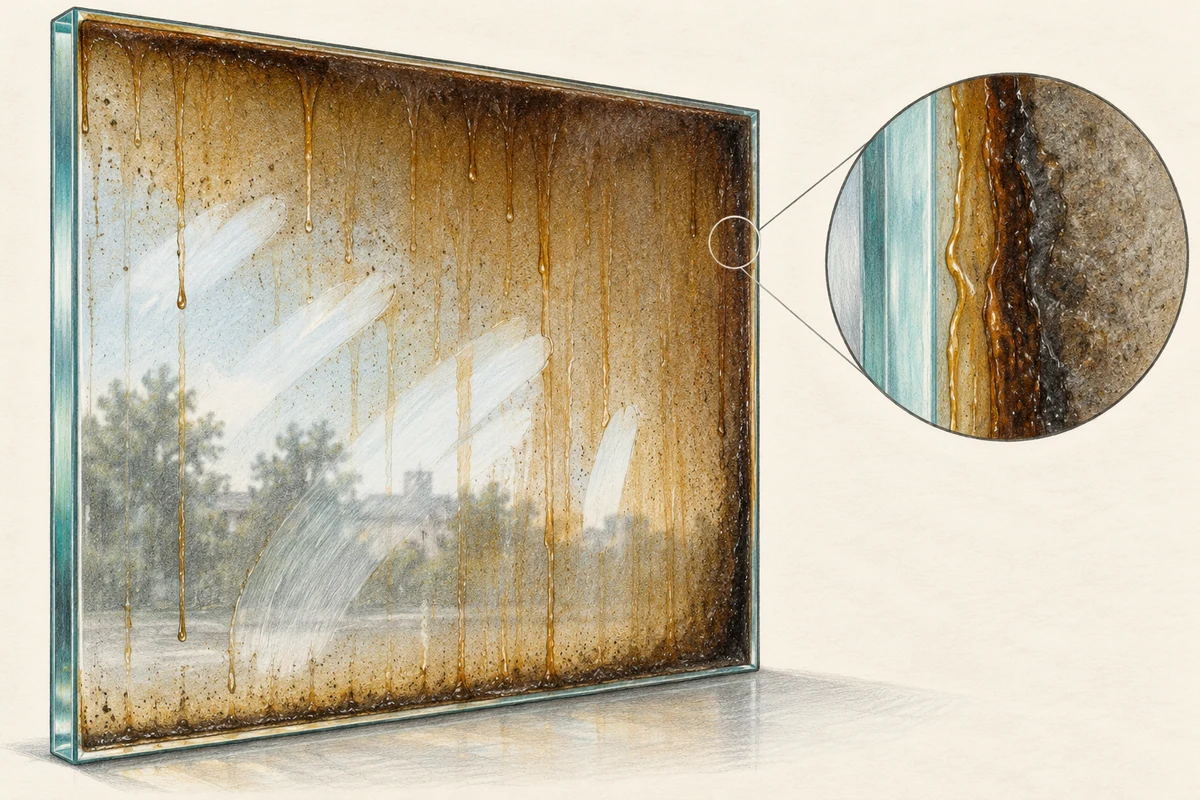
Nicotine / Tar Film
Residue/film — tobacco/vape condensates and combustion by-products; brown/amber veil, drip legs on verticals, strong odor; typically SC-0, localized SC-1 where abrasive/dusty wiping introduced shallow micro-texture
Nicotine / tar film is an appearance change on glass from tobacco smoke or vape condensates (nicotine, tars, glycols, aromatics) and combustion by-products that deposit as a sticky brown/amber veil. It often shows edge build, finger wipe “windows”, and drip legs on vertical glazing where condensation cycles occur. Classification is appearance-only per VIS (method-agnostic).
Illustration, reference page, and PDF complete
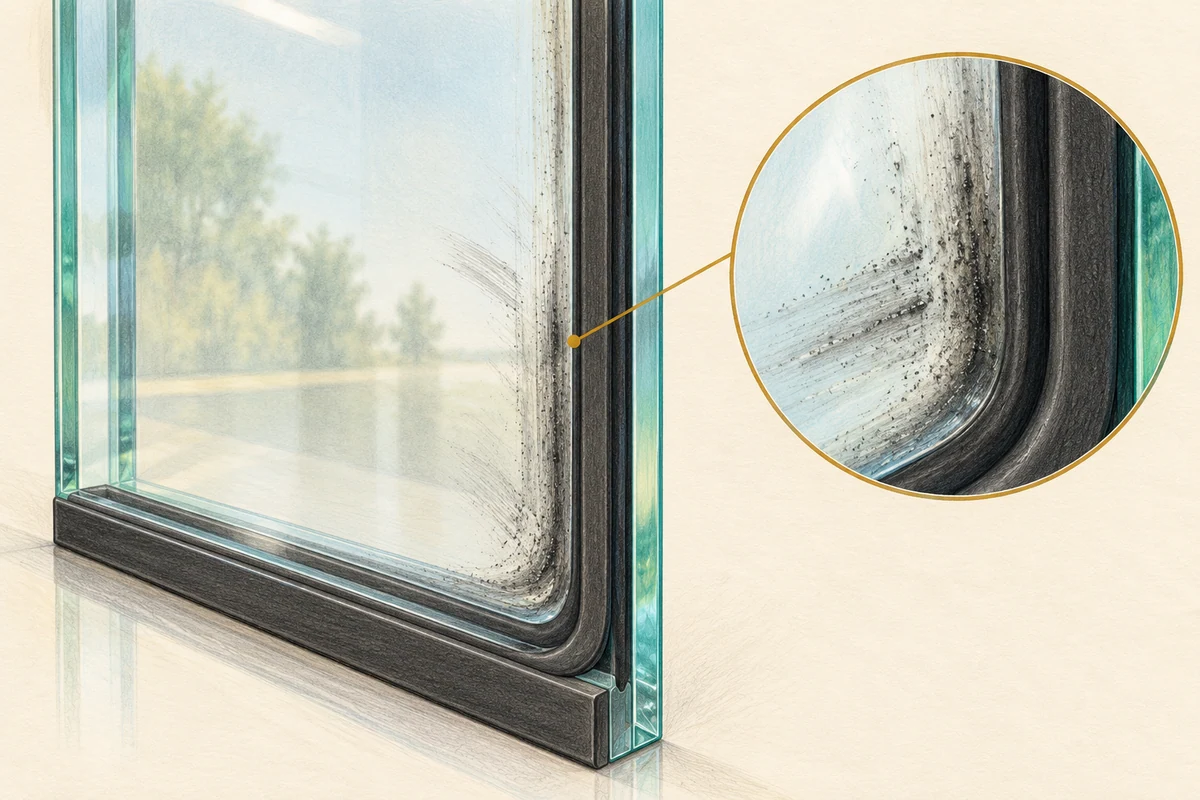
EPDM Gasket Black Rub
Residue/transfer — elastomer contact from glazing gaskets/sweeps; grey–black smudge bands, corner arcs, wipe-smeared trails; typically SC-0, localized SC-1 where abraded with dust/cloth
EPDM gasket black rub is an appearance change on glass caused by contact transfer of ethylene-propylene-diene (EPDM) glazing gaskets, weatherstrips, door sweeps, or setting blocks. It presents as grey–black smudge bands, corner arcs mirroring gasket geometry, or wipe-smeared trails where attempts were made to clean. Transfer may include carbon black, antiozonants, and surface waxes from the elastomer.
Illustration, reference page, and PDF complete
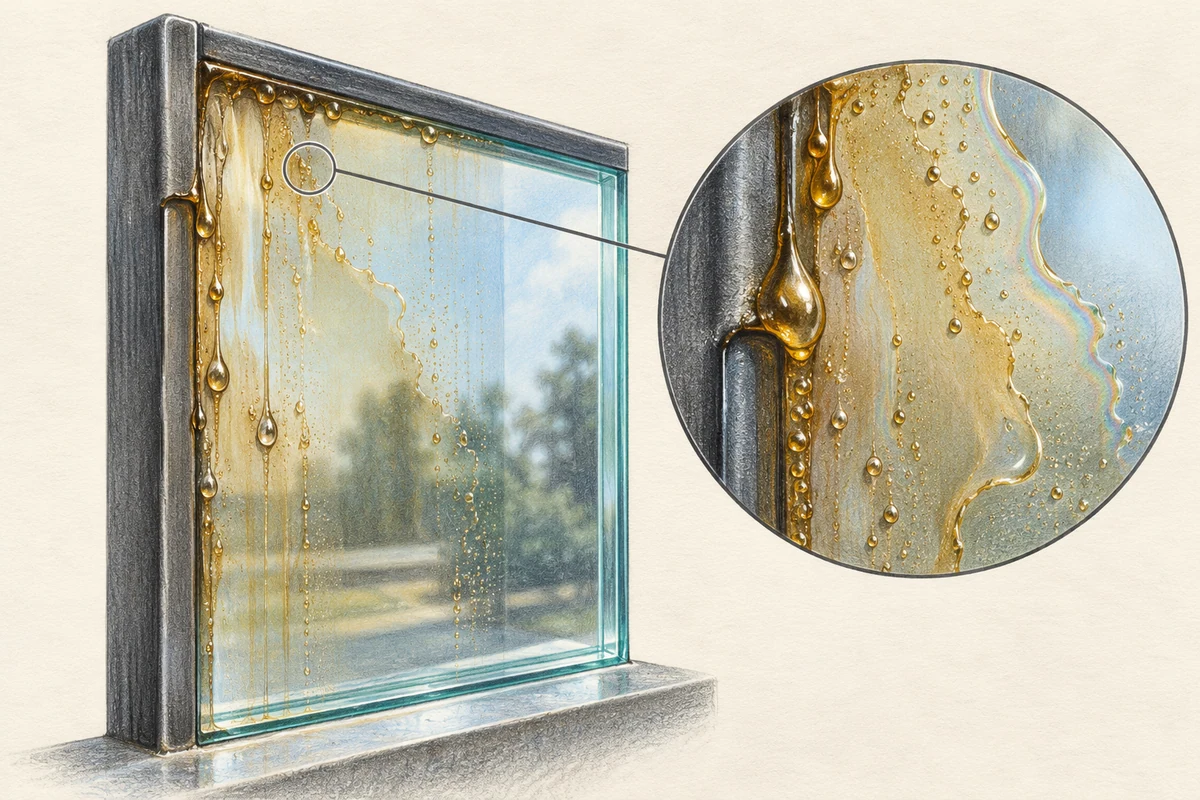
PVC Plasticizer Smear / Migration Film
Residue/film — contact transfer from PVC/vinyl gaskets, wraps, edge trims, blinds; amber/brown oily smear, strong wetting anomalies, nodey contact patches; typically SC-0, localized SC-1 where abraded with dusty cloths
PVC plasticizer smear / migration film is an appearance change on glass caused by phthalate/alt-plasticizer migration and oily exudate transfer from PVC/vinyl components (edge trims, protection wraps, temporary films, blinds/slats, gasket liners, packing). It presents as an amber/brown oily smear or veil, often with distinct contact patches (nodes/lines) and pronounced wetting anomalies.
Illustration, reference page, and PDF complete
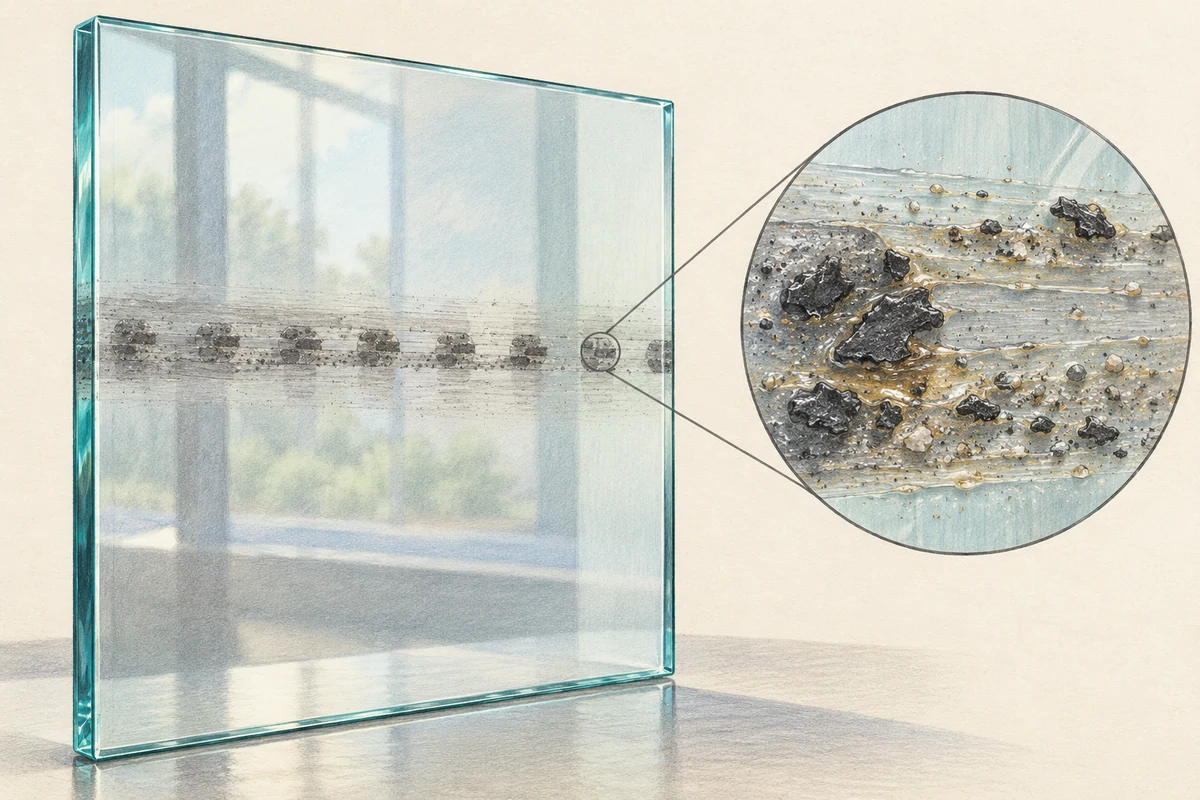
Neoprene Roller Transfer
Residue/transfer — conveyor/guide rollers, staging cradles; dotty/patchy nodes at roller pitch, smudged linear bands; typically SC-0, localized SC-1 where abrasive dust was present
Neoprene roller transfer is an appearance change on glass caused by contact with neoprene-coated rollers or cradle pads during factory conveying, glass washing, staging, or transport. It presents as dotty or patchy contact nodes repeating at roller pitch, sometimes superimposed on smudged linear bands at consistent elevations. Deposits may include neoprene wear fines, plasticizers, and entrained shop dust.
Illustration, reference page, and PDF complete
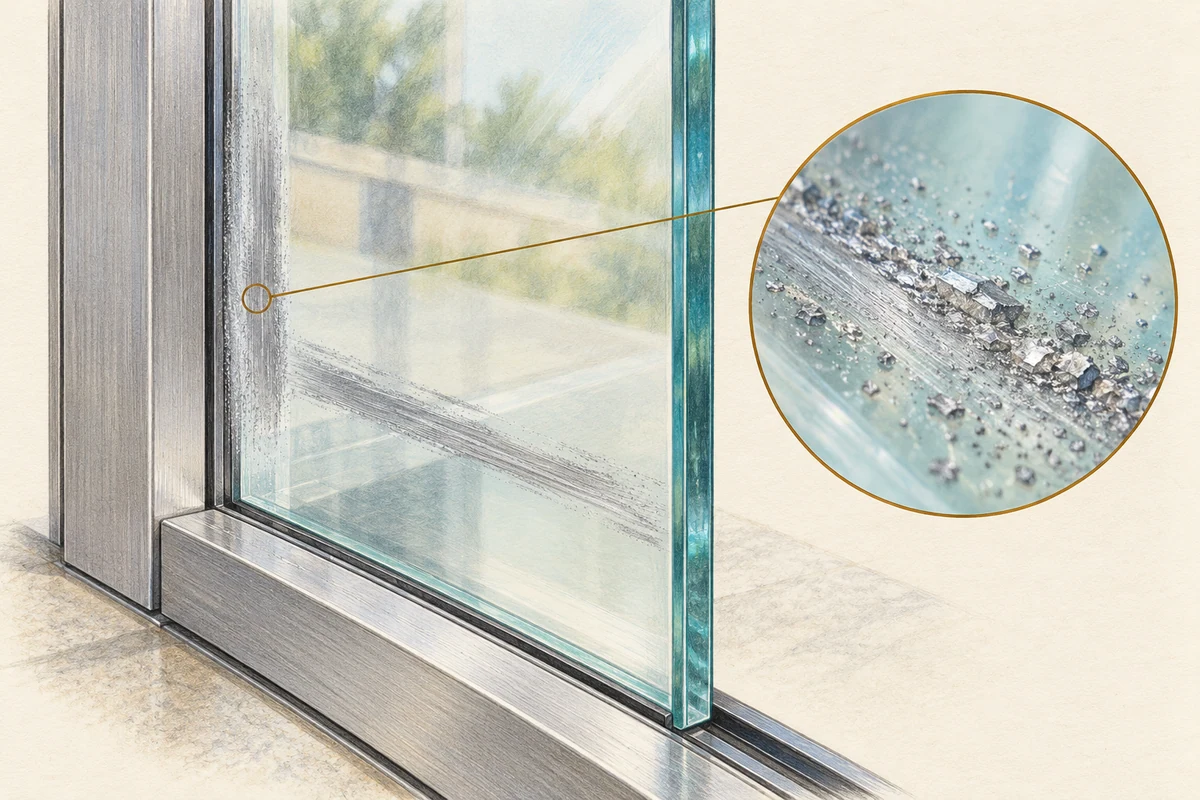
Aluminum Rub / Grey Smear
Residue/transfer — contact with aluminum frames/extrusions/tools; cool grey metallic smear, linear along contact paths; typically SC-0, localized SC-1 where dry abrasion occurred
Aluminum rub / grey smear is an appearance change on glass caused by mechanical contact with aluminum components (frames, extrusions, setting blocks/shims, ladders, straightedges, glazing tools) that leave a metallic grey transfer film. It typically tracks linear contact paths at frame interfaces or along tool routes. Classification is appearance-only per VIS (method-agnostic).
Illustration, reference page, and PDF complete
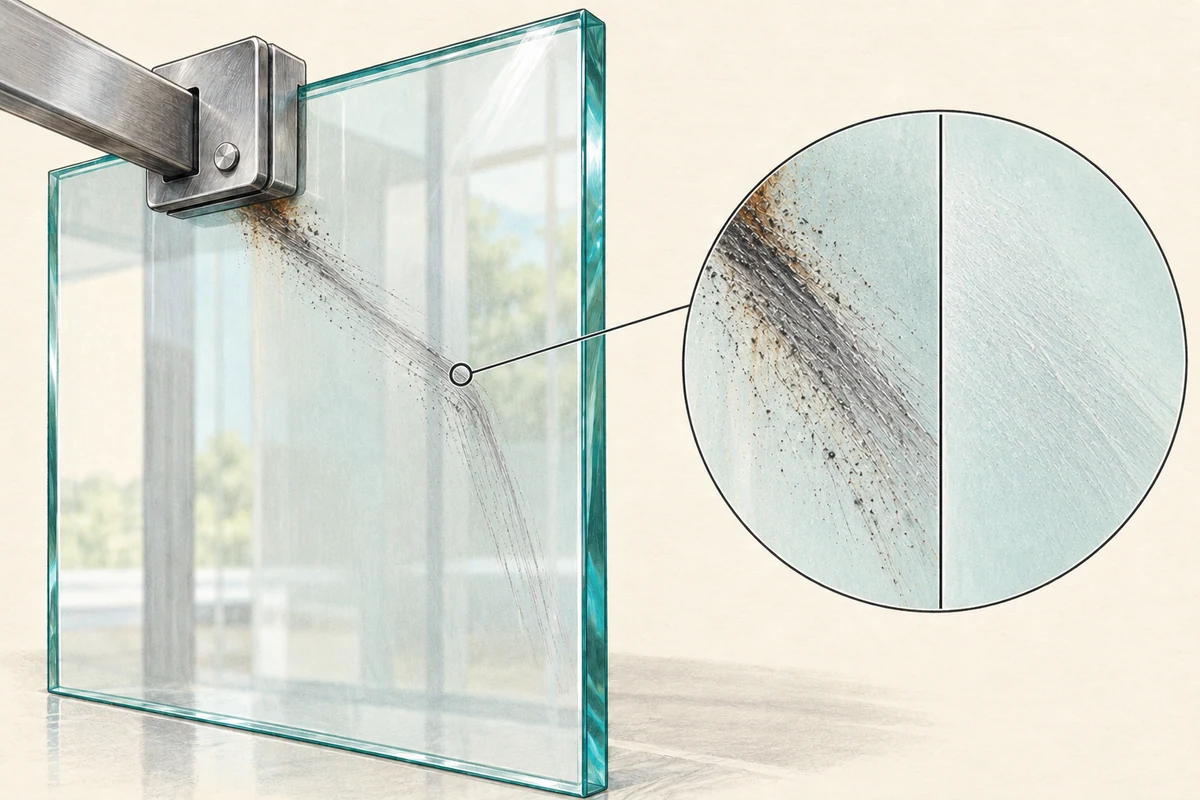
Steel / Ferrous Rub / Black Smear
Residue/transfer — contact with carbon steel or ferrous hardware/tools; dark grey-to-black smear, may oxidize brown; typically SC-0, localized SC-1 where abraded
Steel / ferrous rub / black smear is an appearance change on glass caused by mechanical contact with carbon steel or ferrous components (fasteners, brackets, trowels, knives, ladders, window bars, site hardware) leaving a dark grey/black transfer. May slowly oxidize to brown at the edges if moisture is present. Classification is appearance-only per VIS (method-agnostic).
Illustration, reference page, and PDF complete
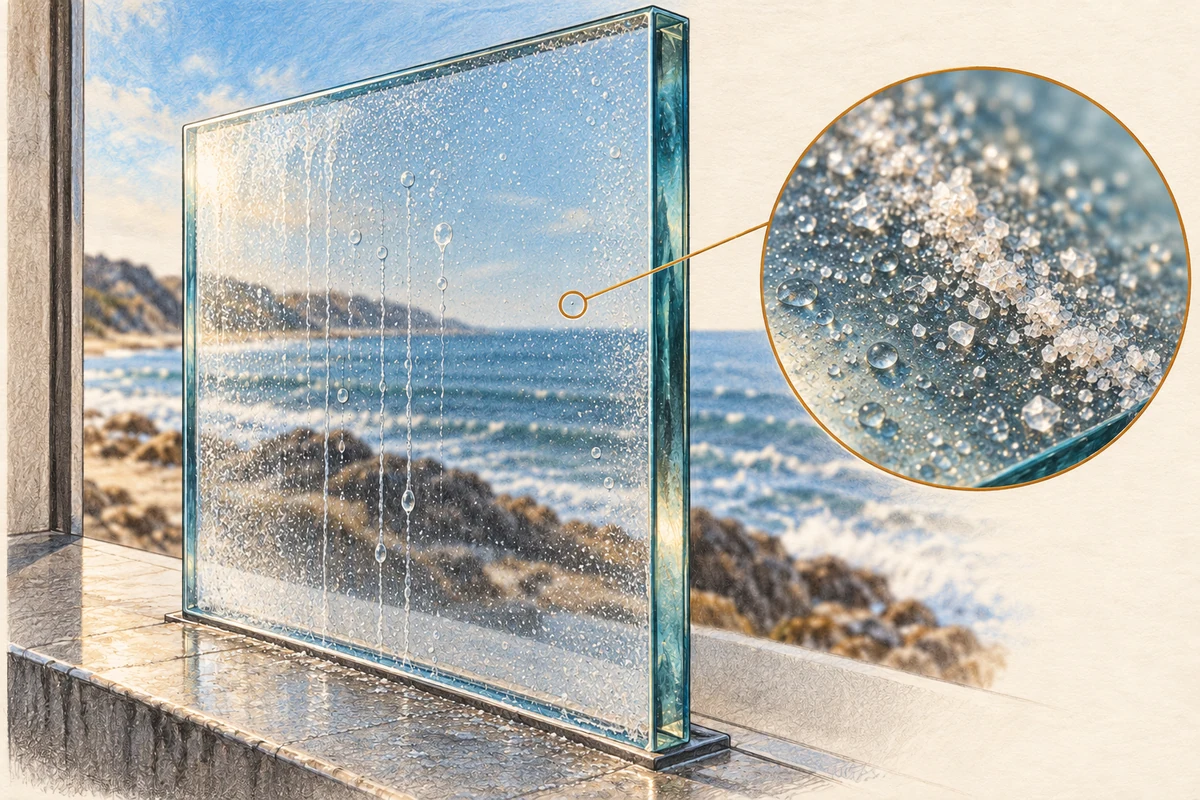
Salt-Spray Crystals / Shoreline Frosting
Environmental residue/attack — marine/coastal aerosol deposition; crystalline rings, feathered frosting at windward exposures; typically SC-0 for loose crystals/films, SC-1 where micro-texture begins from cyclic wet/dry
Salt-spray crystals / shoreline frosting is an appearance change on glass caused by marine/coastal aerosols (sea salts and hygroscopic constituents) depositing and cycling via evaporation/condensation. It presents as crystalline rings/halos, feathery “frosted” veils on windward façades, and recurring drip/rivulet maps under prevailing winds.
Illustration, reference page, and PDF complete
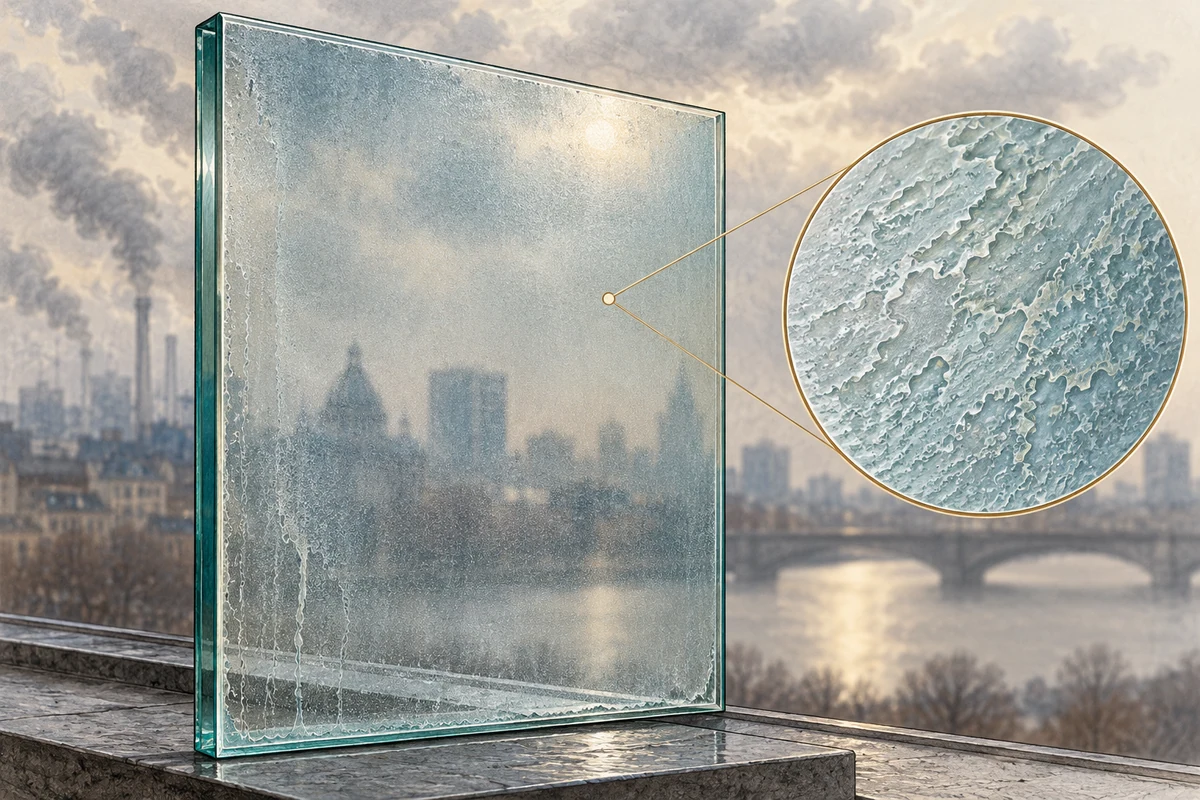
Atmospheric Corrosion Matte (SOx/NOx / “Acid Rain”)
Environmental attack — pollutant-assisted weathering of soda-lime glass surfaces; non-directional milky matte, loss of specular clarity, rivulet/edge bias from runoff; typically SC-1 when micro-texture forms; SC-0 if only residue present
Atmospheric corrosion matte is an appearance change on glass driven by acidic or pollutant-laden moisture (e.g., SOx/NOx, industrial emissions) and cyclic wet/dry exposure, producing surface hydration/leaching and very fine micro-texture. It presents as a non-directional, low-contrast milky haze that reduces specular clarity and can map runoff/edge dwell. Classification is appearance-only per VIS (method-agnostic).
Illustration, reference page, and PDF complete
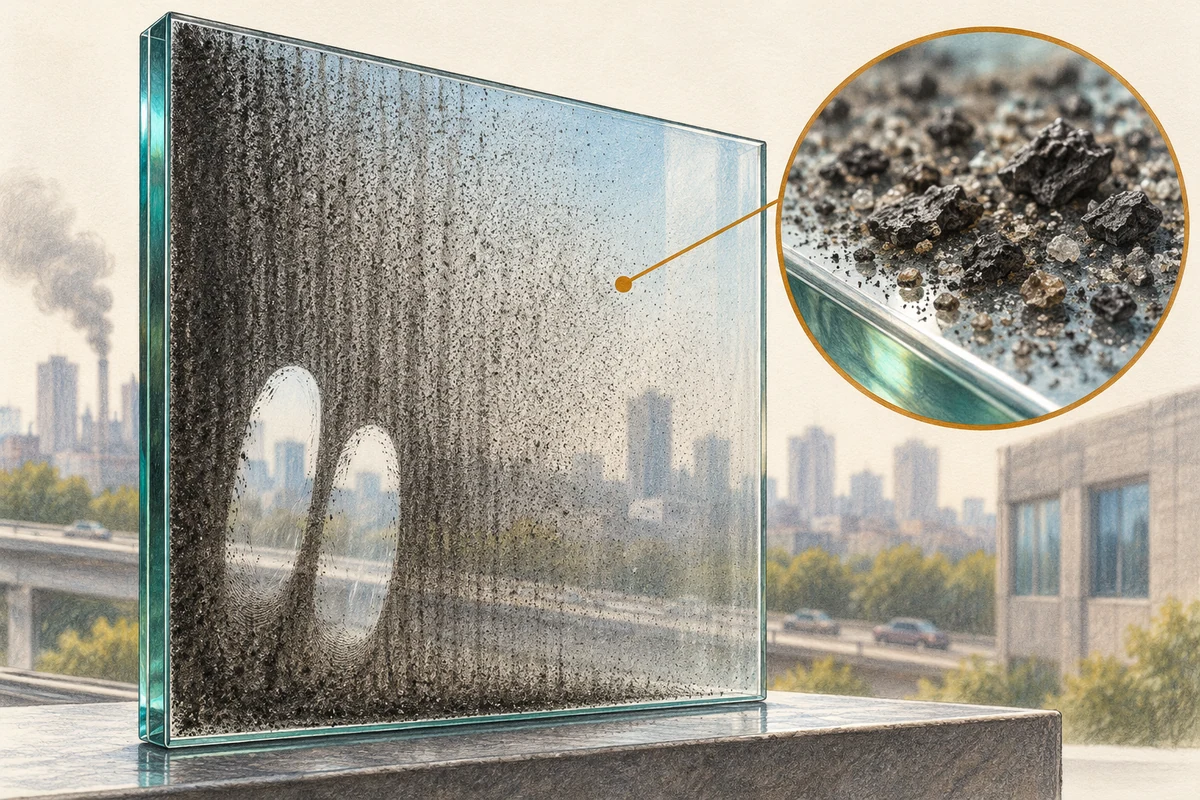
Soot / Particulate Pollution Film
Environmental residue — carbonaceous/industrial particulates; grey-to-black dry film, fingerprint lifts, directional fall-out bias; typically SC-0, localized SC-1 where dust-laden wiping induced shallow micro-texture
Soot / particulate pollution film is an appearance change on glass produced by airborne particulates (carbon soot, diesel exhaust, industrial dust, ash) that accumulate as a dry, grey–black veil. It often shows directional deposition based on airflow, edge build, and finger “lift” windows where casual contact removed soil. Classification is appearance-only per VIS (method-agnostic).
Illustration, reference page, and PDF complete
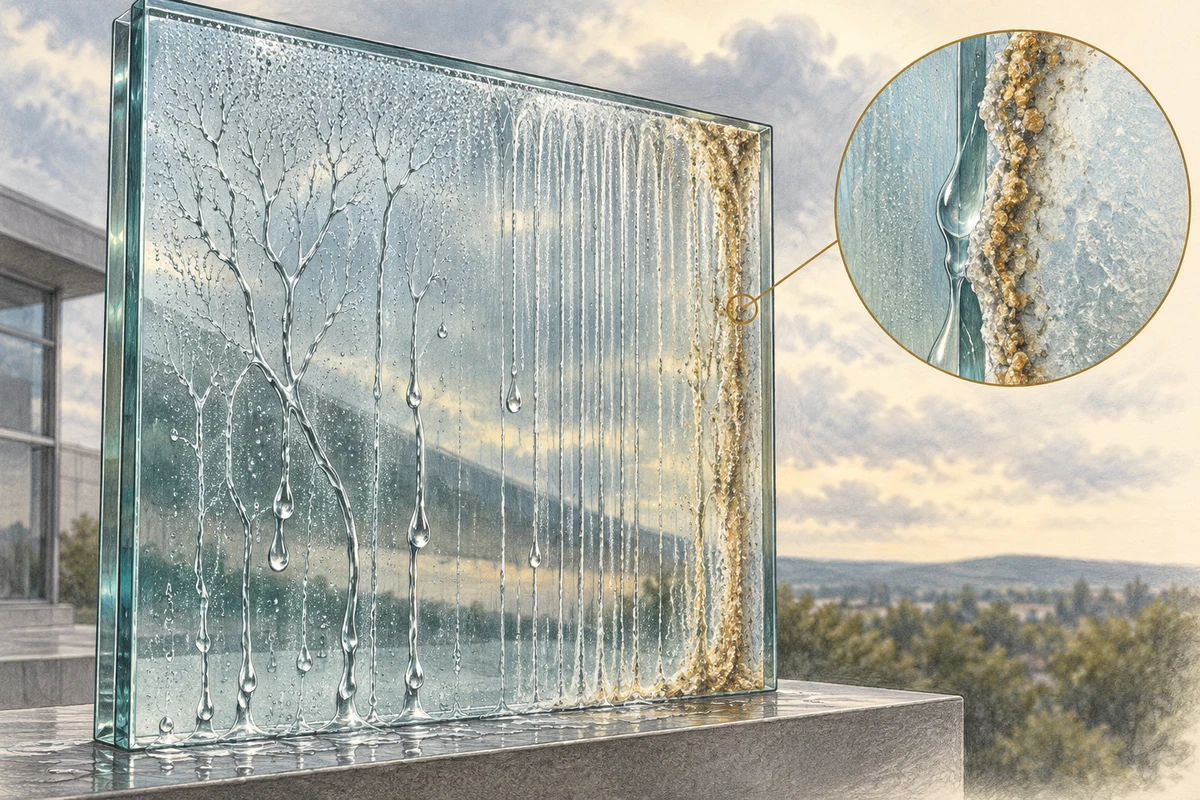
Condensation / Runoff Patterns
Environmental residue/attack — recurring moisture paths concentrating soils/minerals; rivulet maps, drip legs, head-to-sill curtains; typically SC-0 for residue films, SC-1 where micro-texture develops from cyclic deposition
Condensation / runoff patterns are appearance changes on glass driven by recurrent water paths (dew, HVAC condensation, building runoff, irrigation overspray) that concentrate dissolved soils/minerals and produce rivulet maps, drip legs, curtains, and edge blooms. With prolonged cycling, very shallow micro-texture may form in preferred paths. Classification is appearance-only per VIS (method-agnostic).
Illustration, reference page, and PDF complete
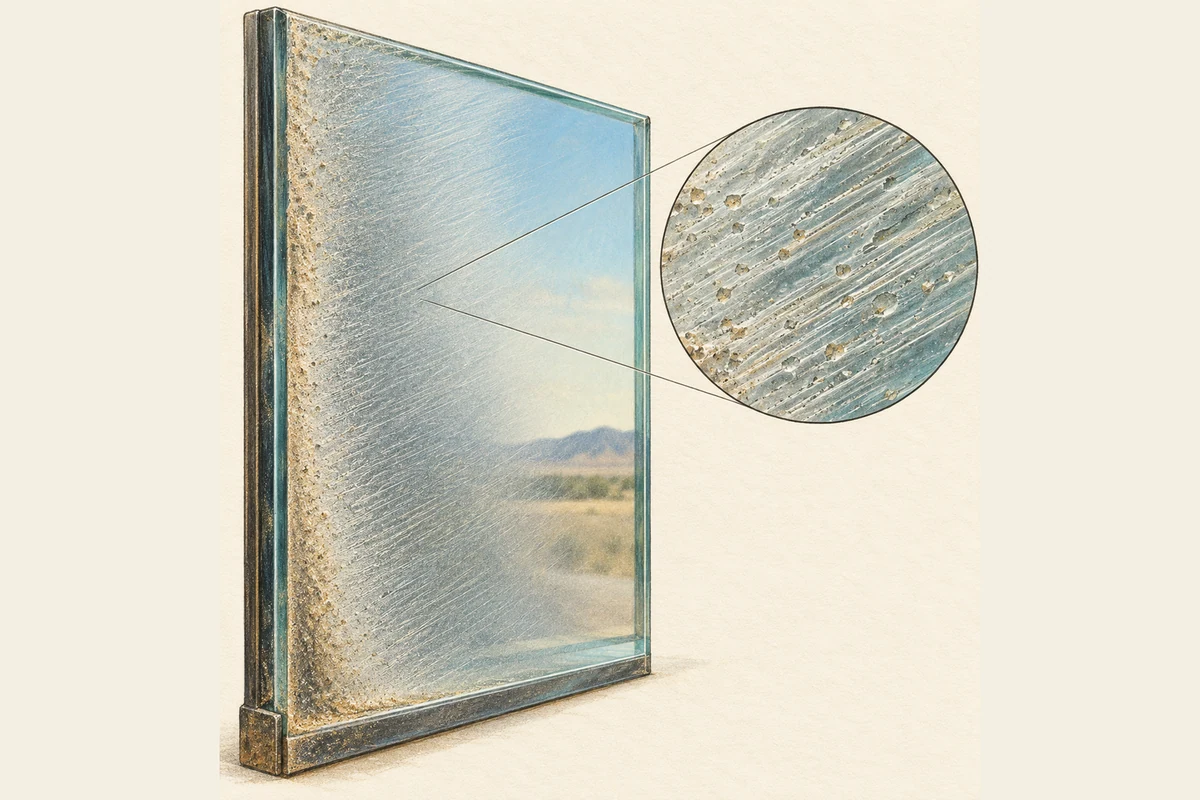
Wind-Borne Sand Abrasion (Eolian)
Environmental abrasion — airborne mineral particulates driven by wind; directional frosting, lee-side bias, frame-adjacent “blast” zones; typically SC-1 to SC-2 where micro-texture/incisions exist
Wind-borne sand abrasion is an appearance change on glass caused by air-entrained mineral particulates (silica, feldspar, grit) scouring exposed faces under sustained winds. It presents as directional frosting/haze, micro-pitting, and fine linear incisions concentrated on windward elevations and edge “blast” zones near frames and corners. Classification is appearance-only per VIS (method-agnostic).
Illustration, reference page, and PDF complete
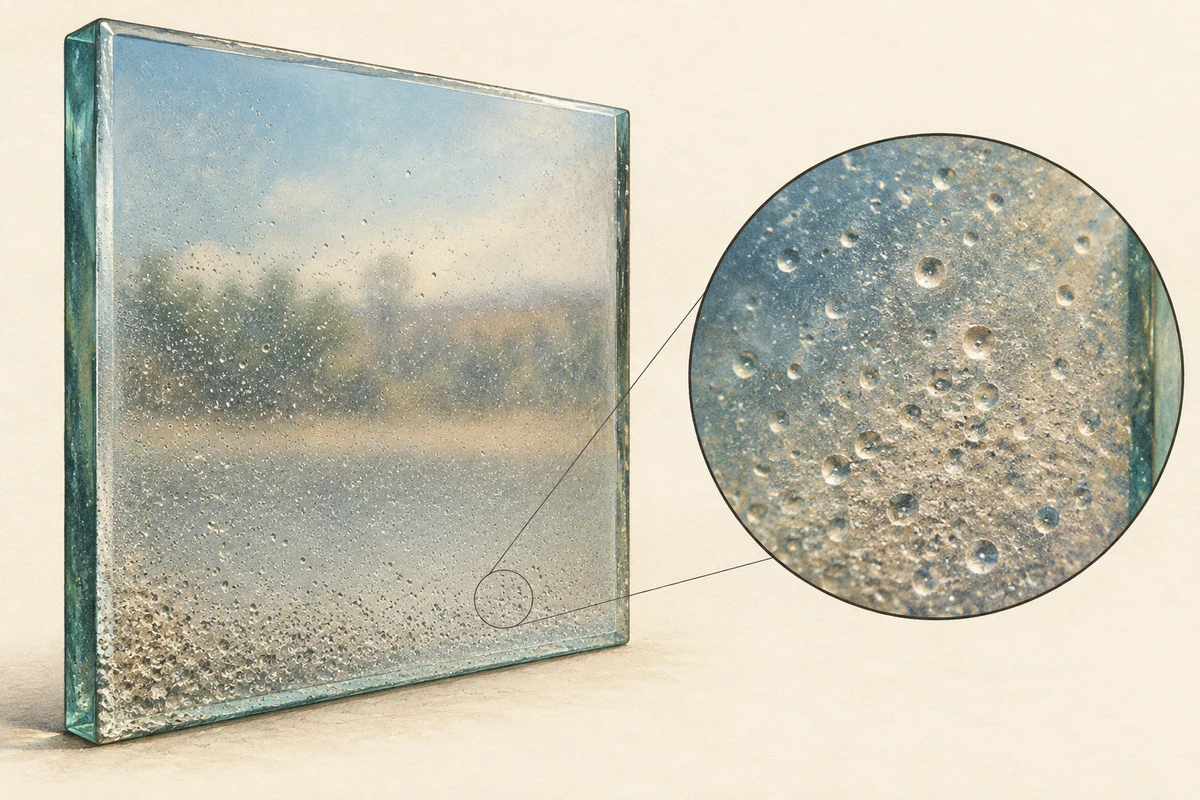
Dust-Storm Micro-Pitting
Environmental abrasion — high-velocity particulate impacts during dust/sand storms; peppered micro-craters, lee/height gradients, edge “blast” zones; typically SC-2 in impacted fields, SC-1 at margins
Dust-storm micro-pitting is an appearance change on glass caused by high-velocity mineral particulate impacts during dust/sand storm events, producing peppered micro-craters and a matte scatter field. Concentrations track wind exposure, building geometry, and near-grade vortices, often forming edge blast zones and height gradients. Classification is appearance-only per VIS (method-agnostic).
Illustration, reference page, and PDF complete
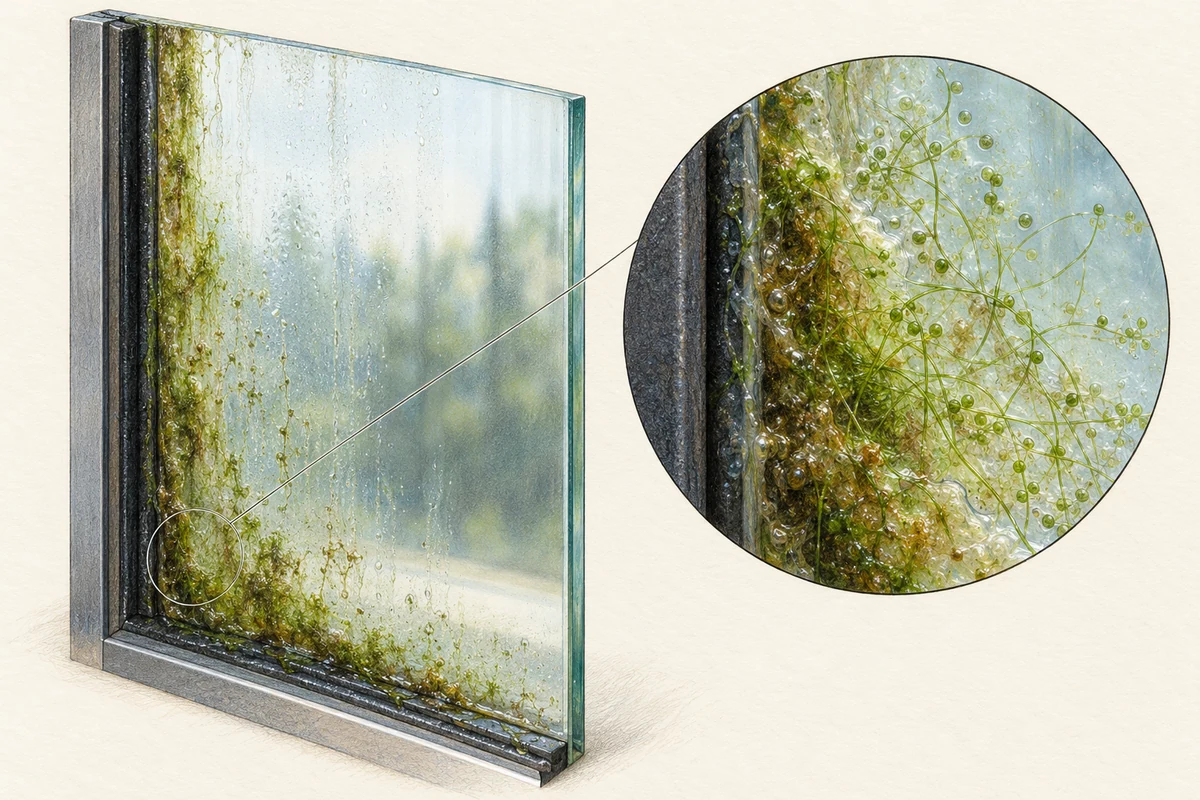
Algae / Biofouling Film
Biological residue — microbial/algal growth on moisture-retentive façades; green/brown film, strandy colonies at edges/sealants, wetting anomalies; typically SC-0, localized SC-1 where biofilm traps grit and induces shallow micro-texture
Algae / biofouling film is an appearance change on glass resulting from microbial colonization (algae, cyanobacteria, biofilms) under persistent moisture and nutrient availability (organics, dust). It presents as green to brown films, strand/filament colonies at gasket/edge zones, and wetting anomalies where biofilm alters surface energy. Classification is appearance-only per VIS (method-agnostic).
Illustration, reference page, and PDF complete
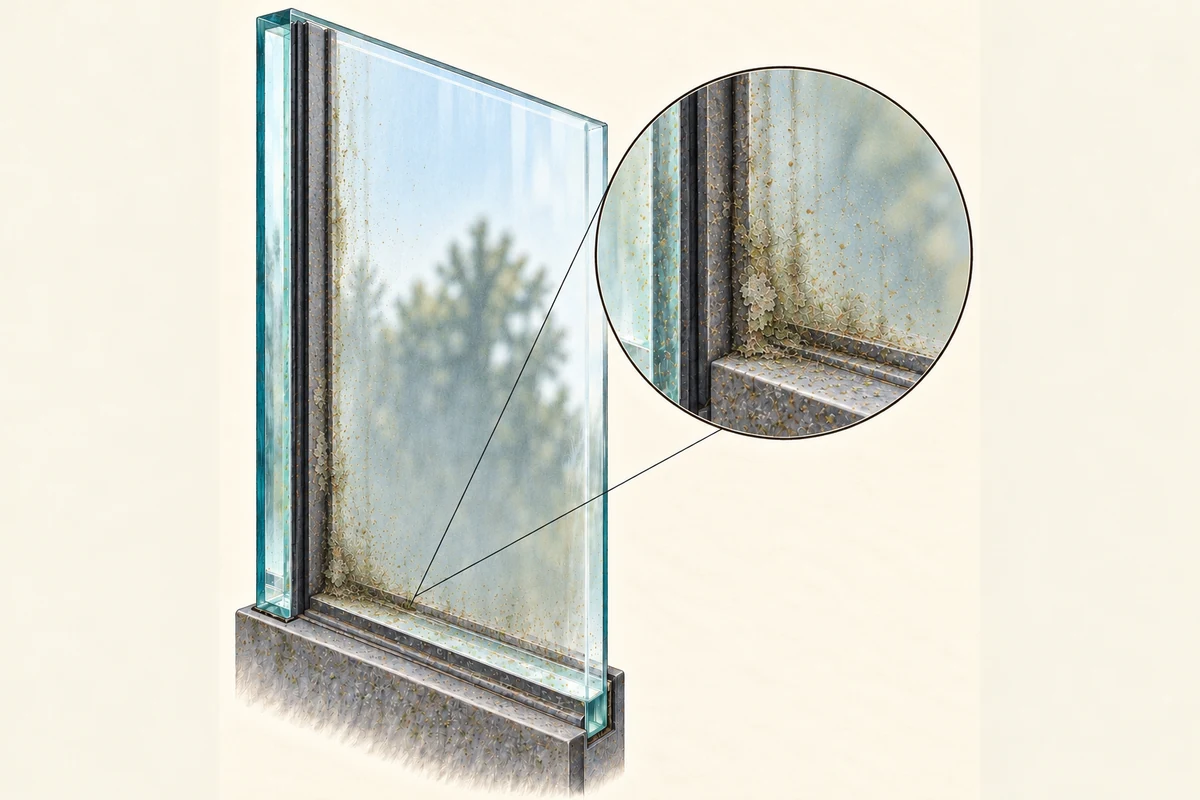
Lichens / Moss (Rough Adhesion)
Biological residue/growth — symbiotic fungi–algae (lichens) and bryophytes (moss) adhering where moisture and nutrients persist; rough, tenacious pads/tufts, edge colonization; typically SC-0 for organic mass, localized SC-1 where grit is trapped or prior abrasive wiping occurred
Lichens / moss represent biological colonization on glass under persistent damp/shade with nutrient deposition (dust, organics). They appear as tenacious rough pads (lichens) or small green tufts (moss), commonly edge-biased near gaskets, sealants, weeps, horizontal ledges, and shaded façades. Classification is appearance-only per VIS (method-agnostic). Inspect after Non-Invasive Reveal under VIS lighting/geometry;
Illustration, reference page, and PDF complete
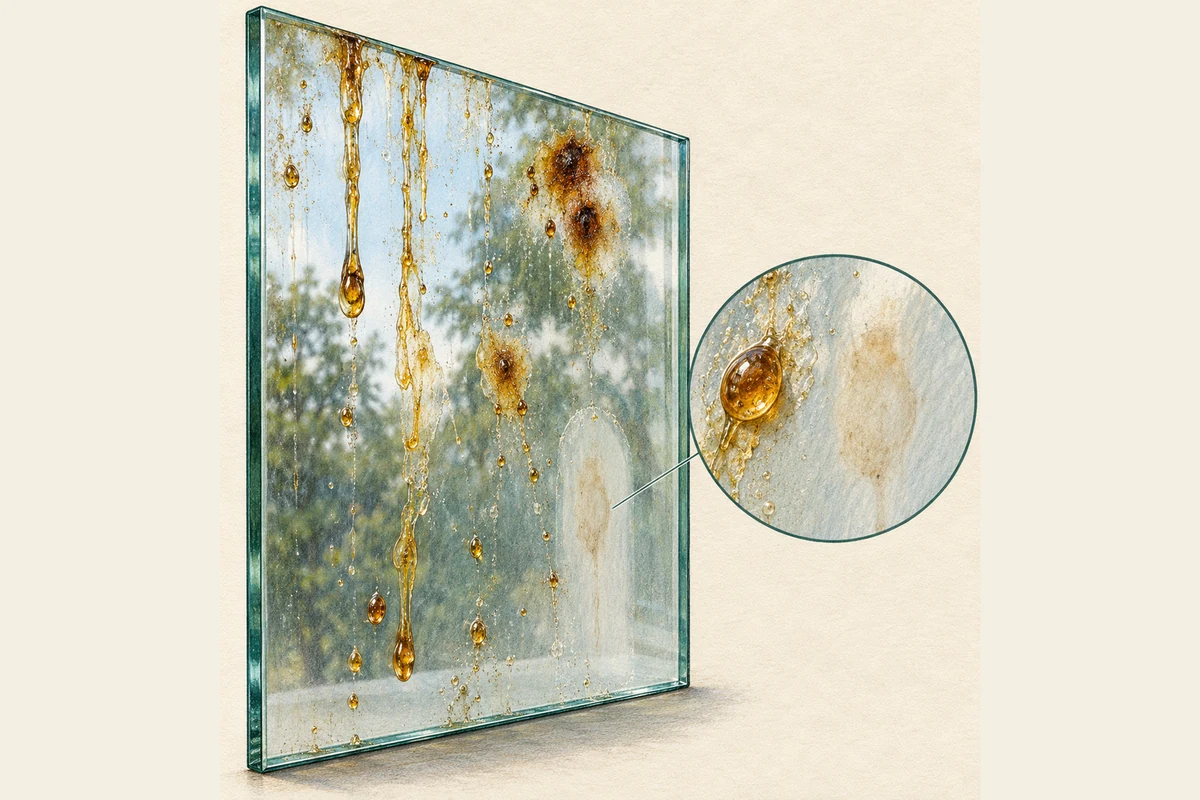
Tree Sap / Organic Exudate Shadow
Biological/organic residue & shadowing — resin/exudate droplets, smears, UV-browned films; amber tacky spots, stringers, wetting anomalies; typically SC-0 for fresh residue, localized SC-1 where long dwell/UV causes very shallow micro-texture; reclassify to chemical etch if substrate matte persists
Tree sap / organic exudate shadow is an appearance change on glass arising from plant resins/exudates (e.g., conifer resin, honeydew, plant gums) that deposit as amber droplets/films and may brown under UV. It presents as tacky amber spots, stringy smears, or browned films with distinct wetting anomalies; after removal, a shadow (tone change) may remain where long dwell + UV altered the near-surface.
Illustration, reference page, and PDF complete
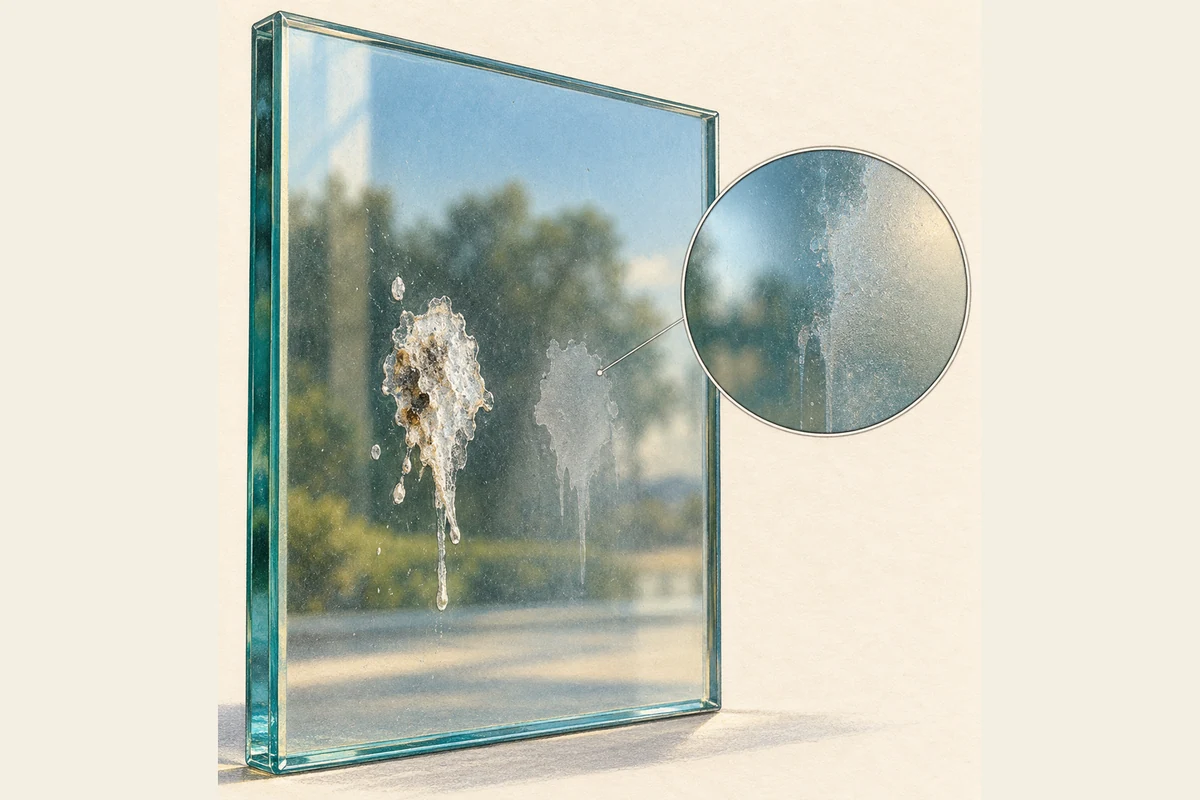
Avian Residue Acid Shadow
Biological/organic residue & acid shadowing — bird droppings with urates/organics; discrete splats with radial feathering, white urate crust; post-lift color/shine “shadow”; typically SC-0 for fresh residue, localized SC-1 where long dwell/heat induces very shallow micro-texture; reclassify to chemical etch if substrate matte persists
Avian residue acid shadow is an appearance change on glass produced by bird droppings (mixture of uric acid/urates, water, organics) that deposit as discrete splats and may bleach or dull the underlying glass after removal, leaving a color/shine “shadow.” High dwell time, sun/heat, and repeated incidents increase the likelihood of near-surface alteration. Classification is appearance-only per VIS (method-agnostic).
Illustration, reference page, and PDF complete
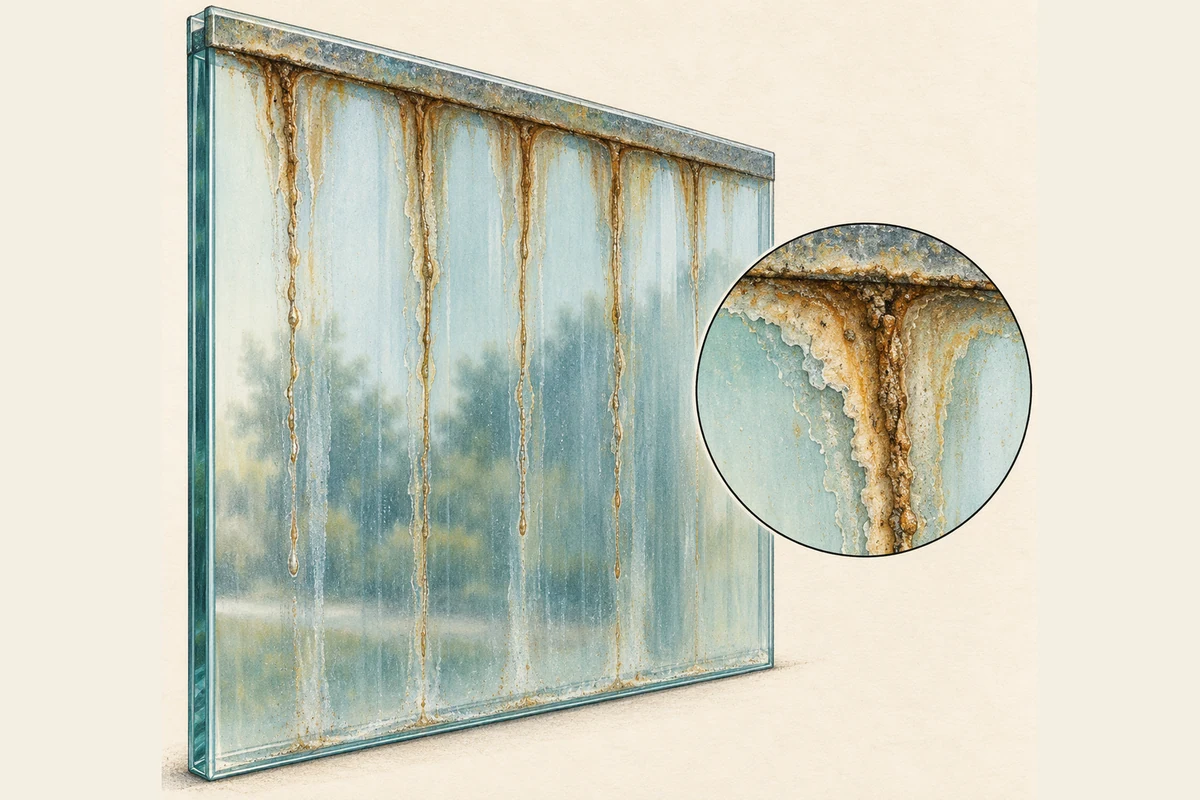
Recurring Drip / Run Staining Pattern
Environmental residue/attack — repetitive gravity-flow paths concentrating soils/minerals from architectural features; vertical drip legs, fan runs, repeat at identical elevations; typically SC-0 for residue films, SC-1 where cyclic deposition forms very shallow micro-texture; reclassify to mineral system if crystalline rims/etch are dominant
Recurring drip/run staining is an appearance change on glass caused by repeated gravity-driven moisture paths that carry soils/minerals/organics from upstream features (caps, signage letters, flashings, parapets, shading fins). It presents as vertical “drip legs,” fan-shaped runs, or curtains that repeat at the same height across adjacent lites beneath the same source detail.
Illustration, reference page, and PDF complete
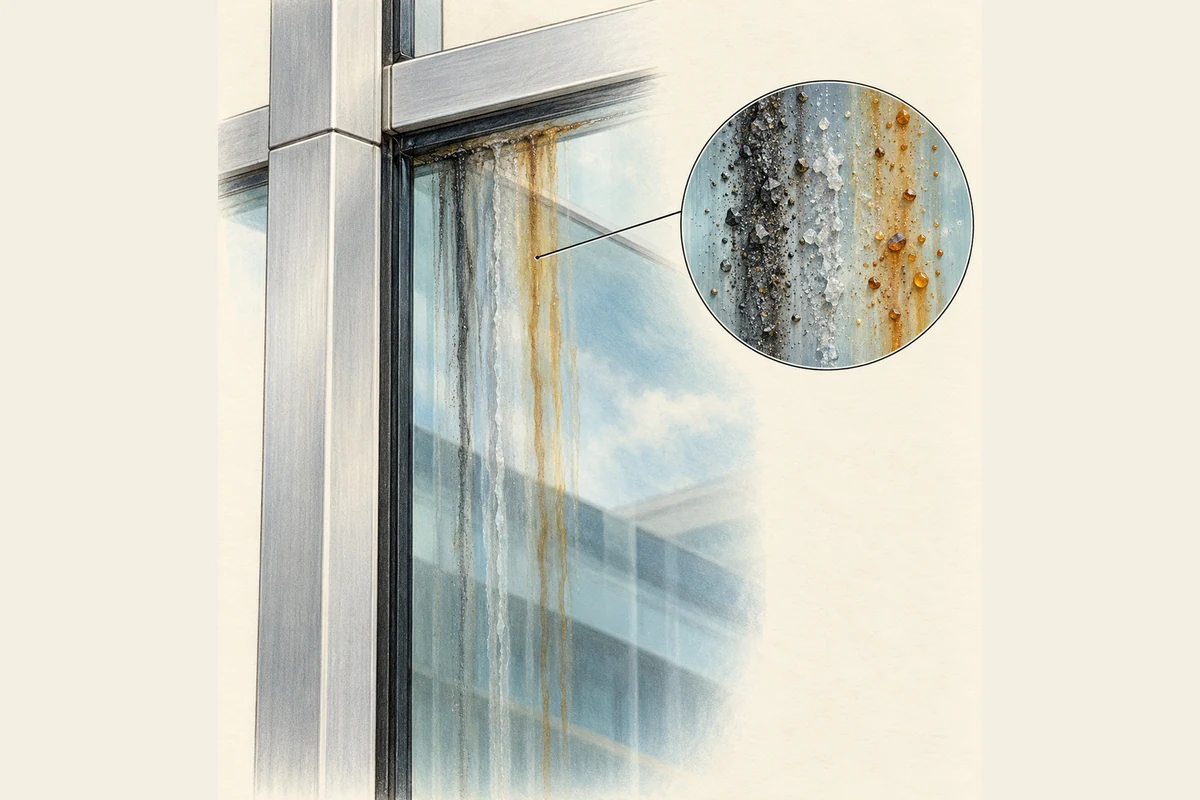
Curtain Wall Runoff Staining (Adjacent Materials Interactions)
Environmental residue/attack — soils/minerals/chemicals mobilized from adjacent envelope materials; vertical bay-to-bay run curtains, tannin/metal oxide tones, silicone/bitumen halos; typically SC-0 for film-only, localized SC-1 where cyclic deposition produces very shallow micro-texture; reclassify to mineral system if crystalline rims/etch dominate
Curtain wall runoff staining (adjacent materials interactions) is an appearance change on glass caused by moisture transporting constituents from neighboring materials—sealants, gaskets, metals, masonry, timber, coatings—onto the glass surface during rain/dew/condensation events.
Illustration, reference page, and PDF complete
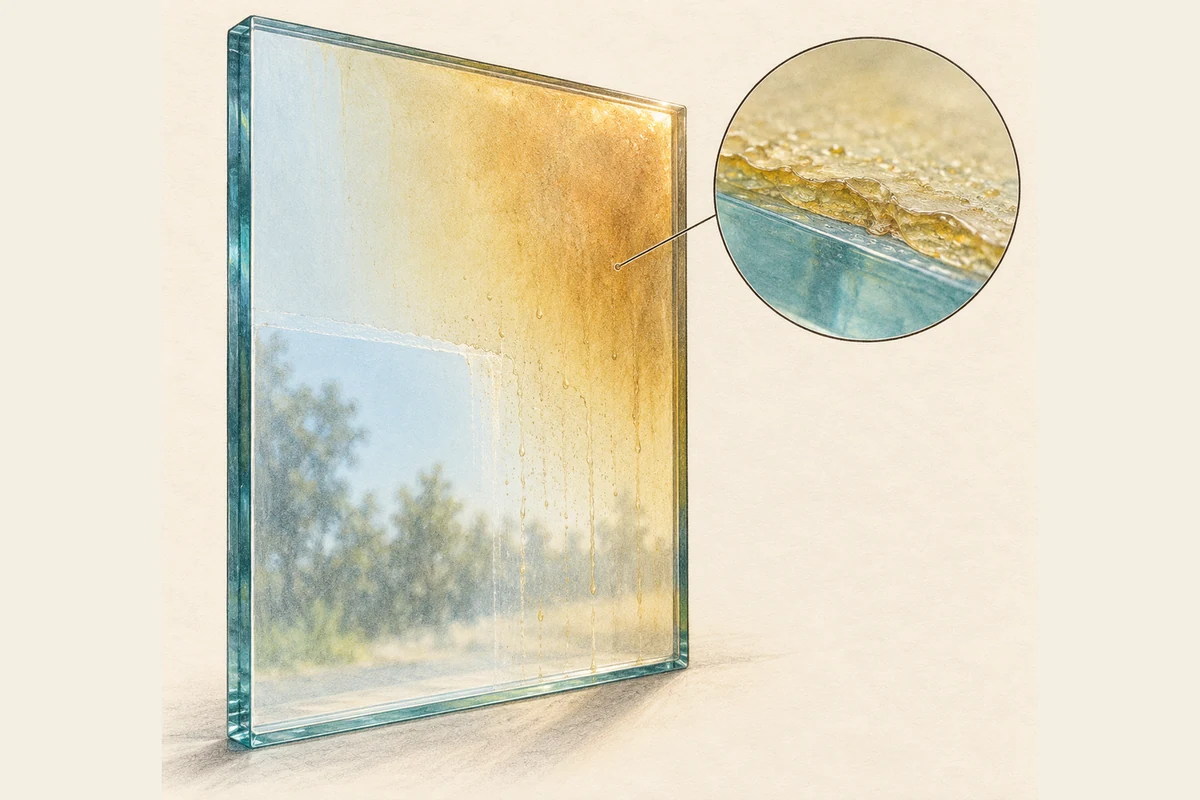
UV-Induced Browning / Yellowing of Residues
Photo-degradation of films — chromophore formation/oxidation within organic residues; amber/yellow cast, loss of clarity, wetting anomalies; typically SC-0 for film-only, localized SC-1 where long dwell/UV yields very shallow micro-texture
UV-induced browning/yellowing of residues is an appearance change on glass caused by photo-oxidation and polymerization within organic surface films (detergent remnants, maintenance additives, kitchen/HVAC aerosols, tree resins/honeydew carryover), producing a persistent amber/yellow veil and wetting anomalies. With prolonged exposure, very shallow micro-texture may develop beneath the film.
Illustration, reference page, and PDF complete
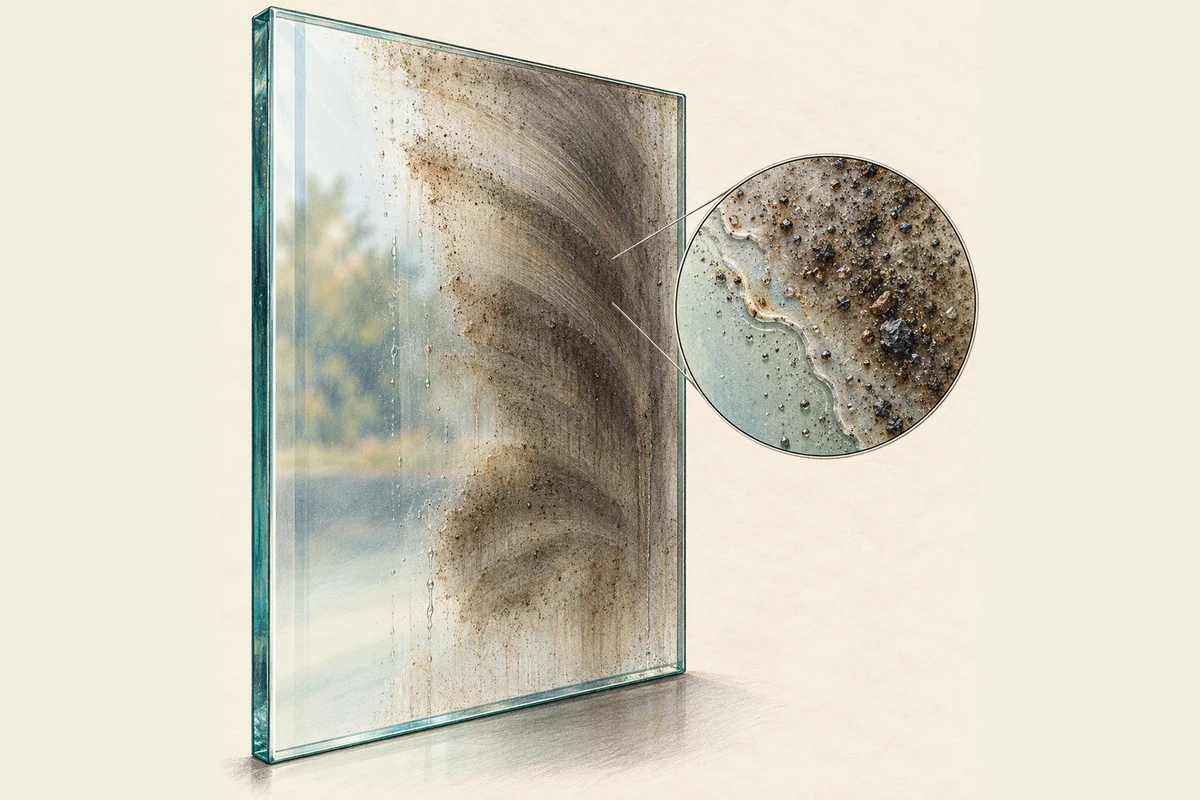
Oxidation Darkening of Films
Photo-degradation of films — oxidative crosslinking/soot capture within organic residues; grey→brown dark veil, loss of specular “snap,” wetting anomalies; typically SC-0 for film-only, localized SC-1 where long dwell yields very shallow micro-texture
Oxidation darkening of films is an appearance change on glass caused by oxidative aging of organic surface residues (maintenance detergents/additives, HVAC/kitchen aerosols, traffic-related organics) and/or particulate entrainment (soot/oxyde fines) within those films. It presents as a neutral grey to brown dark veil, often patchy and aligned with wipe paths or airflow cones, with wetting anomalies at boundaries.
Illustration, reference page, and PDF complete
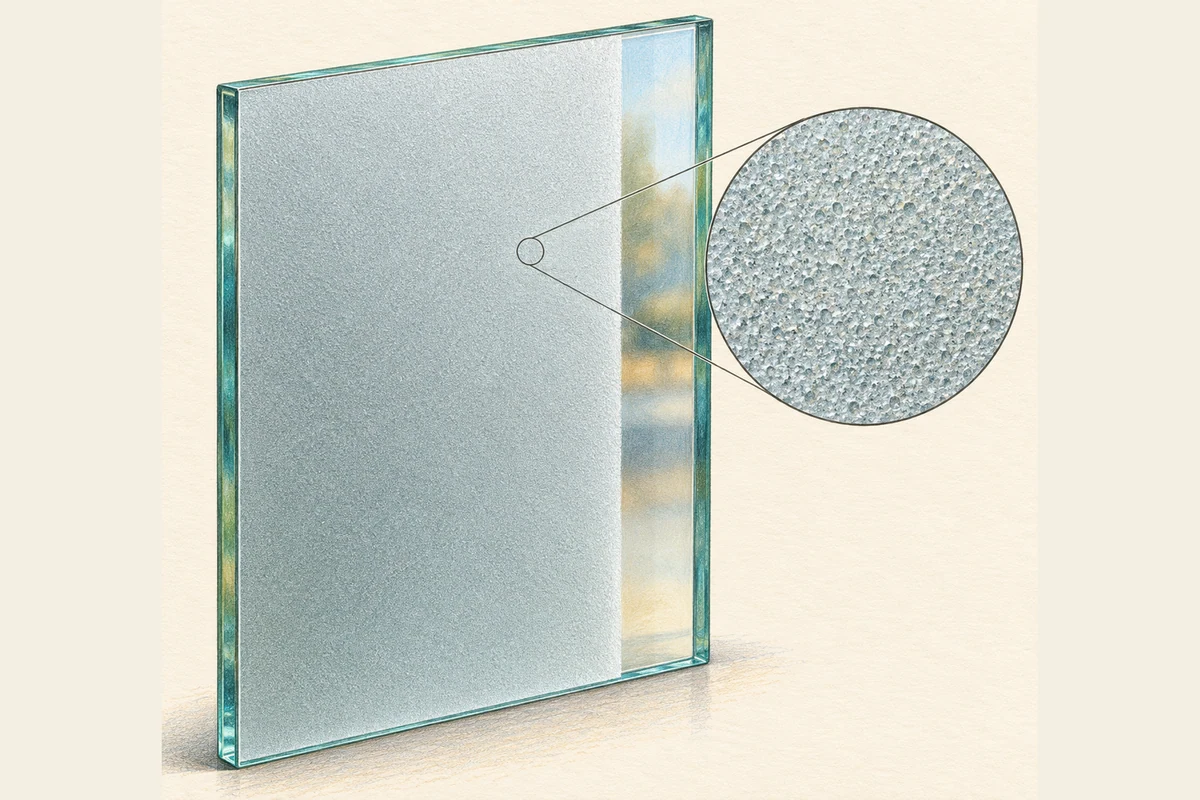
Sandblast / Abrasive-Blast Etch (Uniform Frosted Field)
Intentional surface modification — abrasive impact removal of surface glass; uniformly matte/frosted fields with boundary masks; typically SC-2 across worked areas; depth depends on media, pressure, dwell, and mask design
Sandblast / abrasive-blast etch is an appearance change on glass produced by propelled abrasive media (e.g., silica, aluminum oxide, garnet, glass bead, soda) that erodes the surface to create uniform or patterned matte/frosted fields. Presentations include full-field frosting, masked graphics, and stencil lettering. Classification is appearance-only per VIS (method-agnostic).
Illustration, reference page, and PDF complete
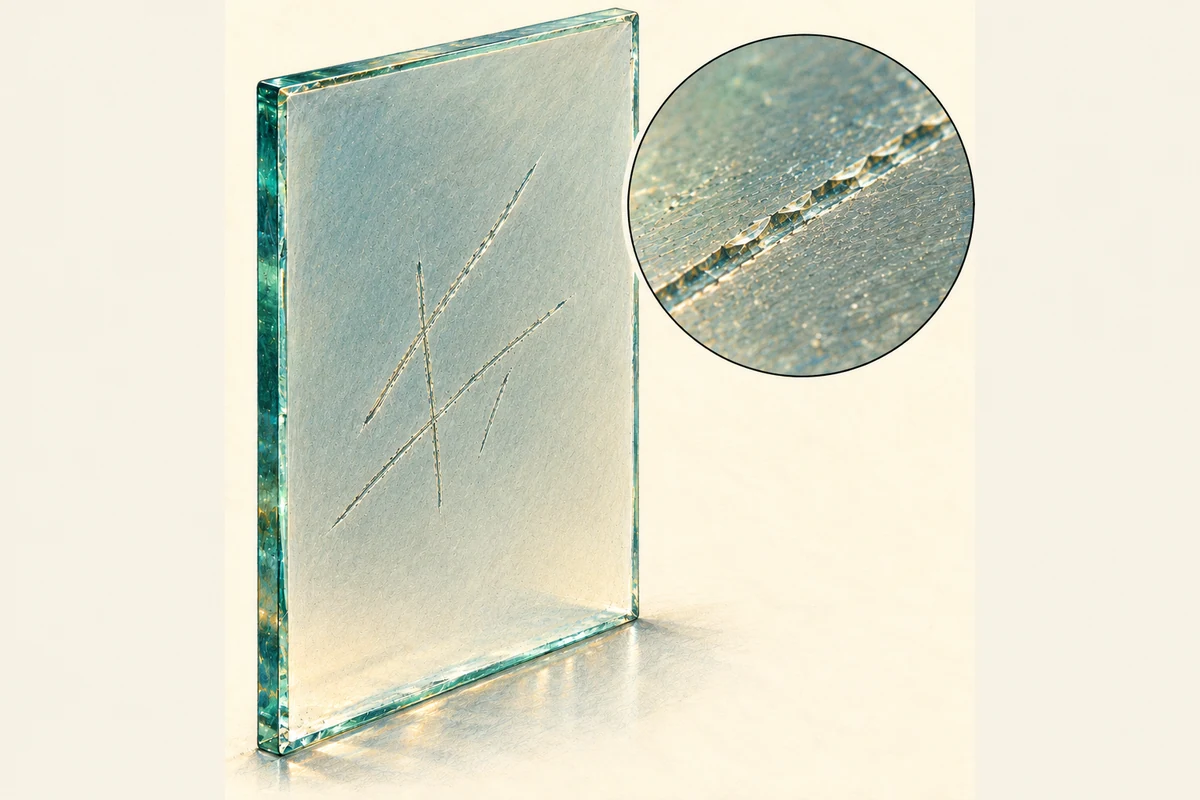
Scribed / Engraved Tool Marks
Intentional surface modification — hard-point incision of glass with metal/ceramic tools; discrete linear grooves, alphanumerics, or graphic outlines; chip-flank sparkle under raking; typically SC-2 along grooves, SC-1 at feathered tails
Scribed / engraved tool marks are appearance changes created by hard-point contact (carbide/steel points, diamonds, glass cutters, masonry nails, ceramic chips) drawn across the glass surface to inscribe letters, numbers, outlines, or linear tags. The action cuts and plows the surface, producing grooves with micro-chipping (chip flanks) and bright edge sparkle in raking light.
Illustration, reference page, and PDF complete
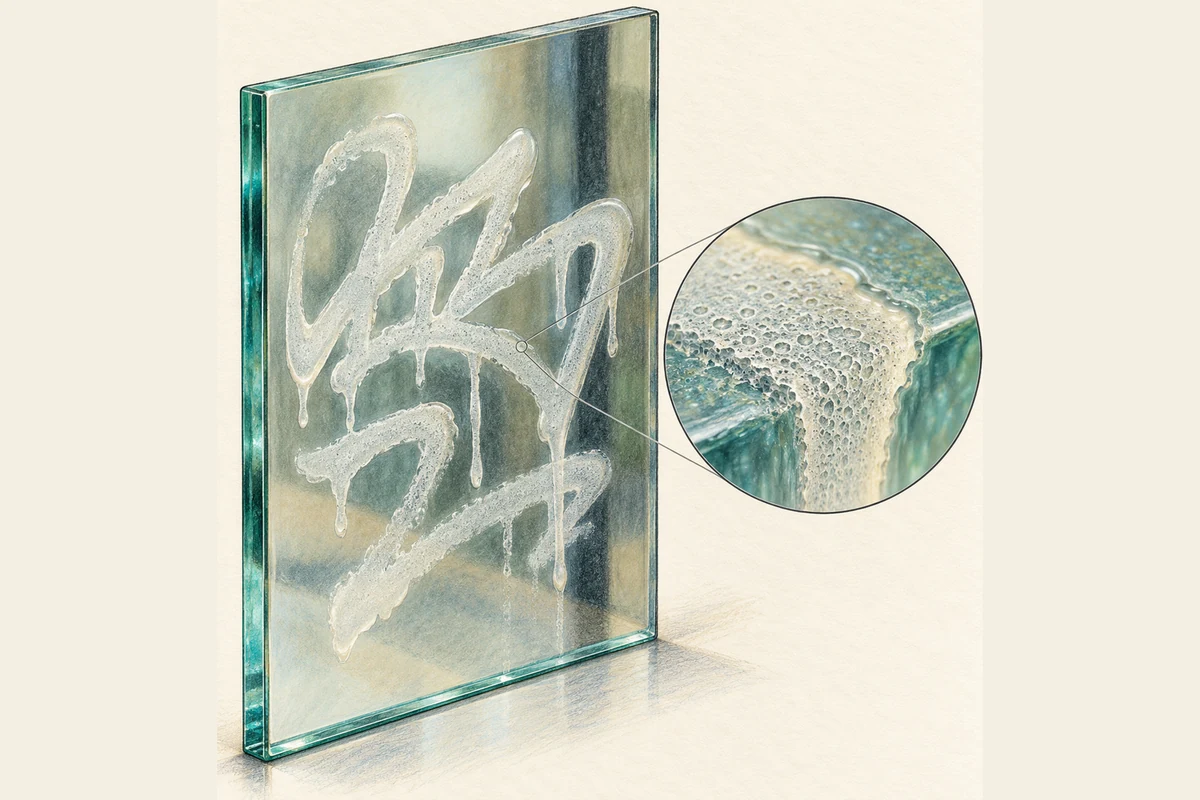
Acid-Marker Tagging (HF-Bearing)
Intentional chemical etch — field-applied acids/fluoride gels; whitened modeled micro-texture with run legs/cream swirls/meniscus rings; typically SC-2 in worked strokes, SC-1 at feather; depth depends on chemistry, dwell, and reapplication
Acid-marker tagging is an appearance change produced by field-applied acidic agents (often HF-bearing gels/creams or “etch pens”) that chemically attack silica, creating whitened, matte micro-texture in letter/stroke geometry. Presentations include freehand tags, initials, and panel-fill scribbles; artifacts such as cream swirls, meniscus rims, runs/drips are common.
Illustration, reference page, and PDF complete
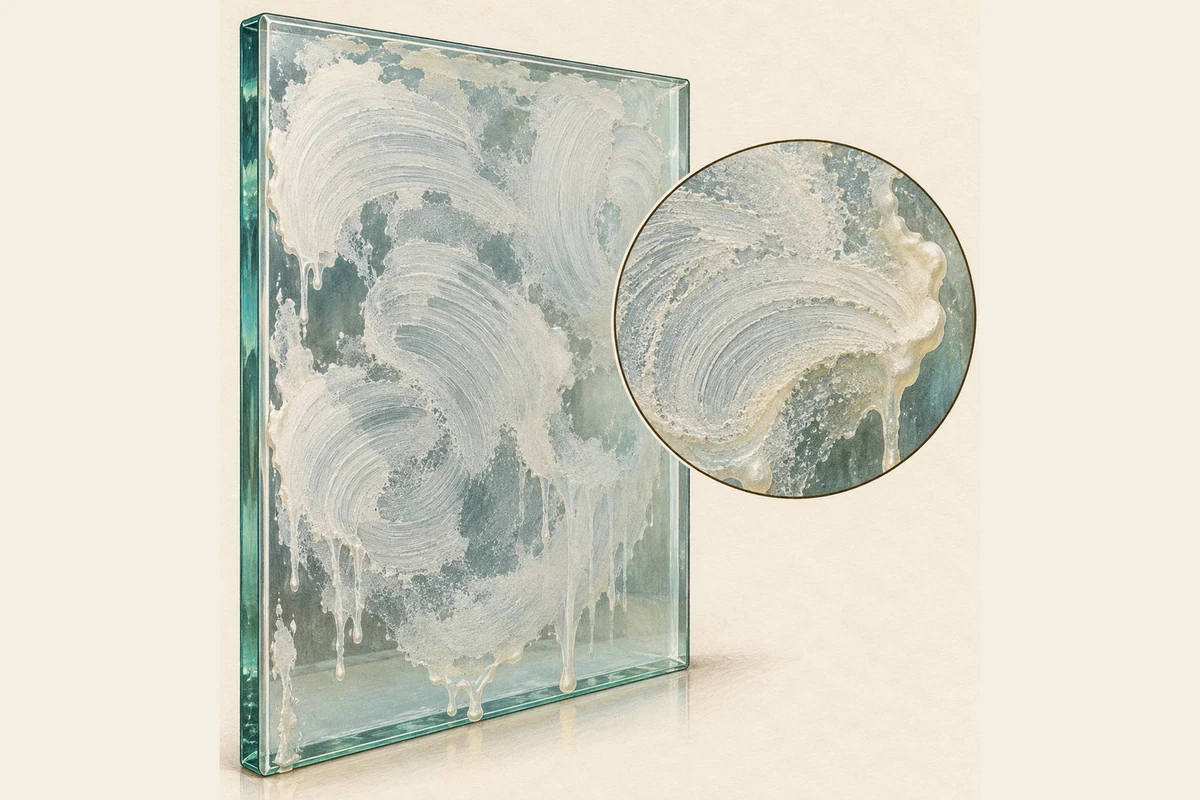
Etch-Cream Patterning (Consumer Etchant Traces)
Intentional chemical etch — store-bought glass/ceramic etch creams and gels; patchy white/milky fields, brush/dauber swirls, pooled meniscus rims; typically SC-2 within worked areas, SC-1 in feathered halos; depth varies with dwell/reapplication
Etch-cream patterning is an appearance change created by consumer or contractor-grade etching creams/gels (commonly fluorides/acidic bases intended for glass/ceramics). Application by brush, dauber, sponge, or finger yields patchy white/milky micro-texture with tool-mark swirls, pooling at edges, and drip legs if over-applied.
Illustration, reference page, and PDF complete
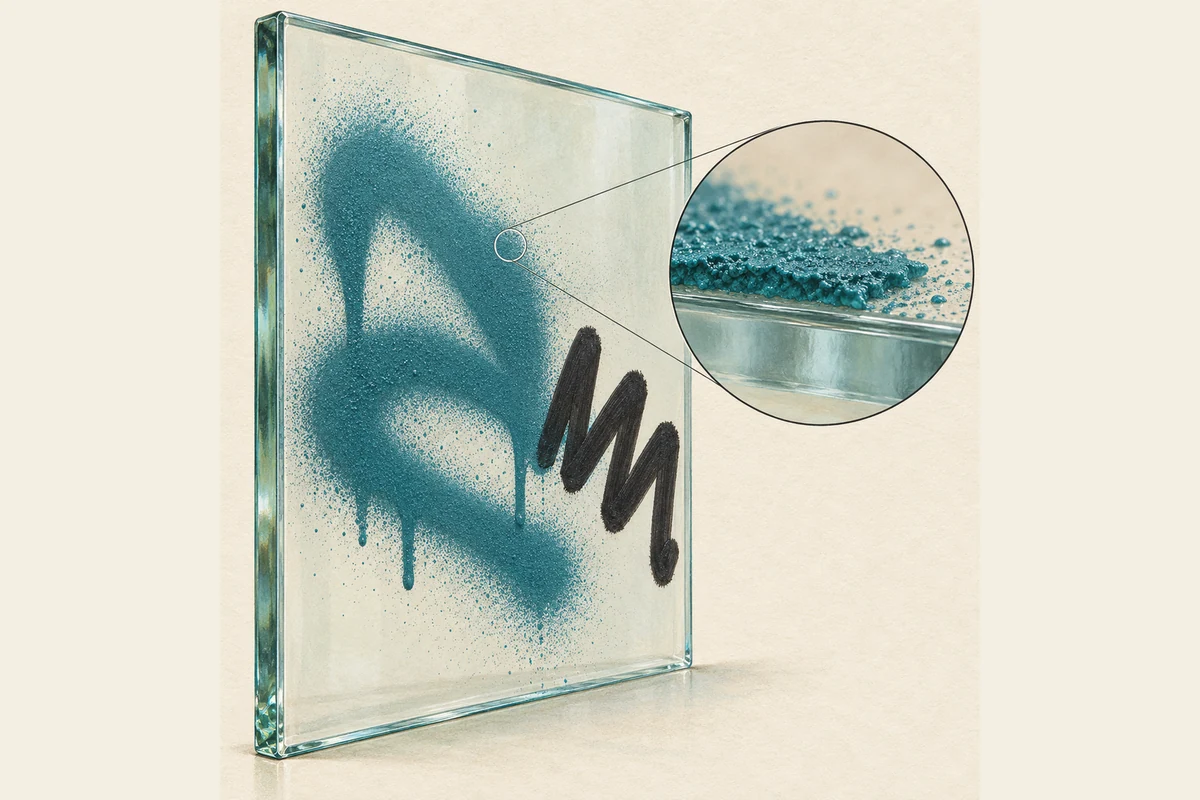
Spray Paint / Marker Coatings
Intentional applied coatings — paint/ink films deposited on glass; opaque/semi-opaque color fields, drips, feathered overspray, felt-tip stroke geometry; typically SC-0 for film-on-top, localized SC-1 only where prior abrasive attempts introduced shallow micro-texture; reclassify to chemical/mechanical families if substrate alteration persists after true film lift
Spray paint / marker coatings are appearance changes caused by deliberate application of paints or inks (aerosol lacquer/acrylic/alkyd, enamel, permanent markers, paint pens) onto the glass surface, producing opaque or semi-opaque films, stenciled fills, or freehand tags. The applied medium sits atop the glass and, absent prior abrasive attempts, does not alter the substrate.
Illustration, reference page, and PDF complete
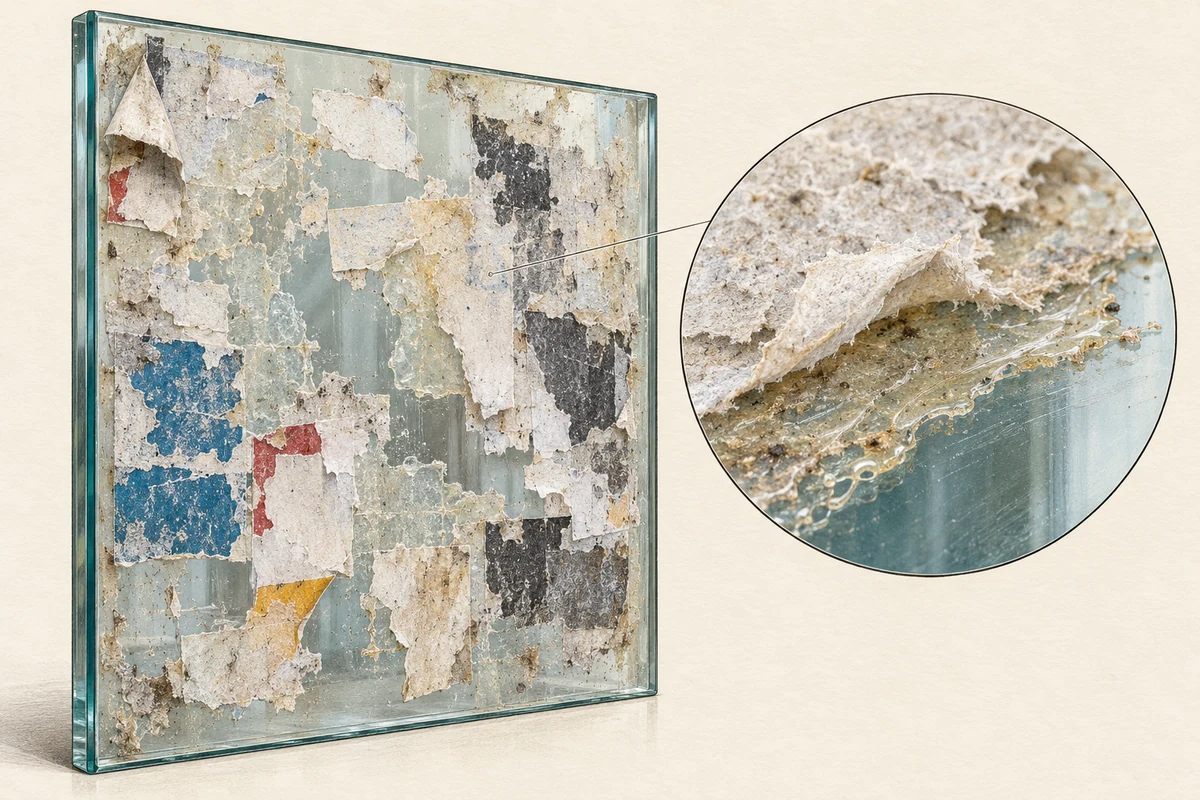
Sticker / Poster Adhesive Campaigns (Mass Adhesive Residue)
Intentional applied materials — large-area paper/vinyl labels, posters, and campaign stickers; residual adhesive films, paper fiber ghosts, grid liner prints; typically SC-0 for intact film-on-top, localized SC-1 where prior scraping introduced very shallow micro-texture; reclassify if substrate alteration persists after true residue lift
Sticker/poster adhesive campaigns are appearance changes from affixed labels, posters, and vinyls applied to glass, leaving adhesive films, paper fiber ghosts, and outline “shadows.” Multi-layer campaigns may build heterogeneous films with edge dirt rims. The materials are exogenous; absent abrasive attempts, the substrate remains unaltered. Classification is appearance-only per VIS (method-agnostic).
Illustration, reference page, and PDF complete
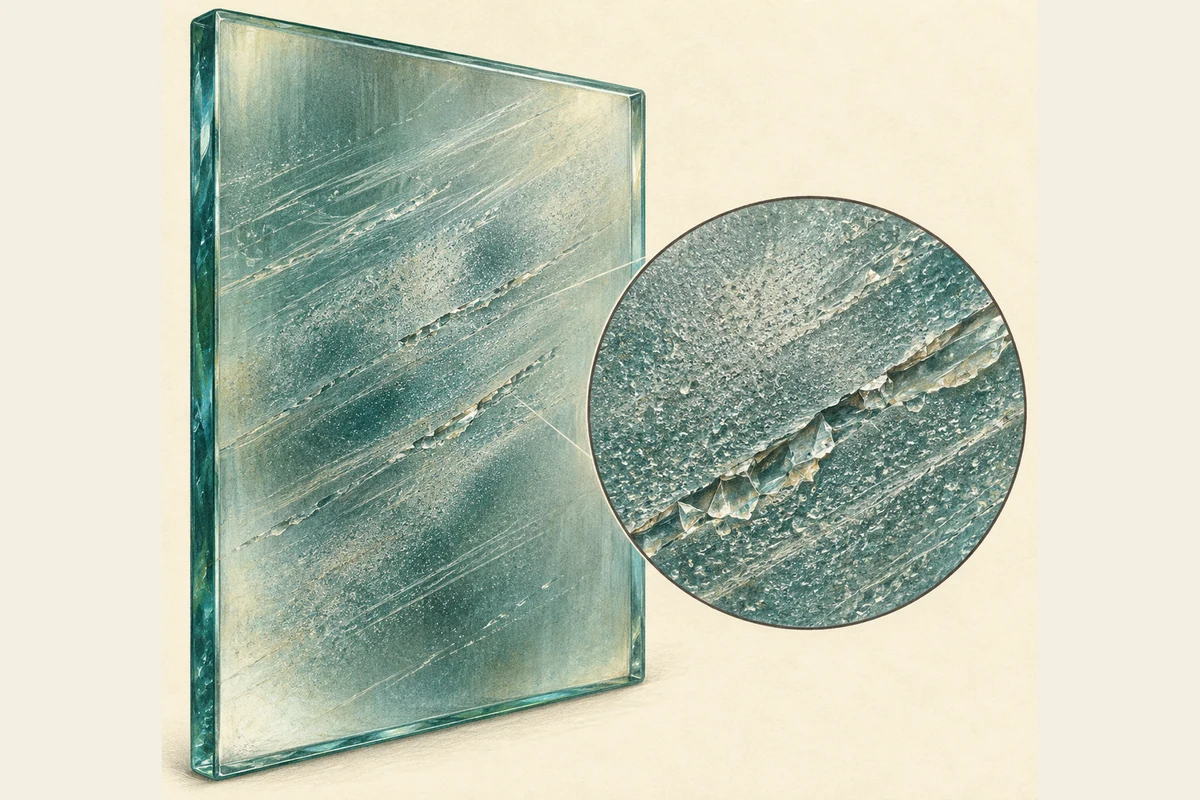
Mixed Chemical–Mechanical Field (Etch + Track / Hybrid Presentation)
Mixed mechanism — overlapping chemical alteration and mechanical abrasion/scoring; modeled micro-texture with superposed linear tracks or scuffs; halos/runs from chemistry plus chip-flank sparkle in lines; SC-1 across etched field with SC-2 along mechanical strokes
Mixed chemical–mechanical field is an appearance change on glass where chemical alteration (acid/alkali/mineral etch or residue-induced micro-texture) coexists with and/or is overlain by mechanical actions (scraper/razor, pad swirls, directional scuffs, or line scoring). The result is a hybrid field in which modeled matte or haloed zones intermix with linear tracks having chip-flank features.
Illustration, reference page, and PDF complete
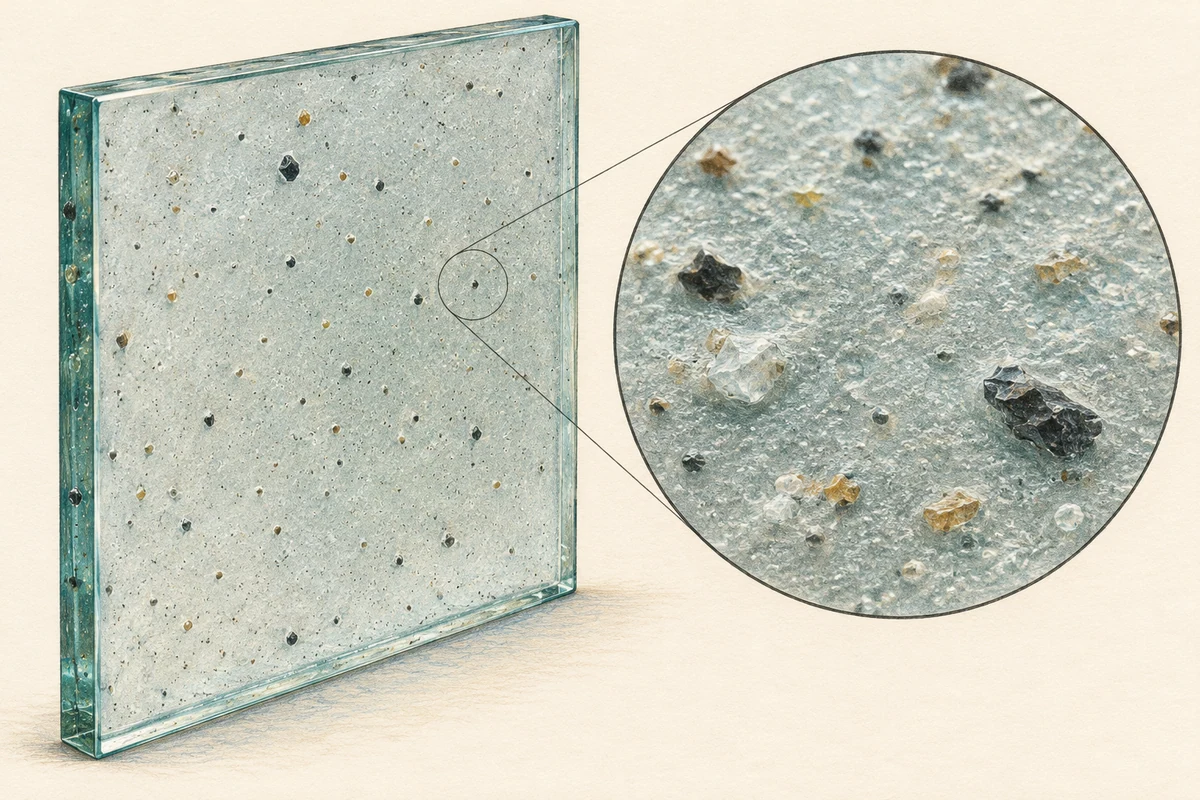
Modeled Micro-Texture with Embedded Particulates (Uncertain Chemistry)
Mixed/unknown mechanism — low-contrast matte with fine embedded or partially embedded specks; may result from chemical softening plus particulate impingement/setting; SC-1 broadly in field, isolated SC-2 at raised particulates or micro-divots
Modeled micro-texture with embedded particulates is an appearance change in which a subtle, non-directional matte field is accompanied by discrete specks that appear embedded or partially seated in the surface. The presentation suggests chemical softening/attack (acidic, alkaline, or mineral) combined with particle deposition/impingement, but the exact chemistry is uncertain.
Illustration, reference page, and PDF complete
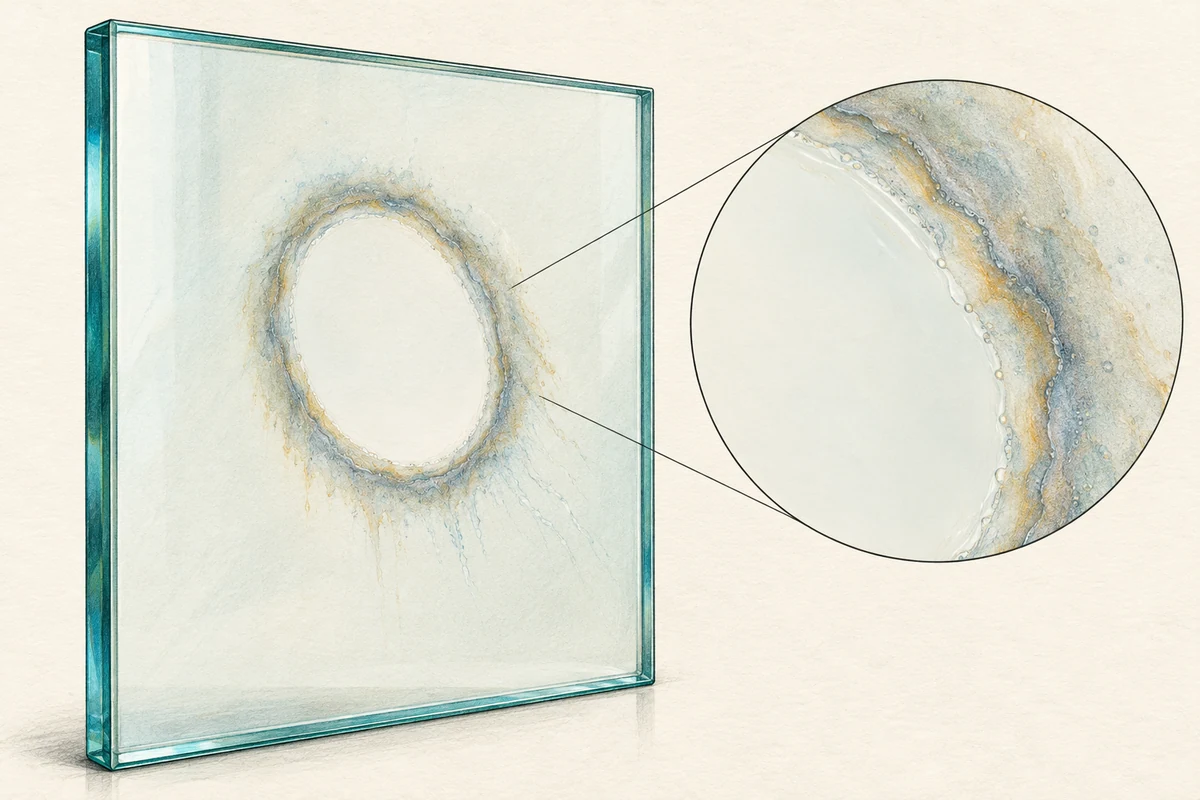
Halo without Central Feature (Unknown Chemistry)
Unknown mechanism — annular rings/ovals with no obvious central nucleus; evaporative/deposition rim remains while core is visually clear; typically SC-0 at core and SC-0–SC-1 on rim; reclassify to mineral/surfactant/sealant families if diagnostic cues present
Halo without central feature is an appearance change presenting as a ring or oval band whose center is not visibly occupied by residue or defect. The annulus is presumed to result from edge-biased deposition during wetting/evaporation, surfactant Marangoni flow, or migration from adjacent materials, but the controlling chemistry is not yet identified. Classification is appearance-only per VIS (method-agnostic).
Illustration, reference page, and PDF complete
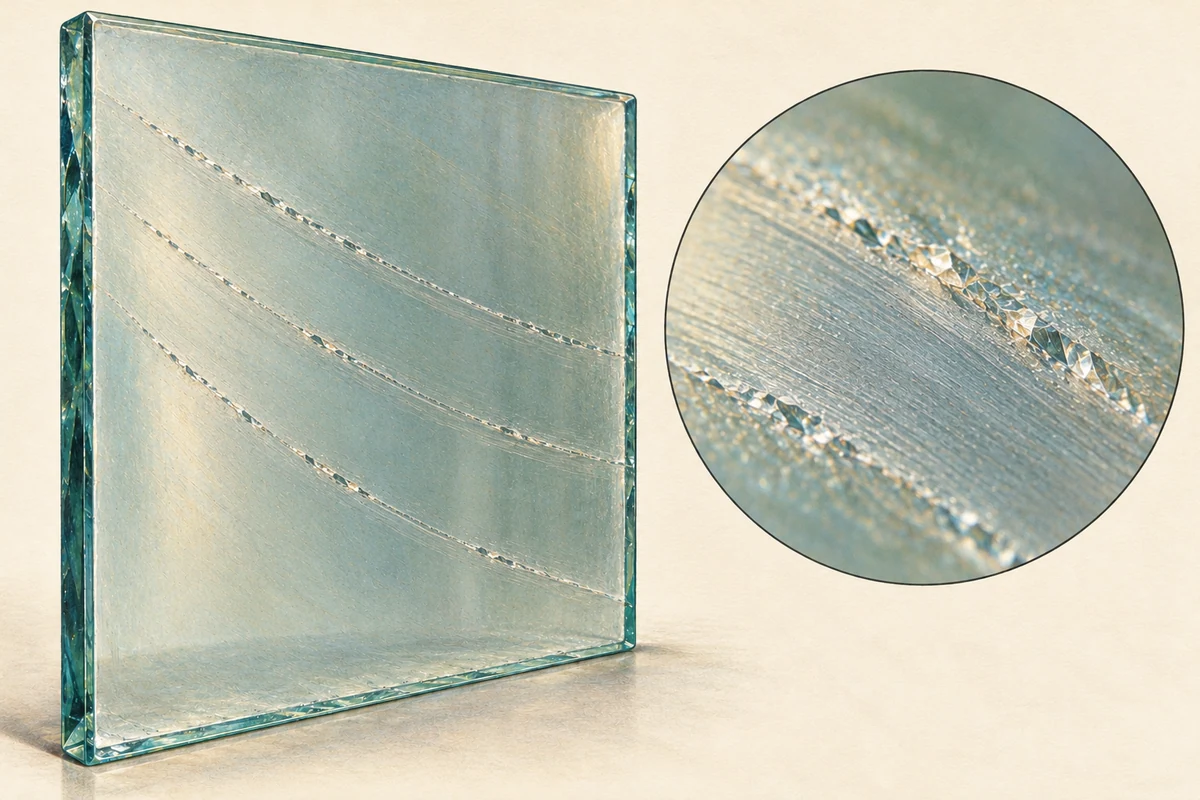
Directional Patterning with Intermittent Chip Flanks (Uncertain Tool/Pad)
Unknown/mixed mechanism — directional lines/arcs with periodic edge sparkle and variable relief; suggests intermittent hard-point contact within an otherwise pad/cloth motion; SC-1 along most paths with localized SC-2 “spikes” at higher-pressure segments or entrained particulates
Directional patterning with intermittent chip flanks is an appearance change characterized by linear or arced paths (often repeating in lanes or sweeps) where most of the path reads as shallow abrasion (SC-1) but localized segments exhibit chip-flank sparkle (SC-2) indicative of momentary hard-point contact (entrained grit, damaged pad edge, nicked squeegee, or tool corner).
Illustration, reference page, and PDF complete
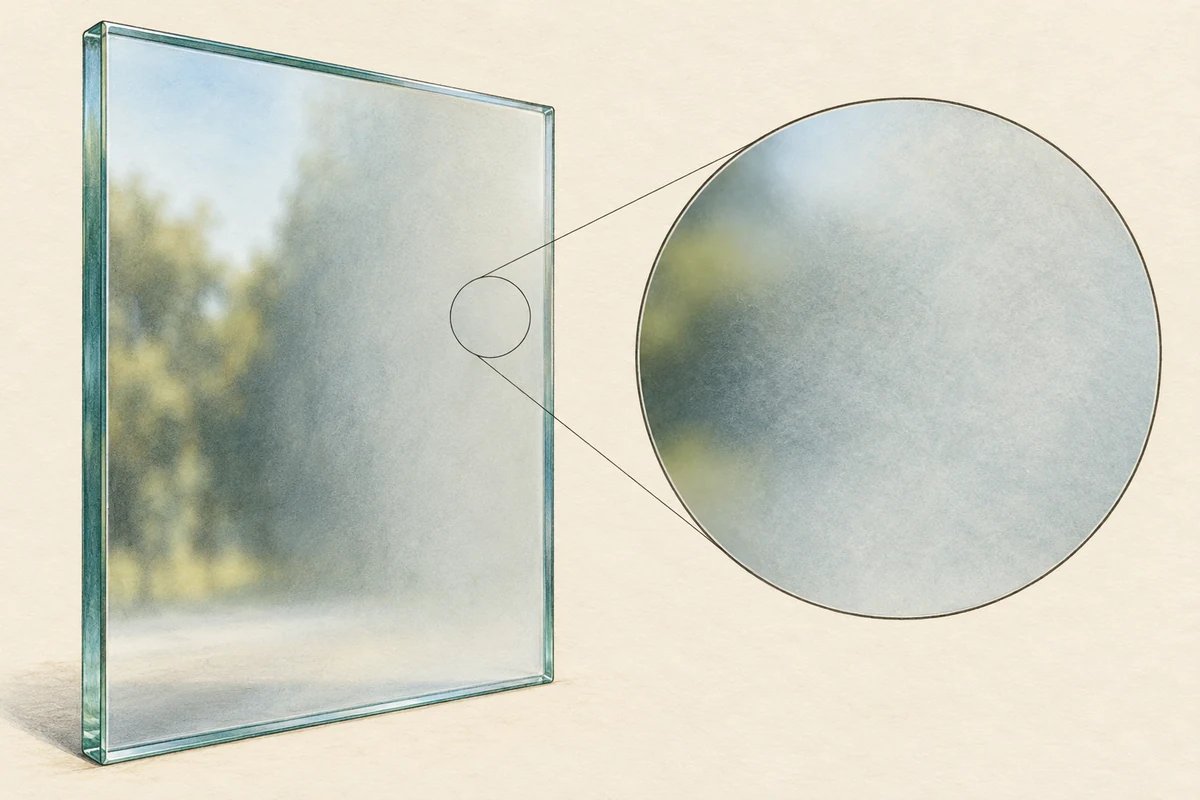
Non-Directional Milky Field, Low Contrast (Undetermined)
Unknown mechanism — broad low-contrast haze without obvious directionality, rings, runs, or discrete particulates; may reflect weathering, aged films, or incipient micro-texture; typically SC-0 to SC-1 across the field
Non-directional milky field (low contrast) is an appearance change characterized by a broad, subtle, “milky” veil over part or all of a lite without clear directional patterning, annular halos, runs/drips, or discrete peppering/pits. Possible contributors include aged organic films, very early environmental weathering, soft chemical exposure short of distinct etch, or legacy maintenance residues.
Illustration, reference page, and PDF complete
No Standards definitions match those filters.