
On this page
- Hard-water conditions: deposit, stain, or etch?
- Identify what remains on the surface after a controlled reveal
- GlassRenu Hard-Water Condition Spectrum
- A repeatable assessment from location to classification
- Confirm the surface
- Document before cleaning
- Establish a clean baseline
- Inspect clean and dry
- Check substrate relief safely
- Assign and document the DSS
- What does the revealed test patch show?
- Glossary and supporting concepts
- Safety, scope, and acceptance
- Source basis and version
RESOURCE CENTER / FIELD ASSESSMENT
Hard-water conditions: deposit, stain, or etch?
Use a clean baseline, controlled reveal, consistent viewing geometry, and surface-relief cues to separate removable mineral material from persistent non-etch staining and actual glass-surface alteration.
THE THREE-CONDITION MODEL
Identify what remains on the surface after a controlled reveal
These definitions align to the existing Ch.03 Hard-Water / Mineral System in the Damage Specification Standards. The DSS identifies the condition; it does not prescribe a restoration method or decide post-restoration acceptance.
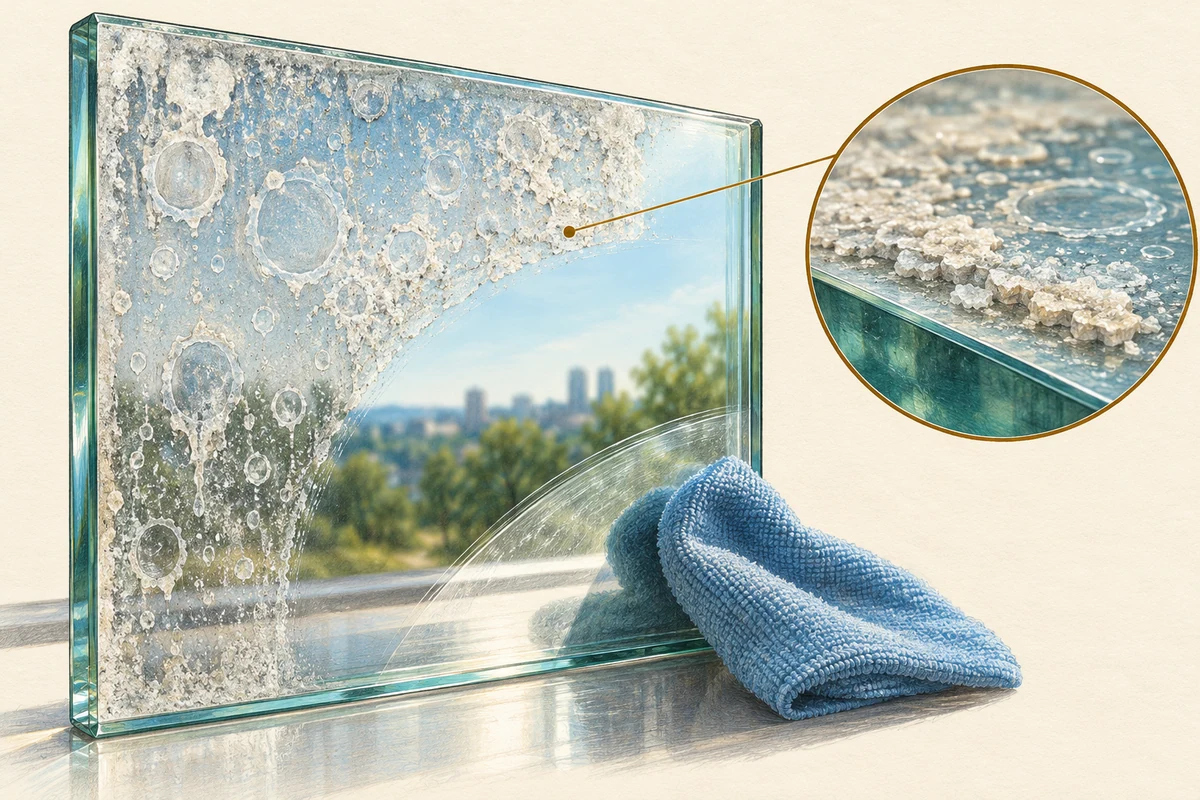
CONDITION 1 / SURFACE MATERIAL
Mineral deposits
Bonded mineral residue that sits on the glass. When it is fully removed without altering the substrate, no modeled micro-texture remains and the clean glass reads SC-0.
- What you see
- Spot constellations, rings, halos, crystalline scale, run trains, or sheet-like films that follow water exposure and drying patterns.
- What confirms it
- After a Non-Invasive Reveal and a small controlled residue-lift test, the clean substrate has no modeled micro-texture and reads SC-0.
- How to address it
- Use the sourced reveal and controlled residue-lift process to expose a representative clean area. Do not abrade or force a classification.
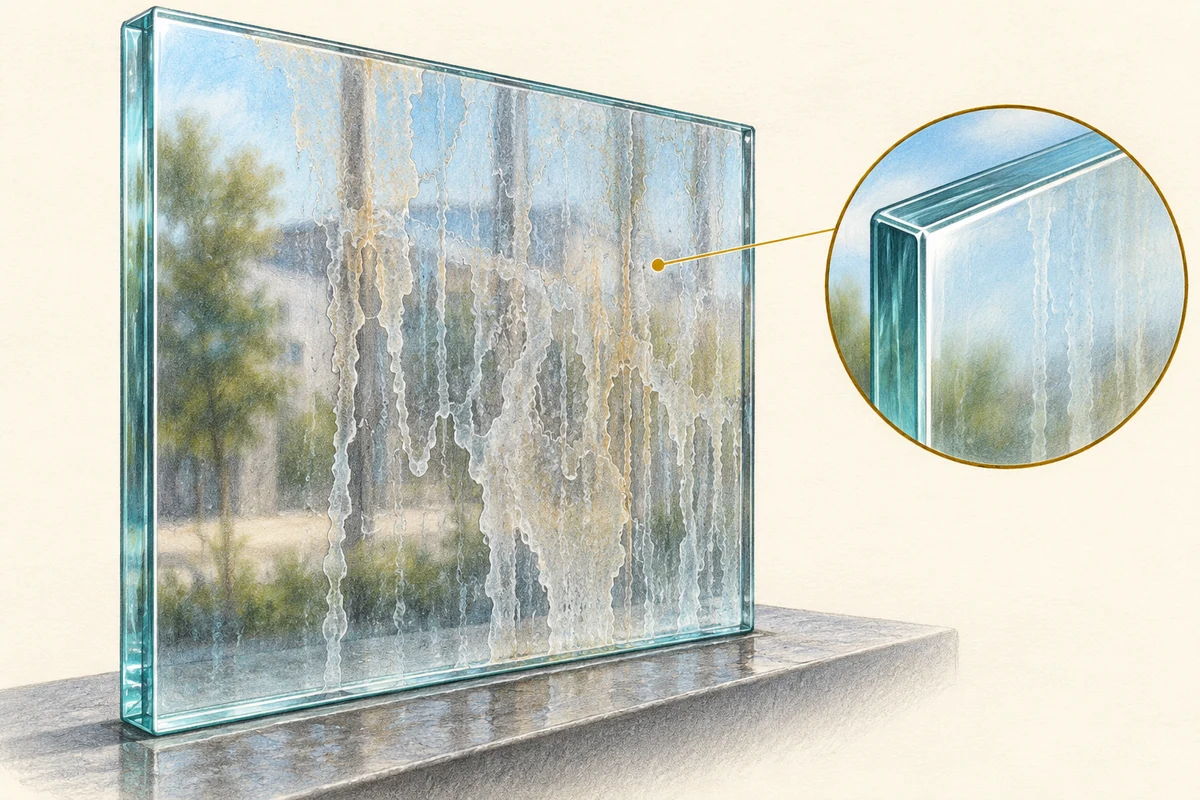
CONDITION 2 / PERSISTENT NON-ETCH
Mineral staining
A tenacious film, veil, or color shift that persists after reveal, while a truly clean substrate remains SC-0 with no modeled micro-texture.
- What you see
- Soft halos, bands, whitish or grey veil, gently mottled tone, or persistent discoloration in prior deposit and runoff footprints.
- What confirms it
- A revealed test patch still shows an optical appearance change, but the clean glass substrate remains non-relief (SC-0).
- How to address it
- Document the persistent film and clean test patch. Evaluate within trained restoration scope; a product result alone does not prove stain or etch identity.
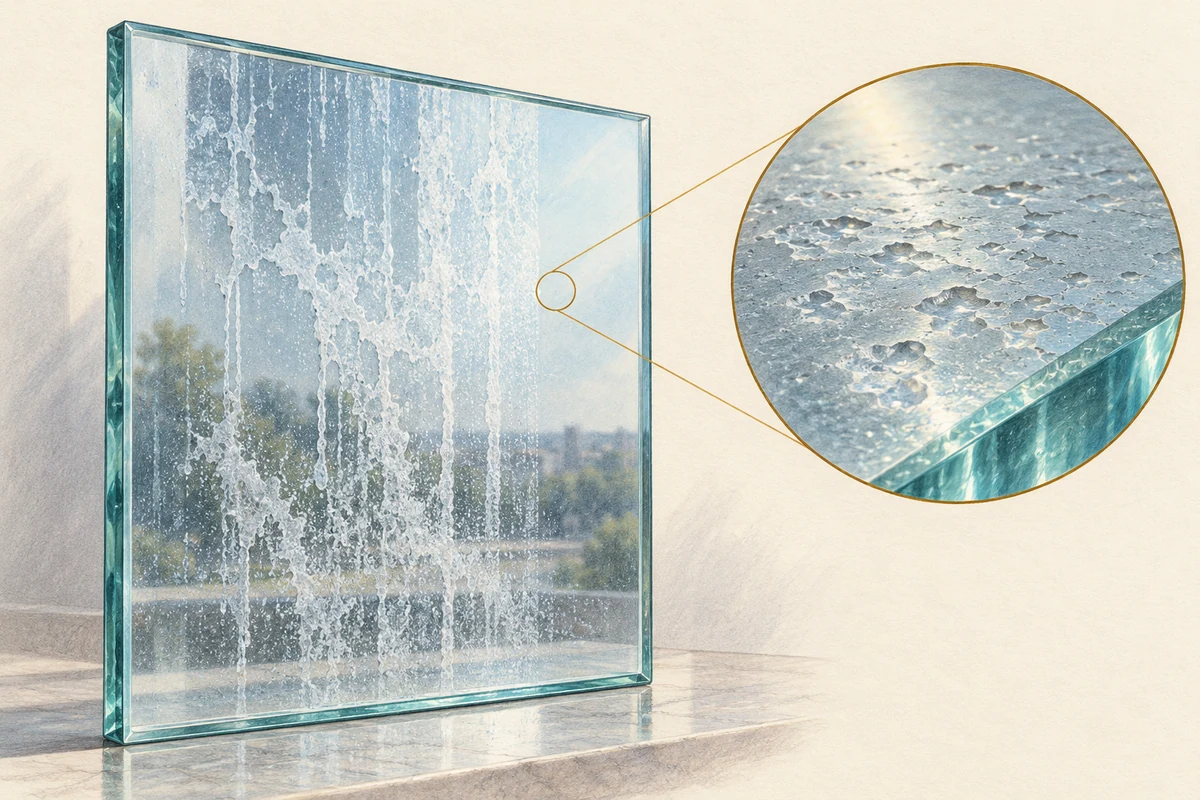
CONDITION 3 / SURFACE ALTERATION
Mineral etching
Subsurface attack that remains after surface material is removed. The glass shows modeled micro-texture, diminished specular clarity, and typically an SC-1 or SC-2 response.
- What you see
- Soft-edged frosted fields, milky or dulled reflections, persistent ring and run footprints, and non-directional micro-texture in raking light.
- What confirms it
- Modeled micro-texture remains on the clean substrate after reveal, commonly with a slight or clear MSRT response (SC-1 or SC-2).
- How to address it
- Cleaning alone cannot reverse altered glass. Complete DSS/CAT assessment, confirm coating and integrity limits, and refer for trained restoration evaluation.
DESCRIPTIVE ASSESSMENT AID
GlassRenu Hard-Water Condition Spectrum
The spectrum adds useful field detail without replacing DSS identity, VIS CAT classification, or acceptance criteria.
- H0Clear baselineClean, dry surface with no visible mineral footprint.
- D1Light spotsDiscrete spots or ring halos; removable surface material.
- D2Bonded scaleDense or crystalline deposit field that still clears to SC-0.
- S1Faint veilPersistent close-view halo or film; clean substrate remains SC-0.
- S2Persistent stainBroader visible film, banding, or discoloration; still non-etch.
- E1Slight micro-textureSubtle modeled texture with an SC-1 response after reveal.
- E2Clear micro-textureLegible frosted field or optical loss with an SC-2 response.
Do not convert these labels directly into CAT numbers. Use each DSS Severity & CAT Mapping section with the complete VIS assessment.
FIELD SEQUENCE
A repeatable assessment from location to classification
- 1
Confirm the surface
Record pane ID, product family, exposed surface number, worked-surface status, and whether a functional coating may be present. Use parallax to separate exposed from between-pane conditions.
- 2
Document before cleaning
Capture the overall water pattern, edges, sill and mullion relationships, and any suspected exposure source. Treat unknown residue or chemicals as hazardous until identified.
- 3
Establish a clean baseline
Perform the sourced Non-Invasive Reveal using neutral-pH/distilled water and lint-free microfiber. Use a small representative test area; do not abrade to force removal.
- 4
Inspect clean and dry
View at 12, 36, and 72 inches at normal incidence and through an oblique sweep. Use raking light to resolve film boundaries, modeled micro-texture, and optical scatter.
- 5
Check substrate relief safely
When appropriate, make one light, non-marring MSRT pass on a representative clean area. Use a polymer stylus if a coating is suspected. Never stylus across crystalline nodules or contaminated material.
- 6
Assign and document the DSS
Use Ch.03.01 for removable deposit, Ch.03.02 for persistent non-etch staining, and Ch.03.03 for etched micro-texture. Record multiple codes when conditions overlap.
FAST DIFFERENTIATION
What does the revealed test patch show?
Deposit
Clean substrate is SC-0 with no residual modeled micro-texture or persistent optical shadow.
Stain
A film, veil, or color shift persists, but the clean substrate remains SC-0 and non-etched.
Etch
Modeled micro-texture, frost, or optical scatter remains on the clean glass, commonly at SC-1 or SC-2.
Source basis and version
This page is a navigational and assessment aid derived from the GlassRenu Damage Specification Standards 2026 master source: Ch.03.01 Mineral Deposits, Ch.03.02 Mineral Staining, and Ch.03.03 Mineral Etching, together with the VIS inspection geometry and MSRT conventions cited by those records.
Module version: 0.2.1 Assessment guide: 1.0 Date: October 21, 2026