
On this page
- Diagnosis summary
- Safety and classification scope
- Definition (Reference)
- Typical Presentation (Informative)
- Field Identification Cues (Normative)
- Classification Mapping (to VIS-DA) (Normative)*
- Indicative Relief / Depth (Informative)
- Differentiation & False Positives (Informative)
- Evidence Package (Documentation Requirements) (Normative)*
- Mis-ID Pitfalls (Informative)
- Reporting Language (Template)
- Related glossary terms
- Related DSS
- Source and version
DAMAGE SPECIFICATION STANDARD / METHOD-AGNOSTIC
DSS-A.01.05 — Low-E / Functional-Coating Appearance Change Inside Cavity (#2 / #3)
Assembly / internal condition - typically CAT-5 by location; out of in-place scope
Diagnosis summary
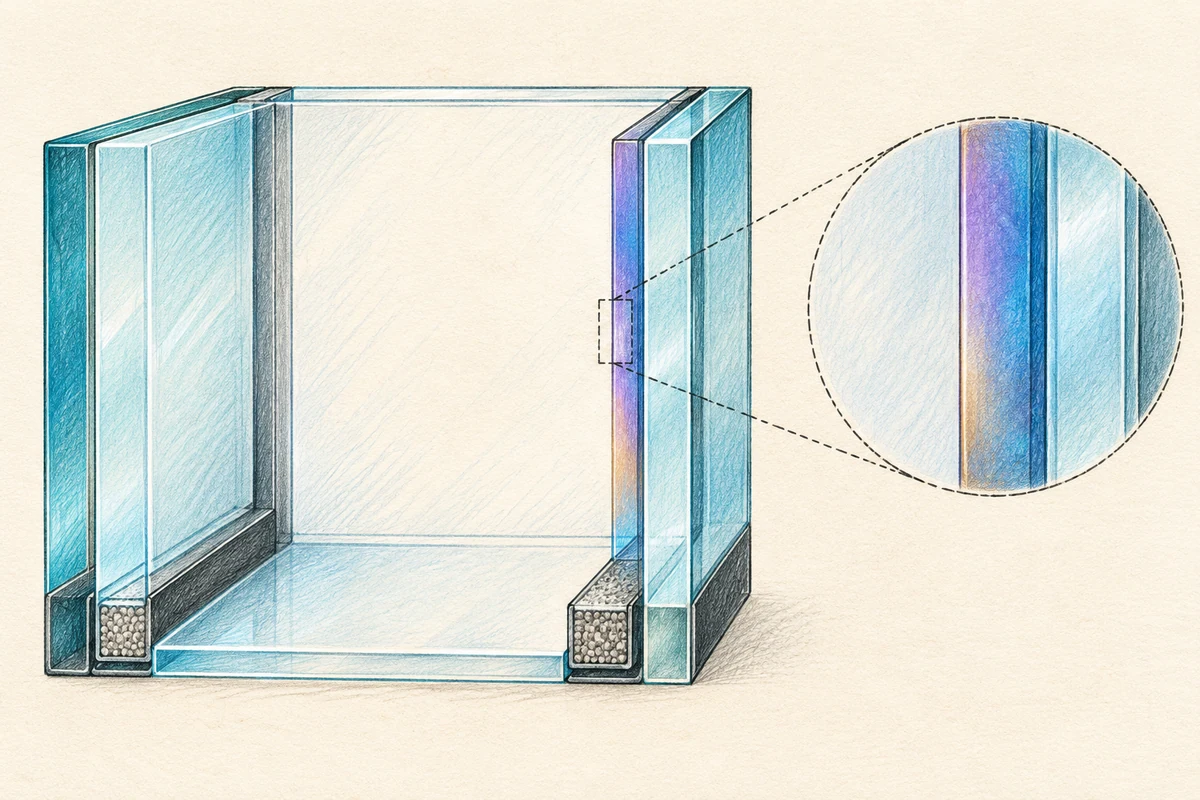
Non-uniform appearance change (e.g., patchiness, color shift/iridescence, fine “islands”/pinholes, micro-mottle) on a functional coating located on IGU cavity faces (#2 or #3). Because the affected face is between panes, it is not an exposed worked surface and is not addressable in-place; classification is governed by location/condition.
Definition (Reference)
ReferenceNon-uniform appearance change (e.g., patchiness, color shift/iridescence, fine “islands”/pinholes, micro-mottle) on a functional coating located on IGU cavity faces (#2 or #3). Because the affected face is between panes, it is not an exposed worked surface and is not addressable in-place; classification is governed by location/condition. VIS defines surface numbering and treats between-pane (fixed parallax) cues as out-of-scope by location. “Coating anomaly” is a defined VIS term (adapted from ASTM C1376).
Typical Presentation (Informative)
Informative- Patchy or blotchy zones, subtle color non-uniformity/iridescence, or fine pinholes/islands most evident in oblique/raking views; no change after cleaning of exposed faces (Non-Invasive Reveal).
- Often distributed irregularly; may occur with other cavity issues (e.g., internal haze, spacer-edge phenomena).
Field Identification Cues (Normative)
NormativeLocation / access (primary):
- Use surface numbering to identify #2/#3. Demonstrate between-pane by fixed parallax (feature stays fixed relative to its reflection as the observer moves). CAT-5 by location when confirmed.
Surface-catch class (MSRT):
- Not determinative for a cavity-face condition. MSRT applies to exposed faces only and is a single, non-marring pass used to support classification-not acceptance.
Inspection environment / reveal controls:
- Perform Non-Invasive Reveal (clean & dry) on the exposed face(s) before evaluation; if the cue persists, it supports a cavity location. Acceptance pertains to the exposed surface under evaluation.
Viewing / lighting:
- Apply VIS geometry: 12 / 36 / 72 in; normal incidence + oblique sweep (~60°-120°) under raking light to capture sheen/color change and patch boundaries.
Classification Mapping (to VIS-DA) (Normative)*
Normative- CAT-5 - Out of scope for in-place restoration when the anomaly resides on #2/#3 (between panes). Document and refer per project protocol (manufacturer/warranty/replacement). Note: For worked, exposed coated faces, VIS-A prohibits coating anomalies at acceptance (context: ASTM C1376), but that acceptance requirement does not apply to cavity-face anomalies.
Indicative Relief / Depth (Informative)
Informative- No accessible surface-relief reading on the exposed face; numeric depth is not applicable. Classification is appearance + location only.
Differentiation & False Positives (Informative)
Informative- vs. Coating rub/patchiness on the worked exposed face (Co-family): Worked-face coating anomalies are disallowed at acceptance (VIS §6.2.e); cavity anomalies are between panes (fixed parallax) and CAT-5.
- vs. Exterior/interior residue films (R-family): Face-side films respond to Non-Invasive Reveal; cavity anomalies do not.
- vs. Internal volatile fog/haze (A.01.01): Haze presents as a diffuse veil; coating corrosion shows patchy/color change with coating-like boundaries. Use parallax and perimeter context to separate.
Evidence Package (Documentation Requirements) (Normative)*
Normative- Photo set (VIS): 12 / 36 / 72 in, normal + oblique, with raking; include frames that show patch boundaries and at least one parallax sequence demonstrating a between-pane cue.
- Forms: Record pane ID; surface numbering (#1-#4; laminate-internal); worked surface Y/N; functional coating present on worked surface? (Y/N/Unknown); reveal status; lighting/time; geometry checklist.
- Narrative split: “Cavity-face functional-coating anomaly on #2/#3; CAT-5 by location. VIS-A coating acceptance (no anomalies on worked coated surfaces) does not apply to cavity faces; refer per protocol.”
Mis-ID Pitfalls (Informative)
InformativeAttempting to “correct” a cavity coating anomaly on the exposed face risks creating a worked region (visible transition edge) that VIS disallows at acceptance for CAT-0...CAT-4. Confirm parallax and reveal status before any action.
Reporting Language (Template)
Template- A.01.05 Low-E/Functional-Coating Appearance Change (Cavity #2/#3) - Patchy/iridescent coating appearance between panes, verified by fixed parallax; no change after Non-Invasive Reveal of exposed faces; MSRT not applicable to cavity face. CAT-5 (out of in-place scope by location). Documented per VIS geometry; refer per project protocol.
Related glossary terms
- Raking lightGRK-129
- Coating rubGRK-115
Source and version
GlassRenu Damage Specification Sheets (DSS), DSS-A.01.05. Source revision and extraction date are recorded in the deployment manifest.
Open the complete published DSS with table of contents (PDF)
Normative and informative labels are preserved from the source. The downloadable one-sheet is a condensed classification aid; this web page retains the complete source-based specification content.