
On this page
- Diagnosis summary
- Safety and classification scope
- Definition (Reference)
- Typical Presentation (Informative)
- Field Identification Cues (Normative)
- Classification Mapping (to VIS-DA) (Normative)
- Indicative Depth / Relief (Informative)
- Differentiation & False Positives (Informative)
- Evidence Package (Documentation Requirements) (Normative)
- Mis-ID Pitfalls (Informative)
- Reporting Language (Template)
- Related glossary terms
- Related DSS
- Source and version
DAMAGE SPECIFICATION STANDARD / METHOD-AGNOSTIC
DSS-A.03.01 — Mirror Edge Blackening (back-coating corrosion)
Assembly / back-coated products - typically out of in-place scope
Diagnosis summary
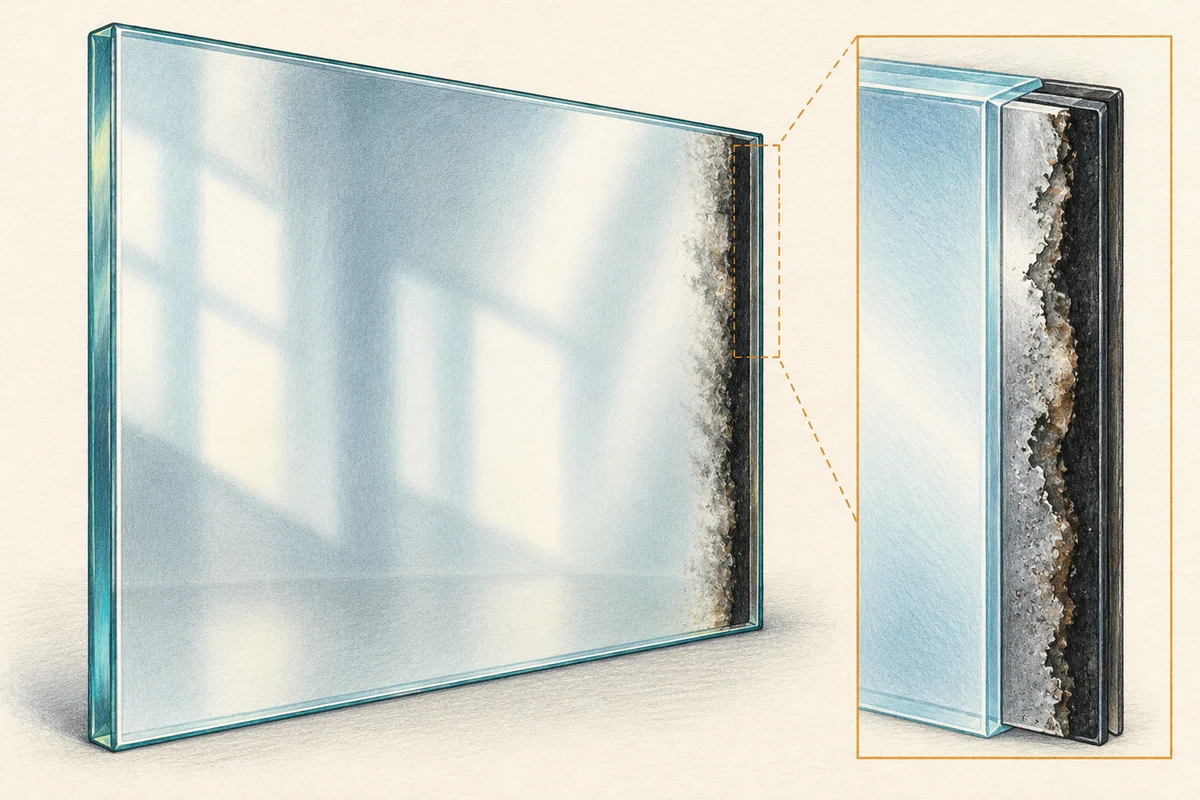
Localized darkening/blackening that initiates at the perimeter of a silvered mirror and advances inward beneath the protective paint (back-coating). The phenomenon results from moisture/chemical ingress at edges or penetrations, leading to corrosion of the reflective metal layer. Appearance is behind the glass substrate (back side), not on the exposed viewing face.
Definition (Reference)
ReferenceLocalized darkening/blackening that initiates at the perimeter of a silvered mirror and advances inward beneath the protective paint (back-coating). The phenomenon results from moisture/chemical ingress at edges or penetrations, leading to corrosion of the reflective metal layer. Appearance is behind the glass substrate (back side), not on the exposed viewing face. Classification/acceptance pertain to the exposed surface only under the VIS; back-side deterioration is handled by location/scope rules.
Typical Presentation (Informative)
Informative- Perimeter “creep” band that is dark, brown-green, or black, often irregular or “map-edged,” growing inward from edges, cutouts, or scratched back-paint.
- Under-glass look: no change with front-face cleaning/reveal; no tactile relief on the viewing face.
- May be asymmetric (more severe at wet corners, splash zones, sinks).
- May show haloing around penetrations (mounts, clips) or at unsealed edges.
Field Identification Cues (Normative)
NormativeSurface-catch class (MSRT):
- On the exposed viewing face, record SC-0 (no relief). Perform one light, non-marring pass only; MSRT supports classification and must not abrade the surface. On suspected coated faces (front-surface functional coat over mirror glass), prefer a polymer stylus or rely on visual/location cues.
Reveal / lighting / geometry:
- Evaluate clean & dry after a Non-Invasive Reveal; use raking light and assess at 12 / 36 / 72 in at normal incidence and through an oblique sweep ~60°-120°. The back-side defect will not change with reveal and will remain visible by parallax/location cueing.
Location/access:
- Confirm the observation sits behind the glass (back-coating) rather than on the worked surface. Acceptance pertains only to the exposed surface under evaluation. Record pane ID and, where helpful, fixture/location context on Forms:
Classification Mapping (to VIS-DA) (Normative)
Normative- CAT-5 (Out of Scope for In-Place Restoration): If the cue is confirmed as back-coating corrosion (behind the glass), classify CAT-5 by location/condition and refer to replacement or mirror-fabrication remedies per project protocol. Surface catch on the viewing face is non-determinative; location controls.
- If any additional face-side damage (scratches, pits, coating anomalies) is present on the exposed surface, classify that face-side condition separately under the appropriate M/Co/Ch family by CAT; do not let the back-side condition drive face-side acceptance.
Indicative Depth / Relief (Informative)
InformativeNot applicable-deterioration occurs behind the viewing surface within the reflective/paint system. On the viewing face: SC-0 is expected; numeric depth for the back-side condition is not used for VIS classification/acceptance, which remain appearance-based on the exposed surface.
Differentiation & False Positives (Informative)
Informative- vs. Front-face residues/films (R-series): Residues change with reveal and may show front-face MSRT cues; mirror blackening does not respond to reveal and remains under-glass.
- vs. Coating anomalies on the worked surface (Co-series): Coating rub/sheens occur on the exposed face and are disallowed at acceptance on coated surfaces; mirror edge blackening is behind the glass and is handled as CAT-5 location.
- vs. IGU between-pane defects: Fixed parallax within an IGU cavity indicates between-pane location; treat as CAT-5 similarly (out of in-place scope).
Evidence Package (Documentation Requirements) (Normative)
Normative- Photo set (VIS):
- 12 / 36 / 72 in; normal + oblique; include raking frames.
- One edge context frame showing the advancing black band from the perimeter or cutout; one macro confirming the cue sits behind the glass (unchanged by reveal; SC-0 on face).
- MSRT result: Record SC-0 on the viewing face; one pass only; prefer polymer stylus if a front functional coat is suspected.
- Forms: Pane ID; location; reveal status; lighting/time; geometry checklist; note “back-coating corrosion (behind glass)”; attach photos.
Mis-ID Pitfalls (Informative)
Informative- Attempting to “polish out” what is actually behind the glass can create needless face-side worked regions with transition edges, which VIS disallows at acceptance. Keep classification appearance-only for the face unless genuine face-side damage exists.
Reporting Language (Template)
Template- A.03.01 - Mirror Edge Blackening (back-coating corrosion): “Dark/black under-glass band originating at the perimeter/cutout consistent with back-coating corrosion. Non-responsive to Non-Invasive Reveal; MSRT on viewing face = SC-0. Location/condition places the cue behind the exposed surface; classified CAT-5 (out of in-place scope) per VIS. No additional face-side damage observed at acceptance geometry (12/36/72 in; normal + oblique; raking light).”
Related glossary terms
- Raking lightGRK-129
- Coating rubGRK-115
- ScratchGRK-032
Source and version
GlassRenu Damage Specification Sheets (DSS), DSS-A.03.01. Source revision and extraction date are recorded in the deployment manifest.
Open the complete published DSS with table of contents (PDF)
Normative and informative labels are preserved from the source. The downloadable one-sheet is a condensed classification aid; this web page retains the complete source-based specification content.