
On this page
- Diagnosis summary
- Safety and classification scope
- Classification & Scope (Normative)
- Typical Presentation (Informative)
- Field Identification Cues (Normative)
- Surface-catch class (MSRT)
- Visual signature
- Viewing / lighting
- Location / access
- Mechanism cue (context)
- Severity & CAT Mapping (Normative)
- Differentiation & Mis-ID Pitfalls (Informative)
- Evidence Package *(Documentation Requirements) (Normative)
- Reporting Language (Template)
- Related glossary terms
- Related DSS
- Source and version
DAMAGE SPECIFICATION STANDARD / METHOD-AGNOSTIC
DSS-Ch.02.03 — Efflorescence-Associated Surface Attack
Chemical - alkaline salts/waterborne alkali; run-bloom halos, crust islands, grainy micro-texture
Diagnosis summary
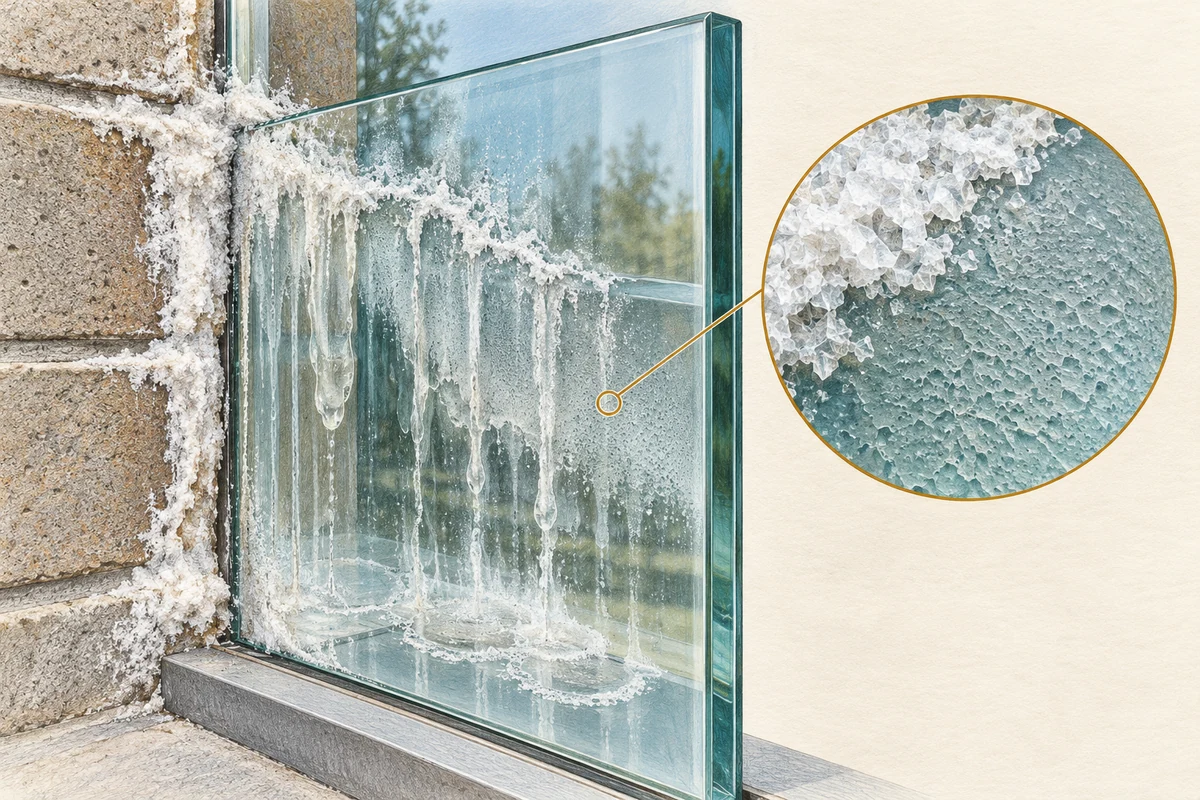
Efflorescence-associated surface attack is alkaline exposure of glass from waterborne salts and pore solutions migrating out of concrete/masonry. As moisture evaporates, alkali-rich films and salt blooms at the glass interface can etch the exposed face, leaving grainy micro-texture and run/pool halos after residues are removed. Classification is appearance-only per VIS (method-agnostic).
Classification & Scope (Normative)
NormativeEfflorescence-associated surface attack is alkaline exposure of glass from waterborne salts and pore solutions migrating out of concrete/masonry. As moisture evaporates, alkali-rich films and salt blooms at the glass interface can etch the exposed face, leaving grainy micro-texture and run/pool halos after residues are removed. Classification is appearance-only per VIS (method-agnostic). Inspect after Non-Invasive Reveal under VIS lighting/geometry; record surface numbering and worked-surface status on Forms: Handle active efflorescence per site safety.
Typical Presentation (Informative)
Informative- Run-bloom halos beneath masonry/copings/headers where moisture exits; feathered white bloom contiguous with vertical run legs.
- Crust islands (thin, friable salt plates) at sill/gasket lines; after reveal, duller “shadow” remains with grainy micro-texture in raking light.
- Seasonality common (wet, cooling periods); may repeat at the same geometry after rain/dry cycles.
Field Identification Cues (Normative)
NormativeSurface-catch class (MSRT)
- SC-0 where salt residue only remains prior to reveal.
- SC-1 (slight) to SC-2 (clear) if etch formed beneath/within the bloom footprint. Perform one light, non-marring pass; polymer stylus if a coating is suspected. MSRT supports classification only.
Visual signature
- Feathered bloom edges and run halos; interiors read as milky/grainy frost after reveal.
- No chip-flank sparkle (not mechanical); no discrete fused nodules/pits (not hot-particle).
Viewing / lighting
- Evaluate clean & dry at 12 / 36 / 72 in, normal incidence and oblique sweep (~60°-120°) with raking light to resolve grain and bloom edges. Document distances/angles in-frame.
Location / access
- Record pane ID and surface numbering (#1-#4; laminate-internal). If fixed parallax indicates between-pane, classify CAT-5 by location (out of in-place scope) and refer.
Mechanism cue (context)
- Masonry/concrete interfaces above the lite; weep paths; sealant discontinuities; recurrent moisture events; visible white salt bloom on adjacent porous materials.
Severity & CAT Mapping (Normative)
NormativeAssign CAT by appearance + MSRT + morphology (three-part cueing). Depth ranges are indicative-measurement not required.
- CAT-1 (Benign / non-relief): Bloom/film only, clears at reveal; SC-0; visible mainly in raking. Indicative relief: 0-10 μm.
- CAT-2 (Light): Subtle etched halos/fields with SC-1; grain evident in raking; limited impact at standard view. Indicative relief: 10-40 μm.
- CAT-3 (Moderate): SC-2 across broader run-bloom regions; grainy frost legible at standard distance; persistent halo geometry. Indicative relief: 40-120 μm.
- CAT-4 (Severe): Pronounced matte/frosted swaths with repeated cycles; distinct at standard & wide-field; may show opaque edge crust shadows. Indicative relief: 120-300 μm+.
- CAT-5 (by condition/location): Between-pane/inaccessible by parallax, integrity indicators (active cracks, pane movement), or confirmed functional-coating loss on the surface to be worked → CAT-5.
CAT is appearance-based; acceptance is separate under VIS-A at 12/36/72 in. Do not “probe” with MSRT.
Differentiation & Mis-ID Pitfalls (Informative)
Informative- vs. Concrete splash/run-off (Ch.02.02): Concrete splash yields speckled constellations/curtain bands tied to one-time events; efflorescence attack shows recurrent bloom halos following moisture/weep paths.
- vs. HCl brick-wash fallout (Ch.01.02): HCl runs have cleaner frost with sharper borders; efflorescence often leaves feathered white bloom and granular ghosting after reveal.
- vs. Organic-acid footprints (Ch.01.03): Biogenic patches are localized ovals with pool centers; efflorescence tracks porous-substrate moisture patterns (joints/headers/weep).
- vs. Residue films (R-family): Detergent/soot films remove at reveal and remain SC-0; etched bloom persists with SC-class > 0.
- vs. Coating anomalies (Co-family): Coating rub/patchiness shows sheen/color change but no etched relief; on a worked coated surface any anomaly is not permitted at acceptance (VIS §6.2.e).
Evidence Package *(Documentation Requirements) (Normative)
Normative- Photo set (VIS): 12 / 36 / 72 in, normal + oblique; include raking macros resolving bloom edges/grain; add context frames showing weep paths, joints, porous substrates. Record distance/angle in-frame.
- MSRT result: One light, non-marring pass on representative halo/interior; record SC-class (SC-0/1/2). Prefer polymer stylus if a coating is suspected.
- Forms: Pane ID; product family & surface numbering; worked surface Y/N; functional coating present on worked surface? (Y/N/Unknown); reveal status; lighting/time; geometry checklist; photos attached.
- Acceptance split: Post-restoration acceptance per VIS-A §6; classification ≠ acceptance. Coated-face appearance rules apply per VIS §6.2.e.
Reporting Language (Template)
Template- Ch.02.03 Efflorescence-Associated Surface Attack - Run-bloom halos / crust islands with [SC-1/SC-2] on surface #___, visible at [12/36/72 in] under VIS geometry after Non-Invasive Reveal. Morphology: feathered bloom edges with grainy micro-texture; no chip-flank sparkle or discrete pepper. Classification: CAT-[2/3/4] by relief/visibility; CAT-5 if between-pane, integrity cues, or coating-side loss on the surface to be worked. Forms + photo set completed; acceptance per VIS-A §6 (separate).
Related glossary terms
- Raking lightGRK-129
- Coating rubGRK-115
Source and version
GlassRenu Damage Specification Sheets (DSS), DSS-Ch.02.03. Source revision and extraction date are recorded in the deployment manifest.
Open the complete published DSS with table of contents (PDF)
Normative and informative labels are preserved from the source. The downloadable one-sheet is a condensed classification aid; this web page retains the complete source-based specification content.