
On this page
- Diagnosis summary
- Safety and classification scope
- Classification & Scope (Normative)
- Typical Presentation (Informative)
- Field Identification Cues (Normative)
- Surface-catch class (MSRT)
- Visual signature
- Viewing / lighting
- Location / access
- Severity & CAT Mapping (Normative)
- Differentiation & Mis-ID Pitfalls (Informative)
- Evidence Package (Documentation Requirements) (Normative)
- Reporting Language (Template)
- Related glossary terms
- Related DSS
- Source and version
DAMAGE SPECIFICATION STANDARD / METHOD-AGNOSTIC
DSS-M.05.01 — Short FD Scratch Cluster
Mechanical - factory handling/wash-induced; multiple short, parallel lineations
Diagnosis summary
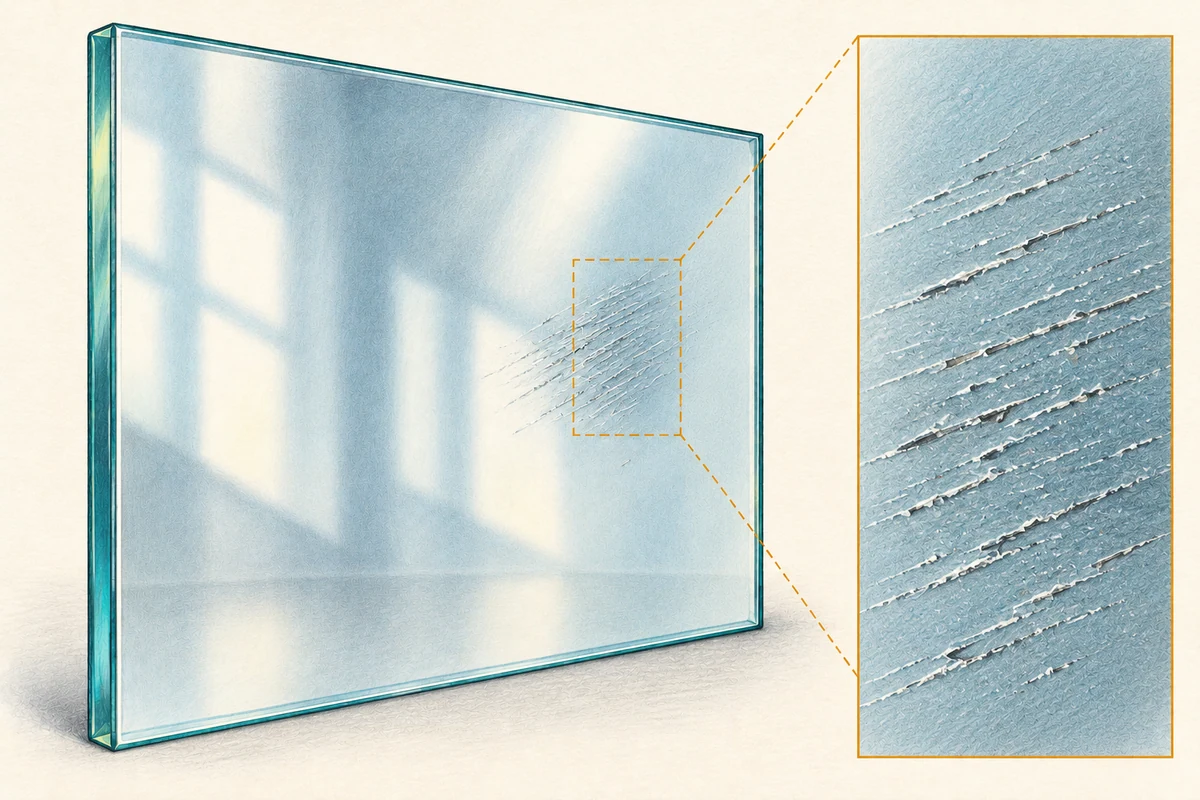
A short FD scratch cluster is a localized patch (typically hand-sized or smaller) of multiple short, generally parallel fine scratches produced by entrained grit/debris during factory washing/handling. Lines are co-oriented, often confined to a narrow zone, and persist after Non-Invasive Reveal. Classification is appearance-only per VIS (method-agnostic).
Classification & Scope (Normative)
NormativeA short FD scratch cluster is a localized patch (typically hand-sized or smaller) of multiple short, generally parallel fine scratches produced by entrained grit/debris during factory washing/handling. Lines are co-oriented, often confined to a narrow zone, and persist after Non-Invasive Reveal. Classification is appearance-only per VIS (method-agnostic). Inspect after Non-Invasive Reveal using VIS lighting/geometry and record surface numbering and worked-surface status on Forms:
Typical Presentation (Informative)
Informative- Tight patch of short, parallel or slightly fanned lines (mm to cm length), often one orientation.
- Strongest in raking light; at higher severity, edges show micro-chipping (“chip flanks”) with bright sparkle.
- Often near wash flow paths or handling lanes; no continuous long tracks across the lite (distinguishes from M.01 tracks).
Field Identification Cues (Normative)
NormativeSurface-catch class (MSRT)
- Light clusters: SC-1 (slight); pronounced clusters: SC-2 (clear) where chip flanks are present. Perform one light, non-marring pass only; polymer stylus on suspected coated faces. MSRT supports classification, not acceptance.
Visual signature
- Multiple short, co-oriented scratches within a compact area; no long, continuous lane. Look for consistent stroke width and fine debris satellites.
Viewing / lighting
- Evaluate clean & dry at 12 / 36 / 72 in, normal incidence + oblique sweep (~60°-120°) with raking light; record distances/angles in-frame.
Location / access
- Confirm on the exposed face. Use parallax in IGUs-fixed parallax indicates between-pane → CAT-5 by location. Record surface numbering #1-#4 / laminate-internal on Forms:
Severity & CAT Mapping (Normative)
NormativeAssign CAT by appearance + MSRT + morphology (three-part cueing under VIS). Depths below are indicative to anchor the spectrum:
- CAT-2 (Light): Fine, shallow lines; SC-1, clean edges, no chip flanks; mainly a raking-only cue at close/standard view. Indicative depth: ~0.2-1 μm.
- CAT-3 (Moderate): Clear catch (SC-2) on representative lines; minor chip flanks and/or modeled micro-texture; noticeable at standard view. Indicative depth: ~1-5 μm.
- CAT-4 (Severe): Rough, bright chip flanks, peppered pits/craters, or broad matte sectors within the cluster; distinct at standard & wide-field views. Indicative depth: ≥5 μm.
- CAT-5 (by location/condition): Between-pane/inaccessible by parallax, or integrity indicators (active cracks, moving pane) → CAT-5; document and refer.
CAT assignment is appearance-based; acceptance is separate (VIS §6). Do not use MSRT to “probe.”
Differentiation & Mis-ID Pitfalls (Informative)
Informative- vs. Linear scoring / tracks (M.01): M.01 shows extended, continuous lines (sometimes pane-spanning); FD clusters are localized with short lineations.
- vs. Micro-abrasion swirls / pad trails (M.02.01): Swirls are looped/curvilinear; FD clusters are straight, co-oriented lines.
- vs. Residue films/overspray (R-family): Residues change with reveal and read SC-0; true FD lines persist and can read SC-1/SC-2.
- vs. Coating anomalies (Co-family): Coating rub/patchiness is area-based, typically SC-0/SC-1 and lacks chip flanks; visible anomalies on a worked coated surface are not permitted at acceptance.
Evidence Package (Documentation Requirements) (Normative)
Normative- Photo set (VIS): 12 / 36 / 72 in, normal + oblique, include raking macros that resolve individual line edges (confirm presence/absence of chip flanks) and at least one context frame showing the cluster’s confinement (not pane-spanning). Record distance/angle in-frame.
- MSRT result: Record SC class (SC-0/1/2) with one light, non-marring pass on a representative line; polymer stylus on suspected coated faces. MSRT is supportive only.
- Forms: Pane ID; product family & surface numbering (#1-#4; laminate-internal); worked surface Y/N; functional coating on worked surface? (Y/N/Unknown); reveal status; lighting/time; geometry checklist; photos attached.
- Acceptance split: VIS §6 governs post-restoration appearance; classification ≠ acceptance. Transition edges and coating anomalies remain disqualifying per category criteria.
Reporting Language (Template)
Template- M.05.01 FD Scratch Cluster - Short (localized). Hand-sized patch of short, co-oriented fine lines on surface #___; MSRT = SC-[1/2] on representative lines; chip flanks [absent/present]. Visible at [12/36/72 in] under VIS geometry after Non-Invasive Reveal. Classification: CAT-[2/3/4] by morphology + MSRT; if between-pane/inaccessible → CAT-5. Forms + photo set completed per VIS.
Related glossary terms
- ScratchGRK-032
- Raking lightGRK-129
- Coating rubGRK-115
- AbrasionGRK-035
Source and version
GlassRenu Damage Specification Sheets (DSS), DSS-M.05.01. Source revision and extraction date are recorded in the deployment manifest.
Open the complete published DSS with table of contents (PDF)
Normative and informative labels are preserved from the source. The downloadable one-sheet is a condensed classification aid; this web page retains the complete source-based specification content.