
On this page
- Diagnosis summary
- Safety and classification scope
- Definition (Reference).
- Typical Presentation (Informative).
- Field Cues (Normative).
- Classification Mapping (Normative).
- Indicative Depth (Informative).
- Differentiation (Informative).
- Evidence Package (Normative).
- Mis-ID Pitfalls (Informative).
- Reporting Language (Template).
- Related glossary terms
- Related DSS
- Source and version
DAMAGE SPECIFICATION STANDARD / METHOD-AGNOSTIC
DSS-P.01.01 — Roller Wave (Periodic Flatness Deviation)
Processing / Manufacturing Feature - reference; generally not damage
Diagnosis summary
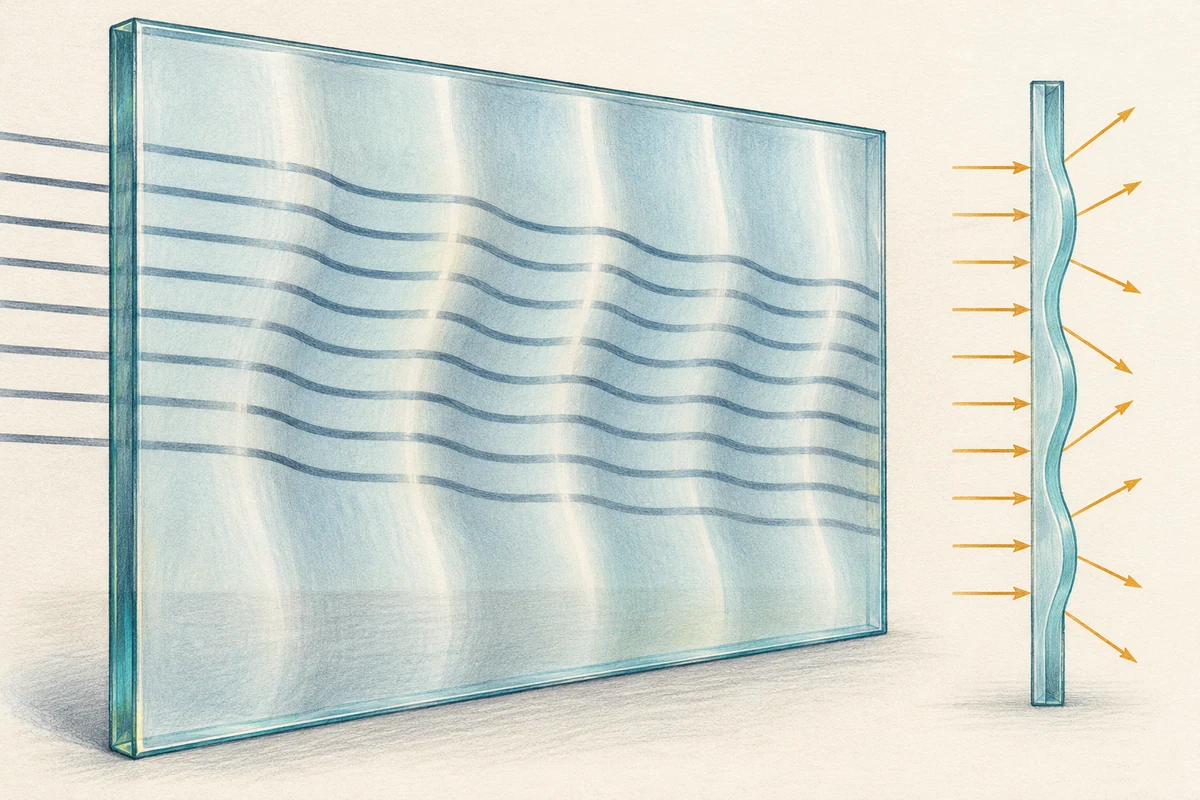
A periodic flatness deviation characteristic of heat-treated flat glass that appears as bands/undulations in reflection or transmission. It is a factory feature of the product, not a field-induced surface relief defect. For measurement background on optical/roll-wave distortion in heat-treated flat glass, see ASTM C1651 (informative reference noted in VIS).
Definition (Reference).
ReferenceA periodic flatness deviation characteristic of heat-treated flat glass that appears as bands/undulations in reflection or transmission. It is a factory feature of the product, not a field-induced surface relief defect. For measurement background on optical/roll-wave distortion in heat-treated flat glass, see ASTM C1651 (informative reference noted in VIS).
Typical Presentation (Informative).
Informative- Alternating light/dark bands visible across reflections (e.g., mullions, horizon lines), sometimes more apparent at oblique angles.
- Uniform across large areas of a lite or series of lites from the same run; not localized like scratches or pits.
- Does not respond to Non-Invasive Reveal (cleaning) and shows no surface catch. Use VIS inspection lighting/geometry to visualize consistently.
Field Cues (Normative).
Normative- Surface catch (MSRT): none (PVΔ as “damage” ≈ 0 at the surface). Perform one light non-marring pass only to confirm absence of relief.
- Morphology: global/periodic flatness effect; no chip flanks, no pits, no modeled micro-texture.
- Visibility geometry: evaluate under VIS Section 5-raking/low-angle light as needed, with 12/36/72 in distances and normal + oblique sweep.
Classification Mapping (Normative).
Normative- Not field damage. Do not classify as CAT-1...CAT-4. Roller wave is a processing feature referenced here to prevent misclassification; acceptance of factory flatness/optical quality is governed by the applicable product standards/project specs, not by VIS (which governs post-restoration acceptance).
Indicative Depth (Informative).
Informative- N/A as surface relief. Roller wave is flatness/optical deviation; at the glass surface it does not present as a localized relief feature detectable by MSRT. If factory flatness or optical distortion must be quantified, see ASTM C1651 background as noted in VIS (informative).
Differentiation (Informative).
Informative- Versus micro-abrasion / pad trails (M.02.01): abrasion presents localized haze or directional swirls and may show slight catch; roller wave is global/periodic and non-tactile.
- Versus over-polish/burnish (M.02.04): burnish is a localized appearance change (often directional) and may show a transition edge; roller wave has no transition edge and extends broadly.
- Versus modeled micro-texture (chemical etch): chemical etch shows non-linear micro-texture strongest in raking light and can exhibit slight/clear catch at severity; roller wave remains non-tactile and periodic.
Evidence Package (Normative).
Normative- Photo set at 12 / 36 / 72 in under VIS geometry; include one frame with straight-line reflection (string line, mullion, horizon) to show periodicity. Note MSRT = none. Record pane IDs and apply surface numbering conventions.
Mis-ID Pitfalls (Informative).
Informative- Attempting corrective “spot work” on roller wave-treating it like a scratch field-can introduce visible worked zones and transition edges. VIS explicitly separates classification from acceptance and requires non-invasive pre-inspection cleaning only.
Reporting Language (Template).
Template- “Observed roller wave (factory flatness feature) presenting as periodic reflective banding across lite(s). No surface catch (MSRT). Condition is a processing feature; not classified as field damage under DSS. Inspection performed per VIS §5 (lighting/viewing).”
Related glossary terms
- Roll-wave distortionGRK-028
- Optical distortionGRK-117
- Scratch fieldGRK-108
- Raking lightGRK-129
- AbrasionGRK-035
- ScratchGRK-032
Source and version
GlassRenu Damage Specification Sheets (DSS), DSS-P.01.01. Source revision and extraction date are recorded in the deployment manifest.
Open the complete published DSS with table of contents (PDF)
Normative and informative labels are preserved from the source. The downloadable one-sheet is a condensed classification aid; this web page retains the complete source-based specification content.