
On this page
- Diagnosis summary
- Safety and classification scope
- Definition (Reference)
- Typical Presentation (Informative)
- Field Identification Cues (Normative)
- Classification Mapping (to VIS-DA) (Normative)
- Indicative Depth / Relief (Informative)
- Differentiation & False Positives (Informative)
- Evidence Package (Documentation Requirements) (Normative)
- Mis-ID Pitfalls (Informative)
- Reporting Language (Template)
- Related glossary terms
- Related DSS
- Source and version
DAMAGE SPECIFICATION STANDARD / METHOD-AGNOSTIC
DSS-P.02.02 — Seeds / Blisters (entrapped gas)
Float & raw glass feature - reference; generally not “damage”
Diagnosis summary
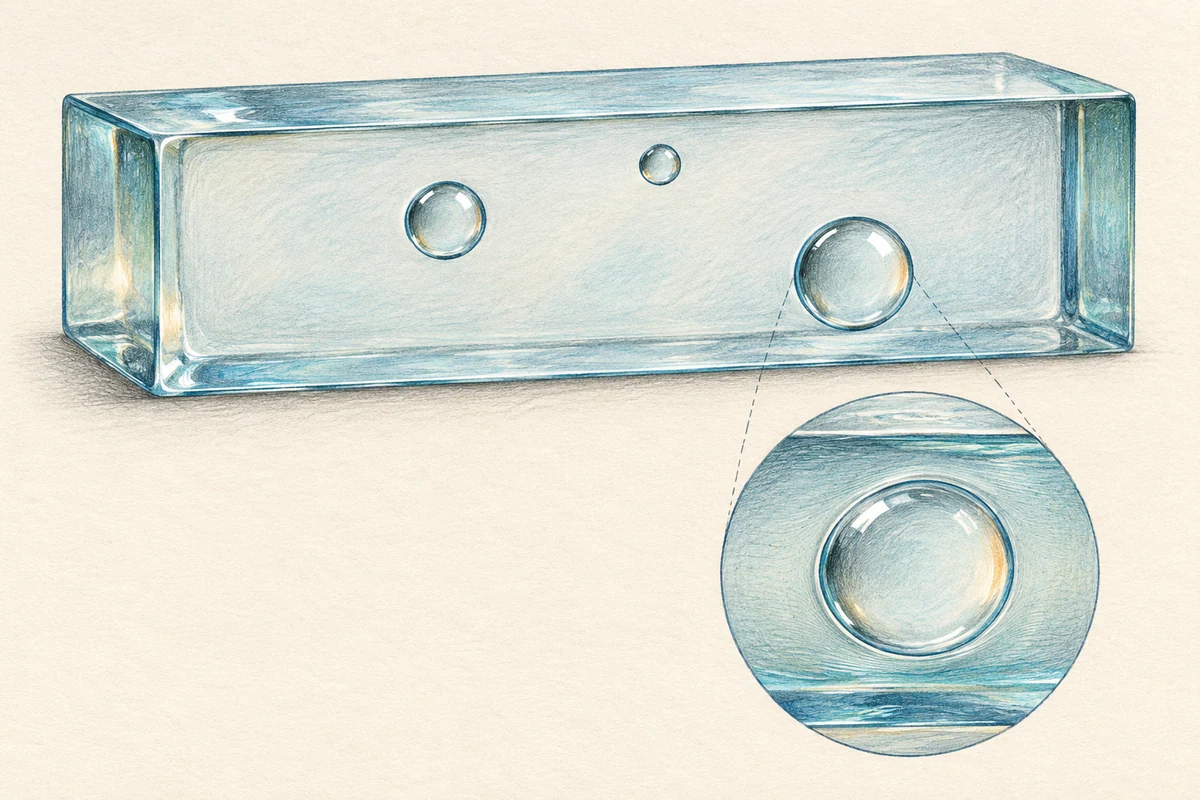
Seeds/blisters are gas inclusions formed during melting/float manufacture, appearing as encapsulated bubbles within the glass body. When fully encapsulated, they are a manufacturing feature and not a surface-relief defect. Evaluate using VIS lighting and viewing geometry for observation consistency; product acceptance for factory inclusions is separate from post-restoration acceptance under VIS.
Definition (Reference)
ReferenceSeeds/blisters are gas inclusions formed during melting/float manufacture, appearing as encapsulated bubbles within the glass body. When fully encapsulated, they are a manufacturing feature and not a surface-relief defect. Evaluate using VIS lighting and viewing geometry for observation consistency; product acceptance for factory inclusions is separate from post-restoration acceptance under VIS.
Typical Presentation (Informative)
Informative- Discrete, rounded or lenticular spots that remain fixed with parallax relative to the glass thickness (no boundary ring or worked perimeter).
- Most noticeable at oblique sweep; may exhibit slight optical lensing; does not respond to Non-Invasive Reveal (clean/dry).
Field Identification Cues (Normative)
NormativeSurface-catch class (MSRT):
- Fully encapsulated seed/blister: SC-0 (none) - a single, light, non-marring pass detects no tactile relief because the feature is within the glass, not on the exposed surface. Do not abrade or repeat.
- Open blister / burst inclusion: If the bubble has broken to the surface, it will read as a local pit/crater and may present clear catch; classify by morphology (see CAT-3/4 cues; see “Pit / Crater” term).
Visual signature:
- Encapsulated: small, stable point feature with no transition edge; no chip flanks; fixed location regardless of wipe/clean.
- Open: local pit/crater possibly with a faint halo under raking light.
Viewing/lighting: Inspect at 12 / 36 / 72 in with normal incidence and oblique sweep (~60°-120°) under raking light per VIS.
Location/access: Record surface numbering (#1-#4; laminate-internal); encapsulated features reside within the lite thickness (not between panes). If a similar cue is found to be between panes (fixed parallax in an IGU), treat as out of in-place scope.
Classification Mapping (to VIS-DA) (Normative)
Normative- Encapsulated seed/blister (non-relief): Processing Feature - Not Surface Damage (outside CAT-1...CAT-4). Document and proceed per project specifications for factory inclusions.
- Open blister / surface pit: Classify by observable morphology and surface-catch (often CAT-3/4 depending on depth cues).
- Between-pane or inaccessible condition: If a look-alike defect is confirmed within IGU cavity (fixed parallax) or otherwise out of in-place scope, record CAT-5 and refer per project protocol.
Indicative Depth / Relief (Informative)
Informative- Encapsulated: No measurable surface relief at the exposed surface (SC-0).
- Open blister: presents as local crater/pit; relief depth varies; use morphology + catch rather than assigning a numeric depth in the field.
Differentiation & False Positives (Informative)
Informative- vs. Metallic/paint specks (Residues/Overspray): Residues typically clean/soften with reveal; encapsulated blisters do not.
- vs. Micro-abrasion “pepper”: Abrasion fields show directional patterning or webbing and may escalate to slight/clear catch; encapsulated seeds are isolated and SC-0.
- vs. Hot-particle pits (Th.01): Thermal pits often exhibit bright chip flanks and clear catch; encapsulated seeds do not. Classify thermal pits per M/Th families.
Evidence Package (Documentation Requirements) (Normative)
Normative- Photo set (VIS): 12 / 36 / 72 in, normal + oblique; include raking usage; where practical, capture a fixed reference to demonstrate lack of boundary/working.
- MSRT: Record SC-0 for encapsulated features (one pass only; non-marring). If open, record SC-1/SC-2 accordingly.
- Forms: Pane ID; surface numbering; worked surface Y/N; coating present on worked surface? (Y/N/Unknown); reveal status; lighting/time.
- Acceptance split: VIS governs post-restoration appearance; factory inclusions are governed by product standards/project specs-do not conflate.
Mis-ID Pitfalls (Informative)
InformativeAttempting “spot-correction” of an encapsulated seed can introduce a worked region (visible transition edge) that is not permitted at VIS acceptance. Keep classification appearance-only unless an open pit is confirmed.
Reporting Language (Template)
Template- P.02.02 Seeds/Blisters (Processing Feature) - Discrete encapsulated inclusion observed at VIS geometry; MSRT = SC-0 (no surface relief). No transition edge or fracture morphology. Recorded as manufacturing feature; not categorized as surface damage under VIS-DA. If an open pit is present, classify by CAT-3/4 morphology; if a between-pane look-alike is confirmed, record CAT-5 and refer per project protocol.
Related glossary terms
- Raking lightGRK-129
- AbrasionGRK-035
Source and version
GlassRenu Damage Specification Sheets (DSS), DSS-P.02.02. Source revision and extraction date are recorded in the deployment manifest.
Open the complete published DSS with table of contents (PDF)
Normative and informative labels are preserved from the source. The downloadable one-sheet is a condensed classification aid; this web page retains the complete source-based specification content.