
On this page
- Diagnosis summary
- Safety and classification scope
- Definition (Reference)
- Typical Presentation (Informative)
- Field Identification Cues (Normative)
- Classification Mapping (to VIS-DA) (Normative)
- Indicative Depth / Relief (Informative)
- Differentiation & False Positives (Informative)
- Evidence Package (Documentation Requirements) (Normative)
- Mis-ID Pitfalls (Informative)
- Reporting Language (Template)
- Related glossary terms
- Related DSS
- Source and version
DAMAGE SPECIFICATION STANDARD / METHOD-AGNOSTIC
DSS-P.03.01 — Seamed / Arris Edge Texture (as-processed edge finish)
Fabrication & finishing - reference; generally not “damage”
Diagnosis summary
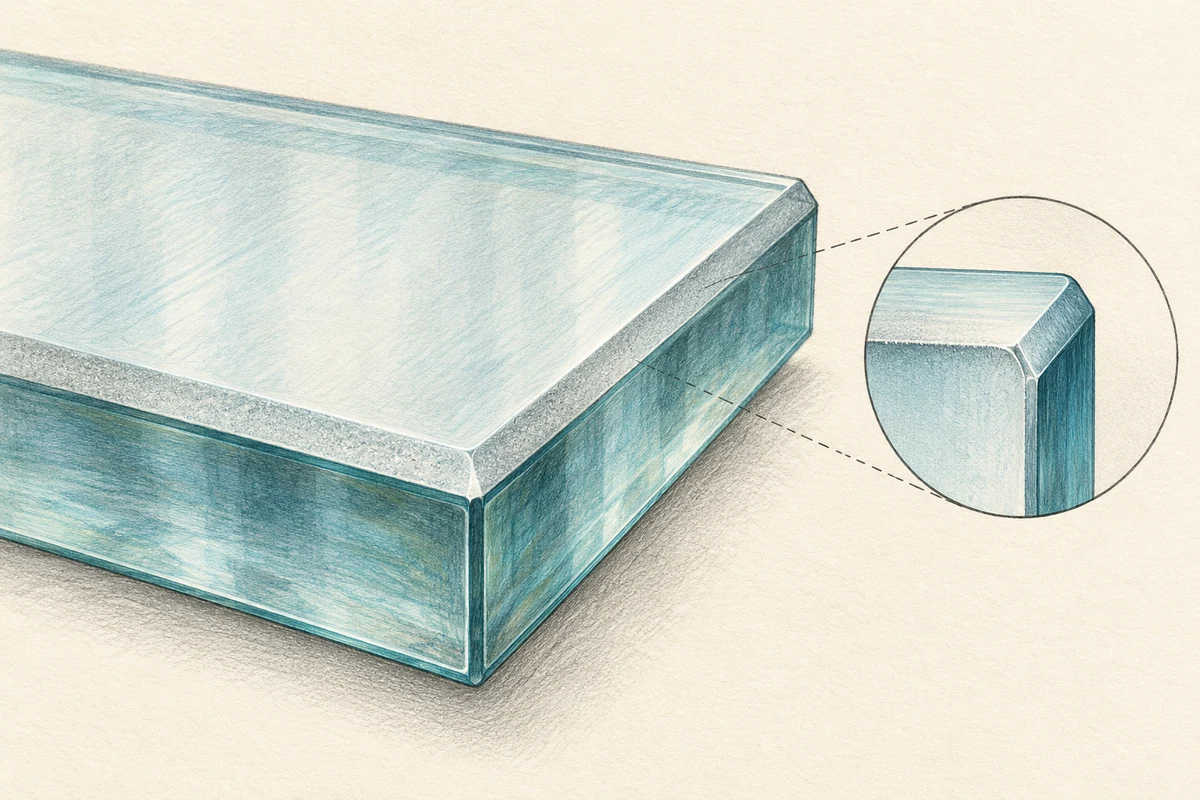
Seamed/arris edge texture is the factory edge finish produced by light grinding to remove sharpness after cutting. It may appear as a narrow frosted/ground band at the perimeter or as micro-striations normal to the edge. This is a manufacturing edge feature, not a worked-surface defect. Evaluate observations under VIS lighting/geometry;
Definition (Reference)
ReferenceSeamed/arris edge texture is the factory edge finish produced by light grinding to remove sharpness after cutting. It may appear as a narrow frosted/ground band at the perimeter or as micro-striations normal to the edge. This is a manufacturing edge feature, not a worked-surface defect. Evaluate observations under VIS lighting/geometry; product/ factory acceptance criteria are distinct from post-restoration acceptance governed by VIS.
Typical Presentation (Informative)
Informative- Uniform, narrow band (typically a few millimetres wide) of matte/frosted texture along the edge arris; may show fine, parallel grind lines.
- Visibility depends on angle/raking light and background contrast; does not change with Non-Invasive Reveal (clean/dry).
Field Identification Cues (Normative)
NormativeSurface-catch class (MSRT):
- On the face area adjacent to the edge: SC-0 (none) for the factory arris itself (no local worked-surface relief on the face). Perform one light, non-marring pass per VIS §5.5; do not abrade or repeat.
Visual signature:
- Non-directional frosted/matte edge band without a transition edge on the face and without chip flanks. (If chip flanks or pits/craters are present on the face, evaluate under M.03/M.04 families.)
Viewing/lighting:
- Inspect at 12 / 36 / 72 in using normal incidence and oblique sweep (~60°-120°) with raking light; surfaces clean/dry. Scan edges and corners at each distance.
Location/access:
- Document pane ID and surface numbering (#1-#4; laminate-internal) on forms; acceptance pertains to the exposed surface under evaluation.
Classification Mapping (to VIS-DA) (Normative)
Normative- Processing feature - not surface damage. When observation confirms uniform factory arris with SC-0 on the face and no transition edge, record “Processing Feature - Not Surface Damage (outside CAT-1...CAT-4).”
- Escalate when:
- Edge micro-chips / clamshells propagate onto the face with clear catch or bright flanks → classify per M.03 (edge & corner) at CAT-3/4 by morphology.
- Between-pane/inaccessible cues (fixed parallax in IGU rabbet area) → CAT-5 by location/condition; refer per project protocol.
Indicative Depth / Relief (Informative)
Informative- Factory arris is edge-only matte texture; no measurable relief on the face area (SC-0) unless accompanied by chips/pits (then classify by M.03/M.04 morphology rather than assigning numeric depth).
Differentiation & False Positives (Informative)
Informative- vs. Abrasion fields on face (M.02): Abrasion shows directional/web texture on the face and can escalate to slight/clear catch; a factory arris remains edge-bound and SC-0 on the face.
- vs. Coating anomalies (Co.01/Co.03): Coating rub/patchiness is localized on the worked surface and disallowed at acceptance when coatings are present; factory arris is an edge feature, not a coating change.
- vs. Hot-particle peppering (Th.01): Thermal pits present bright chip flanks and clear catch on the face; arris texture does not.
Evidence Package (Documentation Requirements) (Normative)
Normative- Photo set (VIS): 12 / 36 / 72 in, normal + oblique; include raking usage; capture one frame showing edge band continuity across a long run to establish factory uniformity.
- MSRT result: Record SC-0 on the face adjacent to the arris; one pass only; non-marring.
- Forms: Pane ID; product family and surface numbering; worked surface Y/N; functional coating present on worked surface? (Y/N/Unknown); reveal status; lighting/time; geometry checklist.
- Acceptance split: VIS governs post-restoration appearance; factory edge finishes follow product standards/project specs-do not conflate.
Mis-ID Pitfalls (Informative)
InformativeAttempting to “blend out” the factory edge frost onto the face can create a worked region with a visible transition edge, which VIS disallows at acceptance (CAT-0...CAT-4). Keep classification appearance-only unless face damage is present.
Reporting Language (Template)
Template- P.03.01 Seamed/Arris Edge Texture (Processing Feature) - Uniform factory arris observed; MSRT on face = SC-0 (no surface relief). No transition edge or chip-flank morphology on the face. Recorded as manufacturing edge finish; not categorized as surface damage under VIS-DA. If face chips/pits exist, classify under M.03/M.04 by CAT and morphology; if between-pane cues are involved, record CAT-5 and refer per project protocol.
Related glossary terms
- GrindingGRK-166
- Acceptance criteriaGRK-151
- Raking lightGRK-129
- Coating rubGRK-115
- AbrasionGRK-035
Source and version
GlassRenu Damage Specification Sheets (DSS), DSS-P.03.01. Source revision and extraction date are recorded in the deployment manifest.
Open the complete published DSS with table of contents (PDF)
Normative and informative labels are preserved from the source. The downloadable one-sheet is a condensed classification aid; this web page retains the complete source-based specification content.