
On this page
- Diagnosis summary
- Safety and classification scope
- Definition (Reference)
- Typical Presentation (Informative)
- Field Identification Cues (Normative)
- Classification Mapping (to VIS-DA) (Normative)
- Indicative Depth / Relief (Informative)
- Differentiation & False Positives (Informative)
- Evidence Package (Documentation Requirements) (Normative)
- Mis-ID Pitfalls (Informative)
- Reporting Language (Template)
- Related glossary terms
- Related DSS
- Source and version
DAMAGE SPECIFICATION STANDARD / METHOD-AGNOSTIC
DSS-P.03.03 — Cutting Skid Lines (factory micro-lines)
Fabrication & finishing - reference; generally not “damage”
Diagnosis summary
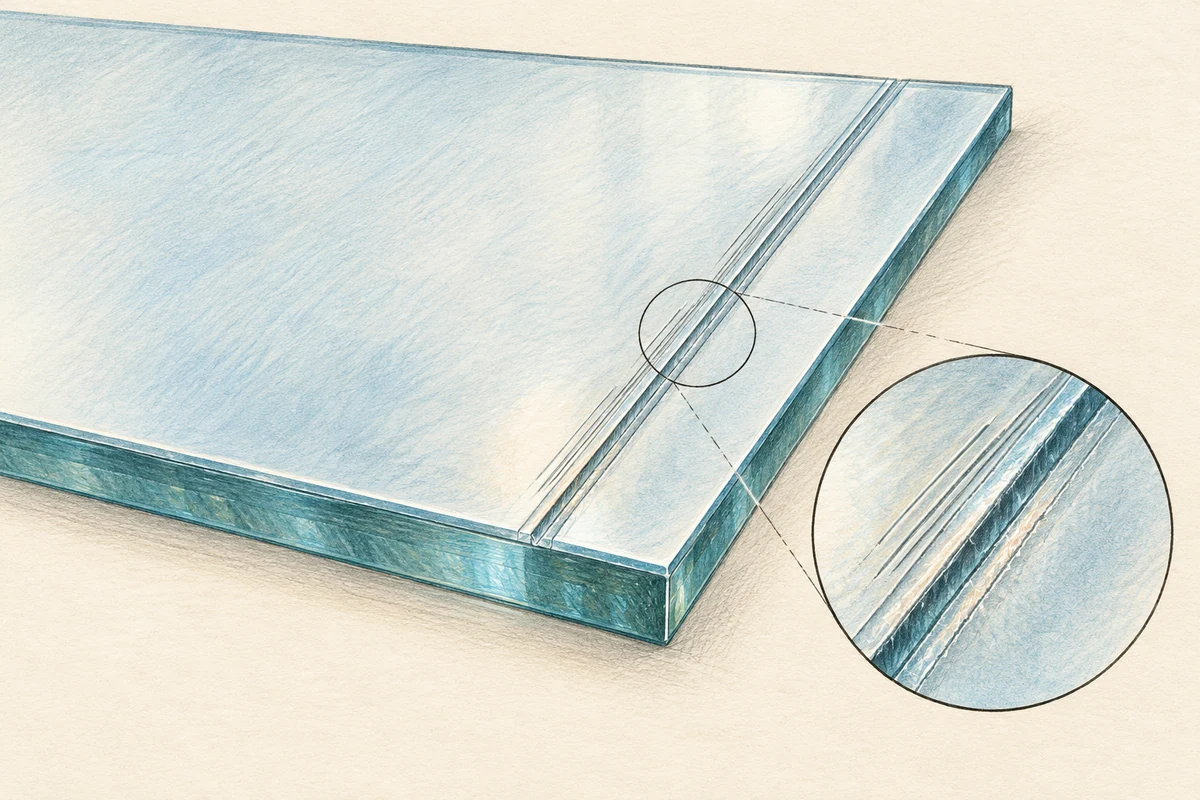
Cutting skid lines are fine, short micro-lines generated during score-and-break cutting at the factory (wheel slip or micro-chatter just before/after the primary score). They are usually confined to the edge zone and appear only in raking/oblique views. As a manufacturing artifact, they are not, by themselves, a worked-surface defect on the face.
Definition (Reference)
ReferenceCutting skid lines are fine, short micro-lines generated during score-and-break cutting at the factory (wheel slip or micro-chatter just before/after the primary score). They are usually confined to the edge zone and appear only in raking/oblique views. As a manufacturing artifact, they are not, by themselves, a worked-surface defect on the face. VIS separates observation under controlled lighting/geometry from post-restoration acceptance; treat factory features accordingly.
Typical Presentation (Informative)
Informative- Clustered, parallel micro-lines oriented with the cut direction, typically perpendicular to the nearby edge; lengths often a few millimetres.
- Edge-proximate and non-localized (no “worked perimeter” ring).
- Visibility increases under raking light with oblique sweep; a Non-Invasive Reveal (clean & dry) does not materially change the cue.
Field Identification Cues (Normative)
NormativeSurface-catch class (MSRT):
On the face near the edge zone, record SC-0 (none) to SC-1 (slight) only. Perform one light, non-marring pass per VIS §5.5; do not abrade or repeat. On suspected coated faces, prefer a polymer stylus and default to visual cues where any coating risk exists.
Visual signature:
Short, fine, parallel micro-lines confined to the edge zone; no transition edge, no pits/craters, no bright chip flanks typical of mechanical scoring.
Viewing/lighting:
Evaluate at 12 / 36 / 72 in, normal + oblique sweep (~60°-120°) under raking light; surfaces clean & dry.
Location/access:
Log pane ID and surface numbering (#1-#4; laminate-internal) on forms; acceptance pertains to the exposed surface being evaluated.
Classification Mapping (to VIS-DA) (Normative)
Normative- Processing feature - not surface damage. If the cue is edge-proximate, uniform, and SC-0/SC-1 with no transition edge or fracture morphology on the face, record “Processing Feature - Not Surface Damage (outside CAT-1...CAT-4).”
- Escalate when:
- Any clear catch with bright chip flanks or extended linear runs across the face → classify under M.01 (linear scoring/tracks) at CAT-3/4 by morphology.
- Indicators show the condition is between panes / inaccessible (fixed parallax in IGU) → CAT-5 by location/condition; refer per project protocol.
Indicative Depth / Relief (Informative)
InformativeFactory cutting micro-lines on the face typically register SC-0 to SC-1 (qualitative), implying very shallow relief (sub-micron to low single-micron range). Numeric depth is not required for classification; use MSRT class and morphology.
Differentiation & False Positives (Informative)
Informative- vs. Fabrication-debris (FD) scratches (M.05): FD tracks are longer-run lineations that traverse the face (often bands) and may escalate in catch; cutting skid lines are short, edge-zone micro-lines. (Classify FD under M.05.)
- vs. Abrasion fields (M.02): Abrasion shows directional/web texture with potential SC-1/SC-2 and broader field extent; cutting skid lines remain discrete and edge-bound.
- vs. Coating rub/patchiness (Co.01/Co.03): Coating anomalies are localized changes on the worked surface and are not permitted at acceptance on coated faces; cutting skid lines are manufacturing edge artifacts. Apply VIS §6.2.e for coated surfaces.
Evidence Package (Documentation Requirements) (Normative)
Normative- Photo set (VIS): 12 / 36 / 72 in, normal + oblique; include raking frames. Capture at least one oblique macro showing parallel micro-lines in the edge zone and one context frame showing edge continuity.
- MSRT result: Record SC-0 / SC-1; one pass only, non-marring; on coated faces prefer polymer stylus.
- Forms: Pane ID; product family and surface numbering; worked surface Y/N; functional coating present on worked surface? (Y/N/Unknown); reveal status; lighting/time; geometry checklist.
- Acceptance split: VIS post-restoration acceptance governs face appearance; do not conflate factory edge artifacts with VIS acceptance criteria.
Mis-ID Pitfalls (Informative)
InformativeAttempting to “blend away” factory edge-zone micro-lines onto the face can create a worked region with a visible transition edge, which VIS disallows at acceptance (CAT-0...CAT-4). Keep classification appearance-only unless face damage is present.
Reporting Language (Template)
Template- P.03.03 Cutting Skid Lines (Processing Feature) - Edge-zone parallel factory micro-lines observed at VIS geometry; MSRT = SC-0/SC-1 (no/trace relief). No transition edge or chip-flank morphology on the face. Recorded as manufacturing artifact; not categorized as surface damage under VIS-DA. If long, tactile lines with bright flanks extend across the face, classify under M.01 by CAT; if between-pane, record CAT-5 and refer per protocol.
Related glossary terms
- Acceptance criteriaGRK-151
- Raking lightGRK-129
- Coating rubGRK-115
- AbrasionGRK-035
- ScratchGRK-032
Source and version
GlassRenu Damage Specification Sheets (DSS), DSS-P.03.03. Source revision and extraction date are recorded in the deployment manifest.
Open the complete published DSS with table of contents (PDF)
Normative and informative labels are preserved from the source. The downloadable one-sheet is a condensed classification aid; this web page retains the complete source-based specification content.