
On this page
- Diagnosis summary
- Safety and classification scope
- Definition (Reference)
- Typical Presentation (Informative)
- Field Identification Cues (Normative)
- Classification Mapping (to VIS-DA) (Normative)
- Indicative Relief (Informative)
- Differentiation & False Positives (Informative)
- Evidence Package (Documentation Requirements) (Normative)
- Mis-ID Pitfalls (Informative)
- Reporting Language (Template)
- Related glossary terms
- Related DSS
- Source and version
DAMAGE SPECIFICATION STANDARD / METHOD-AGNOSTIC
DSS-P.03.05 — Patterned / Textured Glass Relief (design)
Specialty & decorative - reference; generally not “damage”
Diagnosis summary
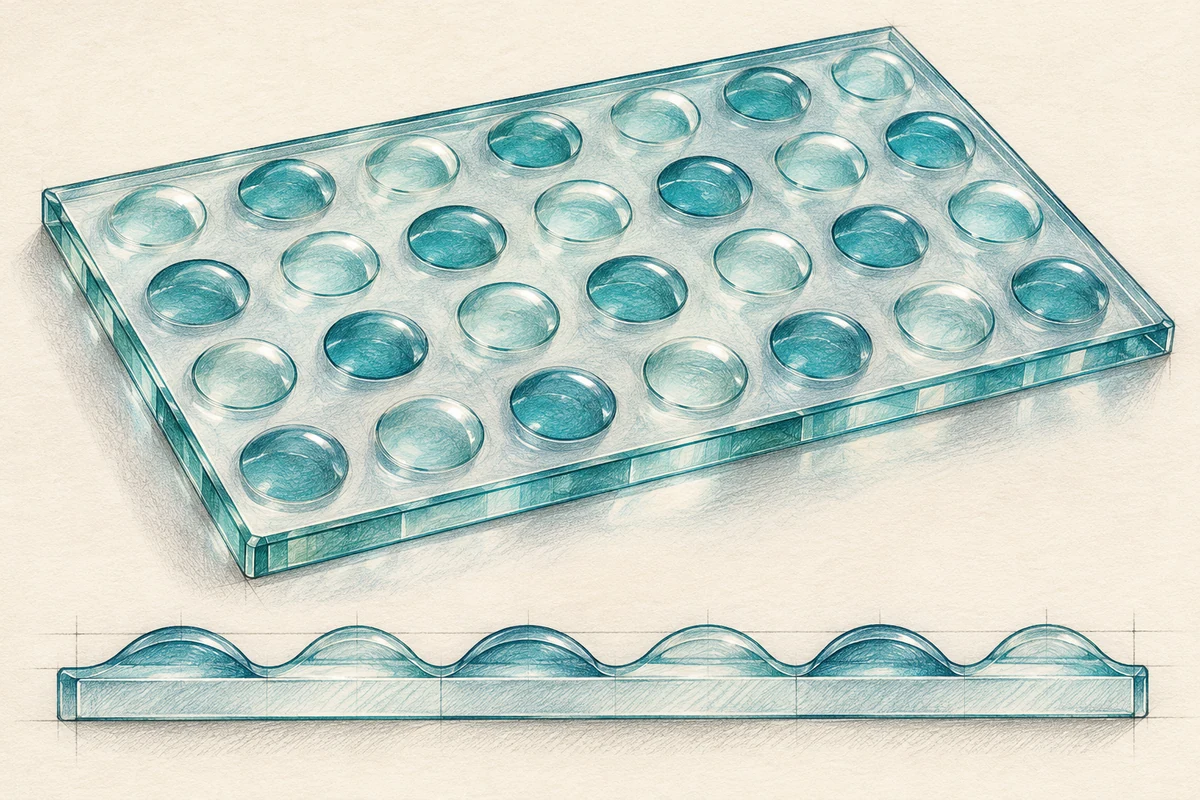
Patterned/textured glass is manufactured with intentional surface relief (e.g., flutes, prismatic or pebbled textures) as an aesthetic/functional design. The relief is inherent to the product, not a worked-surface defect. Evaluate observations under the VIS inspection lighting/geometry;
Definition (Reference)
ReferencePatterned/textured glass is manufactured with intentional surface relief (e.g., flutes, prismatic or pebbled textures) as an aesthetic/functional design. The relief is inherent to the product, not a worked-surface defect. Evaluate observations under the VIS inspection lighting/geometry; post-restoration acceptance of worked areas is governed by VIS and must not be conflated with factory/product acceptance for decorative glass.
Informative context: industry “how to view decorative glazing” guidance (NGA FB67-20) recognizes that decorative products have intentional textures/patterns and should be viewed with appropriate geometry and expectations.
Typical Presentation (Informative)
Informative- Uniform, repeating relief (linear, geometric, pebbled, ribbed), continuous over the lite.
- Contrast and apparent “grain” vary with angle and raking light; a non-invasive reveal (clean & dry) does not remove or change the relief.
Field Identification Cues (Normative)
NormativeSurface-catch class (MSRT):
- On the intended textured face, MSRT will sense design relief; do not abrade. One light, non-marring pass only; on coatings, prefer a polymer stylus or rely on visual morphology + location. MSRT supports classification only (not acceptance).
Visual signature:
- Non-directional, uniform relief without a worked transition edge; no chip flanks/pits typical of mechanical scoring or hot-particle attack. Use normal incidence and oblique sweep (~60°-120°) at 12 / 36 / 72 in under raking light.
Location/access:
- Record pane ID and surface numbering (#1-#4; laminate-internal); acceptance pertains to the exposed surface under evaluation.
Classification Mapping (to VIS-DA) (Normative)
Normative- Processing/design feature - not surface damage. If the observation is uniform product texture with no transition edge and no damage morphology, record “Design Feature - Not Surface Damage (outside CAT-1...CAT-4).”
- Escalate when:
- A local worked region is visible on the textured face (e.g., a transition edge/ring, local directional patterning, chip flanks or pits/craters). → Classify under M- or Ch- families by morphology and assign CAT per VIS (appearance-only).
- The cue shows fixed parallax within an IGU (between-pane). → CAT-5 (out of in-place scope); refer per project protocol.
Indicative Relief (Informative)
InformativeDecorative relief height is a product attribute, not a damage depth; numeric depth is not required for classification/acceptance of design texture. Acceptance for any worked area remains appearance-based (no transition edge, no directional patterning at required views).
Differentiation & False Positives (Informative)
Informative- vs. Abrasion fields (M.02): Abrasion presents directional/web texture and may produce slight/clear catch; design textures are uniform and lack chip flanks.
- vs. Chemical etch (Ch.03/Ch.01): Etch shows modeled micro-texture and can create localization/halos; design texture is consistent and non-localized.
- vs. Coating anomalies (Co.01/Co.03): Coating rub/patchiness is a worked-surface anomaly and is not permitted on coated faces at acceptance (VIS §6.2.e). Decorative relief is product geometry, not a coating change.
Evidence Package (Documentation Requirements) (Normative)
Normative- Photo set (VIS): 12 / 36 / 72 in, normal + oblique; include raking frames showing uniform texture and context frames proving product continuity (not a localized worked patch).
- MSRT result: Record SC class (note: design texture may feel as relief; record without probing). One pass only; non-marring; on suspected coated faces, prefer polymer stylus or rely on visual cues.
- Forms: Pane ID; product family and surface numbering; worked surface Y/N; functional coating present on worked surface? (Y/N/Unknown); reveal status; lighting/time; geometry checklist.
- Acceptance split: Decorative glass viewing should follow the VIS distances/angles; coating anomalies and transition edges/directional patterning remain disqualifying in worked areas.
Mis-ID Pitfalls (Informative)
Informative“Blending” or polishing a small patch on a textured face to “match” relief can create a worked region with a visible transition edge, which VIS disallows at acceptance. Do not attempt to “flatten” design relief.
Reporting Language (Template)
Template- P.03.05 Patterned/Textured Glass Relief (Design Feature) - Uniform product texture observed at VIS geometry; no transition edge and no damage morphology (no chip flanks/pits). MSRT recorded without probing (supports classification only). Logged as design feature - not surface damage under VIS-DA. If any localized worked patch or coating anomaly is present on the inspected face, classify and evaluate per VIS Sections 4 & 6.
Related glossary terms
- Raking lightGRK-129
- Coating rubGRK-115
- AbrasionGRK-035
Source and version
GlassRenu Damage Specification Sheets (DSS), DSS-P.03.05. Source revision and extraction date are recorded in the deployment manifest.
Open the complete published DSS with table of contents (PDF)
Normative and informative labels are preserved from the source. The downloadable one-sheet is a condensed classification aid; this web page retains the complete source-based specification content.