
On this page
- Diagnosis summary
- Safety and classification scope
- Definition (Reference)
- Typical Presentation (Informative)
- Field Identification Cues (Normative)
- Classification Mapping (to VIS-DA) (Normative)
- Indicative Relief / Depth (Informative)
- Differentiation & False Positives (Informative)
- Evidence Package (Documentation Requirements) (Normative)
- Mis-ID Pitfalls (Informative)
- Reporting Language (Template)
- Related glossary terms
- Related DSS
- Source and version
DAMAGE SPECIFICATION STANDARD / METHOD-AGNOSTIC
DSS-P.04.02 — Laminated Interlayer Pattern / Print (design)
Specialty / decorative system - reference; generally not “damage”
Diagnosis summary
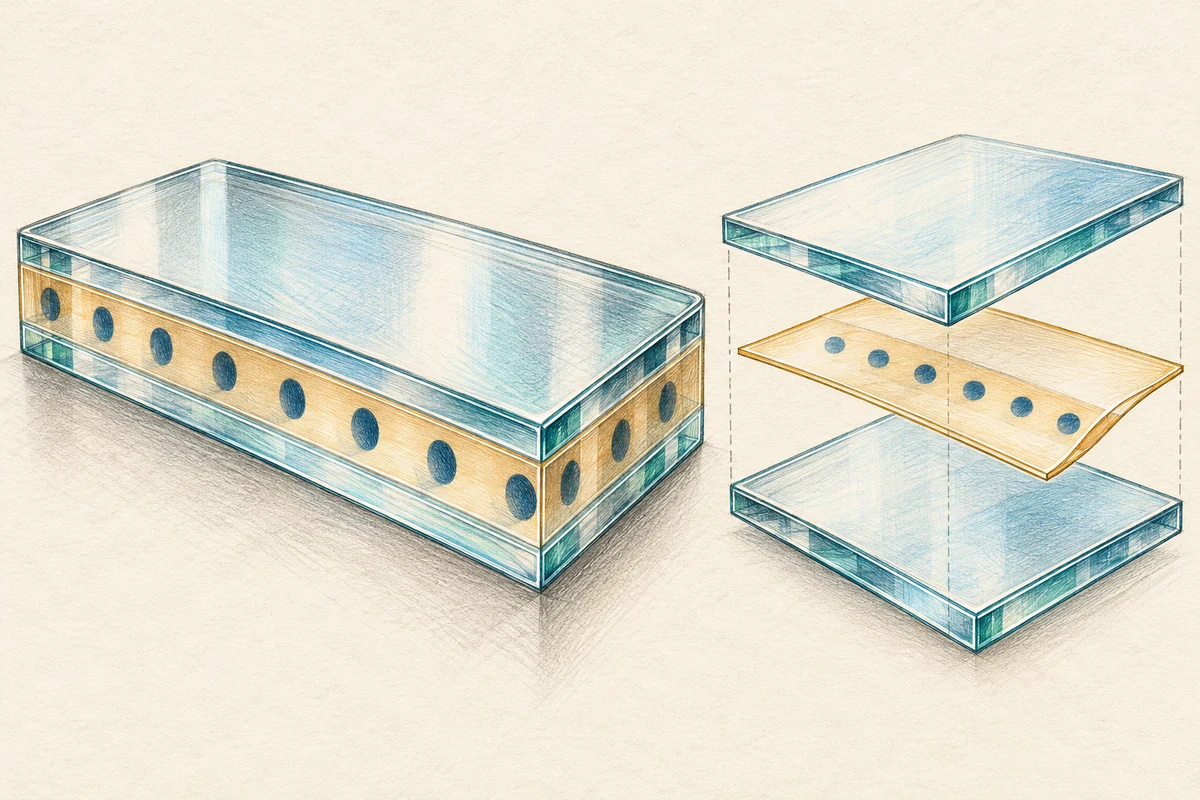
Laminated glass can incorporate printed, patterned, or decorative interlayers (e.g., ceramic-ink prints on film, colored/gradient PVB/ionoplast, fabric meshes). These visuals reside within the laminate between plies and are intentional design attributes, not worked-surface defects on the exposed face.
Definition (Reference)
ReferenceLaminated glass can incorporate printed, patterned, or decorative interlayers (e.g., ceramic-ink prints on film, colored/gradient PVB/ionoplast, fabric meshes). These visuals reside within the laminate between plies and are intentional design attributes, not worked-surface defects on the exposed face. Product identity and baseline terminology follow ASTM C1172 (laminated architectural flat glass) and are listed normatively in VIS; the ISO 12543 laminated glass series is informative background.
Typical Presentation (Informative)
Informative- Uniform, repeatable artwork or tint that is fixed between plies and shows no perimeter/transition edge on the exposed surface.
- Apparent contrast varies with angle and raking light; a non-invasive reveal (clean & dry) does not change the printed appearance. Evaluate under VIS geometry.
Field Identification Cues (Normative)
NormativeSurface-catch class (MSRT):
- On the exposed face, the print is encapsulated; record SC-0 (none) with one light, non-marring pass per VIS §5.5 (supports classification only; do not abrade). Prefer a polymer stylus or visual-only on suspected coated faces.
Visual signature:
- Design-true edges and artwork seen through the ply; no worked transition ring on the exposed face; no chip flanks/pits typical of mechanical or hot-particle damage. Confirm by normal incidence and oblique sweep (~60°-120°) at 12 / 36 / 72 in with raking light.
Location / access:
- Log pane ID and surface numbering (#1-#4 for IGU cavity-bounding faces; laminate-internal for interlayer-adjacent faces). Acceptance in VIS pertains to the exposed surface only.
Classification Mapping (to VIS-DA) (Normative)
Normative- Design/processing feature - not surface damage. If the observation is uniform printed interlayer with SC-0 on the exposed face and no worked perimeter, record “Design Feature - Not Surface Damage (outside CAT-1...CAT-4).”
- Escalate when:
- A local worked region exists on the exposed face (visible transition edge/ring, directional patterning, chip flanks/pits) → classify under M-/Ch- families by morphology and assign CAT per VIS.
- The cue is between panes or within the laminate (i.e., laminate-internal cue) such that it’s inaccessible → CAT-5 by location/condition; document and refer per project protocol.
Indicative Relief / Depth (Informative)
InformativePrinted interlayers are encapsulated graphics, not face-side relief; the exposed face registers SC-0. Numeric “depth” is not applicable for design prints; any worked area on the exposed face remains appearance-based under VIS acceptance (no transition edge, no directional patterning at required views).
Differentiation & False Positives (Informative)
Informative- vs. Interlayer defects (A.02 family): Bubbles/stringers/edge haze are defect morphologies within the laminate (not design prints) and may trigger CAT-5 by inaccessibility. Design prints are continuous and intentional.
- vs. Coating anomalies (Co.01/Co.03): Coating rubs/patchiness are worked-surface anomalies on the exposed face and are disallowed at acceptance when present on the worked surface; design prints are behind the face.
- vs. Paint/film overspray (R.02/R.01): Overspray/adhesive films are on the exposed face and can change with reveal; printed interlayers do not change after cleaning.
Evidence Package (Documentation Requirements) (Normative)
Normative- Photo set (VIS): 12 / 36 / 72 in, normal + oblique, include raking macros showing artwork through the ply with no face-side perimeter, plus context frames confirming pattern continuity. Record lighting/time and reveal status.
- MSRT result: Record SC class on the exposed face (one pass, non-marring). Use polymer stylus or visual-only near coatings.
- Forms: Pane ID; surface numbering; worked surface Y/N; functional coating on worked surface? (Y/N/Unknown); geometry checklist; photos attached.
- Acceptance split: VIS governs post-restoration appearance on the exposed surface; product design prints in the laminate are outside VIS acceptance unless a worked patch exists on the face.
Mis-ID Pitfalls (Informative)
InformativeAttempting to “blend” the exposed face to “mute” a laminate print introduces a worked region with a visible transition edge, which VIS disallows at acceptance. Do not modify face geometry to change encapsulated artwork.
Reporting Language (Template)
Template- P.04.02 Laminated Interlayer Pattern/Print (Design Feature) - Uniform printed/tinted interlayer visible through the ply; MSRT on exposed face = SC-0 (no relief). No transition edge and no chip-flank/pit morphology on the face. Logged as design/processing feature - not surface damage under VIS-DA. If a worked patch is present on the face, classify by morphology and assign CAT; if laminate-internal/inaccessible, record CAT-5 and refer per protocol.
Related glossary terms
- Laminated glassGRK-009
- Raking lightGRK-129
- Coating rubGRK-115
Source and version
GlassRenu Damage Specification Sheets (DSS), DSS-P.04.02. Source revision and extraction date are recorded in the deployment manifest.
Open the complete published DSS with table of contents (PDF)
Normative and informative labels are preserved from the source. The downloadable one-sheet is a condensed classification aid; this web page retains the complete source-based specification content.