
On this page
- Diagnosis summary
- Safety and classification scope
- Definition (Reference)
- Typical Presentation (Informative)
- Field Identification Cues (Normative)
- Classification Mapping (to VIS-DA) (Normative)
- Indicative Relief / Depth (Informative)
- Differentiation & False Positives (Informative)
- Evidence Package (Documentation Requirements) (Normative)
- Mis-ID Pitfalls (Informative)
- Reporting Language (Template)
- Related glossary terms
- Related DSS
- Source and version
DAMAGE SPECIFICATION STANDARD / METHOD-AGNOSTIC
DSS-P.04.03 — Spandrel Opacity Variation (system tolerance)
Specialty/Decorative Systems - reference; generally not “damage”
Diagnosis summary
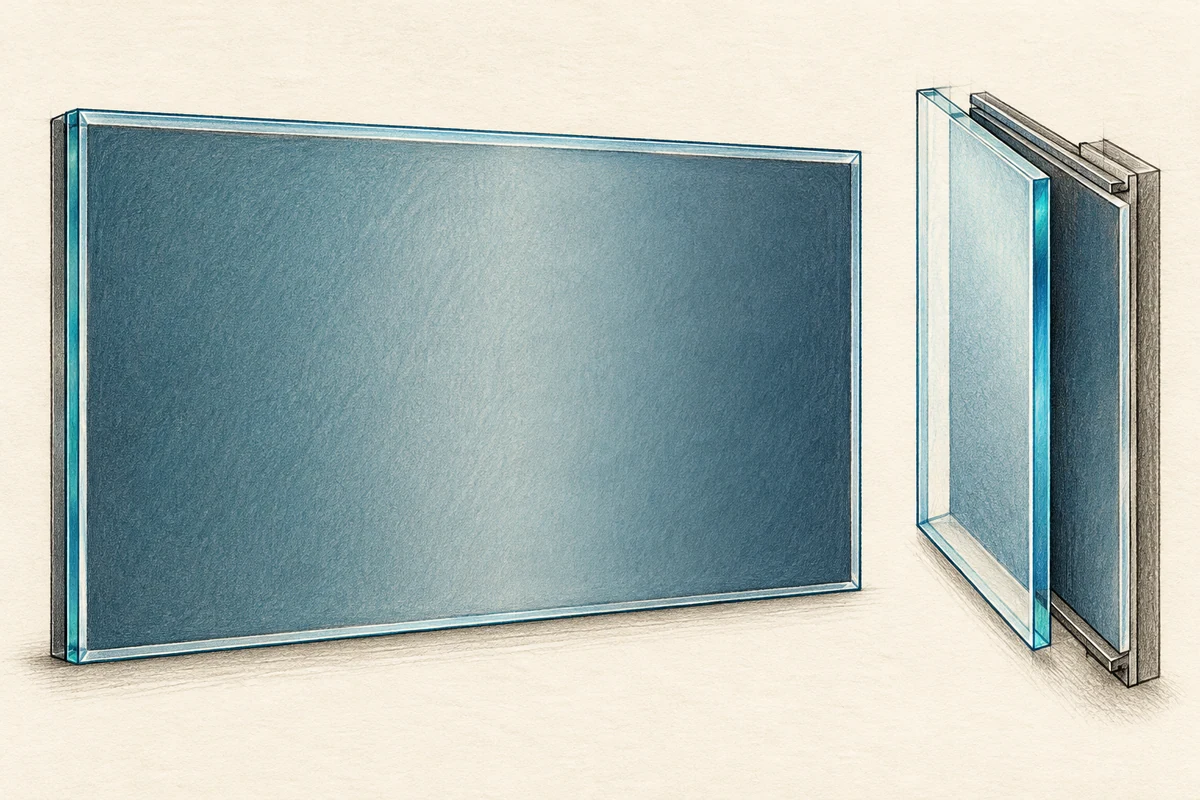
Spandrel glass uses an opaque back-paint or ceramic-frit system to mask building elements. Minor opacity/tonal variation is a system/production tolerance (paint film build, substrate/cavity effects) and is not a worked-surface defect. Evaluate using the VIS inspection lighting/geometry;
Definition (Reference)
ReferenceSpandrel glass uses an opaque back-paint or ceramic-frit system to mask building elements. Minor opacity/tonal variation is a system/production tolerance (paint film build, substrate/cavity effects) and is not a worked-surface defect. Evaluate using the VIS inspection lighting/geometry; post-restoration acceptance for any worked area follows VIS and must not be conflated with factory/product acceptance for spandrel systems.
Typical Presentation (Informative)
Informative- Low-contrast “mottle/cloudiness” visible through the exterior lite over pane-scale areas; increases/decreases with angle/raking.
- Subtle panel-to-panel tone shift; uniform across a lite without a discrete, local boundary.
- No tactile relief on the exposed surface after reveal/dry. (Use the VIS geometry-12/36/72 in; normal + oblique sweep; raking light.)
Field Identification Cues (Normative)
Normative- Surface-catch class (MSRT): SC-0 (none). One light, non-marring pass per VIS §5.5; do not abrade or repeat. On suspected coated faces, prefer a polymer stylus or rely on visual cues. MSRT supports classification only.
- Visual signature: Pane-scale opacity/tonal non-uniformity without a local “worked” perimeter, transition edge, chip flanks, or pits/craters.
- Viewing/lighting: Inspect at 12 / 36 / 72 in, normal incidence and oblique sweep (~60°-120°) under raking light; surfaces clean & dry (non-invasive reveal).
- Location/access: Log pane ID & surface numbering (#1-#4; laminate-internal) on forms; acceptance pertains to the exposed surface being evaluated.
Classification Mapping (to VIS-DA) (Normative)
Normative- Not field damage. If observation confirms pane-scale opacity variation with SC-0 and no worked boundary, record: “Design/System Feature - Not Surface Damage (outside CAT-1...CAT-4).” Classification remains appearance-only; do not assign a CAT for factory/system tolerances.
- Escalate / reclassify when localized anomalies are present:
- Pinholes/holidays or adhesion-loss islands in the back-paint → Co.04.02 / Co.04.03 (coating defects on spandrel). (Worked-surface coating anomalies are not permitted at acceptance on coated faces; apply VIS §6.2.e.)
- Surface rub/patchiness on an exterior coated face (non-spandrel functional coat) → Co.01/Co.03 and classify by CAT per VIS (appearance-only).
- Between-pane look-alike (fixed parallax in an IGU) → CAT-5 (out of in-place scope by location); refer per project protocol.
Indicative Relief / Depth (Informative)
InformativeOpacity variation is a visual/optical system attribute; no tactile relief at the exposed surface (SC-0). Numeric depth is not applicable; classification relies on MSRT class + morphology and VIS viewing geometry.
Differentiation & False Positives (Informative)
Informative- vs. Coating anomalies (worked-surface): Coating rub/patchiness is localized, may show a worked boundary, and is disallowed at acceptance on coated faces (VIS §6.2.e). Spandrel opacity variation is pane-scale/system-level with no worked perimeter.
- vs. Chemical etch or abrasion fields: Etch/abrasion present modeled micro-texture or directionality and can escalate to SC-1/SC-2; spandrel mottle remains SC-0 and perimeter-free at the exposed surface under VIS geometry.
- vs. Decorative glazing texture: Patterned/textured glass has intentional surface relief (design). Evaluate per VIS geometry and decorative-glazing viewing guidance (NGA FB67-20, informative) rather than treating as opacity variation.
Evidence Package (Documentation Requirements) (Normative)
Normative- Photo set (VIS): 12 / 36 / 72 in, normal + oblique; include raking frames that show pane-scale tone/mottle, and at least one context frame establishing lack of a local worked boundary.
- MSRT result: Record SC-0 (one pass only; non-marring; polymer stylus on suspected coatings).
- Forms: Pane ID; product family & surface numbering; worked surface Y/N; functional coating present on worked surface? (Y/N/Unknown); reveal status; lighting/time; geometry checklist; photos attached.
- Acceptance split: VIS governs post-restoration appearance (no transition edge/directional patterning in worked areas at required views). Factory/system tolerances for spandrel are governed by product standards/project specs-do not conflate.
Mis-ID Pitfalls (Informative)
InformativeAttempting localized “spot-correction” of inherent spandrel mottle can create a worked region with a visible transition edge, which VIS disallows at acceptance (CAT-0...CAT-4). Keep classification appearance-only for system tolerances; only reclassify when true coating defects or worked-surface anomalies exist.
Reporting Language (Template)
Template- P.04.03 Spandrel Opacity Variation (System Tolerance) - Pane-scale opacity/tonal non-uniformity observed at VIS geometry; MSRT = SC-0 (no surface relief). No transition edge or chip-flank/pit morphology on the exposed face. Recorded as design/system feature; not categorized as surface damage under VIS-DA. If localized pinholes/adhesion-loss islands or worked-surface coating rub/patchiness are present, classify under Co.04.02 / Co.04.03 or Co.01/Co.03 by CAT per VIS; if between-pane cues are confirmed, record CAT-5 and refer per project protocol.
Related glossary terms
- Raking lightGRK-129
- Coating rubGRK-115
- AbrasionGRK-035
Source and version
GlassRenu Damage Specification Sheets (DSS), DSS-P.04.03. Source revision and extraction date are recorded in the deployment manifest.
Open the complete published DSS with table of contents (PDF)
Normative and informative labels are preserved from the source. The downloadable one-sheet is a condensed classification aid; this web page retains the complete source-based specification content.