
On this page
- Diagnosis summary
- Safety and classification scope
- Classification & Scope (Normative)
- Typical Presentation (Informative)
- Field Identification Cues (Normative)
- Surface-catch class (MSRT)
- Visual signature
- Viewing / lighting
- Location / access
- Mechanism cue (context)
- Severity & CAT Mapping (Normative)
- Differentiation & Mis-ID Pitfalls (Informative)
- Evidence Package *(Documentation Requirements) (Normative)
- Reporting Language (Template)
- Related glossary terms
- Related DSS
- Source and version
DAMAGE SPECIFICATION STANDARD / METHOD-AGNOSTIC
DSS-R.01.04 — Mastic / Bitumen / Tar Transfer
Residue/film - roofing/asphalt/bituminous adhesives; dark brown-black tacky smear, drag strings, soil-loaded bands; typically SC-0
Diagnosis summary
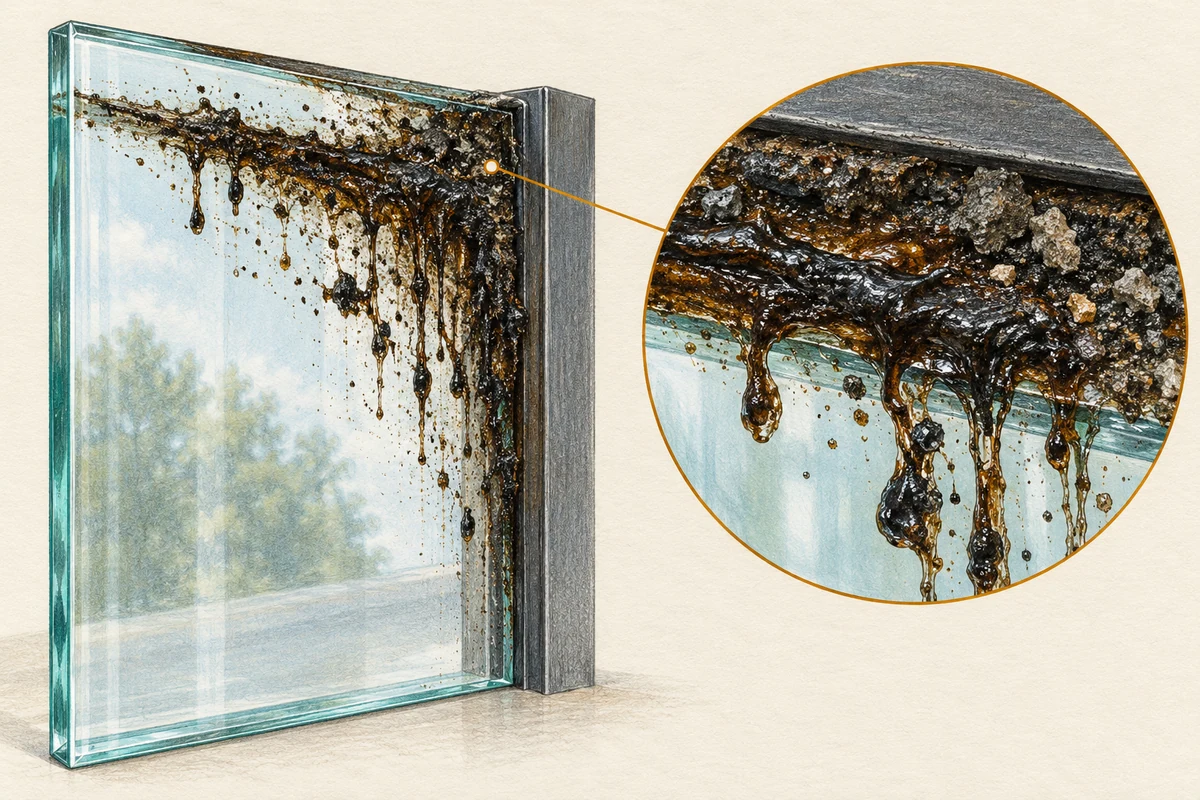
Mastic/bitumen/tar transfer is an appearance change on glass from bituminous products (roofing asphalt, waterproofing mastics, tar-based adhesives/primers) contacting the surface during construction, roofing, façade waterproofing, or logistics. It presents as dark brown–black, tacky smears/bands, often edge- or frame-adjacent, with drag strings and heavy particulate/soot capture.
Classification & Scope (Normative)
NormativeMastic/bitumen/tar transfer is an appearance change on glass from bituminous products (roofing asphalt, waterproofing mastics, tar-based adhesives/primers) contacting the surface during construction, roofing, façade waterproofing, or logistics. It presents as dark brown-black, tacky smears/bands, often edge- or frame-adjacent, with drag strings and heavy particulate/soot capture. Classification is appearance-only per VIS (method-agnostic). Inspect after Non-Invasive Reveal under VIS lighting/geometry; record surface numbering and worked-surface status. Treat active tack/residues per site safety.
Typical Presentation (Informative)
Informative- Thick, tarry bands or hand/finger prints near roof lines, flashing interfaces, waterproofing joints, hoist points, or material staging paths.
- In specular: high-contrast dark smear; in raking: viscous drag fronts, ropey strings, embedded grit, lint.
- Heat/sun can soften/flow residue, creating sags/legs below the origin.
Field Identification Cues (Normative)
NormativeSurface-catch class (MSRT)
- SC-0 on the clean glass substrate once residue is truly lifted (non-etch).
- Do not run MSRT across active tack; if a small test patch is safely cleaned without abrasion, confirm substrate SC-0 there.
- Use polymer stylus if a functional coating is suspected on the worked face. MSRT supports classification only.
Visual signature
- Opaque, dark brown-black smear with ropey edges, stringers, and heavy soil/soot catch; may show heat flow legs.
- No chip-flank sparkle (not mechanical scoring); no discrete fused nodules/pits (not hot-particle peppering).
Viewing / lighting
- Evaluate clean & dry surroundings at 12 / 36 / 72 in, normal incidence and oblique sweep (~60°-120°). Use raking to highlight drag fronts, stringing, and embedded grit. Record distances/angles in-frame.
Location / access
- Record pane ID and surface numbering (#1-#4; laminate-internal). If residue is observed inside an IGU cavity (by parallax on #2/#3), classify CAT-5 by location (out of in-place scope) and refer.
Mechanism cue (context)
- Nearby roofing/tar kettle work, bituminous membranes, flashing/seal courses, waterproofing primers, hoisting slings or gloved handling transferring tar.
Severity & CAT Mapping (Normative)
NormativeAssign CAT by visibility impact under VIS geometry after a controlled reveal test confirms substrate SC-0 on a small patch. Depth values are indicative-field measurement not required.
- CAT-1 (Benign / non-relief): Thin optical smear; SC-0 on clean substrate; mainly angle/raking visible. Indicative relief: 0-10 μm (optical film).
- CAT-2 (Light): Persistent tar veil with soil/soot loading legible at standard view; SC-0 on substrate at test patch. Indicative relief: ~10-40 μm (film).
- CAT-3 (Moderate): Broad/opaque bands, ropey strings, heat-flow legs visible at standard distance; SC-0 on substrate where truly cleaned. Indicative relief: ~40-120 μm (film stack).
- Reclassify when: After true residue removal, any modeled micro-texture or SC-class > 0 persists on substrate → evaluate under chemical etch (Ch.04/.05) or mechanical families as indicated.
- CAT-5 (by condition/location): Between-pane/inaccessible by parallax, integrity indicators (active cracks, pane movement), or confirmed functional-coating loss on the surface to be worked → CAT-5.
CAT is appearance-based; acceptance is separate under VIS-A at 12/36/72 in. Do not abrade to “force” removal during classification.
Differentiation & Mis-ID Pitfalls (Informative)
Informative- vs. Butyl/PIB smear (R.01.02): PIB is usually edge-line/parallels spacers, tacky but less opaque; bitumen/tar is darker, more odoriferous, and often heat-flowed.
- vs. Polysulfide/PU smear (R.01.03): Polysulfide/PU tends amber/grey, shows elastic tails; tar is brown-black, more ropey with soot catch and heat sag.
- vs. Silicone smear (R.01.01): Silicone reads oily/iridescent, lighter, with corduroy tool lines; tar is opaque/dark with grit capture.
- vs. Mineral staining/etch (Ch.03): Mineral films are light/whitish and non-tacky; tar is dark/tacky, often with odor and particulate embed.
- vs. Coating anomalies (Co-family): Manufacturing rub/patchiness shows sheen/color shift on #2/#3 without tack or odor; tar is field residue on exposed faces, unless parallax shows cavity (CAT-5).
Evidence Package *(Documentation Requirements) (Normative)
Normative- Photo set (VIS): 12 / 36 / 72 in, normal + oblique; include raking macros resolving ropey edges, stringers, grit embed, and any heat-flow legs; add context frames (roofing/waterproofing work zones). Record distance/angle in-frame.
- MSRT result (substrate only): After lifting a small test patch without abrasion, perform one light, non-marring pass on the clean substrate; record SC-class (expect SC-0). Avoid stylus over active tack.
- Forms: Pane ID; product family & surface numbering; worked surface Y/N; functional coating present on worked surface? (Y/N/Unknown); reveal status; lighting/time; geometry checklist; photos attached.
- Acceptance split: Post-restoration acceptance per VIS-A §6; classification ≠ acceptance. Coated-face appearance rules apply per VIS §6.2.e when the worked surface is a factory functional coating.
Reporting Language (Template)
Template- R.01.04 Mastic / Bitumen / Tar Transfer - Dark brown-black, tacky smear with ropey edges/stringers on surface #___; post-reveal test patch shows substrate SC-0; visible at [12/36/72 in] under VIS geometry. Morphology: opaque tar bands, grit embed, heat-flow legs; no chip-flank sparkle, no discrete pepper. Classification: CAT-[1/2/3] by visibility (film-only). CAT-5 if between-pane by parallax, or coating-side loss on the surface to be worked. Forms + photo set attached; acceptance per VIS-A §6.
Related glossary terms
- Test patchGRK-144
- AbrasionGRK-035
Source and version
GlassRenu Damage Specification Sheets (DSS), DSS-R.01.04. Source revision and extraction date are recorded in the deployment manifest.
Open the complete published DSS with table of contents (PDF)
Normative and informative labels are preserved from the source. The downloadable one-sheet is a condensed classification aid; this web page retains the complete source-based specification content.