
On this page
- Diagnosis summary
- Safety and classification scope
- Classification & Scope (Normative)
- Typical Presentation (Informative)
- Field Identification Cues (Normative)
- Surface-catch class (MSRT)
- Visual signature
- Viewing / lighting
- Location / access
- Mechanism cue (context)
- Severity & CAT Mapping (Normative)
- Differentiation & Mis-ID Pitfalls (Informative)
- Evidence Package *(Documentation Requirements) (Normative)
- Reporting Language (Template)
- Related glossary terms
- Related DSS
- Source and version
DAMAGE SPECIFICATION STANDARD / METHOD-AGNOSTIC
DSS-Th.02.01 — Torch Proximity Streaking (Heat Skid / Thermal Streaks)
Thermal - localized heat exposure; elongated tone/shine change ± shallow micro-texture
Diagnosis summary
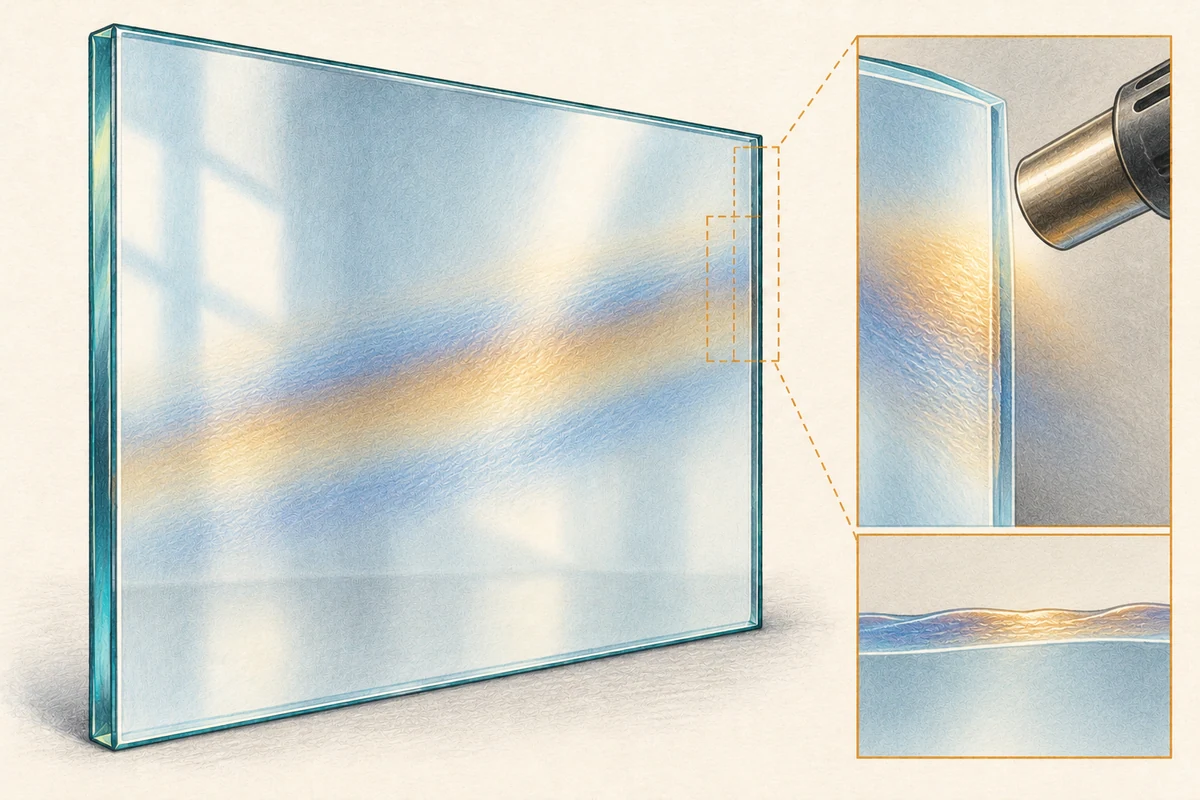
Torch proximity streaking is a localized, elongated appearance change on the exposed face caused by nearby torch/heat tool use (e.g., soldering, brazing, roofing/flashing work). It presents as a streak or band of tone/shine shift and may include modeled micro-texture when the surface has been thermally softened. Classification is appearance-only per VIS (method-agnostic).
Classification & Scope (Normative)
NormativeTorch proximity streaking is a localized, elongated appearance change on the exposed face caused by nearby torch/heat tool use (e.g., soldering, brazing, roofing/flashing work). It presents as a streak or band of tone/shine shift and may include modeled micro-texture when the surface has been thermally softened. Classification is appearance-only per VIS (method-agnostic). Inspect after Non-Invasive Reveal under VIS lighting/geometry; record surface numbering and worked-surface status on Forms:
Typical Presentation (Informative)
Informative- Linear/curvilinear band aligned with torch travel or radiant plume, often tapering with distance from the source.
- Sheen/contrast change in specular view; in raking light may show very fine modeled micro-texture (non-directional).
- May co-occur with soot film (removable) adjacent to a smaller core streak that remains after reveal.
Field Identification Cues (Normative)
NormativeSurface-catch class (MSRT)
- SC-0 when the effect is purely optical/thermal tint or subtle gloss shift (no relief).
- SC-1 (slight) when very shallow micro-texture is present; SC-2 (clear) is uncommon but possible where softening produced minute relief. Perform one light, non-marring pass; polymer stylus if a coating is suspected. MSRT supports classification only.
Visual signature
- Continuous band with soft boundaries (no worked “ring”); no chip flanks, pits, or crater pepper.
- Non-linear grain under raking (if present) reads modeled, not directional scratch webbing.
Viewing / lighting
- Evaluate clean & dry at 12 / 36 / 72 in, normal incidence and oblique sweep (~60°-120°) with raking light to resolve any micro-texture. Document distances/angles in-frame.
Location / access
- Record pane ID and surface numbering (#1-#4; laminate-internal). If parallax shows a between-pane look-alike, classify CAT-5 by location and refer per project protocol.
Mechanism cue (context)
- Proximity to roofing torches, HVAC brazing, flashing work, or open flame; look for directional soot trails and heat-affected metals nearby.
Severity & CAT Mapping (Normative)
NormativeAssign CAT by appearance + MSRT + morphology (three-part cueing). Depth bands below are indicative-numeric measurement not required.
- CAT-1 (Benign / non-relief): Sheen/tone shift only, SC-0, no modeled texture; visible mainly in raking at close/standard view. Indicative relief: ~0-10 μm (optical only).
- CAT-2 (Light): Subtle modeled micro-texture, SC-1 (slight); limited impact at standard view; no chip flanks. Indicative relief: ~10-40 μm.
- CAT-3 (Moderate): Clear detect (SC-2) with visible modeled micro-texture at standard view; boundaries remain soft (no transition ring). Indicative relief: ~40-120 μm.
- CAT-4 (Severe): Pronounced matte/frosted band due to thermal softening/devitrification; distinct at standard & wide-field views; still no pits/craters. Indicative relief: ~120-300 μm+.
- CAT-5 (by location/condition): Between-pane/inaccessible by parallax, integrity indicators (active cracks, pane movement), or confirmed coating-side loss on the surface to be worked → CAT-5.
CAT is appearance-based; acceptance is separate under VIS-A at 12/36/72 in. Do not use MSRT to “probe” or alter surfaces.
Differentiation & Mis-ID Pitfalls (Informative)
Informative- vs. Oxy-fuel/plasma/grinder pepper (Th.01.xx): Hot-particle damage shows discrete nodules/pits with bright rims; torch streaking is a continuous band without discrete pepper.
- vs. Linear scoring (M.01): Scoring forms continuous abrasive lines with chip-flank sparkle; torch streaks show modeled (non-directional) micro-texture or sheen shift.
- vs. Residue films (R-family): Soot and condensate remove at reveal (SC-0). Persisting core band suggests thermal effect → classify here.
- vs. Coating anomalies (Co-family): Coating rub/patchiness may present sheen/color shifts but is governed by coated-surface acceptance; any anomaly on the worked coated face is not permitted at acceptance.
- vs. Roller wave / bow (P.01): Factory flatness features are pane-scale, periodic or global and SC-0; torch streaking is local and may show SC-1/SC-2.
Evidence Package *(Documentation Requirements) (Normative)
Normative- Photo set (VIS): 12 / 36 / 72 in, normal + oblique, include raking macros resolving any micro-texture; add context frames showing suspected heat source alignment. Record distance/angle in-frame.
- MSRT result: Record SC-class (SC-0/1/2) with one light, non-marring pass (polymer stylus if a coating is suspected).
- Forms: Pane ID; product family & surface numbering; worked surface Y/N; functional coating present on worked surface? (Y/N/Unknown); reveal status; lighting/time; geometry checklist; photos attached.
- Acceptance split: Post-restoration acceptance per VIS-A §6; classification ≠ acceptance. Coating-side anomalies on the worked surface remain disqualifying.
Reporting Language (Template)
Template- Th.02.01 Torch Proximity Streaking - Localized heat-affected band on surface #___ with [SC-0/SC-1/SC-2]; no pits/craters or chip flanks; visible at [12/36/72 in] under VIS geometry after Non-Invasive Reveal. Morphology: sheen/contrast shift ± modeled micro-texture; boundaries soft (no worked ring). Classification: CAT-[1/2/3/4] by cues; CAT-5 if between-pane/integrity or coating-side loss on the surface to be worked. Forms + photo set attached; acceptance per VIS-A §6.
Related glossary terms
- Raking lightGRK-129
- Coating rubGRK-115
- AbrasiveGRK-168
- ScratchGRK-032
Source and version
GlassRenu Damage Specification Sheets (DSS), DSS-Th.02.01. Source revision and extraction date are recorded in the deployment manifest.
Open the complete published DSS with table of contents (PDF)
Normative and informative labels are preserved from the source. The downloadable one-sheet is a condensed classification aid; this web page retains the complete source-based specification content.