
On this page
- Diagnosis summary
- Safety and classification scope
- Definition (Reference)
- Typical Presentation (Informative)
- Field Identification Cues (Normative)
- Viewing / Lighting (use VIS)
- Classification Mapping (to VIS-DA) (Normative)
- Indicative Depth / Relief (Informative)
- Differentiation & False Positives (Informative)
- Evidence Package (Documentation Requirements) (Normative)
- Reporting Language (Template)
- Related glossary terms
- Related DSS
- Source and version
DAMAGE SPECIFICATION STANDARD / METHOD-AGNOSTIC
DSS-A.01.03 — Desiccant Dust / Fines in IGU Cavity
Diagnosis summary
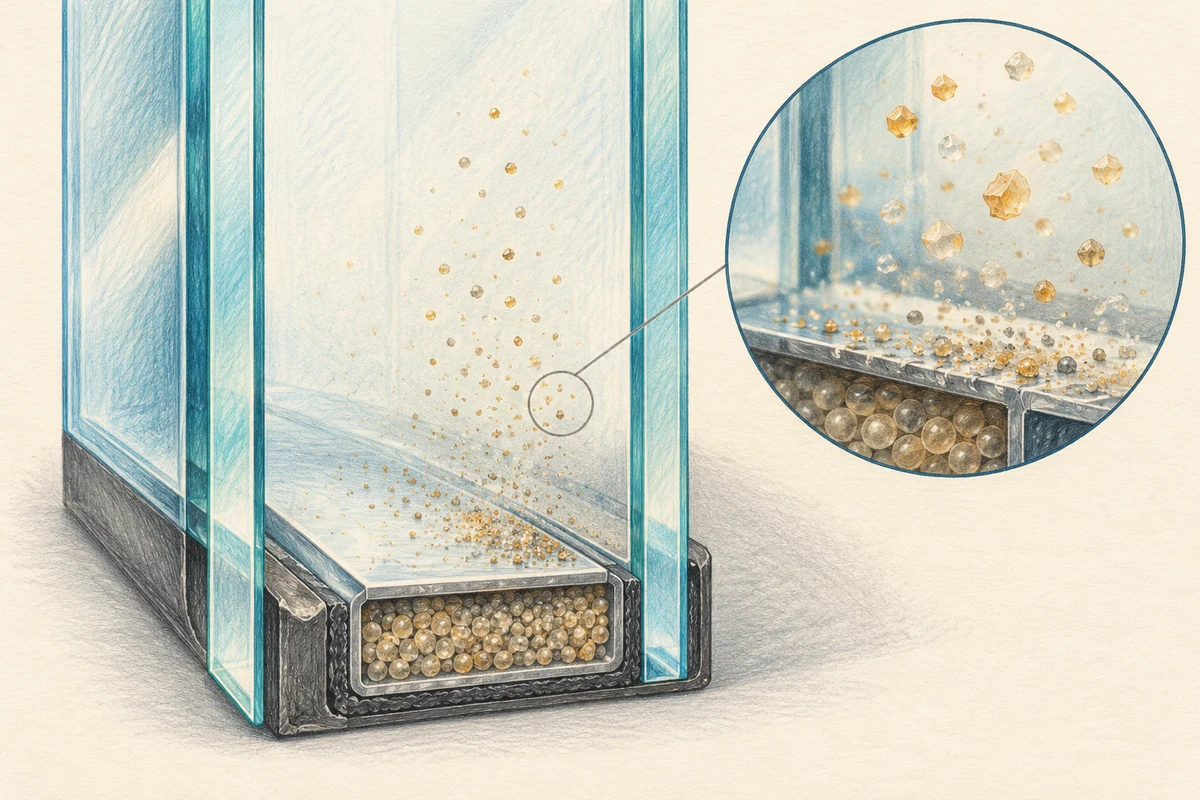
Particulate fines (typically white/gray) released from or tracked by the spacer/desiccant system within an insulating glass unit (IGU) cavity. Presents on cavity faces (#2 and/or #3) and is not accessible in-place. IGU surface numbering and “between-pane” determination follow the VIS conventions.
Definition (Reference)
ReferenceParticulate fines (typically white/gray) released from or tracked by the spacer/desiccant system within an insulating glass unit (IGU) cavity. Presents on cavity faces (#2 and/or #3) and is not accessible in-place. IGU surface numbering and “between-pane” determination follow the VIS conventions.
Typical Presentation (Informative)
Informative- Discrete specks or light “peppering” scattered near the spacer or in streaks/bands within the cavity; may increase over time as the unit ages.
- Most apparent in raking light or against dark interiors; does not respond to exterior/interior cleaning.
- Apparent location is stable under parallax (i.e., the specks move with the glass/its reflection consistently as a between-pane feature, not on the outer face).
Field Identification Cues (Normative)
Normative- Location cue (parallax): Fixed parallax confirming #2/#3 cavity faces → record as a between-pane condition.
- MSRT (surface-catch): Not applicable to the cavity faces; do not attempt tactile checks on inboard/outboard faces to infer between-pane relief. (MSRT supports field classification only on exposed faces under VIS; use visual + location cues for cavity features.)
- Surface numbering on forms: Log #1-#4 per VIS and note “cavity (#2/#3)” in remarks.
Viewing / Lighting (use VIS)
InformativeEvaluate at 12 / 36 / 72 in with normal incidence + oblique sweep (~60°-120°) under raking light; surfaces must be clean/dry (Non-Invasive Reveal) to exclude face-side residues.
Classification Mapping (to VIS-DA) (Normative)
Normative- CAT-5 (Non-repairable / out of in-place scope by location). Between-pane/cavity contaminants are not addressable in place; document and refer per project protocol (manufacturer/warranty/replacement).
Indicative Depth / Relief (Informative)
InformativeNot applicable as a surface-relief quantity on the exposed faces. The feature resides on #2/#3 cavity faces or within the spacer/cavity environment; field acceptance remains appearance-only and location-based under VIS.
Differentiation & False Positives (Informative)
Informative- vs. Exterior/interior dust or paint specks (R-family): Face-side residues change with Non-Invasive Reveal; true cavity fines do not. Use parallax to confirm between-pane location.
- vs. Spacer smear/bleed (A.01.04): Smear appears as continuous bands/films along the spacer sightline rather than discrete specks; both are CAT-5 by location. (Document with close oblique photos and refer.)
- vs. Low-E coating rub/patchiness on worked surface (Co-family): Coating anomalies are on an exposed worked face and are disallowed at acceptance; cavity fines sit behind the face (CAT-5). Log surface numbering to avoid mis-ID.
Evidence Package (Documentation Requirements) (Normative)
Normative- Photo set (VIS): 12 / 36 / 72 in, normal + oblique; include raking frames and at least one sequence demonstrating fixed parallax relative to the reflection.
- Forms: Pane ID; product family; surface numbering (#1-#4; laminate-internal); “cavity (#2/#3)” noted; lighting/time; geometry checklist.
- Narrative note: “Between-pane particulate; non-responsive to Non-Invasive Reveal; CAT-5 by location.” (VIS separates classification from acceptance; factory/warranty governs IGU integrity.)
Reporting Language (Template)
TemplateA.01.03 Desiccant Dust/Fines (IGU Cavity) - Discrete particulate visible on #2/#3 faces confirmed by fixed parallax under VIS geometry. Non-responsive to Non-Invasive Reveal; MSRT not applicable to cavity faces. CAT-5 (between-pane; out of in-place scope). Documented with photo set and surface numbering; refer to manufacturer/warranty per project protocol.
Related glossary terms
- DesiccantGRK-220
- Insulating glass unit (IGU)GRK-010
- SpacerGRK-219
- Raking lightGRK-129
- Coating rubGRK-115
Source and version
GlassRenu Damage Specification Sheets (DSS), DSS-A.01.03. Source revision and extraction date are recorded in the deployment manifest.
Open the complete published DSS with table of contents (PDF)
Normative and informative labels are preserved from the source. The downloadable one-sheet is a condensed classification aid; this web page retains the complete source-based specification content.