
On this page
- Diagnosis summary
- Safety and classification scope
- Definition (Reference)
- Typical Presentation (Informative)
- Field Identification Cues (Normative)
- Classification Mapping (to VIS-DA) (Normative)*
- Indicative Relief / Depth (Informative)
- Differentiation & False Positives (Informative)
- Evidence Package (Documentation Requirements) (Normative)*
- Mis-ID Pitfalls (Informative)
- Reporting Language (Template)
- Related glossary terms
- Related DSS
- Source and version
DAMAGE SPECIFICATION STANDARD / METHOD-AGNOSTIC
DSS-A.01.06 — Breather / Altitude-Tube Staining Pattern (#2 / #3)
Assembly / internal condition - typically CAT-5 by location; out of in-place scope
Diagnosis summary
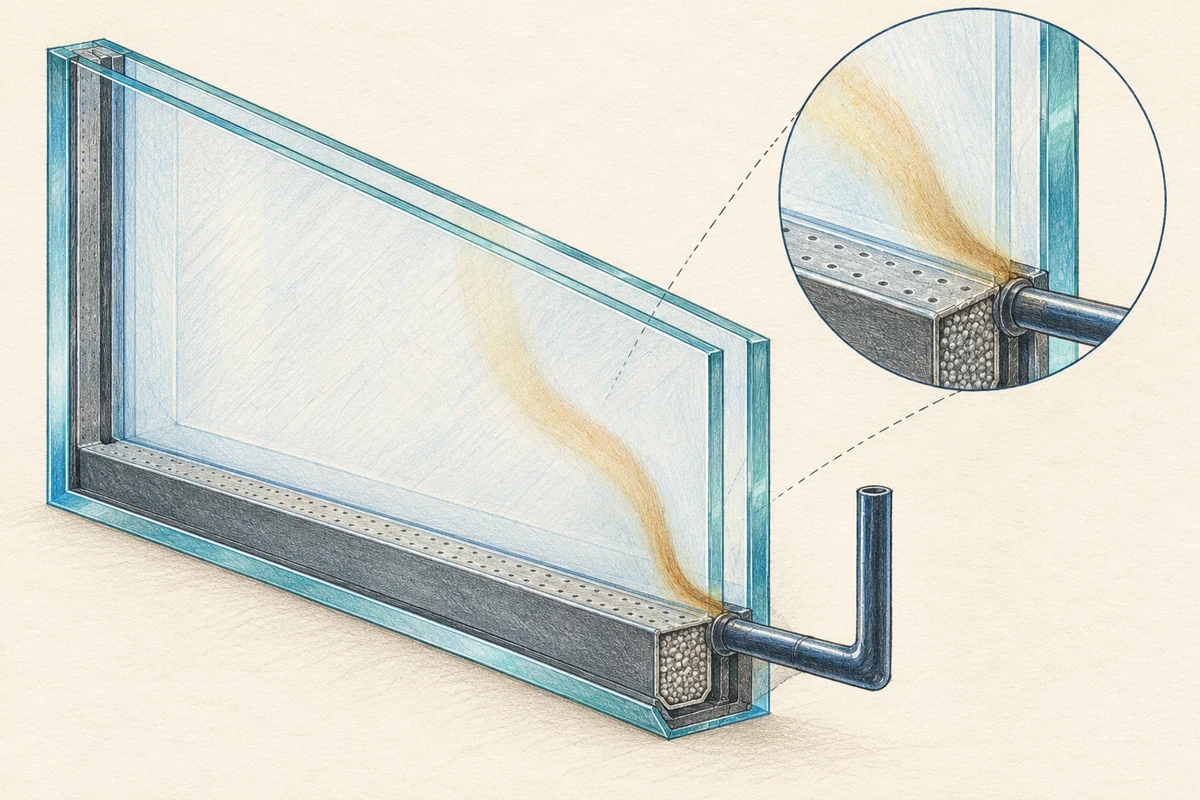
Characteristic staining or streaking patterns deposited on IGU cavity faces (usually #2 / #3) associated with breather/altitude-tube ports used during fabrication/shipping/altitude equalization. By location (between panes), these cues are not on an exposed worked face and are not addressable in place; classification is therefore location/condition-driven.
Definition (Reference)
ReferenceCharacteristic staining or streaking patterns deposited on IGU cavity faces (usually #2 / #3) associated with breather/altitude-tube ports used during fabrication/shipping/altitude equalization. By location (between panes), these cues are not on an exposed worked face and are not addressable in place; classification is therefore location/condition-driven. This entry follows VIS surface numbering and between-pane verification by fixed parallax.
Typical Presentation (Informative)
Informative- Localized halos, arcs, or drip-like streaks emanating from or near the tube entry/sightline, commonly along the perimeter; tone may be translucent, slightly glossy, or matte.
- No change after Non-Invasive Reveal of the exposed faces; persists in identical position when viewed at different angles (i.e., parallax-fixed between the panes).
Field Identification Cues (Normative)
NormativeLocation / access (primary):
- Identify faces via surface numbering (#1-#4). Demonstrate between-pane location by fixed parallax (feature remains stationary relative to its reflection as the observer moves). If confirmed, classify CAT-5 by location.
Surface-catch class (MSRT):
- Not determinative for a cavity-face cue. MSRT is for exposed faces only and is a single, non-marring pass to support classification-not acceptance. On the exposed face, record SC-0 (no relief) if checked.
Inspection environment / reveal controls:
- Perform Non-Invasive Reveal (clean & dry) on the exposed surface(s) before evaluation; if the cue persists unchanged, that supports a cavity origin. Do not use blades/abrasives/chemicals prior to classification.
Viewing / lighting:
- Apply VIS geometry: 12 / 36 / 72 in; normal incidence + oblique sweep (~60°-120°) with raking light. Include perimeter shots that show the cue’s relationship to the likely tube location.
Classification Mapping (to VIS-DA) (Normative)*
Normative- CAT-5 - Out of scope for in-place restoration when the staining resides on #2/#3 (between panes). Document and refer per project protocol (manufacturer/warranty/replacement).
Indicative Relief / Depth (Informative)
Informative- No accessible relief on the exposed face (SC-0 if checked). Apparent “depth” is within the cavity; numeric surface depth on the exposed face is not applicable.
Differentiation & False Positives (Informative)
Informative- vs. Spacer smear/bleed (A.01.04): Spacer smear typically forms continuous bands parallel to the spacer; breather-tube staining often radiates from a point/port or short perimeter segment. Both are CAT-5 by location-document geometry and parallax.
- vs. Internal haze/volatile fogging (A.01.01): Fogging is a diffuse veil across a broader field; tube staining is localized with identifiable origin. Use parallax and perimeter context.
- vs. Face-side residue (R-family): Face films respond to reveal; cavity staining does not. Confirm with reveal and fixed parallax.
Evidence Package (Documentation Requirements) (Normative)*
Normative- Photo set (VIS): 12 / 36 / 72 in, normal + oblique, raking; include a parallax sequence and perimeter frames that show the tube/port adjacency.
- Forms: Record pane ID, product family & surface numbering (#1-#4; laminate-internal), worked surface Y/N, functional coating present on worked surface? (Y/N/Unknown), reveal status, lighting/time, geometry checklist.
- Narrative split: “Between-pane perimeter staining consistent with breather/altitude-tube origin on #2/#3; CAT-5 by location; refer per protocol.”
Mis-ID Pitfalls (Informative)
InformativeAttempting to “clean” a cavity artifact from the exposed face risks creating a worked region (visible transition edge), which VIS disallows at acceptance for CAT-0...CAT-4. Confirm reveal status and parallax before any action.
Reporting Language (Template)
Template- A.01.06 Breather/Altitude-Tube Staining (Cavity #2/#3) - Localized perimeter staining consistent with tube/port origin; parallax-fixed between panes; no change after Non-Invasive Reveal; MSRT not applicable to cavity face. CAT-5 (out of in-place scope by location). Documented per VIS geometry; refer per project protocol.
Related glossary terms
- StainGRK-046
- DepositGRK-045
- Raking lightGRK-129
- AbrasiveGRK-168
Source and version
GlassRenu Damage Specification Sheets (DSS), DSS-A.01.06. Source revision and extraction date are recorded in the deployment manifest.
Open the complete published DSS with table of contents (PDF)
Normative and informative labels are preserved from the source. The downloadable one-sheet is a condensed classification aid; this web page retains the complete source-based specification content.