
On this page
- Diagnosis summary
- Safety and classification scope
- Definition (Reference)
- Typical Presentation (Informative)
- Field Identification Cues (Normative)
- Location / access (primary)
- Surface-catch class (MSRT)
- Inspection environment / reveal controls
- Viewing / lighting
- Classification Mapping (to VIS-DA) (Normative)
- Indicative Relief / Depth (Informative)
- Differentiation & False Positives (Informative)
- Evidence Package (Documentation Requirements) (Normative)
- Reporting Language (Template)
- Related glossary terms
- Related DSS
- Source and version
DAMAGE SPECIFICATION STANDARD / METHOD-AGNOSTIC
DSS-A.04.01 — Black Spots / Voids in Active Layer (PDLC / EC; switchable glazing)
Assembly / internal condition - typically CAT-5 by location; out of in-place scope
Diagnosis summary
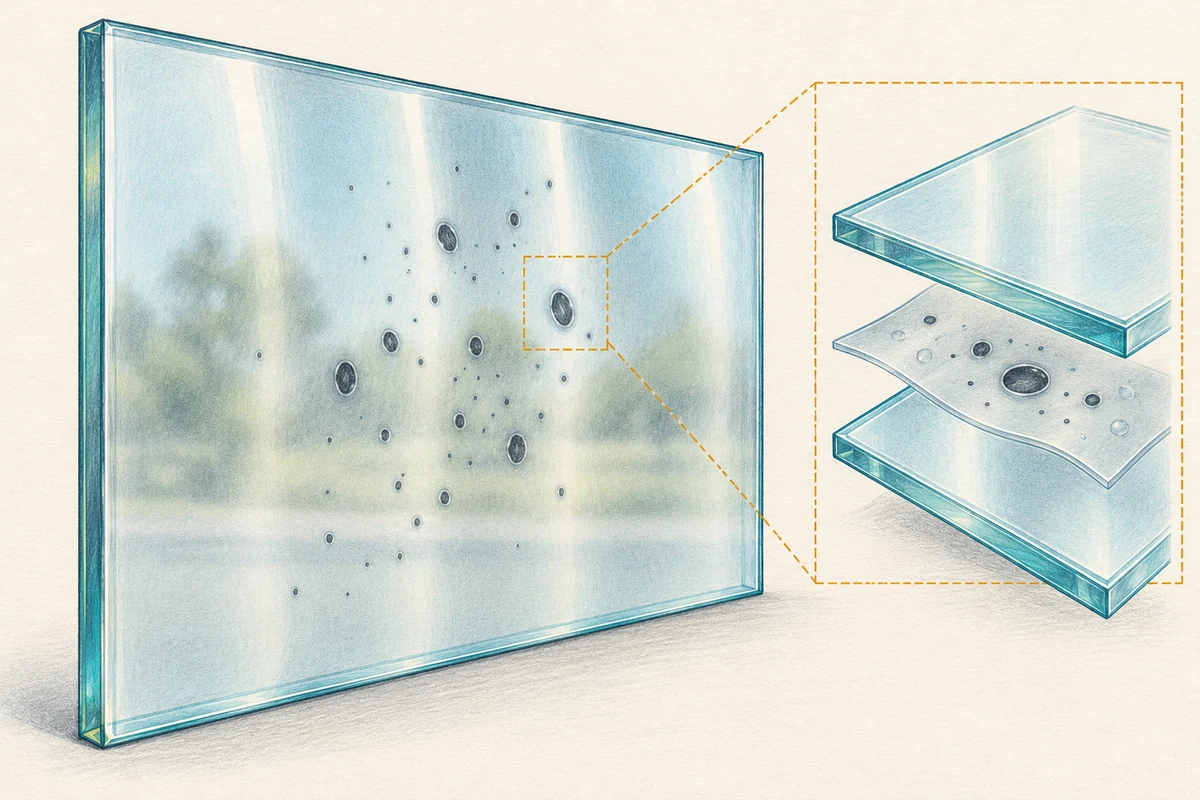
Discrete dark “black” spots, pin-voids, or small opaque islands occurring within the active switchable layer (e.g., PDLC or electrochromic stack) of a smart-glazing lite. Because the cue resides within the laminate or device stack (not on an exposed worked face), it is not addressable in place; classification is governed by location/condition under VIS rules.
Definition (Reference)
ReferenceDiscrete dark “black” spots, pin-voids, or small opaque islands occurring within the active switchable layer (e.g., PDLC or electrochromic stack) of a smart-glazing lite. Because the cue resides within the laminate or device stack (not on an exposed worked face), it is not addressable in place; classification is governed by location/condition under VIS rules. Use VIS surface numbering and parallax to confirm non-face location before assigning CAT.
Typical Presentation (Informative)
Informative- Small, sharply defined dark points or voids that remain visible in both “on” and “off” states (contrast may vary with state).
- Often static in position; may be isolated or occur in small clusters; sometimes biased near busbars/lead areas or printed electrode edges.
- No change after Non-Invasive Reveal of exposed faces; no worked transition edge on the face when viewed under VIS inspection geometry.
Field Identification Cues (Normative)
NormativeLocation / access (primary)
- Confirm the cue sits within the device/laminate and is not on a worked face. Demonstrate fixed parallax (feature remains fixed relative to its reflection as the observer moves). If between panes or internal to the laminate/device, classify CAT-5 by location. Record surface numbering on forms (#1-#4; tag laminate-internal when applicable).
Surface-catch class (MSRT)
- On exposed face(s), record SC-0 (none). The Manual Surface-Relief Test is a single, non-marring pass used only to support classification-not acceptance; it cannot “probe” an internal cue. Prefer a polymer stylus on suspected coated faces, or rely on visual/location cues.
Inspection environment / reveal controls
- Perform Non-Invasive Reveal (clean & dry) before evaluation; persistence confirms non-face location. Avoid blades/abrasives/chemicals prior to classification.
Viewing / lighting
- Apply VIS geometry: 12 / 36 / 72 in; view at normal incidence and through an oblique sweep (~60°-120°) with raking light. Use back-lit frames when safe to emphasize internal contrast.
Classification Mapping (to VIS-DA) (Normative)
Normative- CAT-5 - Out of in-place scope when the condition is laminate/device-internal (not on an exposed worked surface). Document and refer per project protocol (fabricator/manufacturer/warranty).
- If any additional face-side damage exists (e.g., scratches, coating rub/patchiness), classify that separately under the appropriate family (M/Co/Ch) and assign CAT per VIS; do not let an internal cue drive face-side acceptance.
Indicative Relief / Depth (Informative)
Informative- Not applicable on the exposed face(s): SC-0 is expected. Numeric μm ranges in VIS apply to face-side defects only; internal device/laminate anomalies have no measurable face-relief for MSRT.
Differentiation & False Positives (Informative)
Informative- vs. Coating anomalies on the worked surface (Co-family): Coating rub/sheens occur on the exposed face and are disallowed at acceptance on coated surfaces (VIS §6.2.e). Internal active-layer voids show fixed parallax and remain unaffected by reveal.
- vs. Between-pane particulate (A.01.03): Cavity fines present on #2/#3 faces and may look speckled; verify location with parallax and surface numbering; both are CAT-5 by location, but family assignment differs.
- vs. Face-side residues/films (R-family): Residues change with reveal and can show face-side MSRT cues; internal active-layer voids do not.
Evidence Package (Documentation Requirements) (Normative)
Normative- Photo set (VIS): 12 / 36 / 72 in; normal + oblique; include raking frames and a short sequence (or paired frames) demonstrating fixed parallax. Note lighting/time and reveal status.
- Forms: Pane ID; product family (smart glazing-PDLC/EC); surface numbering (#1-#4; laminate-internal if applicable); “worked surface Y/N”; functional coating present on worked surface? (Y/N/Unknown); environment checks (dry; no condensation).
- Acceptance split: Internal device/laminate conditions are not subject to in-place acceptance under VIS; document and refer. Do not conflate factory/system issues with VIS acceptance for restored faces.
Reporting Language (Template)
TemplateA.04.01 Black Spots/Voids in Active Layer (PDLC/EC) - Discrete internal dark points verified by fixed parallax; no change after Non-Invasive Reveal of #1/#4; MSRT records SC-0 on exposed face(s). Logged as CAT-5 (out of in-place scope by location). Documented per VIS (photos at 12/36/72 in; normal + oblique + raking; surface numbering recorded) and referred to manufacturer/warranty per project protocol.
Related glossary terms
- Raking lightGRK-129
- Coating rubGRK-115
- AbrasiveGRK-168
- ScratchGRK-032
Source and version
GlassRenu Damage Specification Sheets (DSS), DSS-A.04.01. Source revision and extraction date are recorded in the deployment manifest.
Open the complete published DSS with table of contents (PDF)
Normative and informative labels are preserved from the source. The downloadable one-sheet is a condensed classification aid; this web page retains the complete source-based specification content.