
On this page
- Diagnosis summary
- Safety and classification scope
- Classification & Scope (Normative)
- Typical Presentation (Informative)
- Field Identification Cues (Normative)
- Surface-catch class (MSRT)
- Visual signature
- Viewing / lighting
- Location / access
- Mechanism cue (context)
- Severity & CAT Mapping (Normative)
- Differentiation & Mis-ID Pitfalls (Informative)
- Evidence Package *(Documentation Requirements) (Normative)
- Reporting Language (Template)
- Related glossary terms
- Related DSS
- Source and version
DAMAGE SPECIFICATION STANDARD / METHOD-AGNOSTIC
DSS-Ch.05.01 — Bleach / Peroxide Shadowing
Chemical - oxidizer exposure; optical tone shift ± very shallow micro-texture within spill/wipe footprints
Diagnosis summary
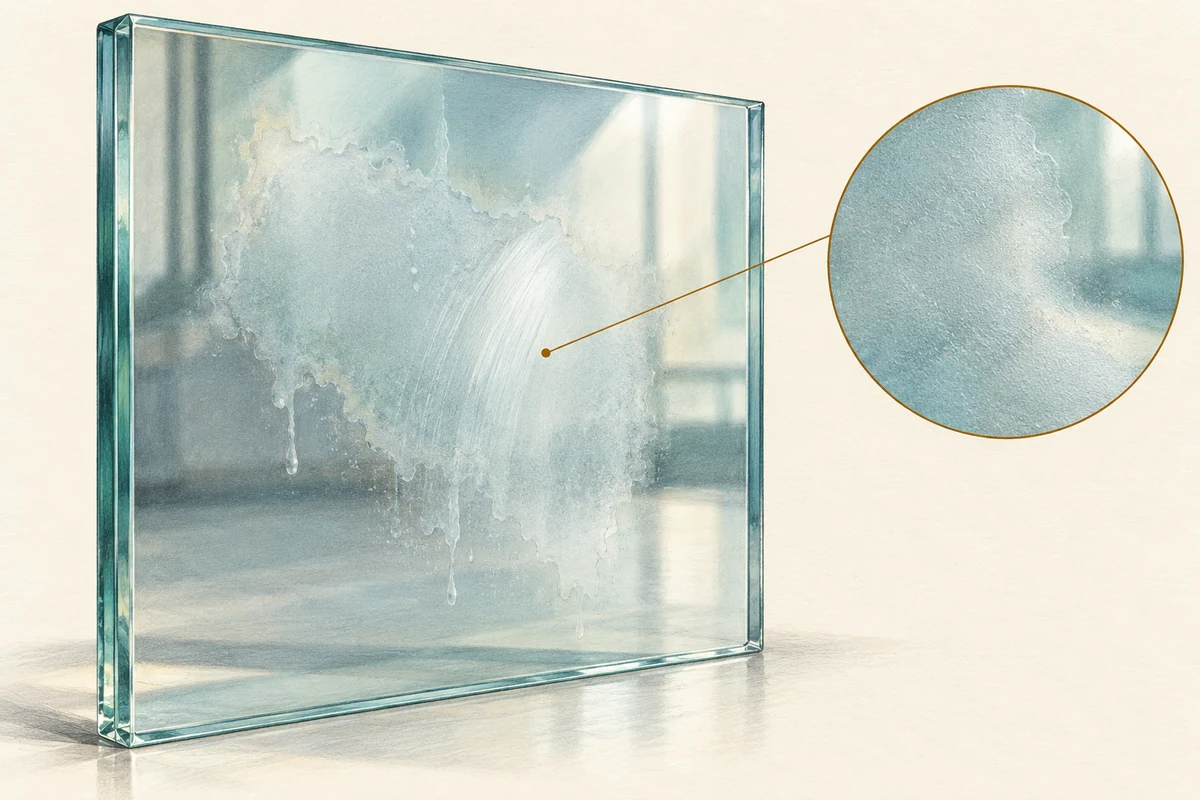
Bleach/peroxide shadowing is an appearance change caused by oxidizing agents (e.g., sodium hypochlorite bleach, hydrogen peroxide cleaners) contacting glass and drying/dwelling on the surface, sometimes in sunlight/heat. It presents as optical tone/contrast shift and, in stronger cases, very shallow, non-directional micro-texture within a spill/wipe footprint.
Classification & Scope (Normative)
NormativeBleach/peroxide shadowing is an appearance change caused by oxidizing agents (e.g., sodium hypochlorite bleach, hydrogen peroxide cleaners) contacting glass and drying/dwelling on the surface, sometimes in sunlight/heat. It presents as optical tone/contrast shift and, in stronger cases, very shallow, non-directional micro-texture within a spill/wipe footprint. Classification is appearance-only per VIS (method-agnostic). Inspect after Non-Invasive Reveal under VIS lighting/geometry; record surface numbering and worked-surface status. Treat fresh/unknown liquids per site safety.
Typical Presentation (Informative)
Informative- Irregular patches matching spill, spray, or wipe vectors, often near janitorial zones or façade-cleaning operations.
- Slight whitening or desaturation of reflections in specular view; under raking, interiors may read very fine modeled micro-texture (when concentrated or sun-baked).
- Edges are usually soft/feathered; overlap lines appear where multiple wipes ended.
Field Identification Cues (Normative)
NormativeSurface-catch class (MSRT)
- Commonly SC-0 (optical only).
- SC-1 (slight) can occur after concentrated or heated oxidizer dwell; SC-2 is rare.
- Perform one light, non-marring pass on a representative interior area; polymer stylus if a coating is suspected. MSRT supports classification only.
Visual signature
- Footprint-bounded tone shift with soft edges; interiors appear non-directional (not lineation).
- No chip-flank sparkle (not mechanical), no discrete fused nodules/pits (not hot-particle).
Viewing / lighting
- Evaluate clean & dry at 12 / 36 / 72 in, with normal incidence and oblique sweep (~60°-120°); use raking light macros to confirm presence/absence of micro-texture. Record distances/angles in-frame.
Location / access
- Record pane ID and surface numbering (#1-#4; laminate-internal). If fixed parallax indicates a between-pane condition, classify CAT-5 by location (out of in-place scope) and refer.
Mechanism cue (context)
- Evidence of bleach/peroxide cleaners, sprayers, janitorial carts, or pressure-washing with oxidizing additives; note sun exposure/dwell time.
Severity & CAT Mapping (Normative)
NormativeAssign CAT by appearance + MSRT + morphology (three-part cueing). Depth/relief values are indicative-field measurement not required.
- CAT-1 (Benign / non-relief): Optical tone/contrast shift only, SC-0; visible mainly at certain angles or in raking; minimal impact at standard view. Indicative relief: 0-10 μm (optical).
- CAT-2 (Light): Very shallow modeled micro-texture, SC-1, confined to spill/wipe footprint; limited impact at standard view. Indicative relief: ~10-40 μm.
- CAT-3 (Moderate): Broader matte/whitened footprint legible at standard distance; SC-1 to SC-2. Indicative relief: ~40-120 μm.
- CAT-4 (Severe): Uncommon for oxidizers alone; if pronounced matte fields or wide-area whitening are present, consider mixed chemistry (alkaline/oxidizer stack) and re-evaluate under applicable DSS. Indicative relief: ~120-300 μm+.
- CAT-5 (by condition/location): Between-pane/inaccessible by parallax, integrity indicators (active cracks/pane movement), or confirmed functional-coating loss on the surface to be worked → CAT-5.
CAT is appearance-based; acceptance is separate under VIS-A at 12/36/72 in. Do not “probe” with MSRT.
Differentiation & Mis-ID Pitfalls (Informative)
Informative- vs. Degreaser/alkaline burn (Ch.04.03): Alkaline burn shows grainier micro-texture with sheet/run geometries; oxidizer shadowing tends to be softer, optical with SC-0 to SC-1.
- vs. Adhesive remover staining (Ch.04.02): Adhesive remover exhibits wipe directionality + overlap lines centered on label sites; oxidizer footprints may be broader sprays or mop wipes.
- vs. Mineral staining/etch (Ch.03): Mineral conditions follow spray arcs/rings/runs and often yield ring halos; oxidizer shadowing lacks mineral ring morphology.
- vs. Solvent bloom (Ch.04.01): Solvent bloom can present similar matting but is linked to paint removal context; cross-check site operations.
- vs. Coating anomalies (Co-family): Coating rub/patchiness gives sheen/color shift but lacks chemical exposure context; on a worked coated surface any anomaly is not permitted at acceptance (VIS §6.2.e).
Evidence Package *(Documentation Requirements) (Normative)
Normative- Photo set (VIS): 12 / 36 / 72 in, normal + oblique; include raking macros of footprint interior and edges; add context frames (cleaners, carts, work area). Record distance/angle in-frame.
- MSRT result: One light, non-marring pass on footprint interior; record SC-class (SC-0/SC-1/SC-2). Polymer stylus if coating is suspected.
- Forms: Pane ID; product family & surface numbering; worked surface Y/N; functional coating present on worked surface? (Y/N/Unknown); reveal status; lighting/time; geometry checklist; photos attached.
- Acceptance split: Post-restoration acceptance per VIS-A §6; classification ≠ acceptance. Coated-face appearance rules apply per VIS §6.2.e.
Reporting Language (Template)
Template- Ch.05.01 Bleach / Peroxide Shadowing - Footprint-bounded tone/whitening on surface #___ with [SC-0/SC-1/SC-2], visible at [12/36/72 in] under VIS geometry after Non-Invasive Reveal. Morphology: soft edges, non-directional interior, no chip-flank sparkle, no discrete pepper. Classification: CAT-[1/2/3/4] by relief/visibility; CAT-5 if between-pane, integrity cues, or coating-side loss on the surface to be worked. Forms + photo set completed; acceptance per VIS-A §6 (separate).
Related glossary terms
- Raking lightGRK-129
- Coating rubGRK-115
- Dwell timeGRK-180
- Work areaGRK-183
Source and version
GlassRenu Damage Specification Sheets (DSS), DSS-Ch.05.01. Source revision and extraction date are recorded in the deployment manifest.
Open the complete published DSS with table of contents (PDF)
Normative and informative labels are preserved from the source. The downloadable one-sheet is a condensed classification aid; this web page retains the complete source-based specification content.