
On this page
- Diagnosis summary
- Safety and classification scope
- Classification & Scope (Normative)
- Typical Presentation (Informative)
- Field Identification Cues (Normative)
- Surface-catch class (MSRT)
- Visual signature
- Viewing / lighting
- Location / access
- Mechanism cue (context)
- Severity & CAT Mapping (Normative)
- Differentiation & Mis-ID Pitfalls (Informative)
- Evidence Package *(Documentation Requirements) (Normative)
- Reporting Language (Template)
- Related glossary terms
- Related DSS
- Source and version
DAMAGE SPECIFICATION STANDARD / METHOD-AGNOSTIC
DSS-Co.05.01 — Frit Smears / Offset
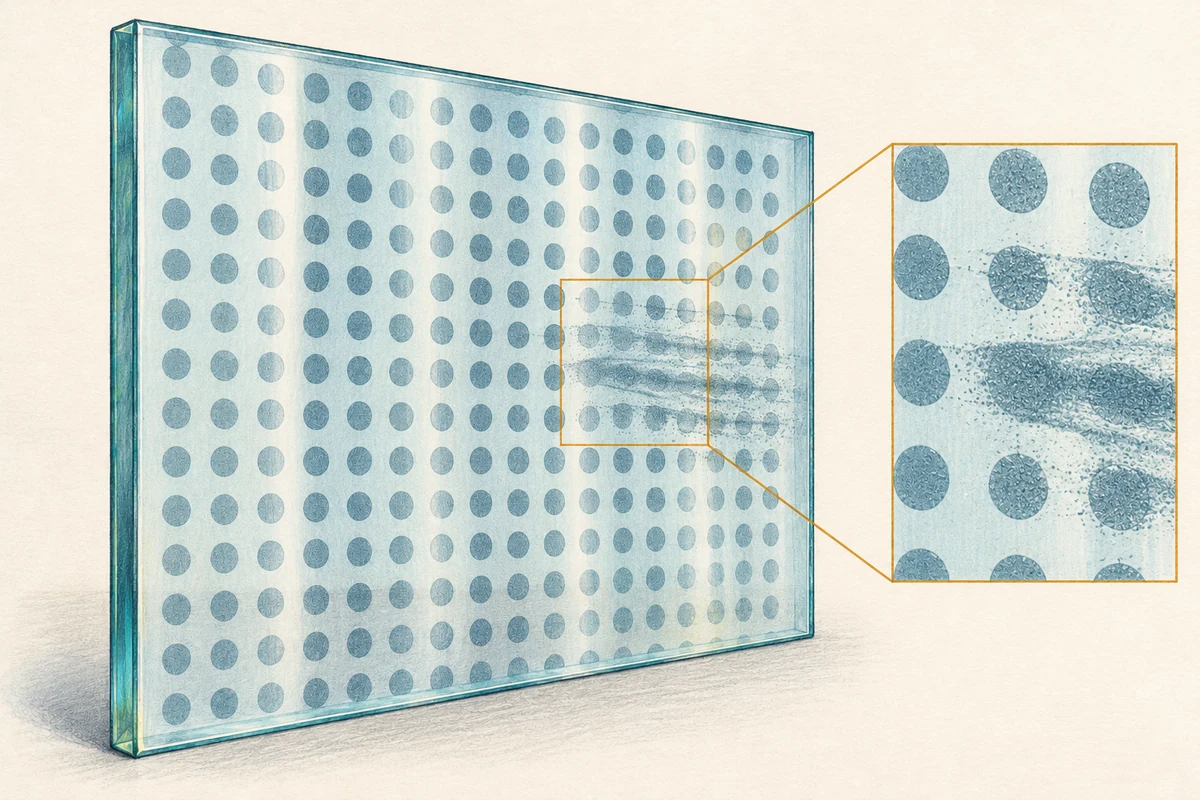
Ceramic frit anomaly - directional “drag,” smudge, or registration shift of the fired frit pattern; planar behind the viewing surface; typically SC-0 at the viewing face. Confirm frit face, artwork intent, and location before attribution.
Diagnosis summary
Frit smears/offset are appearance changes within a fired ceramic frit pattern (dots/lines/graphics) where the intended edges are dragged, feathered, or shifted relative to the artwork. The anomaly is planar in the frit layer (usually on a non-viewing face such as #2 or #4) and non-tactile from the viewing surface. Classification is appearance-only per VIS (method-agnostic).
Classification & Scope (Normative)
NormativeFrit smears/offset are appearance changes within a fired ceramic frit pattern (dots/lines/graphics) where the intended edges are dragged, feathered, or shifted relative to the artwork. The anomaly is planar in the frit layer (usually on a non-viewing face such as #2 or #4) and non-tactile from the viewing surface. Classification is appearance-only per VIS (method-agnostic). Inspect after Non-Invasive Reveal at the viewing face under VIS lighting/geometry; record surface numbering and worked-surface status.
System ID is critical. Verify frit location (surface #), pattern specification (dot size/spacing/line weight), vision vs. non-vision zones, and intended artwork tolerances (shop drawings/submittals).
Typical Presentation (Informative)
Informative- Directional drag/smudge along the screen/roller travel direction; edges look wiped or teardropped.
- Registration offset: entire dot array or linework appears shifted by a small, consistent vector, producing double-image or uneven margins.
- Often lot-repetitive: neighboring lites show similar magnitude/direction of smear/offset.
Field Identification Cues (Normative)
NormativeSurface-catch class (MSRT)
- From the viewing (glass) side: SC-0 (planar behind glass).
- Do not MSRT the frit face in situ. MSRT supports classification only on the viewing surface.
Visual signature
- Edge feathering/drag or vector offset of dots/lines; no chip-flank sparkle, no grooves/pits on the viewing face.
- Dot geometry may become elliptical/teardrop in the direction of travel; line thickening on the lead/trailing edge.
Viewing / lighting
- Evaluate clean & dry at 12 / 36 / 72 in, normal and oblique sweep (~60°-120°); use broad specular to read edge crispness, offset vector, and repeatability. Record distances/angles in-frame.
Location / access
- Record pane ID and surface numbering (#1-#4; laminate-internal). If the frit resides on #2/#3 (IGU interior) or otherwise non-exposed, in-place correction is out of scope → CAT-5 by location (classification remains Co.05.01).
Mechanism cue (context)
- Screen registration error, glass slip during print/transfer, wet-phase contact or roller kiss, handling disturbance before “set”, or cure/transport vibration. Process paperwork may note setup adjustments near production time.
Severity & CAT Mapping (Normative)
NormativeAssign CAT by visibility at acceptance geometry and pattern fidelity impact (edge clarity, offset magnitude). Depth values are apparent optical, not substrate relief.
- CAT-1 (Benign / non-relief): Minor feather/drag legible mainly at oblique/raking; edge blur ≲ 0.1 dot diameter or line gain ≲ 10%; SC-0.
- CAT-2 (Light): Discernible smear/offset at standard distance in common lighting; offset ≲ 0.25 dot diameter (or line gain 10-25%) over limited area; SC-0.
- CAT-3 (Moderate): Pane-noticeable smear/offset at standard distance affecting graphic intent over ≥0.5% of the visible field; offset ~0.25-0.5 dot diameter or line gain >25%; SC-0.
- Reclassify when:
- Loose paint film on viewing face lifts on reveal → R.02.01 Paint overspray.
- Front-face grooves/pits/chip flanks present → evaluate M/Th families.
- Opacity density (cloud) shifts without edge geometry → Co.04.01 Mottle/Cloudiness.
- CAT-5 (by condition/location): Between-pane/inaccessible frit face or system constraints preclude in-place work → CAT-5.
CAT is appearance-based; acceptance is separate under VIS-A at 12/36/72 in. This condition is commonly producer/system-governed when on non-exposed faces.
Differentiation & Mis-ID Pitfalls (Informative)
Informative- vs. Back-paint mottle (Co.04.01): Mottle is cloud-like density variation; Co.05.01 shows geometric edge drag/offset tied to artwork.
- vs. AR/low-E anomalies (Co.02/Co.03): Functional films lack ink dot/line geometry and registration cues.
- vs. Abrasion fields (M.02): Abrasion creates directional micro-texture at the viewing face (often SC-1); Co.05.01 is SC-0 at the viewing face and edge-geometry-specific.
Evidence Package *(Documentation Requirements) (Normative)
Normative- Photo set (VIS): 12 / 36 / 72 in, normal + oblique; macro frames of dot/line edges showing drag or offset; overview establishing vector direction and area. Record distance/angle in-frame.
- System ID. Confirm frit face (surface #), pattern spec (dot size/spacing/line weight), lot/date; obtain shop drawings/submittals if available.
- MSRT (viewing face). Record SC-0 to distinguish from front-face mechanical/chemical attack.
- Lot/replication check. Survey adjacent lites for repeatability (supports process origin).
- Forms: Pane ID; surface numbering & worked-surface status; reveal status; lighting/time; geometry checklist; photos attached.
- Acceptance split: Post-restoration acceptance per VIS-A §6; classification ≠ acceptance. Non-exposed frit faces are typically outside in-place scope.
Reporting Language (Template)
Template- Co.05.01 Frit Smears / Offset - Directional drag/registration shift of ceramic frit on surface #___ (frit face confirmed); MSRT (viewing face): SC-0; visible at [12/36/72 in] under VIS geometry. Morphology: edge feather/offset, no chip-flank grooves/pits at viewing face. Classification: CAT-[1/2/3] by visibility and pattern fidelity; CAT-5 if between-pane/inaccessible. Forms + photo set attached; acceptance per VIS-A §6.
Related glossary terms
- Ceramic fritGRK-234
- Paint oversprayGRK-063
- RepeatabilityGRK-150
- AbrasionGRK-035
Source and version
GlassRenu Damage Specification Sheets (DSS), DSS-Co.05.01. Source revision and extraction date are recorded in the deployment manifest.
Open the complete published DSS with table of contents (PDF)
Normative and informative labels are preserved from the source. The downloadable one-sheet is a condensed classification aid; this web page retains the complete source-based specification content.