
On this page
- Diagnosis summary
- Safety and classification scope
- Definition (Reference)
- Typical Presentation (Informative)
- Field Identification Cues (Normative)
- Classification Mapping (to VIS-DA) (Normative)
- Indicative Relief / Depth (Informative)
- Differentiation & False Positives (Informative)
- Evidence Package (Documentation Requirements) (Normative)
- Mis-ID Pitfalls (Informative)
- Reporting Language (Template)
- Related glossary terms
- Related DSS
- Source and version
DAMAGE SPECIFICATION STANDARD / METHOD-AGNOSTIC
DSS-M.01.05 — Hardware / Fastener Drag Line
Mechanical scoring on the worked surface - appearance-based classification; acceptance per VIS §6
Diagnosis summary
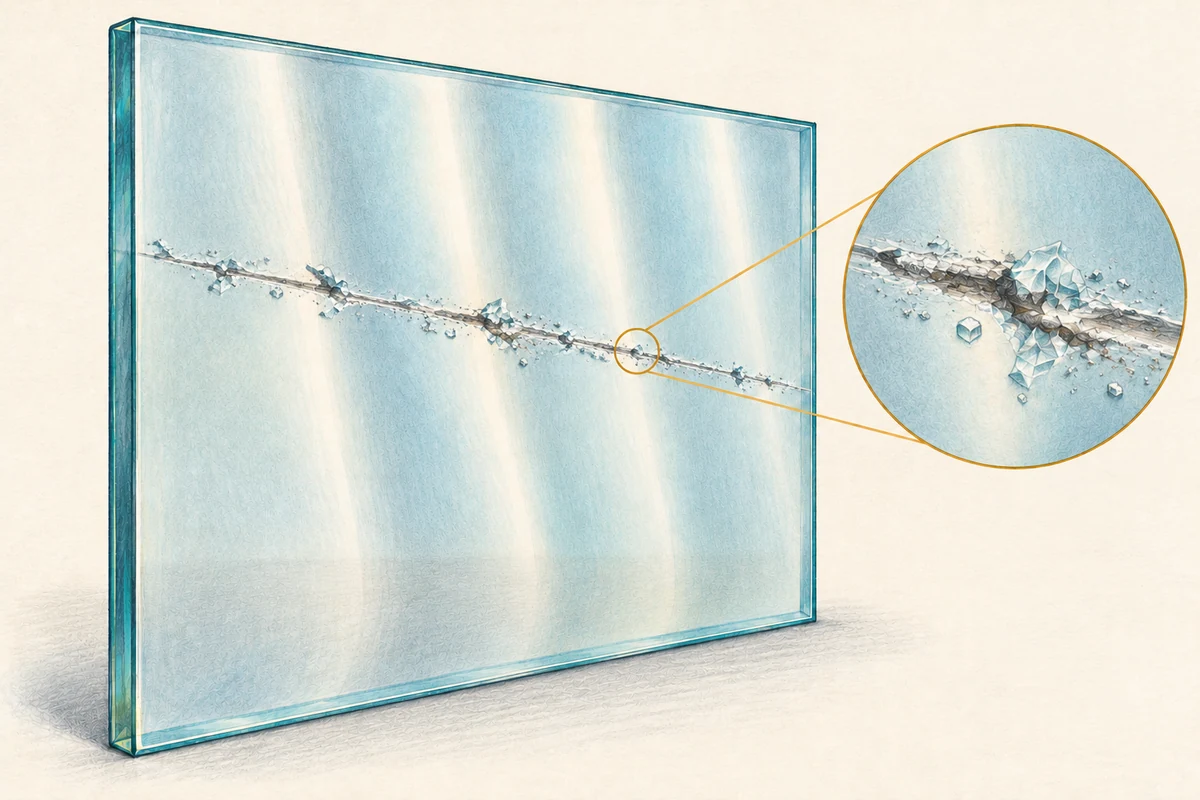
Localized, directional linear line(s) or short runs created when hardware/fasteners/metal fittings (e.g., screw heads, rail/spider fittings, brackets) contact and move across the glass face, leaving a mechanical score. In raking light the line often exhibits bright “chip-flanks” / micro-chipping where depth increases; it persists after Non-Invasive Reveal (clean & dry) and is not a removable film.
Definition (Reference)
ReferenceLocalized, directional linear line(s) or short runs created when hardware/fasteners/metal fittings (e.g., screw heads, rail/spider fittings, brackets) contact and move across the glass face, leaving a mechanical score. In raking light the line often exhibits bright “chip-flanks” / micro-chipping where depth increases; it persists after Non-Invasive Reveal (clean & dry) and is not a removable film. Use VIS terminology for micro-chipping / chip flank, worked surface, surface-catch (MSRT), and VIS viewing/lighting for appearance-based classification.
Typical Presentation (Informative)
Informative- Short, directional linear score emanating from or adjacent to hardware contact points (rails, spiders, standoffs, fasteners), sometimes with intermittent intensity where pressure varied.
- Sparkling edges in raking light from chip-flanks when depth is greater; may occur as single pass or clustered short runs.
- Persists after Non-Invasive Reveal (clean & dry). Inspect at VIS geometry (12 / 36 / 72 in; normal + oblique; raking).
Field Identification Cues (Normative)
NormativeSurface-catch class (MSRT):
- Commonly SC-2 (clear) for true metal-on-glass scores; SC-1 (slight) when shallow. Perform one light, non-marring pass only; MSRT supports classification, not acceptance. Prefer a polymer stylus if a functional coating may be present.
Reveal / lighting / geometry:
- Complete Non-Invasive Reveal before evaluation (clean & dry). Assess at 12 / 36 / 72 in, normal incidence + oblique sweep (~60°-120°) under raking light, per VIS. Record distances/angles in the photo frames.
Location / access:
- Confirm the cue is on the exposed face (not between panes). Use parallax when IGUs are present-fixed parallax indicates a between-pane condition; record surface numbering #1-#4 / laminate-internal on Forms: If between panes/inaccessible → CAT-5 by location.
Classification Mapping (to VIS-DA) (Normative)
NormativeAssign CAT by visibility convention and MSRT outcome at VIS viewing/lighting; apply the VIS three-part cueing (surface catch + edge/surface morphology + location/access):
- CAT-2 - Light: Narrow, clean-edged line(s) with SC-1, no pronounced chip-flanks; limited impact at standard view.
- CAT-3 - Moderate: SC-2 with minor chip-flanks; noticeable at standard distance.
- CAT-4 - Severe: SC-2 (clear-to-strong) with rough chip-flanks, possible pits/craters; distinctly visible at standard and wide-field views. (Classification is appearance-based; acceptance is handled separately in VIS §6.)
Indicative Relief / Depth (Informative)
Informative- CAT-2: ~0.2-1 μm (fine surface incision; minimal flank breakout).
- CAT-3: ~1-5 μm with incipient micro-chipping along flanks.
- CAT-4: ≥5 μm with rough chip-flank breakout; occasional pits/craters. (Depths are illustrative for cueing only; VIS classification/acceptance remains appearance-based.)
Differentiation & False Positives (Informative)
Informative- vs. Straightedge/guide scoring (M.01.02): Guide scoring is ruler-straight over long runs; hardware drag lines are localized near contact points and often short-run.
- vs. Glass-on-glass tracks (M.01.03): Tracks present paired arcs/lines along a sweep path; hardware drag lines are single, local, originating at hardware.
- vs. Residue films/overspray (R-family): Residues change with Non-Invasive Reveal; mechanical scores persist. Apply VIS reveal + geometry.
- vs. Between-pane cues (A-family): Internal features show fixed parallax → CAT-5 by location.
Evidence Package (Documentation Requirements) (Normative)
Normative- Photo set (VIS): 12 / 36 / 72 in, normal + oblique, include raking; add macro frames of the line showing edge morphology (chip-flanks if present) and no worked transition edge. Include at least one context frame that shows adjacency to hardware/fastener. Record reveal status, lighting, time, distance/angles.
- MSRT result: Record SC class (SC-1 / SC-2 as observed); one pass, non-marring; on suspected coated faces, prefer polymer stylus.
- Forms: Pane ID; surface numbering (#1-#4 / laminate-internal); worked surface Y/N; functional coating present on worked surface? (Y/N/Unknown); geometry checklist; attach photos-per VIS Appendix X3.
Mis-ID Pitfalls (Informative)
Informative- Attempting to “feather” a drag line during inspection can create a worked region/transition edge, which VIS disallows at acceptance for CAT-0...CAT-4. Keep evaluation non-marring and appearance-only.
Reporting Language (Template)
Template- M.01.05 Hardware/Fastener Drag Line - Localized linear line at #__ adjacent to hardware/fastener; MSRT = SC-1/SC-2; chip-flanks present/absent (record). Persists after Non-Invasive Reveal. Classified CAT-2/3/4 by visibility and flank severity per VIS. Photo set at 12/36/72 in (normal + oblique + raking), with a context frame showing the hardware origin; surface numbering and form fields recorded. Acceptance per VIS §6 (appearance-based).
Related glossary terms
- Raking lightGRK-129
- ChipGRK-034
Source and version
GlassRenu Damage Specification Sheets (DSS), DSS-M.01.05. Source revision and extraction date are recorded in the deployment manifest.
Open the complete published DSS with table of contents (PDF)
Normative and informative labels are preserved from the source. The downloadable one-sheet is a condensed classification aid; this web page retains the complete source-based specification content.