
On this page
- Diagnosis summary
- Safety and classification scope
- Classification & Scope (Normative)
- Typical Presentation (Informative)
- Field Identification Cues (Normative)
- Surface-catch class (MSRT)
- Visual signature
- Viewing / lighting
- Severity & CAT Mapping (Normative)
- Differentiation & Mis-ID Pitfalls (Informative)
- Evidence Package (Documentation Requirements) (Normative)
- Reporting Language (Template)
- Related glossary terms
- Related DSS
- Source and version
DAMAGE SPECIFICATION STANDARD / METHOD-AGNOSTIC
DSS-M.03.04 — Edge “Shelling” at Hardware Holes/Slots
Mechanical - edge & corner damage at penetrations
Diagnosis summary
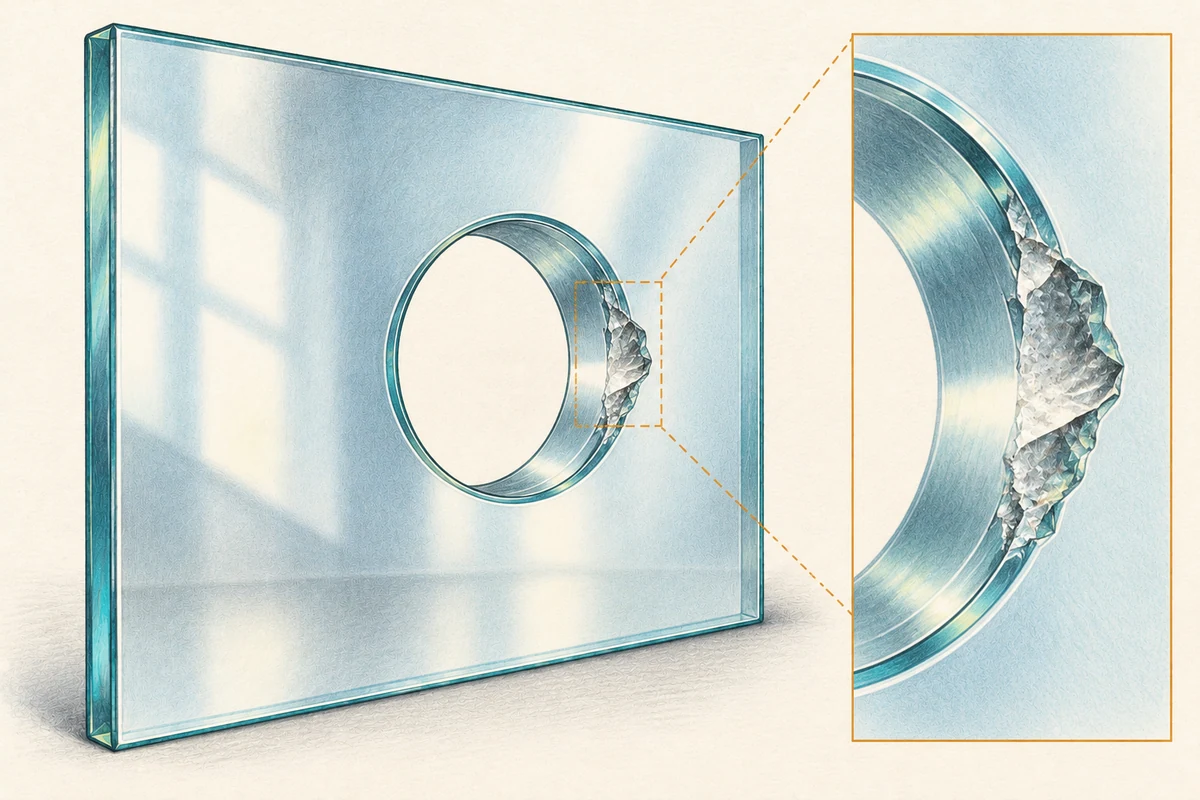
Edge “shelling” at hardware holes/slots is a localized shell-type loss that originates at the perimeter of a drilled hole or machined notch and intrudes onto the exposed face. It is distinct from a factory exit-lip (a uniform burr confined to the hole/slot perimeter that reads SC-0 on the face and is not damage). Classification here is appearance-only per VIS; restoration methodology is out of scope.
Classification & Scope (Normative)
NormativeEdge “shelling” at hardware holes/slots is a localized shell-type loss that originates at the perimeter of a drilled hole or machined notch and intrudes onto the exposed face. It is distinct from a factory exit-lip (a uniform burr confined to the hole/slot perimeter that reads SC-0 on the face and is not damage). Classification here is appearance-only per VIS; restoration methodology is out of scope. Inspect under VIS lighting/geometry and record surface numbering and worked-surface status on Forms:
Typical Presentation (Informative)
Informative- Crescent/shell-shaped losses or ragged “bites” breaking from the hole/slot perimeter onto the face; often brightest in raking light.
- May include short chip flanks and micro-cracking radiating from the penetration.
- Common at hardware landings (standoff holes, spider fittings) or notch roots. (Use VIS oblique sweep and raking light.)
Field Identification Cues (Normative)
NormativeSurface-catch class (MSRT)
- Expect SC-2 (clear) where shelling intrudes onto the face. Perform one light, non-marring pass only per VIS §5.5; do not abrade or “probe.” Prefer a polymer stylus on suspected coated faces; MSRT supports classification, not acceptance.
Visual signature
- Bright, rough chip flanks at the penetration edge with discrete shell geometry; distinguish from a uniform exit-lip that is edge-confined and SC-0 on the face.
Viewing / lighting
- After Non-Invasive Reveal (clean & dry), evaluate at 12 / 36 / 72 in, normal incidence and oblique sweep (~60°-120°) under raking light.
- Location / access Record pane ID and surface numbering (#1-#4; laminate-internal) on Forms: If fixed parallax proves a between-pane look-alike or the defect is otherwise inaccessible, record CAT-5 and refer.
Severity & CAT Mapping (Normative)
NormativeAssign CAT by appearance + MSRT + morphology (three-part cueing under VIS). Depths below are indicative to anchor the spectrum:
- CAT-2 → low CAT-3 (lower bound): Small, shallow shells just breaking onto the face; SC-1-SC-2; primarily a raking-light cue at close/standard view. Indicative depth: ~10-40 μm.
- CAT-3 (typical): Pronounced shelling with clear catch and bright, rough chip flanks; noticeable at standard view. Indicative depth: ~40-120 μm.
- CAT-4 (upper bound): Deep/extended shelling with secondary pits/craters and/or short cracks propagating from the penetration; strong catch; clearly visible at standard & wide-field views. Indicative depth: ~120-300 μm+.
- CAT-5 (by location/condition): Between-pane/inaccessible or integrity indicators (active cracks, moving pane) → out of in-place scope; document and refer per project protocol.
CAT assignment is appearance-based under VIS; acceptance is separate (VIS §6).
Differentiation & Mis-ID Pitfalls (Informative)
Informative- vs. Factory drill/slot exit-lip (P.03.04): Exit-lip is a uniform burr confined to the hole/slot, reads SC-0 on the face, and shows no chip-flank morphology. Do not classify as damage.
- vs. Linear scoring (M.01): Scoring forms extended lines across the face; an exit-lip/shelling is peripheral to a hole/slot. If scoring is present, classify under M.01 in addition.
- vs. Coating anomalies (Co.01/Co.03): Worked-face coating rub/patchiness is disallowed at acceptance on coated faces (VIS §6.2.e); shelling shows fracture morphology at a penetration.
Evidence Package (Documentation Requirements) (Normative)
Normative- Photo set (VIS): 12 / 36 / 72 in, normal + oblique, with raking macros of the penetration edge showing chip flanks and at least one context frame proving the condition breaks onto the face (i.e., not just an exit-lip).
- MSRT result: Record SC class (SC-0/1/2 as observed). One pass, non-marring; prefer polymer stylus on suspected coated faces.
- Forms: Pane ID; product family & surface numbering; worked surface Y/N; functional coating on worked surface? (Y/N/Unknown); reveal status; lighting/time; geometry checklist; photos attached.
- Acceptance split: VIS governs post-restoration appearance. Do not conflate a factory exit-lip with face-side acceptance; if a worked region is created, transition edges remain disqualifying at acceptance for CAT-0...CAT-4.
Reporting Language (Template)
Template- M.03.04 Edge “Shelling” at Hardware Hole/Slot - Discrete shell-type loss breaking from [hole/slot] perimeter onto the exposed face #___. MSRT = SC-2 (clear) at shell perimeter; bright, rough chip flanks present. Visible at [12/36/72 in] under VIS geometry. Classification: CAT-[3/4] by morphology + MSRT. Differentiation: not a uniform exit-lip (SC-0 on face). Acceptance: per VIS §6; documentation attached (photo set + forms).
Related glossary terms
- Raking lightGRK-129
- Coating rubGRK-115
Source and version
GlassRenu Damage Specification Sheets (DSS), DSS-M.03.04. Source revision and extraction date are recorded in the deployment manifest.
Open the complete published DSS with table of contents (PDF)
Normative and informative labels are preserved from the source. The downloadable one-sheet is a condensed classification aid; this web page retains the complete source-based specification content.