
On this page
- Diagnosis summary
- Safety and classification scope
- Classification & Scope (Normative)
- Typical Presentation (Informative)
- Field Identification Cues (Normative)
- Surface-catch class (MSRT)
- Visual signature
- Viewing / lighting
- Location / access
- Severity & CAT Mapping (Normative)
- Differentiation & Mis-ID Pitfalls (Informative)
- Evidence Package (Documentation Requirements) (Normative)
- Reporting Language (Template)
- Related glossary terms
- Related DSS
- Source and version
DAMAGE SPECIFICATION STANDARD / METHOD-AGNOSTIC
DSS-M.04.02 — Star Break / Bullseye Initiation (annealed/laminated)
Mechanical - impact-initiated fracture pattern
Diagnosis summary
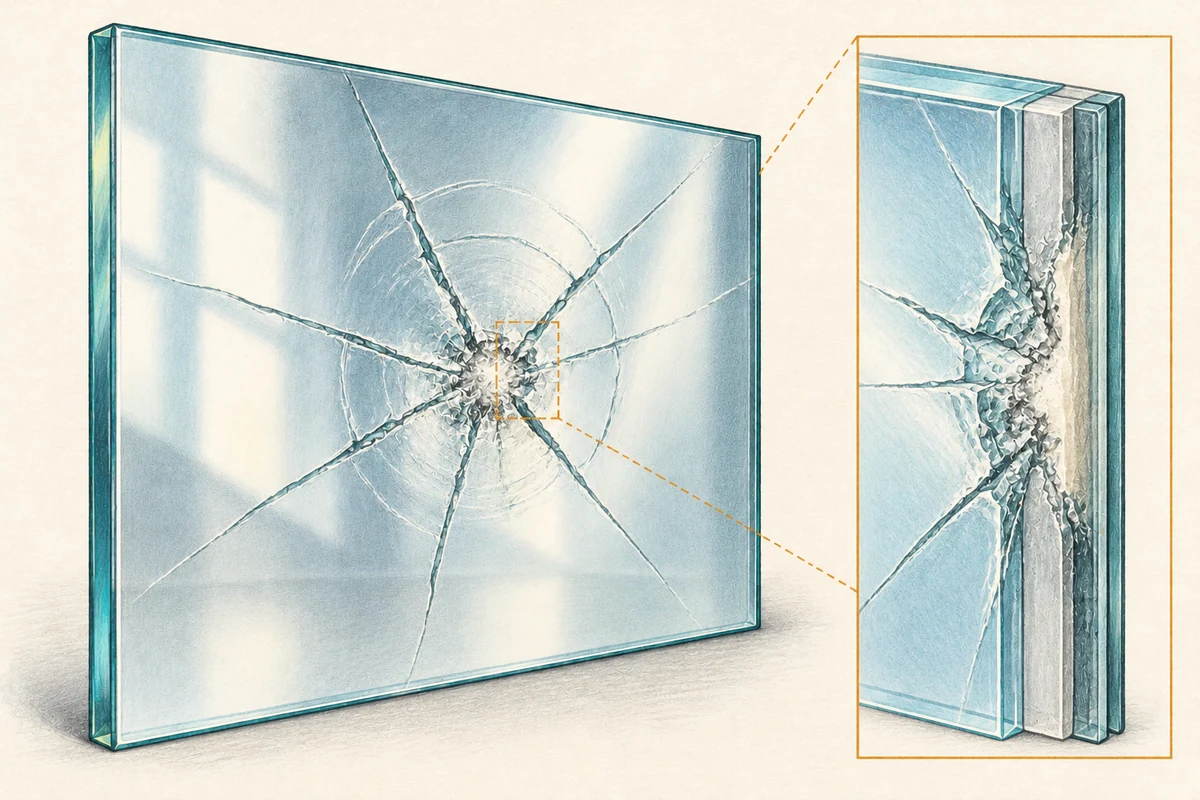
Star breaks / bullseye initiations are impact-origin fracture patterns characterized by a central origin with radial and/or circumferential cracking. For annealed or laminated architectural glass, the presence of active cracks or a star-type network constitutes an integrity indicator and is out of in-place restoration scope under VIS (CAT-5). Classification here is appearance-only; methodology is out of scope.
Classification & Scope (Normative)
NormativeStar breaks / bullseye initiations are impact-origin fracture patterns characterized by a central origin with radial and/or circumferential cracking. For annealed or laminated architectural glass, the presence of active cracks or a star-type network constitutes an integrity indicator and is out of in-place restoration scope under VIS (CAT-5). Classification here is appearance-only; methodology is out of scope. Inspect under VIS lighting/geometry and record surface numbering and worked-surface status on Forms:
Typical Presentation (Informative)
Informative- Central impact origin (may coincide with a small pit/divot) with one or more radial cracks; may show a partial “bullseye” ring in laminated make-ups.
- No full-lite tempered fragmentation (this entry covers annealed/laminated; tempered spontaneous break/fragmentation is treated elsewhere).
- Often visible at standard view; raking light highlights the origin and micro-relief at the pit (if present). (Use VIS geometry.)
Field Identification Cues (Normative)
NormativeSurface-catch class (MSRT)
- Do not perform MSRT across an open crack network. If needed, a single light, non-marring pass may be used adjacent to the origin only to sense any crater rim (SC-class), but MSRT is auxiliary and never determinative for integrity. One pass only; non-marring; on suspected coated faces, prefer a polymer stylus. MSRT supports classification, not acceptance.
Visual signature
- Radial arms emanating from a point origin; may include a small crater/pit with bright rim in raking light. Any through-thickness or running crack is an integrity indicator.
Viewing / lighting
- Evaluate clean & dry (Non-Invasive Reveal) at 12 / 36 / 72 in, normal incidence and oblique sweep (~60°-120°) with raking light per VIS.
Location / access
- Record pane ID and surface numbering (#1-#4; laminate-internal) on Forms: Use parallax to distinguish face-side vs between-pane/laminate-internal cues; fixed parallax indicates a between-pane condition (CAT-5 by location).
Severity & CAT Mapping (Normative)
NormativeAssign category by appearance + integrity (three-part cueing applies; VIS):
- CAT-5 (default for this entry): Active cracks / star or ring network present in annealed or laminated glass → Non-Repairable / Out of Scope for In-Place Restoration. Document and refer per project protocol (e.g., replacement/manufacturer service).
- Reassign only if no cracking is present: If examination confirms no cracks and only a localized pit/divot exists, classify under M.04.01 Impact Divot (CAT-2/3/4 by morphology + MSRT).
CAT assignment is appearance/condition-based; acceptance is separate (VIS §6).
Differentiation & Mis-ID Pitfalls (Informative)
Informative- vs. Impact divot (M.04.01): A divot shows a localized crater rim without a radial crack network. Any running/radial arm(s) → this entry (CAT-5).
- vs. Pellet/BB impact signature (M.04.03): Pellet strikes on annealed/laminated often initiate star patterns; if cracks are present, treat as CAT-5 by integrity.
- vs. Internal inclusion/laminate feature (A-family): Use parallax and surface numbering to avoid misclassifying laminate-internal artifacts; laminate-internal = CAT-5 by location (out of in-place scope).
- vs. Coating anomalies (Co-family): Coating rub/patchiness lacks fracture arms and is governed by VIS coating acceptance; do not conflate with star-type cracking.
Evidence Package (Documentation Requirements) (Normative)
Normative- Photo set (VIS): 12 / 36 / 72 in, normal + oblique, include raking macros of the origin and arms; at least one context frame showing pane edges/corners and no worked transition edge. Record distance/angle in-frame.
- MSRT result: If a crater is present, you may record SC-class adjacent to the origin without crossing cracks; one light, non-marring pass only; polymer stylus on suspected coated faces. MSRT is supportive, not determinative.
- Forms: Pane ID; product family & surface numbering; worked surface Y/N; functional coating on worked surface? (Y/N/Unknown); reveal status; lighting/time; geometry checklist; photos attached.
- Acceptance split: VIS §6 governs post-restoration appearance; classification ≠ acceptance. Integrity indicators (e.g., star breaks) place the lite out of in-place acceptance (CAT-5).
Reporting Language (Template)
Template- M.04.02 Star Break / Bullseye Initiation (annealed/laminated) - Impact-origin fracture pattern with radial arm(s) observed on surface #___; integrity indicator present. MSRT not performed across cracks; if performed adjacent to origin, SC-[ ] recorded. Visible at [12/36/72 in] under VIS geometry after Non-Invasive Reveal. Classification: CAT-5 (out of in-place scope). Location/access: surface numbering recorded; parallax checked. Acceptance: per VIS §6; documentation attached (photo set + forms).
Related glossary terms
- CrackGRK-033
- Laminated glassGRK-009
- Raking lightGRK-129
- Coating rubGRK-115
Source and version
GlassRenu Damage Specification Sheets (DSS), DSS-M.04.02. Source revision and extraction date are recorded in the deployment manifest.
Open the complete published DSS with table of contents (PDF)
Normative and informative labels are preserved from the source. The downloadable one-sheet is a condensed classification aid; this web page retains the complete source-based specification content.