
On this page
- Diagnosis summary
- Safety and classification scope
- Classification & Scope (Normative)
- Typical Presentation (Informative)
- Field Identification Cues (Normative)
- Surface-catch class (MSRT)
- Visual signature
- Viewing / lighting
- Location / access
- Severity & CAT Mapping (Normative)
- Differentiation & Mis-ID Pitfalls (Informative)
- Evidence Package (Documentation Requirements) (Normative)
- Reporting Language (Template)
- Related glossary terms
- Related DSS
- Source and version
DAMAGE SPECIFICATION STANDARD / METHOD-AGNOSTIC
DSS-M.04.03 — Pellet / BB Impact Signature
Mechanical - high-velocity localized impact
Diagnosis summary
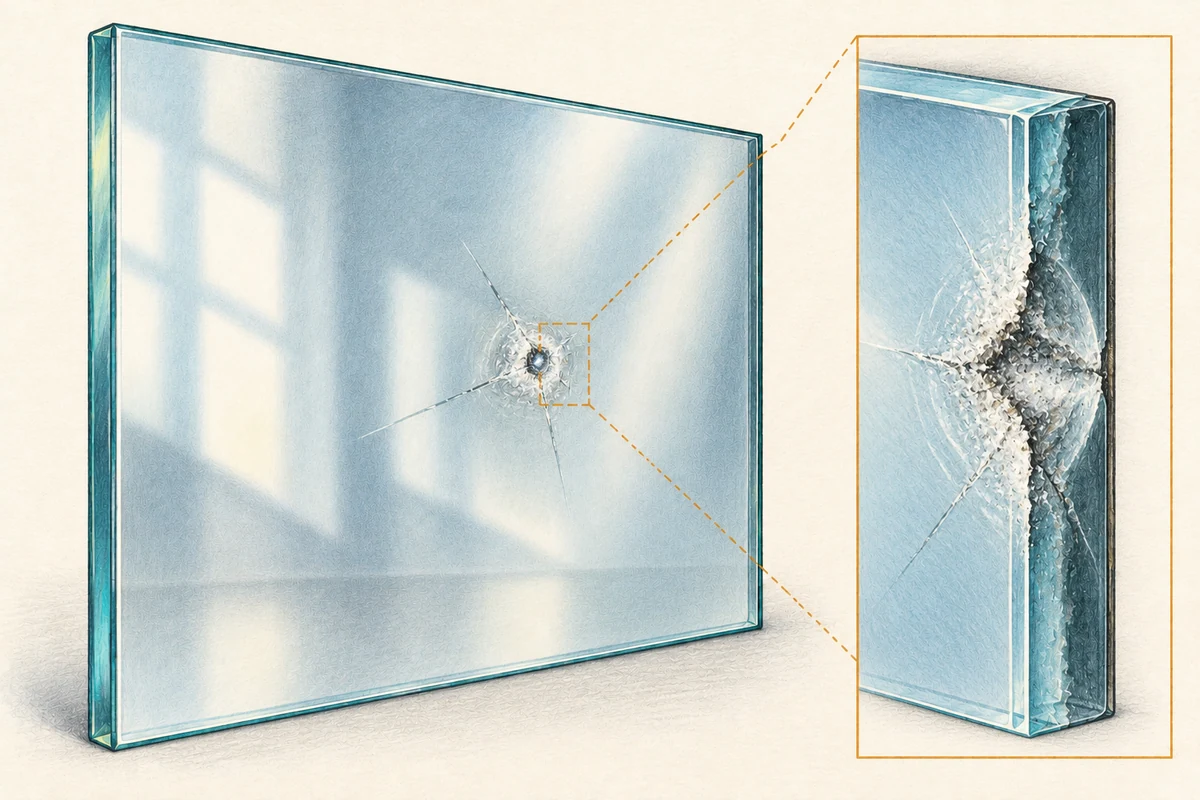
A pellet/BB impact is a high-velocity, localized strike that produces a central crater/divot and may initiate radial cracking or a bullseye/star pattern depending on glass type and energy. Classification here is appearance-only per VIS (method-agnostic).
Classification & Scope (Normative)
NormativeA pellet/BB impact is a high-velocity, localized strike that produces a central crater/divot and may initiate radial cracking or a bullseye/star pattern depending on glass type and energy. Classification here is appearance-only per VIS (method-agnostic). Inspect under VIS lighting/geometry, after Non-Invasive Reveal, and record surface numbering and worked-surface status on Forms: Active cracks/star networks are integrity indicators → CAT-5 (out of in-place scope).
Typical Presentation (Informative)
Informative- Central impact crater with a bright rim; may show peppered satellites near the origin.
- On annealed/laminated, can present radial arms / partial bullseye; on tempered, may show local spall or escalate to full fragmentation (document separately if so).
- Distinct from hot-particle fields by its singular origin and impact geometry (not distributed speckling). Use raking light + oblique sweep to develop edge contrast.
Field Identification Cues (Normative)
NormativeSurface-catch class (MSRT)
- Shallow pellets may read SC-1 (slight); pronounced craters show SC-2 (clear) at the rim. Perform one light, non-marring pass only; polymer stylus preferred on suspected coated faces. MSRT supports classification, not acceptance.
Visual signature
- Localized pit/crater with bright, rough flanks; if radial arms or a running crack are present, treat as integrity (see CAT mapping).
Viewing / lighting
- Evaluate clean & dry at 12 / 36 / 72 in, normal incidence and oblique sweep (~60°-120°) with raking light per VIS.
Location / access
- Record pane ID and surface numbering (#1-#4; laminate-internal). Use parallax to rule out between-pane look-alikes (e.g., cavity fines/marks); fixed parallax indicates a between-pane condition (CAT-5 by location).
Severity & CAT Mapping (Normative)
NormativeAssign category by appearance + MSRT + morphology (three-part cueing under VIS). Depth figures are indicative to anchor the spectrum:
- CAT-2 (Light): Small crater with SC-1, clean rim, no chip flanks, no cracks; mainly a raking-only cue at close/standard view. Indicative depth: ~10-40 μm.
- CAT-3 (Moderate): Pronounced crater with SC-2 (clear); minor chip flanks and/or nearby modeled micro-texture; noticeable at standard view; no cracks. Indicative depth: ~40-120 μm.
- CAT-4 (Severe): Deep crater with rough, bright flanks, peppered satellites; clearly visible at standard & wide-field views; no cracks. Indicative depth: ~120-300 μm+.
- CAT-5 (by integrity/location): Any radial/star cracking, running edge crack, or moving pane → CAT-5 (non-repairable/out of in-place scope). Between-pane presentation by fixed parallax → CAT-5 by location. Document and refer per project protocol.
CAT assignment is appearance/condition-based; acceptance is separate (VIS §6).
Differentiation & Mis-ID Pitfalls (Informative)
Informative- vs. Impact divot (M.04.01): A simple divot lacks radial arms and often has smaller, cleaner rims; pellet strikes trend larger energy, may show satellite pits or incipient cracking-if cracks present → CAT-5.
- vs. Star break/bullseye initiation (M.04.02): If star network is evident, classify under M.04.02 (default CAT-5 by integrity).
- vs. Hot-particle peppering (Th.01.01/Th.01.02): Thermal/ferrous peppering forms distributed fields of fused nodules/pits (often in clusters) rather than a singular impact origin; peppering commonly reads as rough chip-like flanks/fused particles and is mapped under thermal entries.
- vs. Internal cavity artifacts (A-family): Desiccant fines/moisture/haze present between panes and show fixed parallax; do not respond to reveal on #1/#4. Treat as CAT-5 by location.
Evidence Package (Documentation Requirements) (Normative)
Normative- Photo set (VIS): 12 / 36 / 72 in, normal + oblique, include raking macros of the crater rim (and any satellites) and at least one context frame showing proximity to edges/hardware; record distance/angle in-frame.
- MSRT result: Record SC-class (SC-0/1/2) with one light, non-marring pass at the rim (not across any cracks). Prefer polymer stylus on suspected coated faces.
- Forms: Pane ID; product family & surface numbering (#1-#4; laminate-internal); worked surface Y/N; functional coating on worked surface? (Y/N/Unknown); reveal status; lighting/time; geometry checklist; photos attached.
- Acceptance split: VIS §6 governs post-restoration appearance; classification ≠ acceptance. Transition edges, residual pits, embedded particulates, and coating anomalies on coated faces remain disqualifying per the applicable acceptance category.
Reporting Language (Template)
Template- M.04.03 Pellet/BB Impact - Localized crater on surface #___ with SC-[1/2] at rim; [no radial cracking / radial arm(s) present]. Visible at [12/36/72 in] under VIS geometry after Non-Invasive Reveal. Classification: CAT-[2/3/4] by morphology + MSRT; if cracking present → CAT-5 (integrity). Location/access: surface numbering recorded; parallax checked. Acceptance: per VIS §6; documentation attached (photo set + forms).
Related glossary terms
- CrackGRK-033
- Raking lightGRK-129
- DesiccantGRK-220
Source and version
GlassRenu Damage Specification Sheets (DSS), DSS-M.04.03. Source revision and extraction date are recorded in the deployment manifest.
Open the complete published DSS with table of contents (PDF)
Normative and informative labels are preserved from the source. The downloadable one-sheet is a condensed classification aid; this web page retains the complete source-based specification content.