
On this page
- Diagnosis summary
- Safety and classification scope
- Definition (Normative)
- Typical Presentation (Informative)
- Field Identification Cues (Normative)
- Classification Mapping (to VIS-DA) (Normative)
- Indicative Depth / Relief (Informative)
- Differentiation & False Positives (Informative)
- Evidence Package - Documentation Requirements (Normative)
- Mis-ID Pitfalls (Informative)
- Reporting Language (Template)
- Related glossary terms
- Related DSS
- Source and version
DAMAGE SPECIFICATION STANDARD / METHOD-AGNOSTIC
DSS-M.05.02 — Long FD Scratch Field
Mechanical - Fabrication Debris Scratches
Diagnosis summary
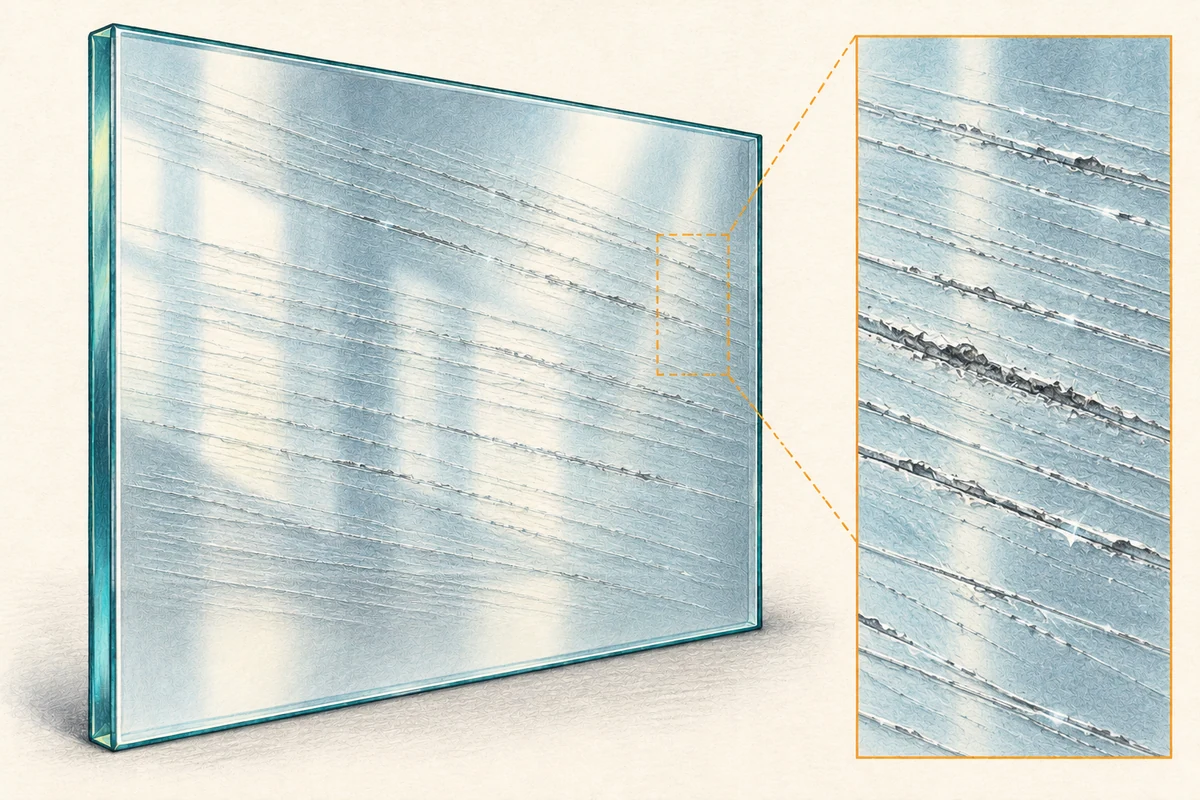
Pane-scale, predominantly parallel lineations caused by trapped/dragged fabrication debris during washing/handling, typically extending across large regions (often banded) rather than isolated short clusters. Classified by visual morphology and surface-catch response; methods of removal are outside scope.
Definition (Normative)
NormativePane-scale, predominantly parallel lineations caused by trapped/dragged fabrication debris during washing/handling, typically extending across large regions (often banded) rather than isolated short clusters. Classified by visual morphology and surface-catch response; methods of removal are outside scope.
Typical Presentation (Informative)
Informative- Repeating, co-directional lines that traverse much of the lite; banding may correlate to wash/transport path.
- Read strongly in raking/oblique views; individual lines may vary in intensity along a common path.
- Often coexists with short FD clusters near starts/stops or edge lands. (Family placement in DSS index confirms this damage class.)
Field Identification Cues (Normative)
Normative- Surface-catch class (MSRT): SC-1 to SC-2 typical; escalate to SC-3 when bright chip flanks/pitting accompany lines. Perform one light, non-marring pass per VIS §5.5; prefer polymer stylus on suspected coated faces.
- Visual signature: Long-run, near-parallel scoring that forms fields/bands rather than a single track; localized bright “edge sparkle” under raking light indicates increasing depth. Evaluate at 12/36/72 in, normal + oblique sweep under raking light.
- Location/access: Record pane ID and surface numbering (#1-#4; laminate-internal). If fixed parallax shows the cue is between panes, classify CAT-5 (out-of-place scope).
Classification Mapping (to VIS-DA) (Normative)
Normative- CAT-2 (Light): SC-1; narrow, clean-edged lines; limited impact at standard view.
- CAT-3 (Moderate): SC-2-SC-3; clear catch; minor chip flanks may appear; noticeable at standard view.
- CAT-4 (Severe): SC-3 with pronounced chip flanks, crater-pepper, or dense banding evident at wide-field views.
- CAT-5: Use only when location/condition places the defect out of in-place scope (e.g., IGU cavity). Acceptance of restored glass is governed separately by VIS §6; do not conflate classification with acceptance.
Indicative Depth / Relief (Informative)
InformativeDepth ranges are illustrative, used to align with CAT and morphology (numeric measurement not required for classification):
- CAT-2: ~0.2-1 μm (shallow, clean-edged; SC-1).
- CAT-3: ~1-5 μm (clear catch; emerging chip flanks).
- CAT-4: ≥5 μm (rough chip flanks; possible pit/crater association). Use MSRT class + morphology as the primary cues; numeric depth is not required.
Differentiation & False Positives (Informative)
Informative- vs. Cutting skid lines (factory, edge-zone): Skid lines are short, edge-confined micro-lines; FD fields are long-run, pane-face bands that may escalate in catch.
- vs. Linear tracks (M.01): Single scraper/straightedge tracks present as one or a few distinct lines with consistent direction; FD fields present as many near-parallel lines forming bands. (See DSS index family separation.)
- vs. Abrasion fields (M.02): Abrasion fields show webbing/swirls and broader texture; FD fields are dominantly linear/parallel.
Evidence Package - Documentation Requirements (Normative)
Normative- Photo set (VIS): 12 / 36 / 72 in, normal + oblique (~60°-120°); include raking-light frames. Capture a context frame showing band extent and at least one macro of line edges/chip flanks.
- MSRT result: Record SC class (one pass, non-marring; polymer stylus on suspected coated faces).
- Forms: Pane ID; surface numbering; worked-surface Y/N; “coating present on worked surface?” Y/N/Unknown; reveal status; lighting/time; geometry checklist.
Mis-ID Pitfalls (Informative)
InformativeAttempting spot-work across a distributed FD field can create visible transition edges; VIS disallows visible worked boundaries in acceptance (CAT-0...CAT-4). Keep classification appearance-only; acceptance is evaluated under VIS §6.
Reporting Language (Template)
Template- M.05.02 Long FD Scratch Field - Pane-scale bands of near-parallel lineations observed at VIS geometry; MSRT = SC-x (record value). Long-run morphology with [chip-flank status]. Classified CAT-y by cues. Pane ID, surface #, and photo set attached; acceptance per VIS §6 (separate determination).
Related glossary terms
- Scratch fieldGRK-108
- ScratchGRK-032
- Raking lightGRK-129
- AbrasionGRK-035
- PittingGRK-078
Source and version
GlassRenu Damage Specification Sheets (DSS), DSS-M.05.02. Source revision and extraction date are recorded in the deployment manifest.
Open the complete published DSS with table of contents (PDF)
Normative and informative labels are preserved from the source. The downloadable one-sheet is a condensed classification aid; this web page retains the complete source-based specification content.