
On this page
- Diagnosis summary
- Safety and classification scope
- Definition (Reference)
- Typical Presentation
- Field Identification Cues
- Differentiation & False Positives
- Classification Mapping (to VIS-DA CAT)
- Indicative Depth / Relief
- Evidence Package (Documentation Requirements)
- Common Sources / Context (Informative)
- Reporting Language (Template)
- Related glossary terms
- Related DSS
- Source and version
DAMAGE SPECIFICATION STANDARD / METHOD-AGNOSTIC
DSS-P.01.02 — Bow / Warp (global shape)
Processing / Manufacturing feature - reference; generally not “damage”
Diagnosis summary
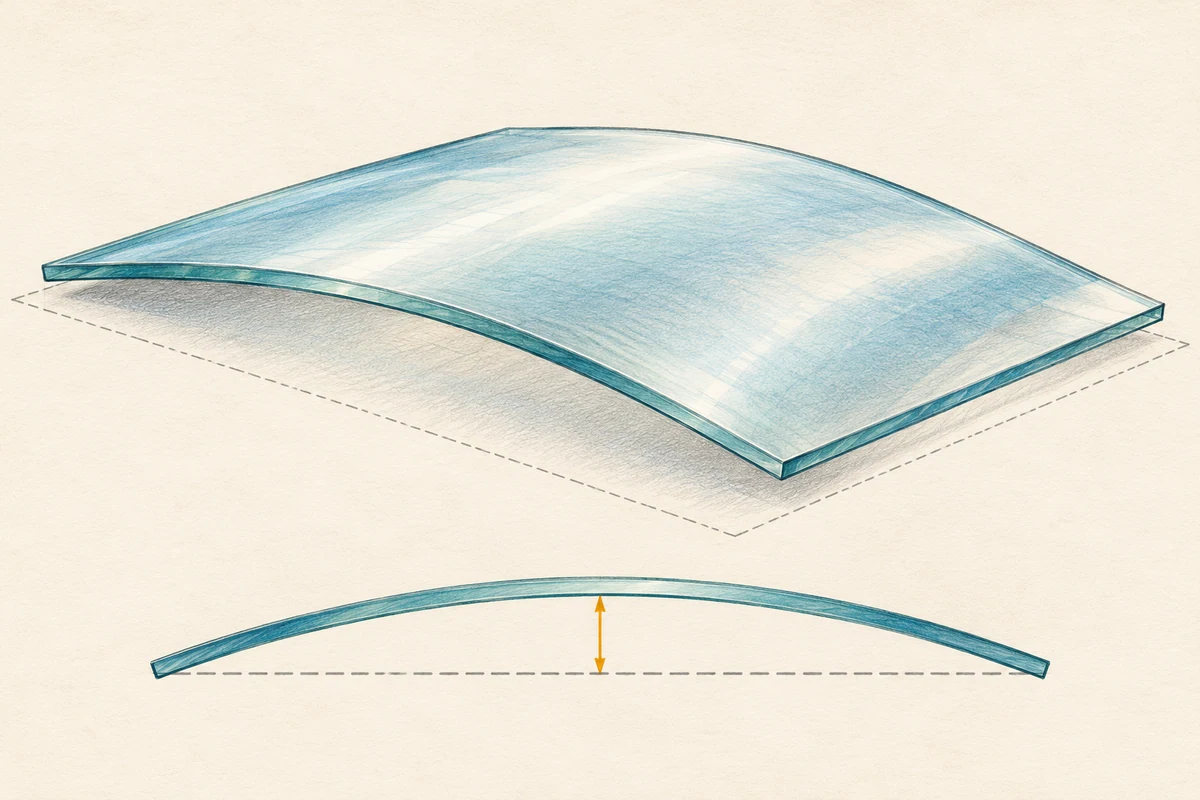
A pane-scale departure from nominal flatness that manifests as gentle, global curvature (bow) or more complex global shape (warp). It alters the way straight lines reflect or transmit across the entire lite but does not present as localized surface relief at the exposed surface. Use of raking/oblique views and the VIS viewing geometry is for observation only;
Definition (Reference)
ReferenceA pane-scale departure from nominal flatness that manifests as gentle, global curvature (bow) or more complex global shape (warp). It alters the way straight lines reflect or transmit across the entire lite but does not present as localized surface relief at the exposed surface. Use of raking/oblique views and the VIS viewing geometry is for observation only; acceptance of factory flatness/shape is governed by product specifications (e.g., C1036/C1048) rather than VIS post-restoration criteria.
Typical Presentation
Informative- Smooth, global bending across the lite; straight building lines or a held straightedge appear uniformly arced in reflection/transmission at normal or oblique view.
- No localized “worked area” or ring/edge; no swirl/web patterning.
- Often most apparent in large lites, spandrel areas, or heat-treated product family; can be accentuated by façade geometry and lighting. (Observation per VIS inspection distances/angles.)
Field Identification Cues
InformativeSurface-catch class:
SC-0 (none). A single light pass of the Manual Surface-Relief Test should not detect a tactile interruption because the condition is pane-scale shape, not a local relief feature. (Use MSRT exactly as defined; single, non-marring pass.)
Visual signature:
Uniform, directionless bending of reflected/transmitted lines at normal and oblique sweep; no “transition edge” or localized boundary.
Location/access:
Whole lite; pertains to the exposed surface being evaluated for observation only.
Differentiation & False Positives
Informative- vs. Roller wave (P.01.01): Roller wave is a periodic flatness deviation often seen in heat-treated glass (short-wavelength, repeating banding) and is documented separately; bow/warp is global/low-frequency curvature. Both are factory shape features rather than local surface relief. Use VIS geometry to observe; do not classify as surface damage.
- vs. Restoration-induced “lensing” / over-polish: Lensing presents as a localized worked region with a perceivable boundary (transition edge/ring) and may show directional patterning; bow/warp has no boundary and no MSRT catch.
- vs. Framing or substrate misalignment: Apparent waviness caused by bent mullions or uneven substrates can mimic global shape issues; confirm with cross-pane comparisons and fixed references at VIS distances/angles.
Classification Mapping (to VIS-DA CAT)
InformativeBecause bow/warp is a pane-scale shape with SC-0 and no local morphology, it is not a surface-damage category in VIS-DA (§4). If observation confirms only global shape without local relief/morphology, record “Processing Feature - Not Surface Damage (outside CAT-1...4)”. If the apparent anomaly is within an IGU cavity or otherwise inaccessible, record as CAT-5 (out of in-place scope) by location/condition.
Indicative Depth / Relief
InformativeNot applicable as a local depth value. Bow/warp is global flatness/shape; no micrometer-scale surface relief is detected at the exposed surface by MSRT (SC-0).
Evidence Package (Documentation Requirements)
NormativeCapture per VIS conventions to avoid hyper-scrutiny and to keep records consistent across trades:
- Photo set at VIS geometry: 12 in, 36 in, 72 in at normal and oblique sweep; include a straight reference (ruler/edge) in frame when practical; log distance/angle in frame text.
- Time discipline: Observe per pane-size time limits from VIS quick card (apply once per distance).
- MSRT result: Record SC-0 (none) for bow/warp; do not abrade or repeat passes.
- Form fields: Use VIS Appendix X3 checklist-pane IDs, product family, surface numbering, worked surface Y/N, pre-inspection reveal status, lighting notes.
Common Sources / Context (Informative)
Informative- Heat-treatment and quench processes; global cooling/handling effects; permissible flatness/shape tolerances addressed by product specifications (C1036/C1048 families). (Product acceptance per project specs; VIS governs post-restoration appearance only.)
Reporting Language (Template)
Template- P.01.02 Bow/Warp (Processing Feature) - Observed global curvature across lite at VIS geometry; MSRT SC-0 (no surface relief). No localized transition edge or directional patterning. Recorded as manufacturing flatness/shape feature; not classified as surface damage under VIS-DA. Product-tolerance acceptance remains per project’s referenced factory standards (e.g., C1036/C1048).
Related glossary terms
See the complete glossary A–Z for supporting terminology.
Source and version
GlassRenu Damage Specification Sheets (DSS), DSS-P.01.02. Source revision and extraction date are recorded in the deployment manifest.
Open the complete published DSS with table of contents (PDF)
Normative and informative labels are preserved from the source. The downloadable one-sheet is a condensed classification aid; this web page retains the complete source-based specification content.