
On this page
- Diagnosis summary
- Safety and classification scope
- Definition (Reference)
- Typical Presentation (Informative)
- Field Identification Cues (Normative)
- Classification Mapping (to VIS-DA) (Normative)
- Indicative Depth / Relief (Informative)
- Differentiation & False Positives (Informative)
- Evidence Package (Documentation Requirements) (Normative)
- Mis-ID Pitfalls (Informative)
- Reporting Language (Template)
- Related glossary terms
- Related DSS
- Source and version
DAMAGE SPECIFICATION STANDARD / METHOD-AGNOSTIC
DSS-P.02.03 — Stones / Knots (solid inclusions)
Float & raw glass feature - reference; encapsulated = factory feature; “open” = classify by surface morphology
Diagnosis summary
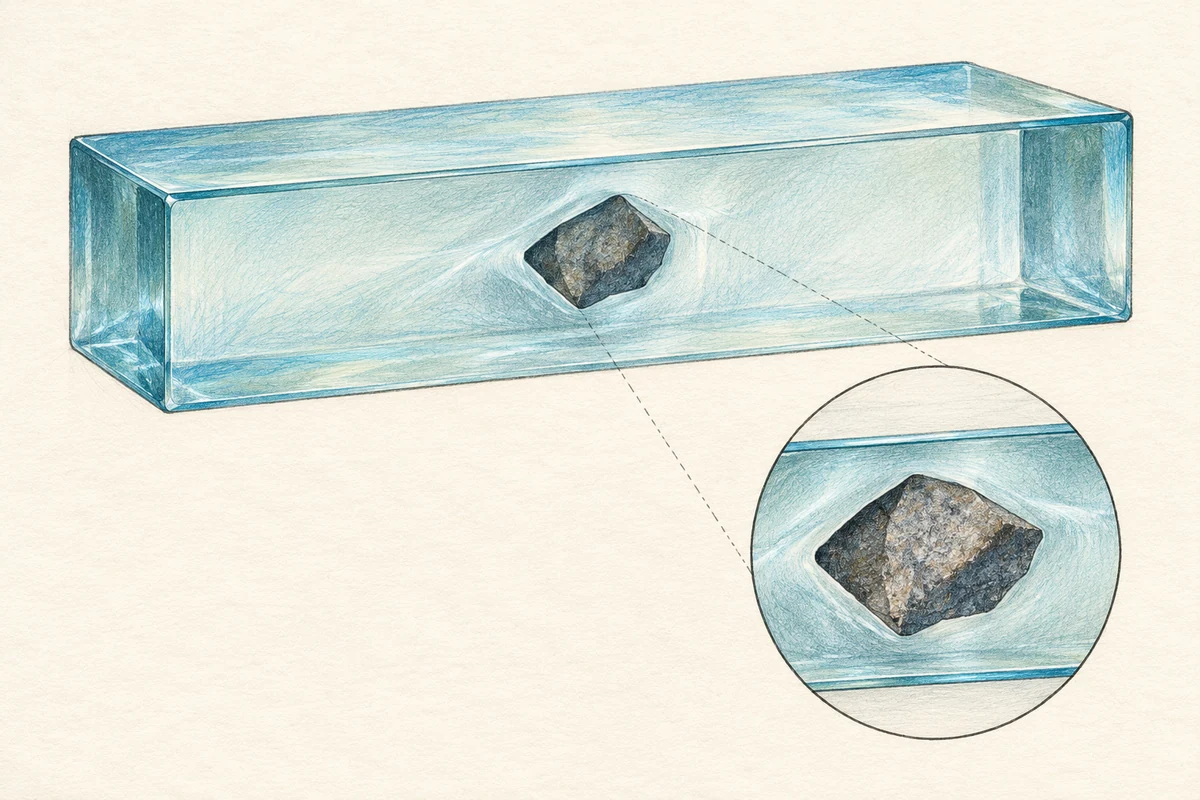
Stones/knots are solid inclusions within the glass body (e.g., unmelted batch, refractory fragments) produced during glass manufacture. When fully encapsulated, they are manufacturing features (optical/appearance effects) rather than surface-relief defects. Evaluate with VIS lighting/geometry for consistency; product/factory acceptance is distinct from VIS post-restoration acceptance.
Definition (Reference)
ReferenceStones/knots are solid inclusions within the glass body (e.g., unmelted batch, refractory fragments) produced during glass manufacture. When fully encapsulated, they are manufacturing features (optical/appearance effects) rather than surface-relief defects. Evaluate with VIS lighting/geometry for consistency; product/factory acceptance is distinct from VIS post-restoration acceptance.
Typical Presentation (Informative)
Informative- Discrete, non-gas inclusion often visible as a speck or tiny body with slight lensing/shadow; location appears stable under parallax (moves with the glass, not with the surface reflection).
- Pane-wide cleaning (Non-Invasive Reveal) does not change visibility; no wipe-responsive residue film.
- If the inclusion breaks the surface (rare), the site presents as a pit/crater with possible chip flanks in raking light.
Field Identification Cues (Normative)
NormativeSurface-catch class (MSRT):
- Encapsulated stone/knott: SC-0 (none) - one light, non-marring pass finds no tactile relief (feature is subsurface). Do not abrade or repeat passes.
- Open (surface-breaking) stone: reads as local pit/crater; expect SC-1/SC-2 depending on depth/edge condition (see CAT-3/4 cues).
Morphology / visual signature:
- Encapsulated: no transition edge, no chip flanks, no local modeled micro-texture; discrete point feature.
- Open: pit/crater possibly with bright flanks in raking light; may be visible at standard/wide-field views if severe.
Viewing/lighting (use VIS): Inspect at 12 / 36 / 72 in, normal and oblique sweep (~60°-120°) under raking light; surfaces must be clean/dry.
Location/access: Record surface numbering (#1-#4; laminate-internal). If a similar cue is confirmed between panes (fixed parallax), record CAT-5 (out of in-place scope by location).
Classification Mapping (to VIS-DA) (Normative)
Normative- Encapsulated stone/knott (non-relief): Processing Feature - Not Surface Damage (outside CAT-1...CAT-4); document only.
- Open (surface-breaking) stone: classify by observable morphology + surface-catch: often CAT-3 (clear catch; modeled texture/lines nearby) or CAT-4 if rough chip flanks/pits are prominent at standard/wide-field views.
- Between-pane/inaccessible look-alike: CAT-5 by location/condition; refer per project protocol.
Indicative Depth / Relief (Informative)
Informative- Encapsulated: no measurable surface relief at the exposed surface (SC-0).
- Open: relief varies; field classification relies on catch + morphology (pit/crater; chip flanks), not numeric depth.
Differentiation & False Positives (Informative)
Informative- vs. Seeds/Blisters (P.02.02): Seeds are gas inclusions; when open, present as craters but often with smoother edges; encapsulated seeds also read SC-0. Stones are solid and more likely to have irregular boundaries if open. (Use MSRT + raking.)
- vs. Hot-particle peppering (Th.01): Thermal pits show bright chip flanks and often occur in clusters/fields; classify per CAT-3/4 morphology if present.
- vs. Metallic/paint specks (Residues/Overspray): Residues change with Non-Invasive Reveal; true inclusions do not.
Evidence Package (Documentation Requirements) (Normative)
Normative- Photo set (VIS): 12 / 36 / 72 in, normal + oblique; include raking usage; where practical, capture a straight-line reflection to show absence of a worked perimeter.
- MSRT result: Encapsulated → SC-0; Open → SC-1/SC-2 (record). One pass only; non-marring.
- Forms: Pane ID; surface numbering; worked surface Y/N; coating present on worked surface? (Y/N/Unknown); reveal status; lighting/time.
- Acceptance split: VIS governs post-restoration appearance; factory inclusion quality is governed by product standards/project specs-do not conflate.
Mis-ID Pitfalls (Informative)
InformativeLocal “spot-work” on an encapsulated stone can create a worked region with a transition edge, which VIS disallows at acceptance (CAT-0...CAT-4). Keep classification appearance-only unless a surface-breaking pit is confirmed.
Reporting Language (Template)
Template- P.02.03 Stones/Knots (Processing Feature) - Discrete solid inclusion observed at VIS geometry; MSRT = SC-0 (no surface relief). No transition edge or fracture morphology. Recorded as manufacturing inclusion; not categorized as surface damage under VIS-DA. If surface-breaking, classify by CAT-3/4 morphology; if between panes, record CAT-5 and refer per project protocol.
Related glossary terms
- Raking lightGRK-129
Source and version
GlassRenu Damage Specification Sheets (DSS), DSS-P.02.03. Source revision and extraction date are recorded in the deployment manifest.
Open the complete published DSS with table of contents (PDF)
Normative and informative labels are preserved from the source. The downloadable one-sheet is a condensed classification aid; this web page retains the complete source-based specification content.