
On this page
- Diagnosis summary
- Safety and classification scope
- Definition (Reference)
- Typical Presentation (Informative)
- Field Identification Cues (Normative)
- Classification Mapping (to VIS-DA) (Normative)
- Indicative Depth / Relief (Informative)
- Differentiation & False Positives (Informative)
- Evidence Package (Documentation Requirements) (Normative)
- Mis-ID Pitfalls (Informative)
- Reporting Language (Template)
- Related glossary terms
- Related DSS
- Source and version
DAMAGE SPECIFICATION STANDARD / METHOD-AGNOSTIC
DSS-P.02.05 — Draw / Float Swirl (optical patterning)
Float & raw glass feature - reference; generally not “damage”
Diagnosis summary
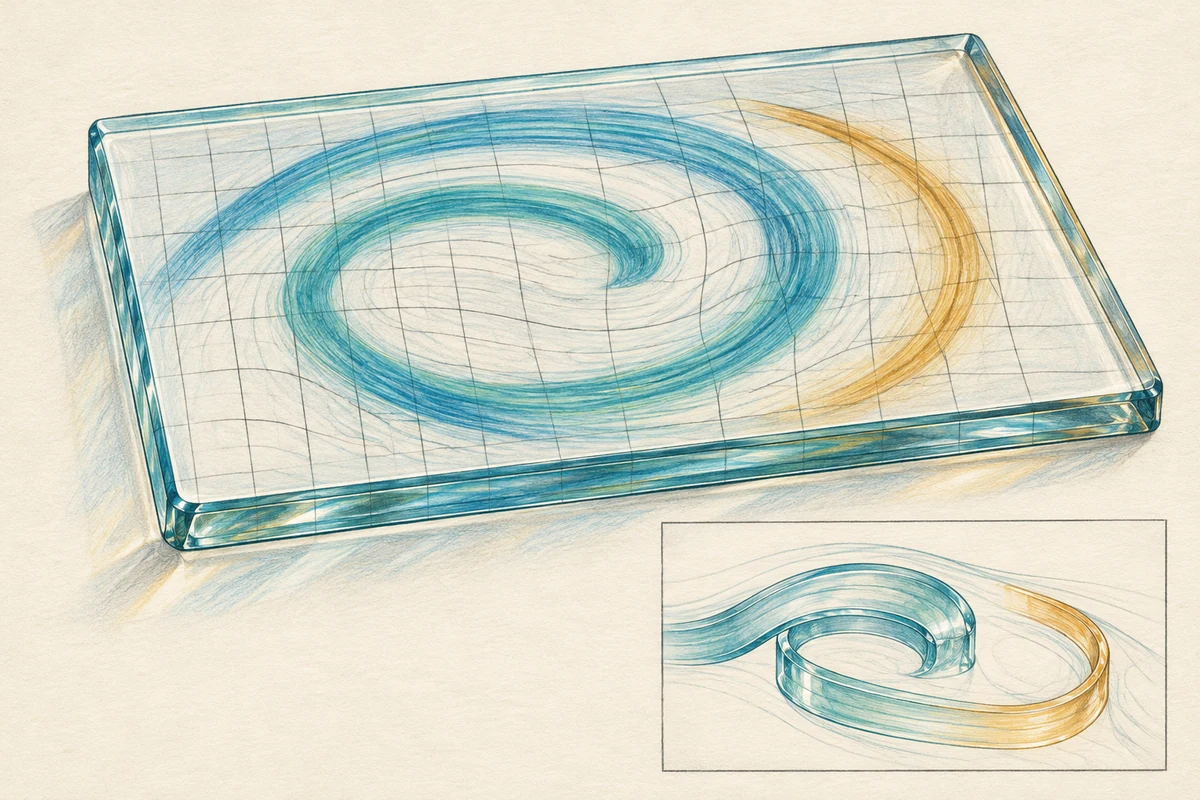
Pane-scale optical flow patterning—subtle swirls/eddies formed by melt/float-bath flow and composition/temperature variations during manufacture. Presents as low-contrast swirl bands or gentle flow lines that bend straight reflections and modulate sheen, typically strongest at oblique angles/raking light. These are factory optical features, not local surface-relief defects.
Definition (Reference)
ReferencePane-scale optical flow patterning-subtle swirls/eddies formed by melt/float-bath flow and composition/temperature variations during manufacture. Presents as low-contrast swirl bands or gentle flow lines that bend straight reflections and modulate sheen, typically strongest at oblique angles/raking light. These are factory optical features, not local surface-relief defects. VIS treats observation under controlled lighting/geometry separately from post-restoration acceptance. For context on optical distortion measurement in heat-treated glass, VIS cites ASTM C1651 informatively.
Typical Presentation (Informative)
Informative- Swirled or meandering bands across regions of a lite; no discrete perimeter or worked boundary.
- Angle-dependent visibility-stronger in raking light and oblique sweep (~60°-120°); can diminish at normal incidence. Use VIS §5 geometry.
Field Identification Cues (Normative)
Normative- Surface-catch class (MSRT): SC-0 (none). Make one light, non-marring pass per VIS §5.5; no tactile interruption because this is optical, not relief. Do not abrade or repeat.
- Visual signature: Pane-scale non-directional swirl/flow appearance; no transition edge, no chip flanks, no pits/craters. See VIS definitions for non-directional variation and directional patterning.
- Viewing/lighting: Inspect at 12 / 36 / 72 in, normal + oblique sweep, under raking light; surfaces clean/dry (non-invasive reveal).
- Location/access: Record surface numbering (#1-#4; laminate-internal) on forms; acceptance pertains to the exposed surface being evaluated.
Classification Mapping (to VIS-DA) (Normative)
Normative- Not field damage. If observation confirms SC-0 with pane-scale optical flow and no local relief, record “Processing Feature - Not Surface Damage (outside CAT-1...CAT-4).” VIS keeps classification separate from acceptance; reserve CAT-5 for location/condition out of in-place scope.
- Between-pane look-alike: If fixed parallax demonstrates a cavity condition, record CAT-5 and refer per project protocol.
Indicative Depth / Relief (Informative)
InformativeNot applicable as a local relief metric. Draw/float swirl is an optical (RI/flow) effect from manufacture; no micrometre-scale relief is detected by MSRT (SC-0).
Differentiation & False Positives (Informative)
Informative- vs. Ream/Cord/Striae (P.02.04): Striae often appear as linear ribbon/streak patterns; draw/float swirl tends toward curvilinear “eddies.” Both are SC-0 and pane-scale. (Use same VIS geometry.)
- vs. Roller wave (P.01.01): Roller wave is periodic flatness deviation from heat-treat; swirls are non-periodic flow patterns from float. (Optical distortion context: ASTM C1651, informative.)
- vs. Abrasion fields (M.02): Abrasion shows directional/web texture and may escalate to slight/clear catch; swirls remain SC-0 with no worked boundary.
- vs. Coating rub/patchiness (Co.01/Co.03): Coating anomalies are localized, often tied to the worked surface and disallowed at acceptance on coated surfaces; float swirl is pane-scale and not confined by a perimeter.
Evidence Package (Documentation Requirements) (Normative)
Normative- Photo set (VIS): 12 / 36 / 72 in, normal + oblique; note raking usage; capture straight-line reflections (mullion/string) bending across the swirl field.
- MSRT result: Record SC-0; one pass only; non-marring.
- Forms: Pane ID; product family and surface numbering; worked surface Y/N; functional coating present on worked surface? (Y/N/Unknown); reveal status; lighting/time; geometry checklist.
- Acceptance split: VIS governs post-restoration appearance; factory optical features are governed by product standards/project specs-do not conflate.
Mis-ID Pitfalls (Informative)
InformativeLocalized “spot correction” of factory swirl can create a worked region with a visible transition edge-not permitted at VIS acceptance for CAT-0...CAT-4. Keep classification appearance-only unless a true surface defect is present.
Reporting Language (Template)
Template- P.02.05 Draw/Float Swirl (Processing Feature) - Pane-scale optical flow patterning observed at VIS geometry; MSRT = SC-0 (no surface relief). No transition edge or fracture morphology. Recorded as manufacturing optical feature; not categorized as surface damage under VIS-DA. If fixed parallax indicates between-pane location, record CAT-5 and refer per project protocol.
Related glossary terms
- Raking lightGRK-129
- Optical distortionGRK-117
- Coating rubGRK-115
- AbrasionGRK-035
Source and version
GlassRenu Damage Specification Sheets (DSS), DSS-P.02.05. Source revision and extraction date are recorded in the deployment manifest.
Open the complete published DSS with table of contents (PDF)
Normative and informative labels are preserved from the source. The downloadable one-sheet is a condensed classification aid; this web page retains the complete source-based specification content.