
On this page
- Diagnosis summary
- Safety and classification scope
- Classification & Scope (Normative)
- Typical Presentation (Informative)
- Field Identification Cues (Normative)
- Surface-catch class (MSRT)
- Visual signature
- Viewing / lighting
- Location / access
- Mechanism cue (context)
- Severity & CAT Mapping (Normative)
- Differentiation & Mis-ID Pitfalls (Informative)
- Evidence Package *(Documentation Requirements) (Normative)
- Reporting Language (Template)
- Related glossary terms
- Related DSS
- Source and version
DAMAGE SPECIFICATION STANDARD / METHOD-AGNOSTIC
DSS-U.01.01 — Mixed Chemical–Mechanical Field (Etch + Track / Hybrid Presentation)
Mixed mechanism - overlapping chemical alteration and mechanical abrasion/scoring; modeled micro-texture with superposed linear tracks or scuffs; halos/runs from chemistry plus chip-flank sparkle in lines; SC-1 across etched field with SC-2 along mechanical strokes
Diagnosis summary
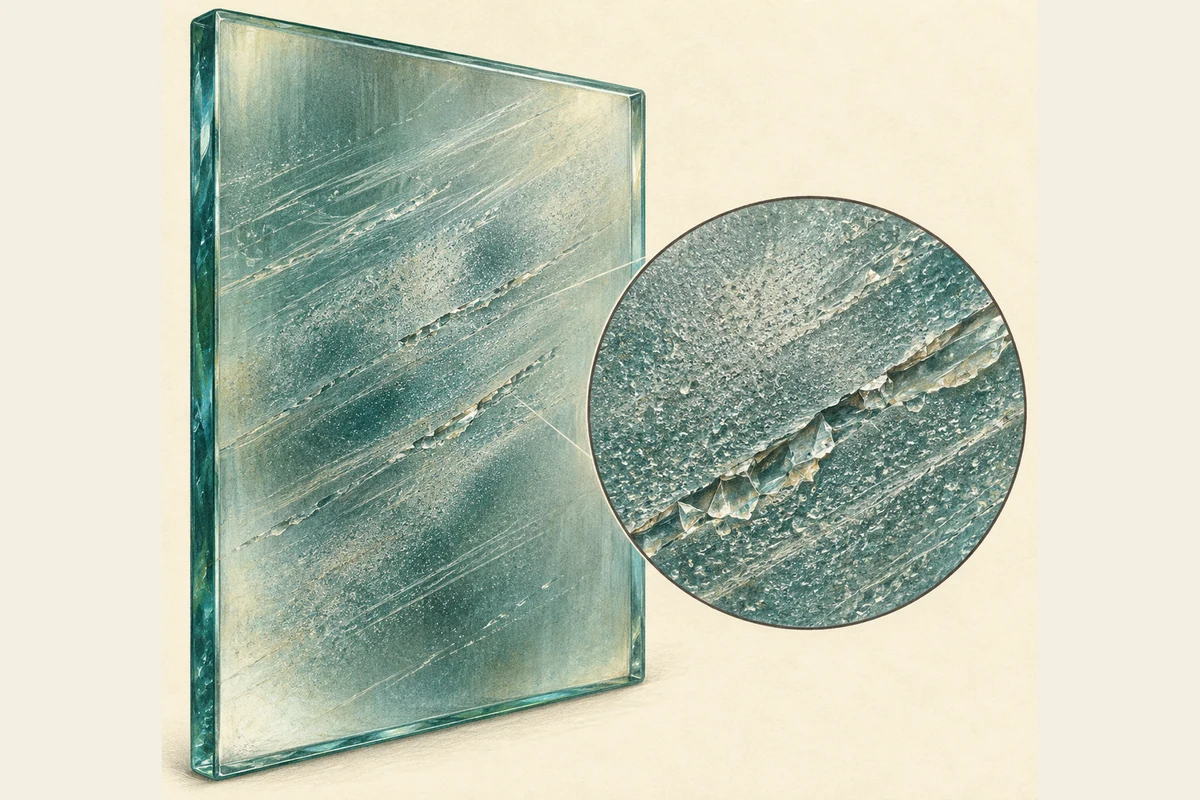
Mixed chemical–mechanical field is an appearance change on glass where chemical alteration (acid/alkali/mineral etch or residue-induced micro-texture) coexists with and/or is overlain by mechanical actions (scraper/razor, pad swirls, directional scuffs, or line scoring). The result is a hybrid field in which modeled matte or haloed zones intermix with linear tracks having chip-flank features.
Classification & Scope (Normative)
NormativeMixed chemical-mechanical field is an appearance change on glass where chemical alteration (acid/alkali/mineral etch or residue-induced micro-texture) coexists with and/or is overlain by mechanical actions (scraper/razor, pad swirls, directional scuffs, or line scoring). The result is a hybrid field in which modeled matte or haloed zones intermix with linear tracks having chip-flank features. Classification is appearance-only per VIS (method-agnostic). Inspect after Non-Invasive Reveal under VIS lighting/geometry; record surface numbering and worked-surface status.
Typical Presentation (Informative)
Informative- Low-contrast matte or haloed area (chemical history) with superposed lines that show chip-flank sparkle in raking (mechanical).
- Run legs/meniscus rings from chemistry crossing or underpinning straight or arced tool paths.
- Patchy sheen shift with directional webbing from attempted cleaning/restoration over chemically altered substrate.
Field Identification Cues (Normative)
NormativeSurface-catch class (MSRT)
- SC-1 broadly within the chemically altered field (incipient micro-texture).
- SC-2 along mechanical lines/tracks (distinct interruption with chip-flank feel).
- Perform one light, non-marring pass on a small revealed test patch-sample both the matte field and the linear features. Use a polymer stylus if a functional coating is suspected. MSRT supports classification only.
Visual signature
- Modeled, non-directional micro-texture (chemical) plus directional lines/scuffs (mechanical).
- Chemical artifacts: halos, meniscus rims, drip mapping; Mechanical artifacts: straightedge alignment, uniform arc radius, cross-hatch, chip-flank sparkle.
- No fused nodules (not hot particle unless co-present-then classify that component separately).
Viewing / lighting
- Evaluate clean & dry at 12 / 36 / 72 in, normal and oblique sweep (~60°-120°); utilize raking to separate field matte from line sparkle. Record distances/angles in-frame.
Location / access
- Record pane ID and surface numbering (#1-#4; laminate-internal). Typically on exposed faces; between-pane by parallax on #2/#3 → CAT-5 by location.
Mechanism cue (context)
- Construction or post-construction cleaning where acid/alkali/mineral incidents were followed by scraper or abrasive pad use.
- Evidence of masonry wash, cement slurry, hard water or acid markers, plus razor scoring or pad swirl attempts to “remove” the chemical effect.
Severity & CAT Mapping (Normative)
NormativeAssign CAT by visibility at acceptance geometry and MSRT. Depth values are indicative-field measurement not required.
- CAT-2 (Light): Small hybrid zone where field shows SC-1 (subtle matte) and lines are faint SC-1-SC-2, with limited standard-view impact. Indicative relief: ~10-40 μm (field) with ~20-60 μm (lines).
- CAT-3 (Moderate): Pane-noticeable hybrid: field matte legible at standard distance (SC-1) with multiple SC-2 tracks (chip flanks evident). Indicative relief: ~40-120 μm (field) plus ~60-150 μm (lines).
- CAT-4 (Severe): Wide-area chemical matte combined with dense/Deep mechanical scoring visible at standard and wide-field; SC-2 prevalent along lines. Indicative relief: ~120-300+ μm local maxima in lines; field matte in ~80-180 μm range.
- Reclassify components when dominant:
- Chemical halo/rings/etch without mechanical tracks → classify under Ch.01/Ch.02/Ch.03 as appropriate.
- Predominantly linear scoring with chip flanks, minimal chemical cues → M.01/M.02 families.
- Fused nodules/pits present → add Th.01 component; if it dominates, classify there.
- CAT-5 (by condition/location): Between-pane/inaccessible, integrity indicators, or confirmed functional-coating loss on the surface to be worked → CAT-5.
CAT is appearance-based; acceptance is separate under VIS-A at 12/36/72 in. Do not abrade to “force” a response during classification.
Differentiation & Mis-ID Pitfalls (Informative)
Informative- vs. Pure mineral system (Ch.03): Mineral alone presents ringed halos/etch without chip-flank lines. Mixed fields show both haloed matte and sparkling line edges.
- vs. Pure abrasion fields (M.02): Abrasion swirls/webs lack chemical run/meniscus artifacts and typically exhibit uniform directionality.
- vs. Coating anomalies (Co): Coating patchiness is planar on coated faces and lacks mechanical chip flanks; mixed fields reveal distinct line relief.
- vs. Hot particle (Th.01): Hot particle produces discrete pits/fused nodules; mixed fields show etched matte + mechanical lines, not peppered fusion unless co-present.
Evidence Package *(Documentation Requirements) (Normative)
Normative- Photo set (VIS): 12 / 36 / 72 in, normal + oblique; raking macros that distinctly show (a) field matte / halos / runs and (b) chip-flank sparkle of lines; overlays or paired frames to demonstrate co-location. Record distance/angle in-frame.
- MSRT results (substrate): After a small reveal test patch, perform one light, non-marring pass through field (record SC-1) and line (record SC-2), plus adjacent control (SC-0).
- Forms: Pane ID; product family & surface numbering; worked surface Y/N; functional coating on worked surface? (Y/N/Unknown); reveal status; lighting/time; geometry checklist; photos attached.
- Acceptance split: Post-restoration acceptance per VIS-A §6; classification ≠ acceptance. Coated-face appearance rules apply per VIS §6.2.e when the worked surface is a factory functional coating.
Reporting Language (Template)
Template- U.01.01 Mixed Chemical-Mechanical Field - Modeled matte/halo with superposed linear tracks on surface #___; post-reveal test patch yields SC-1 in field and SC-2 along lines; visible at [12/36/72 in] under VIS geometry. Morphology: chemical halos/runs + chip-flank sparkle, no fused nodules observed. Classification: CAT-[2/3/4] by visibility and SC-class; component reclassification per notes if one mechanism dominates; CAT-5 if between-pane or coating-side loss on the surface to be worked. Forms + photo set attached; acceptance per VIS-A §6.
Related glossary terms
Source and version
GlassRenu Damage Specification Sheets (DSS), DSS-U.01.01. Source revision and extraction date are recorded in the deployment manifest.
Open the complete published DSS with table of contents (PDF)
Normative and informative labels are preserved from the source. The downloadable one-sheet is a condensed classification aid; this web page retains the complete source-based specification content.