
On this page
- Diagnosis summary
- Safety and classification scope
- Definition (Reference)
- Typical presentation (Informative)
- Field Identification Cues (Normative)
- Classification Mapping (to VIS-DA) (Normative)
- Indicative depth range (μm)
- Evidence & documentation (Informative)
- Associated references (Informative)
- Related glossary terms
- Related DSS
- Source and version
DAMAGE SPECIFICATION STANDARD / METHOD-AGNOSTIC
DSS-A.02.01 — Edge haze / whitening (laminated interlayer; PVB / ionoplast)
Diagnosis summary
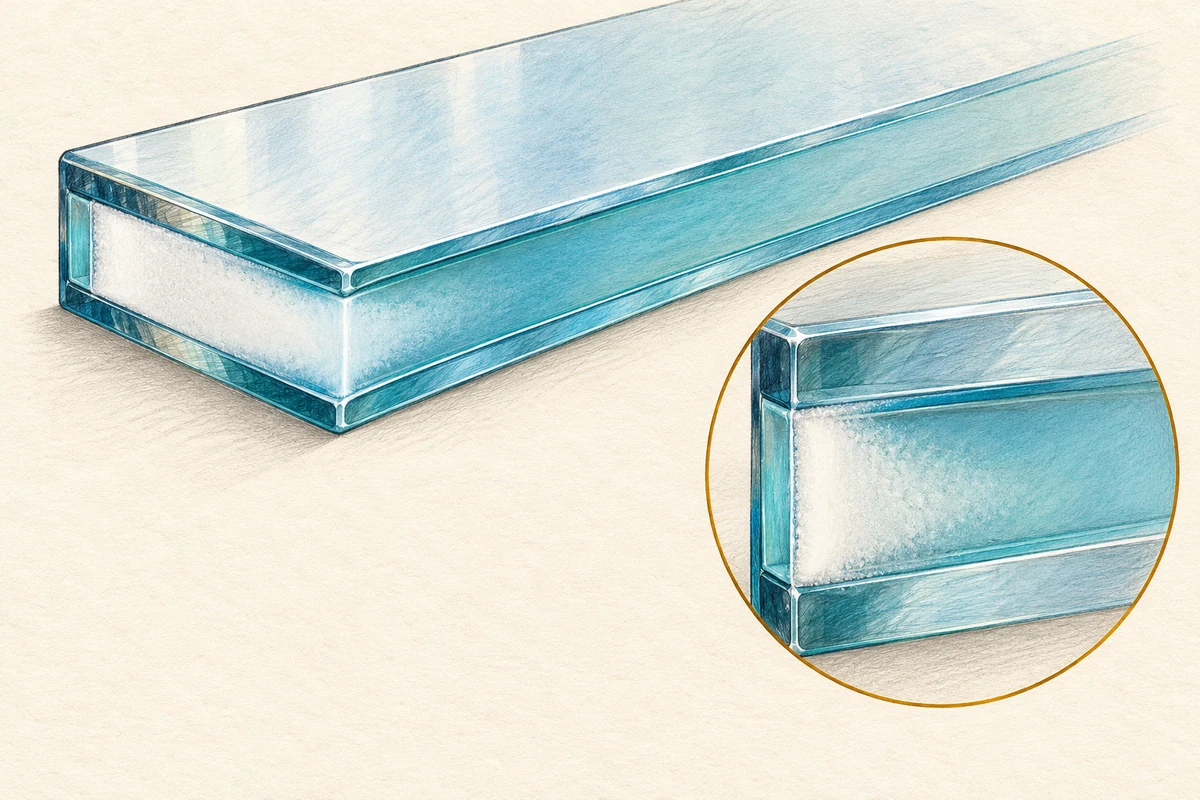
A milky, desaturated band or clouding that develops within the laminated interlayer zone near the perimeter, typically within a few millimeters to several centimeters of the edge. It is an internal condition (between glass plies) of laminated glass and not a worked-surface defect. Because it is laminate-internal, it is generally out of in-place restoration scope; document and refer.
Definition (Reference)
ReferenceA milky, desaturated band or clouding that develops within the laminated interlayer zone near the perimeter, typically within a few millimeters to several centimeters of the edge. It is an internal condition (between glass plies) of laminated glass and not a worked-surface defect. Because it is laminate-internal, it is generally out of in-place restoration scope; document and refer. (Laminated glass & interlayer context: ASTM C1172; ISO 12543.
Typical presentation (Informative)
Informative- Semi-opaque “whitening” ribbon along edges; may appear wedge-shaped or uneven in width around corners.
- Can grow/recall with humidity and temperature changes; does not respond to non-invasive reveal/cleaning.
- May co-present with micro-bubbles/stringers or with slight interlayer retreat at the edge.
- Readable at normal incidence and oblique sweep under raking light; often more visible at standard/wide-field views when back-lit. (Inspection geometry & raking light: VIS §5.3-§5.4.
Field Identification Cues (Normative)
Normative- Surface-catch class (MSRT): None on either exposed face. One light, non-marring pass per VIS §5.5; do not abrade. (MSRT definition and use.
- Visual signature: Edge-parallel, diffuse whitening inside the laminate; no chip-flank sparkle, no pits/craters at the exposed face; persists after non-invasive reveal. (Reveal.
- Location / access: Laminate-internal (between plies). Record surface numbering for the lite(s) and note that the observation is laminate-internal rather than on #1/#4 faces. (Surface numbering & non-exposed surfaces.
- Diagnostic differentiators:
- vs. external eolian/cleaning haze: external fields show face-side cues and may produce surface catch or directional patterning; laminate whitening does not.
- vs. sealant/adhesive film: surface films respond to reveal; laminate whitening does not.
- vs. local delamination (A.02.06): delamination shows a defined boundary (often iridescence, Newton fringes) and may include discrete voids; edge whitening is diffuse without a sharp lensing boundary.
Classification Mapping (to VIS-DA) (Normative)
Normative- CAT-5 (Out of in-place scope): Record as A.02.01 - Laminate-internal whitening (CAT-5) and refer to fabricator/manufacturer or replacement per project protocol. (CAT-5 scope & rationale.
- If any face-side damage is also present (e.g., mechanical scoring at the perimeter), classify that separately under the appropriate M-family item and assign CAT per VIS. (Three-part cueing & boundary guidance.
Indicative depth range (μm)
InformativeNot applicable (internal to laminate). Depth ranges in μm apply to worked-surface defects; laminated interlayer whitening has no meaningful face-side removal depth.
Evidence & documentation (Informative)
Informative- Photos: overview of the lite; edge runs at mid-range; close-ups at raking light. Include one back-lit image when safe, to show internal character. (VIS documentation.
- Recording: pane ID, surface numbering (#1-#4 / laminate-internal), environment (temp/RH), width of whitening band at several stations. (Surface numbering & documentation prompts.
- Inspection conditions: confirm non-invasive reveal completed; inspect under VIS §5 lighting/geometry; MSRT recorded as none. (Reveal & geometry.
Associated references (Informative)
Reference- Product/spec context: ASTM C1172 (laminated architectural flat glass); ISO 12543 (laminated glass series). (Listed in VIS references.
- VIS cross-refs: Terminology (laminated, non-exposed surface); §5 (inspection), §6 (acceptance), §4.2.6 (CAT-5). (Terminology & sections.
Related glossary terms
- HazeGRK-079
- Laminated glassGRK-009
- Raking lightGRK-129
- Surface filmGRK-044
Source and version
GlassRenu Damage Specification Sheets (DSS), DSS-A.02.01. Source revision and extraction date are recorded in the deployment manifest.
Open the complete published DSS with table of contents (PDF)
Normative and informative labels are preserved from the source. The downloadable one-sheet is a condensed classification aid; this web page retains the complete source-based specification content.