
On this page
- Diagnosis summary
- Safety and classification scope
- Definition (Reference)
- Typical Presentation (Informative)
- Field Identification Cues (Normative)
- Classification Mapping (to VIS-DA) (Normative)
- Indicative Relief / Depth (Informative)
- Differentiation & False Positives (Informative)
- Evidence Package (Documentation Requirements) (Normative)
- Mis-ID Pitfalls (Informative)
- Reporting Language (Template)
- Related glossary terms
- Related DSS
- Source and version
DAMAGE SPECIFICATION STANDARD / METHOD-AGNOSTIC
DSS-A.02.06 — Local Delamination (ply/interlayer separation; laminated glass)
Assembly / internal condition - typically CAT-5 by location; out of in-place scope
Diagnosis summary
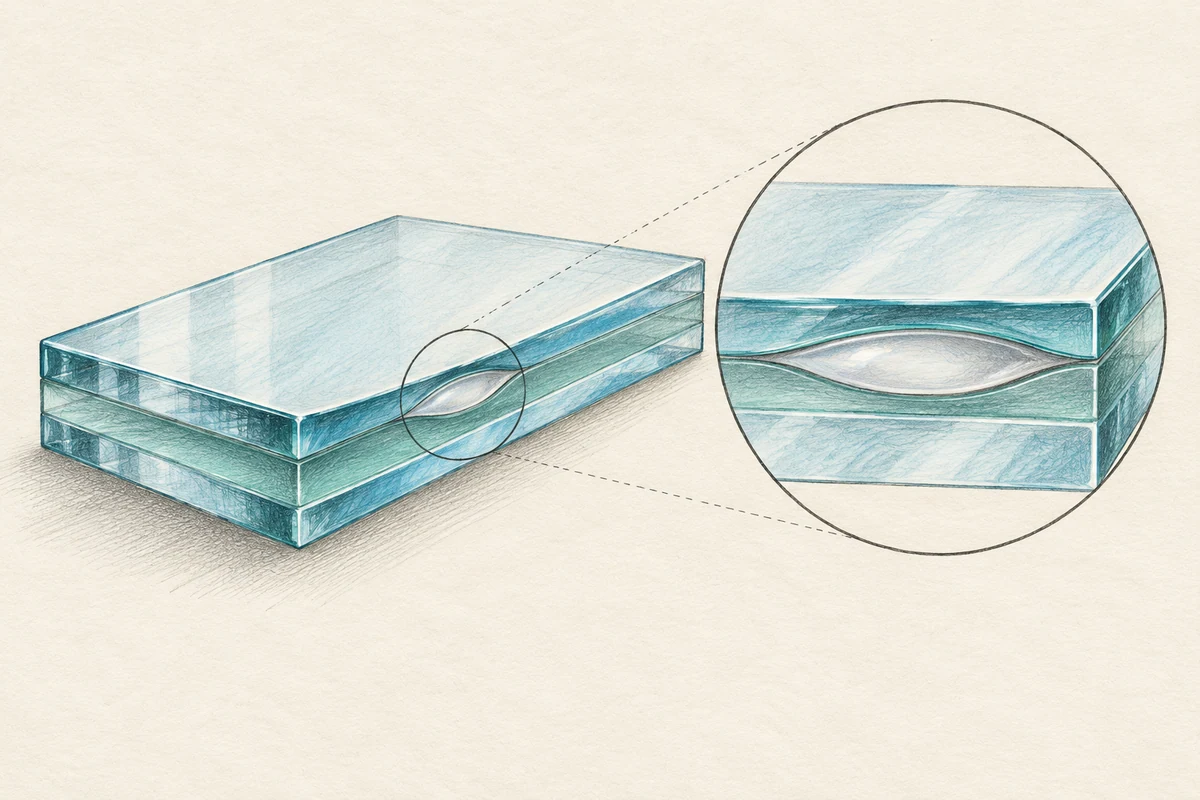
Local delamination is a separation between a glass ply and the interlayer (or between interlayers) creating a void/air interface within the laminate stack. Presents as silvering, Newton-fringe iridescence, or a defined lens-like boundary inside the laminate. Because the cue is laminate-internal (between plies), it is not on an exposed worked face and is not addressable in place;
Definition (Reference)
ReferenceLocal delamination is a separation between a glass ply and the interlayer (or between interlayers) creating a void/air interface within the laminate stack. Presents as silvering, Newton-fringe iridescence, or a defined lens-like boundary inside the laminate. Because the cue is laminate-internal (between plies), it is not on an exposed worked face and is not addressable in place; classification is location/condition-driven. Product/spec context: ASTM C1172 and ISO 12543 (normative in VIS). Use VIS surface numbering and record as laminate-internal (distinct from #1/#4 and IGU #2/#3 faces).
Typical Presentation (Informative)
Informative- Sharp, closed boundary (crescent/amoeboid) showing silvering or rainbow fringes under oblique/raking light; often edge-originating and creeping inward.
- May appear around cutouts/inserts, at corners, or where thermal/UV load and moisture are elevated.
- No change after Non-Invasive Reveal of exposed faces; no worked transition edge on the face. (Apply VIS inspection geometry.)
Field Identification Cues (Normative)
NormativeLocation / access (primary):
- Confirm laminate-internal location. On forms, record product family (laminated) and surface numbering (#1-#4; tag as laminate-internal). Do not re-number laminate-internal interfaces as IGU faces.
Surface-catch class (MSRT):
- On exposed faces, record SC-0 (none). MSRT is single, non-marring and supports classification only-do not abrade to “probe” an internal cue. Prefer polymer stylus on coated faces or rely on visual/location cues.
Inspection environment / reveal controls:
- Perform Non-Invasive Reveal (clean & dry) before evaluation; persistence confirms non-face location. Avoid blades/abrasives/chemicals prior to classification.
Viewing / lighting:
- VIS geometry: 12 / 36 / 72 in; normal incidence + oblique sweep (~60°-120°) with raking light. Add back-lit frames (when safe) to capture fringes/silvering.
Classification Mapping (to VIS-DA) (Normative)
Normative- CAT-5 - Out of in-place scope when separation is within the laminate (not on an exposed worked surface). Document and refer per project protocol (fabricator/manufacturer/warranty).
- If face-side damage also exists (e.g., perimeter scoring), classify that separately under the appropriate M-family item and assign CAT per VIS.
Indicative Relief / Depth (Informative)
Informative- Not a face-relief feature. On the exposed face, MSRT records SC-0. Numeric μm ranges in VIS apply to face-side defects only.
Differentiation & False Positives (Informative)
Informative- vs. Bubbles/stringers (A.02.02): Bubbles are discrete voids (round/linear) without pronounced fringe patterns; delamination shows defined separation boundary with silvering/iridescence.
- vs. Edge haze/whitening (A.02.01): Whitening is diffuse/milky; delamination has a sharp lens-like boundary and fringe effects.
- vs. Interlayer creep/exudation (A.02.04): Creep is material flow/exposure at the edge; delamination is ply/interlayer separation (air interface) within the stack.
- vs. IGU cavity anomalies (A.01 family): Cavity features sit on #2/#3 with fixed parallax between panes; delamination is within a laminate (record as laminate-internal). Use surface numbering to avoid cross-family mis-ID.
Evidence Package (Documentation Requirements) (Normative)
Normative- Photo set (VIS): 12 / 36 / 72 in, normal + oblique, raking; include at least one back-lit macro (when safe) to capture fringes/silvering and a context frame showing edge origin/extent.
- Forms: Pane ID; product family & surface numbering (#1-#4; laminate-internal); worked surface Y/N; functional coating present on worked surface? (Y/N/Unknown); reveal status; lighting/time; geometry checklist.
- Progression note: If observed across site visits, record growth/creep of boundary (mm and date) and any environmental conditions (temperature/RH, sunload).
Mis-ID Pitfalls (Informative)
InformativeAttempting face-side “blending” to hide an internal boundary creates a worked region (visible transition edge) that VIS disallows at acceptance (CAT-0...CAT-4). Keep classification appearance-only and location-based; refer, do not abrade.
Reporting Language (Template)
Template- A.02.06 Local Delamination (laminate-internal) - Defined ply/interlayer separation with silvering/iridescent fringes inside the laminate; no change after Non-Invasive Reveal; MSRT = SC-0 on exposed faces; documented at 12/36/72 in with normal + oblique under raking (incl. back-lit macro). CAT-5 (laminate-internal; out of in-place scope). Refer per project protocol.
Related glossary terms
- Laminated glassGRK-009
- Raking lightGRK-129
- AbrasiveGRK-168
Source and version
GlassRenu Damage Specification Sheets (DSS), DSS-A.02.06. Source revision and extraction date are recorded in the deployment manifest.
Open the complete published DSS with table of contents (PDF)
Normative and informative labels are preserved from the source. The downloadable one-sheet is a condensed classification aid; this web page retains the complete source-based specification content.