
On this page
- Diagnosis summary
- Safety and classification scope
- Definition (Reference)
- Typical Presentation (Informative)
- Field Identification Cues (Normative)
- Classification Mapping (to VIS-DA) (Normative)*
- Indicative Relief / Depth (Informative)
- Differentiation & False Positives (Informative)
- Evidence Package (Documentation Requirements) (Normative)*
- Mis-ID Pitfalls (Informative)
- Reporting Language (Template)
- Related glossary terms
- Related DSS
- Source and version
DAMAGE SPECIFICATION STANDARD / METHOD-AGNOSTIC
DSS-A.02.03 — Contamination Inclusions (foreign matter within laminated interlayer)
Assembly / internal condition - typically CAT-5 by location; out of in-place scope
Diagnosis summary
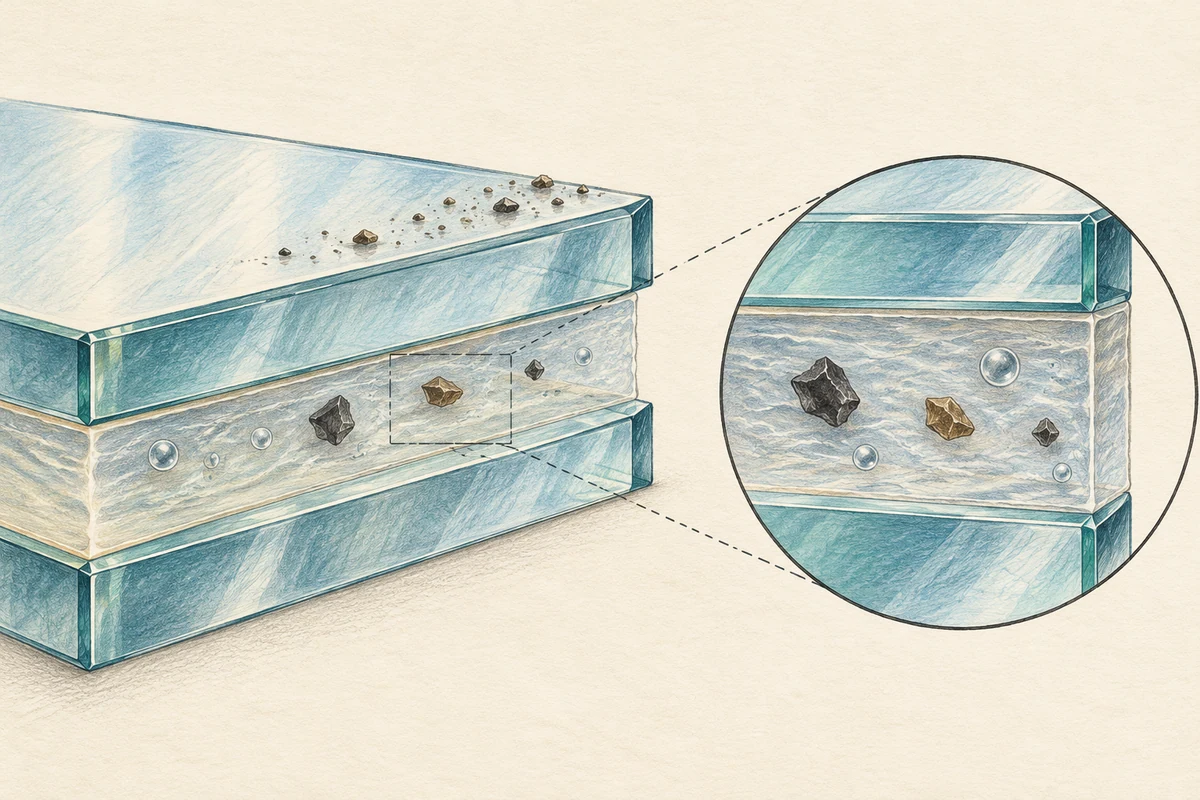
Discrete foreign particles/fibers/particulates encapsulated within the laminated interlayer between glass plies (e.g., dust, fabric lint, granules, hairline fibers). These are laminate-internal features—not on an exposed worked face—and are therefore not addressable in place; classification is location/condition-driven. Product/spec context for laminated glass: ASTM C1172 and ISO 12543 (normative in VIS).
Definition (Reference)
ReferenceDiscrete foreign particles/fibers/particulates encapsulated within the laminated interlayer between glass plies (e.g., dust, fabric lint, granules, hairline fibers). These are laminate-internal features-not on an exposed worked face-and are therefore not addressable in place; classification is location/condition-driven. Product/spec context for laminated glass: ASTM C1172 and ISO 12543 (normative in VIS). Use VIS surface numbering; identify as laminate-internal (distinct from #1/#4 and IGU #2/#3 faces).
Typical Presentation (Informative)
Informative- Point-like specks (dark/opaque), light-colored lint, or fine filaments captured in the interlayer; may align with lay-up direction or appear clustered near edges/inserts.
- No change after Non-Invasive Reveal of exposed faces and no worked transition edge on the face. Evaluate using VIS lighting/geometry.
Field Identification Cues (Normative)
NormativeLocation / access (primary):
- Confirm laminate-internal location. On forms, record product family (laminated) and surface numbering (#1-#4; laminate-internal). Do not re-number laminate-internal faces as IGU faces.
Surface-catch class (MSRT):
- SC-0 (none) on exposed face(s). MSRT is single, non-marring and used only to support classification-not acceptance. Do not abrade.
Inspection environment / reveal controls:
- Perform Non-Invasive Reveal (clean & dry) before evaluation; persistence confirms non-face location. Avoid blades/abrasives/chemicals prior to classification.
Viewing / lighting:
- VIS geometry: 12 / 36 / 72 in; normal incidence + oblique sweep (~60°-120°) under raking light. Back-lit frames can help show particle silhouette.
Classification Mapping (to VIS-DA) (Normative)*
Normative- CAT-5 - Out of in-place scope when inclusions are laminate-internal (not on an exposed worked surface). Document and refer per project protocol (fabricator/manufacturer/warranty).
Indicative Relief / Depth (Informative)
Informative- Not applicable to the exposed face (no measurable surface relief; SC-0). VIS μm ranges apply to face-side defects only.
Differentiation & False Positives (Informative)
Informative- vs. Face-side residues/overspray (R-family): Face films respond to Non-Invasive Reveal; true inclusions do not.
- vs. Stones/knots in float (P.02.03): Factory solid inclusions in the glass mass (processing feature); encapsulated and SC-0 on the face. Classify per processing features, not laminated interlayer contamination.
- vs. Bubbles/stringers (A.02.02): Gas voids without foreign matter; contamination inclusions show solid particulate/fiber boundaries. Keep the family assignment distinct; both are laminate-internal and typically CAT-5.
Evidence Package (Documentation Requirements) (Normative)*
Normative- Photo set (VIS): 12 / 36 / 72 in, normal + oblique, raking; include a back-lit close-up (when safe) to show inclusion boundary; ensure reveal completed is noted.
- Forms: Pane ID; product family & surface numbering (#1-#4; laminate-internal); worked surface Y/N; functional coating present on worked surface? (Y/N/Unknown); reveal status; lighting/time; geometry checklist.
- Optional measurements: Approximate particle size (mm), count per area, distance from edge; note temperature/RH at time of inspection. (Use VIS form notes.)
Mis-ID Pitfalls (Informative)
InformativeAttempting “spot-work” on the face to address an internal inclusion risks creating a worked region (visible transition edge) that VIS disallows at acceptance for CAT-0...CAT-4. Keep classification appearance-only and location-based; refer.
Reporting Language (Template)
Template- A.02.03 Contamination Inclusions (laminate-internal) - Discrete foreign particulate/fiber within interlayer; no change after Non-Invasive Reveal; MSRT = SC-0 on exposed faces; documented at 12/36/72 in with normal + oblique under raking. CAT-5 (laminate-internal; out of in-place scope). Refer per project protocol.
Related glossary terms
- Laminated glassGRK-009
- Raking lightGRK-129
- AbrasiveGRK-168
Source and version
GlassRenu Damage Specification Sheets (DSS), DSS-A.02.03. Source revision and extraction date are recorded in the deployment manifest.
Open the complete published DSS with table of contents (PDF)
Normative and informative labels are preserved from the source. The downloadable one-sheet is a condensed classification aid; this web page retains the complete source-based specification content.