
On this page
- Diagnosis summary
- Safety and classification scope
- Definition (Reference)
- Typical Presentation (Informative)
- Field Identification Cues (Normative)
- Classification Mapping (to VIS-DA) (Normative)
- Indicative Relief / Depth (Informative)
- Differentiation & False Positives (Informative)
- Evidence Package (Documentation Requirements) (Normative)
- Mis-ID Pitfalls (Informative)
- Reporting Language (Template)
- Related glossary terms
- Related DSS
- Source and version
DAMAGE SPECIFICATION STANDARD / METHOD-AGNOSTIC
DSS-A.02.04 — Interlayer Creep / Exudation at Edge
edge ooze; interlayer flow/exposure; location/condition = laminate-internal; typically CAT-5 by location/inaccessibility
Diagnosis summary
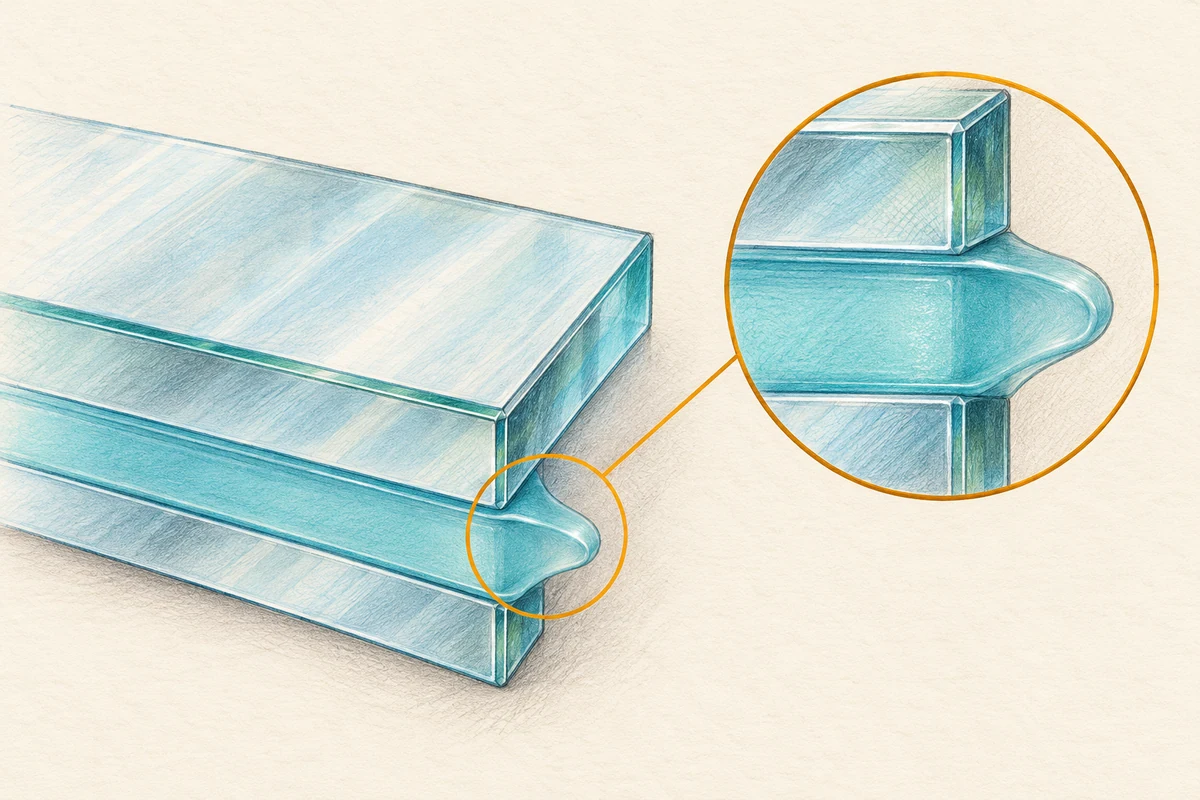
Localized flow, squeeze-out, or exposure of the laminated interlayer at or near the laminate edge. Presents as soft or glossy interlayer material visible at the ply edges; may wet adjacent components or leave a faint transfer on adjacent framing or gaskets. Because the condition originates within the laminate stack (between plies), it is not a face-side glass surface defect.
Definition (Reference)
ReferenceLocalized flow, squeeze-out, or exposure of the laminated interlayer at or near the laminate edge. Presents as soft or glossy interlayer material visible at the ply edges; may wet adjacent components or leave a faint transfer on adjacent framing or gaskets. Because the condition originates within the laminate stack (between plies), it is not a face-side glass surface defect. The laminate’s internal faces are “laminate-internal” and are not accessible for in-place restoration.
Typical Presentation (Informative)
Informative- Soft or tacky bead/film emerging at the edge; sometimes clear, sometimes slightly hazed from dust pickup.
- May print or smudge onto adjacent frame gaskets; can trap debris along the edge line.
- Often intermittent along the perimeter; more pronounced at corners or areas exposed to heat/sunload.
- No discrete “line” or chip-flank morphology on the glass face; effect is edge-localized and internal to the laminate. (Use surface numbering and location cues to confirm laminate-internal origin.)
Field Identification Cues (Normative)
Normative- Location/access: Confirm the observation is at the laminate edge and originates between plies (laminate-internal). Record surface numbering and product type on Forms: If the cue is not on the exposed face and shows fixed parallax (where applicable), treat as out-of-scope for in-place restoration.
- Non-invasive reveal: Clean and dry the exposed face per VIS before evaluating; edge ooze will not be removed by a face-side reveal, though incidental transfer on the face may wipe away.
- MSRT (Manual Surface-Relief Test): On the face, one light, non-marring pass only. Expect SC-0 on the face (no relief) unless there is a separate residue on the face; classification remains location-driven. Prefer polymer stylus if a coating is present on the worked face or rely on visual cues.
- Viewing/lighting: Evaluate at 12 / 36 / 72 in using normal incidence + oblique sweep (~60°-120°) under raking light; document the edge zone and overall context.
Classification Mapping (to VIS-DA) (Normative)
Normative- Default: CAT-5 by location/condition - the condition is between plies (laminate-internal) and not addressable on the exposed face in place. Document and refer per project protocol.
- Escalate/branch when:
- Face residue/transfer is present from the ooze (e.g., on the frame or a smear on the glass face): classify the face residue under the appropriate R.01 / R.05 DSS entry (residue/transfer) by CAT using face-side cues; the source condition (internal ooze) remains CAT-5.
- Edge damage or cracking is also observed: classify those features under M.03 / M.07 as applicable, separate from the laminate-internal ooze.
Indicative Relief / Depth (Informative)
InformativeNot a glass face relief feature. On the exposed face, MSRT typically records SC-0 (no surface catch) unless a separate residue is present. Numeric depth in glass (μm) is not applicable; record qualitative SC class and treat classification as location-driven.
Differentiation & False Positives (Informative)
Informative- vs. Edge sealant smear (R.01.02 / R.01.03): Sealant smears are on the face and removable/alterable by reveal; interlayer creep is within the stack and persists as an edge-internal phenomenon. Face-side smear, if present, should be separately classified under Residues.
- vs. A.02.01 Edge haze/whitening: Whitening is a diffuse optical change within the edge region of the interlayer; creep/exudation presents as material flow/exposure at the perimeter. Both are laminate-internal and generally CAT-5 by location.
- vs. A.02.06 Local delamination: Delamination shows ply/interlayer separation (air/void interface) rather than material ooze; look for edge “silvering”/void lines and parallax behaviors. Both are laminate-internal (CAT-5 by location).
- vs. Coating anomalies on the face (Co.01/Co.03): Coating rubs/patchiness are face-side appearance changes and are disallowed at acceptance on coated surfaces; interlayer creep is internal to the laminate.
Evidence Package (Documentation Requirements) (Normative)
Normative- Photo set (VIS): 12 / 36 / 72 in, normal + oblique sweep with raking light; include at least one macro of the edge showing interlayer exposure/flow and one context frame showing overall perimeter continuity.
- MSRT result (face): Record SC class on the face (expect SC-0); one pass only, non-marring; if a coating is present on the worked face, prefer polymer stylus or rely on visual/location cues.
- Forms: Pane ID; product family + surface numbering (#1-#4; “laminate-internal” as needed); worked surface Y/N; functional coating on worked surface? (Y/N/Unknown); reveal status; lighting/time; geometry checklist; photos attached.
Mis-ID Pitfalls (Informative)
Informative- Attempting to “clean away” internal ooze on the face can smear a residue and create a new face-side film; classify any resulting film under R (Residues) separately from the internal condition.
- Do not abrade the face to “blend” an edge-internal cue; classification is appearance/location-only and acceptance pertains to the exposed face under VIS.
Reporting Language (Template)
TemplateA.02.04 Interlayer Creep / Exudation at Edge (Laminated) - Interlayer material is visibly exposed/flowing at the laminate edge; origin is laminate-internal (non-exposed). Face MSRT = SC-0. Observation persists after non-invasive reveal; classified CAT-5 by location/condition (out of in-place scope). Any incidental face residue from transfer has been recorded separately under R-series (if present). Documented with 12/36/72-in photo set, raking light, and surface numbering per VIS.
Related glossary terms
- Raking lightGRK-129
- Coating rubGRK-115
- Edge damageGRK-031
Source and version
GlassRenu Damage Specification Sheets (DSS), DSS-A.02.04. Source revision and extraction date are recorded in the deployment manifest.
Open the complete published DSS with table of contents (PDF)
Normative and informative labels are preserved from the source. The downloadable one-sheet is a condensed classification aid; this web page retains the complete source-based specification content.