
On this page
- Diagnosis summary
- Safety and classification scope
- Classification & Scope (Normative)
- Typical Presentation (Informative)
- Field Identification Cues (Normative)
- Surface-catch class (MSRT)
- Visual signature
- Viewing / lighting
- Location / access
- Mechanism cue (context)
- Severity & CAT Mapping (Normative)
- Differentiation & Mis-ID Pitfalls (Informative)
- Evidence Package *(Documentation Requirements) (Normative)
- Reporting Language (Template)
- Related glossary terms
- Related DSS
- Source and version
DAMAGE SPECIFICATION STANDARD / METHOD-AGNOSTIC
DSS-Ch.03.02 — Mineral Staining (persistent film/discoloration, non-etch)
Chemical/mineral - tenacious surface film or color shift that persists after reveal; substrate remains SC-0
Diagnosis summary
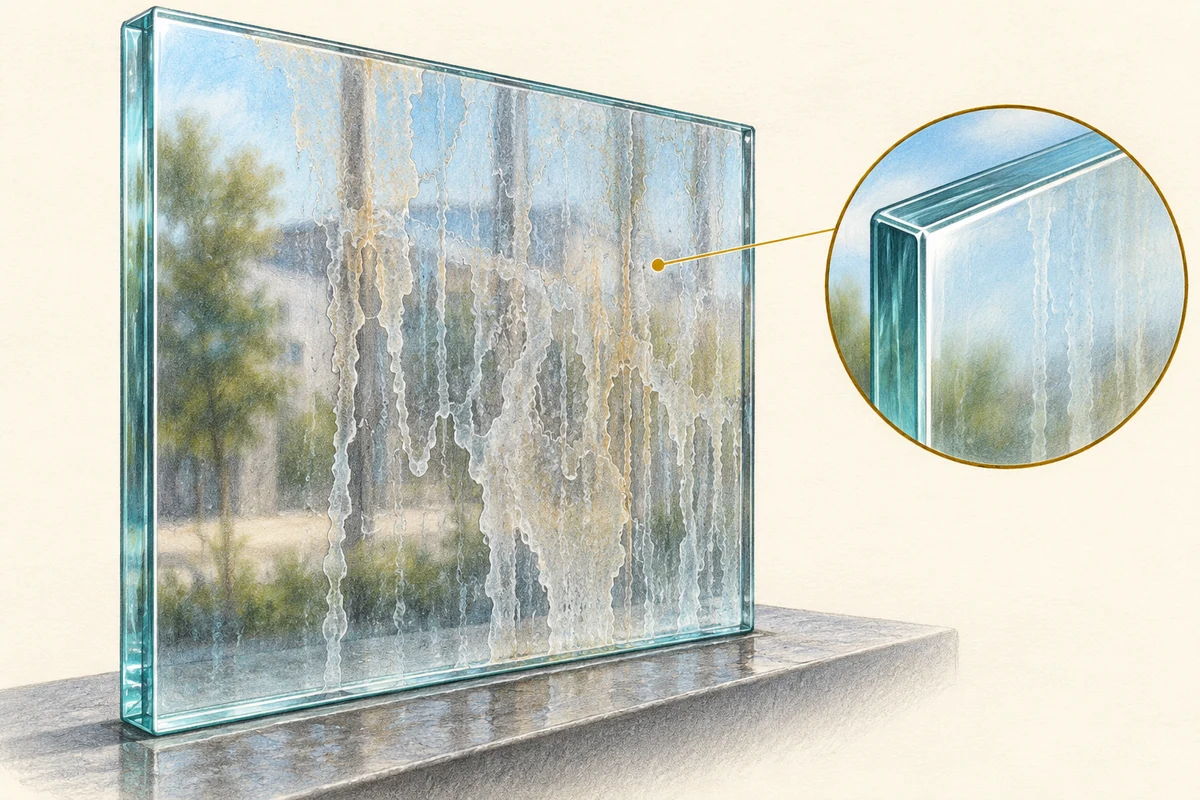
Mineral staining (non-etch) is a tenacious surface film or color shift caused by hard-water minerals/salts (often with organic/soiling binders) that persists after a proper Non-Invasive Reveal yet does not produce subsurface attack. Under magnification/raking, the glass substrate shows no modeled micro-texture when the stain is fully lifted—MSRT on clean substrate = SC-0.
Classification & Scope (Normative)
NormativeMineral staining (non-etch) is a tenacious surface film or color shift caused by hard-water minerals/salts (often with organic/soiling binders) that persists after a proper Non-Invasive Reveal yet does not produce subsurface attack. Under magnification/raking, the glass substrate shows no modeled micro-texture when the stain is fully lifted-MSRT on clean substrate = SC-0. Classification here is appearance-only (method-agnostic). Inspect under VIS lighting/geometry and record surface numbering and worked-surface status on Forms:
Typical Presentation (Informative)
Informative- Residual tone/contrast shift (whitish, grey, brown, or iridescent cast) in the footprint of prior deposits/runs after normal cleaning.
- Halos or bands at drip edges, sills, or mullions; sheet-like veil that softens reflections at certain angles.
- Under raking: no granular/etched micro-texture on the substrate once an area is truly clean-appearance is optical film/contamination related.
Field Identification Cues (Normative)
NormativeSurface-catch class (MSRT)
- On the clean glass substrate: SC-0 (no relief).
- Across remaining film: avoid stylus use on contaminated patches; lift a small test spot (without abrasion) to expose substrate and confirm SC-0.
- Polymer stylus if a coating is suspected. MSRT supports classification only.
Visual signature
- Uniform or gently mottled veil; may track prior drip/run geometry, but edges are optically soft, not rimmed like etched boundaries.
- No chip-flank sparkle (separates from mechanical scoring). No discrete pits/nodules (separates from hot-particle).
Viewing / lighting
- Evaluate clean & dry at 12 / 36 / 72 in, normal incidence and oblique sweep (~60°-120°) with raking light on a revealed test patch to confirm absence of micro-texture. Document distances/angles in-frame.
Location / access
- Record pane ID and surface numbering (#1-#4; laminate-internal). If fixed parallax indicates a between-pane condition (cavity film), classify CAT-5 by location (out of in-place scope).
Mechanism cue (context)
- History of irrigation overspray, HVAC plume, coastal aerosol, or rinse sequences that left mineral/organic film; repeated wet/dry cycling without timely cleaning.
Severity & CAT Mapping (Normative)
NormativeAssign CAT by visibility impact under VIS geometry after a controlled reveal test confirms substrate SC-0. Because staining is non-etch, depth values are not applicable (substrate relief remains 0-10 μm optical only).
- CAT-1 (Benign / non-relief): Faint veil/halo visible mainly in raking at close/standard; substrate SC-0 at the test patch.
- CAT-2 (Light): Noticeable film at standard view under certain angles; still SC-0 on substrate where film is fully lifted; edges soft.
- CAT-3 (Moderate): Persistent, broader veil/banding apparent at standard distance across larger area; SC-0 confirmed at localized lift.
- Reclassify when: Any modeled micro-texture or SC-class > 0 persists on the substrate after true film removal → Ch.03.03 Mineral etching (CAT-2/3/4 by cues).
- CAT-5 (by location/condition): Between-pane/inaccessible by parallax, integrity indicators, or confirmed functional-coating loss on the surface to be worked → CAT-5.
CAT is appearance-based; acceptance is separate under VIS-A at 12/36/72 in. Do not abrade to “force” removal during classification.
Differentiation & Mis-ID Pitfalls (Informative)
Informative- vs. Mineral deposits (Ch.03.01): Deposits fully remove with no residual tone shift; staining persists optically but remains SC-0 on substrate when truly clean. vs. Mineral etching (Ch.03.03): Etch shows modeled micro-texture and SC-1/SC-2 after film removal; staining does not.
- vs. Alkaline/acid etch (Ch.01/.02): Chemical etch exhibits run-organized micro-texture and SC-class > 0; staining is a film/optical condition.
- vs. Coating anomalies (Co-family): Coating rub/patchiness may mimic a veil but will follow coating logic (on the worked coated surface any anomaly is not permitted at acceptance; VIS §6.2.e). Confirm coating presence.
- vs. Soot/detergent films (R-family): Many remove at reveal; persistent non-etch staining may require specialized film lifting (outside classification scope).
Evidence Package *(Documentation Requirements) (Normative)
Normative- Photo set (VIS): 12 / 36 / 72 in, normal + oblique; include pre-reveal overall, and a post-reveal test patch that demonstrates substrate SC-0 (raking macro). Record distance/angle in-frame.
- MSRT result (substrate only): One light, non-marring pass on the clean test patch; record SC-0 if non-etch is confirmed.
- Forms: Pane ID; product family & surface numbering; worked surface Y/N; functional coating present on worked surface? (Y/N/Unknown); reveal status; lighting/time; geometry checklist; photos attached.
- Acceptance split: Post-restoration acceptance per VIS-A §6; classification ≠ acceptance. Coated-face rules apply per VIS §6.2.e.
Reporting Language (Template)
Template- Ch.03.02 Mineral Staining (non-etch) - Persistent surface film/veil on surface #___; post-reveal test patch confirms substrate SC-0 and no modeled micro-texture. Visible at [12/36/72 in] under VIS geometry. Morphology: soft halos/bands/veil; no chip-flank sparkle; no discrete pepper. Classification: CAT-[1/2/3] by visibility impact (non-etch). Reclassify to Ch.03.03 if SC-class > 0 persists on substrate. CAT-5 if between-pane. Forms + photo set attached; acceptance per VIS-A §6.
Related glossary terms
- StainGRK-046
- MagnificationGRK-132
- Surface filmGRK-044
- Raking lightGRK-129
- Coating rubGRK-115
- Test patchGRK-144
- AbrasionGRK-035
- DepositGRK-045
Source and version
GlassRenu Damage Specification Sheets (DSS), DSS-Ch.03.02. Source revision and extraction date are recorded in the deployment manifest.
Open the complete published DSS with table of contents (PDF)
Normative and informative labels are preserved from the source. The downloadable one-sheet is a condensed classification aid; this web page retains the complete source-based specification content.