
On this page
- Diagnosis summary
- Safety and classification scope
- Classification & Scope (Normative)
- Typical Presentation (Informative)
- Field Identification Cues (Normative)
- Severity & CAT Mapping (Normative)
- Differentiation & Mis-ID Pitfalls (Informative)
- Evidence Package *(Documentation Requirements) (Normative)
- Reporting Language (Template)
- Related glossary terms
- Related DSS
- Source and version
DAMAGE SPECIFICATION STANDARD / METHOD-AGNOSTIC
DSS-Ch.03.03 — Mineral Etching (subsurface micro-texture)
Chemical/mineral — dissolution of silica by mineral/alkaline films; modeled micro-texture “frost” within prior deposit/run footprints
Diagnosis summary
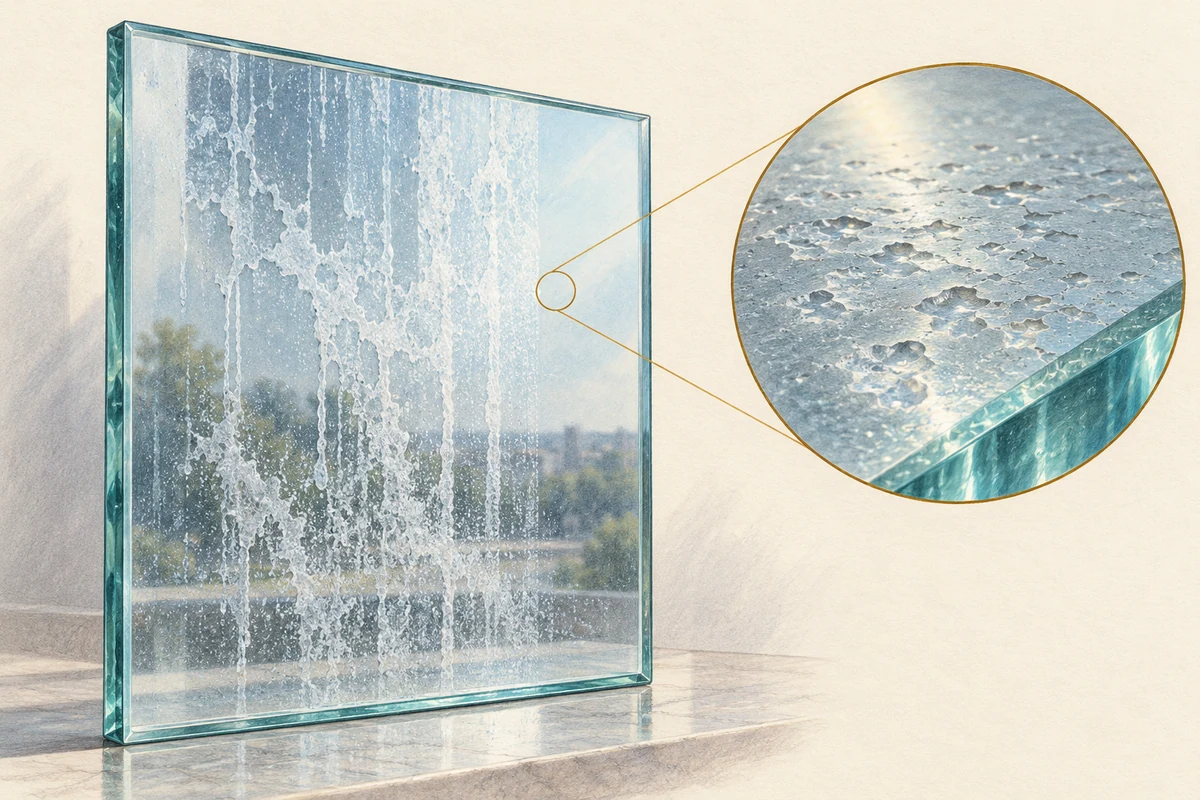
Mineral etching is subsurface attack of the glass network produced by persistent mineral films (e.g., hard-water salts with alkaline bias) and wet/dry cycling that chemically dissolves silica at the surface. After a proper Non-Invasive Reveal, etched areas remain as modeled micro-texture (“frost”) that modifies tone/shine and specular clarity. Classification is appearance-only per VIS (method-agnostic).
Classification & Scope (Normative)
NormativeMineral etching is subsurface attack of the glass network produced by persistent mineral films (e.g., hard-water salts with alkaline bias) and wet/dry cycling that chemically dissolves silica at the surface. After a proper Non-Invasive Reveal, etched areas remain as modeled micro-texture (“frost”) that modifies tone/shine and specular clarity. Classification is appearance-only per VIS (method-agnostic). Inspect under VIS lighting/geometry; record surface numbering and worked-surface status on Forms:
Typical Presentation (Informative)
InformativeFootprints of former deposits/runs/edges that persist after reveal as soft-edged frosted fields; often mirrors drip trains, ring halos, pooling shelves, or sheeting paths.
In raking light the affected zone reads non-directional modeled micro-texture (not a line pattern); specular reflections appear dulled/milky.
May be patchy across exposure gradients (sprinkler throw arcs, sill zones, windward bands).
Field Identification Cues (Normative)
NormativeSurface-catch class (MSRT)
SC-1 (slight) to SC-2 (clear) on etched zones after reveal.
Perform one light, non-marring pass on a representative area; polymer stylus if a coating is suspected. MSRT supports classification only; do not abrade to “force” a response.
Visual signature
Modeled (non-directional) micro-texture confined to prior mineral footprints; no chip-flank sparkle (separates from mechanical scoring), no discrete fused nodules/pits (separates from hot-particle pepper).
Boundaries usually soft/feathered, occasionally ring-accented where drying fronts pinned.
Viewing / lighting
Evaluate clean & dry at 12 / 36 / 72 in, normal incidence and oblique sweep (~60°-120°); use raking light macros to resolve micro-texture. Record distances/angles in-frame.
Location / access
Record pane ID and surface numbering (#1-#4; laminate-internal). If fixed parallax indicates between-pane/cavity condition, classify CAT-5 by location (out of in-place scope) and refer.
Mechanism cue (context)
History of irrigation overspray, coastal aerosol + dust, HVAC plume drift, alkaline rinse/runoff, and poor maintenance enabling dwell/cycling.
Severity & CAT Mapping (Normative)
NormativeAssign CAT by appearance + MSRT + morphology (three-part cueing). Depth/relief values are indicative-field measurement not required.
CAT-2 (Light): Subtle modeled micro-texture, SC-1; visible primarily in raking at close/standard view; little impact at 36/72 in when clean/dry. Indicative relief: ~10-40 μm.
CAT-3 (Moderate): Clear detect (SC-2); frosted field legible at standard distance; footprint geometry evident (rings/runs/shelves). Indicative relief: ~40-120 μm.
CAT-4 (Severe): Pronounced matte/frosted regions obvious at standard & wide-field views; may appear whitened in strong raking. Indicative relief: ~120-300 μm+.
CAT-5 (by condition/location): Between-pane/inaccessible by parallax, integrity indicators (active cracks, pane movement), or confirmed functional-coating loss on the surface to be worked → CAT-5.
CAT is appearance-based; acceptance is separate under VIS-A at 12/36/72 in. Do not “probe” with MSRT.
Differentiation & Mis-ID Pitfalls (Informative)
Informativevs. Mineral deposits (Ch.03.01): Deposits remove fully; etched substrate remains SC-1/SC-2 with modeled micro-texture after true removal.
vs. Mineral staining (Ch.03.02): Staining shows optical veil with substrate SC-0 once truly clean; etching shows substrate SC-class > 0.
vs. Alkaline slurry etch (Ch.02.01/.02): Slurry patterns are often sheeting/splash tied to concrete work; mineral etch commonly follows sprinkler arcs/ring halos with softer boundaries.
vs. Mechanical scoring (M.01): Scoring exhibits directional lineation and chip-flank sparkle; mineral etch is non-directional modeled.
vs. Coating anomalies (Co-family): Coating rub/patchiness can mimic sheen change but lacks substrate relief; on a worked coated surface, such anomalies are not permitted at acceptance (VIS §6.2.e). Confirm coated face.
Evidence Package *(Documentation Requirements) (Normative)
NormativePhoto set (VIS): 12 / 36 / 72 in, normal + oblique; include raking macros resolving micro-texture and boundary; add context frames showing spray lines/sills/mullions or other exposure cues. Record distance/angle in-frame.
MSRT result: One light, non-marring pass on etched field; record SC-class (SC-1/SC-2). Polymer stylus if a coating is suspected.
Forms: Pane ID; product family & surface numbering; worked surface Y/N; functional coating present on worked surface? (Y/N/Unknown); reveal status; lighting/time; geometry checklist; photos attached.
Acceptance split: Post-restoration acceptance per VIS-A §6; classification ≠ acceptance. Coated-face rules apply per VIS §6.2.e.
Reporting Language (Template)
InformativeCh.03.03 Mineral Etching - Modeled micro-texture within prior mineral footprint on surface #___ with [SC-1/SC-2]; visible at [12/36/72 in] under VIS geometry after Non-Invasive Reveal. Morphology: soft-edged frosted field (rings/runs/shelves), no chip-flank sparkle, no discrete pepper. Classification: CAT-[2/3/4] by relief/visibility; CAT-5 if between-pane, integrity cues, or coating-side loss on the surface to be worked. Forms + photo set attached; acceptance per VIS-A §6.
Related glossary terms
- Chemical etchingGRK-036
- Glass corrosion / weatheringGRK-038
- Hard-water depositGRK-037
- Hard-water stainingGRK-055
- DepositGRK-045
- Mineral scaleGRK-051
Source and version
GlassRenu Damage Specification Sheets (DSS), DSS-Ch.03.03. Source revision and extraction date are recorded in the deployment manifest.
Open the complete published DSS with table of contents (PDF)
Normative and informative labels are preserved from the source. The downloadable one-sheet is a condensed classification aid; this web page retains the complete source-based specification content.