
On this page
- Diagnosis summary
- Safety and classification scope
- Classification & Scope (Normative)
- Typical Presentation (Informative)
- Field Identification Cues (Normative)
- Surface-catch class (MSRT)
- Visual signature
- Viewing / lighting
- Location / access
- Mechanism cue (context)
- Severity & CAT Mapping (Normative)
- Differentiation & Mis-ID Pitfalls (Informative)
- Evidence Package *(Documentation Requirements) (Normative)
- Reporting Language (Template)
- Related glossary terms
- Related DSS
- Source and version
DAMAGE SPECIFICATION STANDARD / METHOD-AGNOSTIC
DSS-Ch.06.01 — Silane / Siloxane Migration Halo
Chemical/interaction - penetrating water-repellent from adjacent porous substrates; optical halos/veils, transfer films ± shallow micro-texture
Diagnosis summary
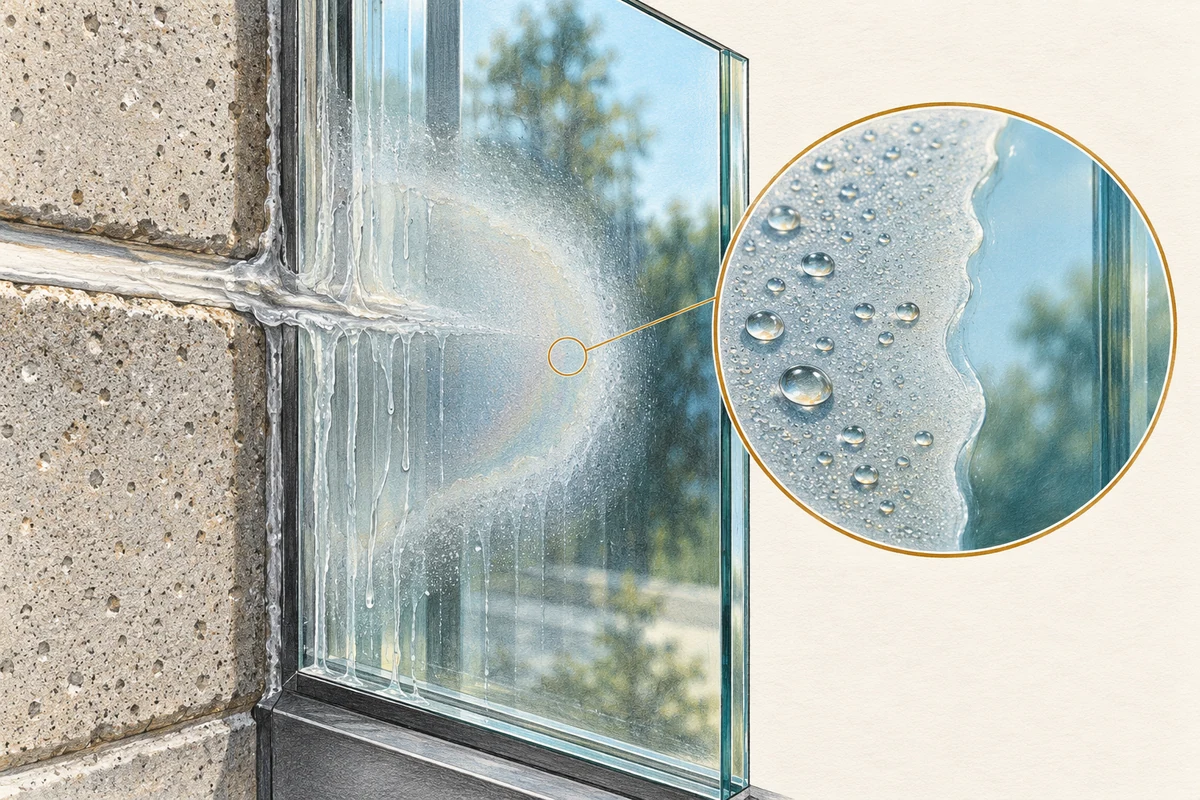
Silane/siloxane migration halo is an appearance change on glass resulting from penetrating water-repellent treatments (silane/siloxane) applied to adjacent porous materials (masonry/concrete/stone). During application, overspray, vapor phase, or capillary contact/weep can deposit organosilicon films on the glass, producing optical halos/veils and, with UV/heat/soiling, tenacious films that may leave very shallow micr…
Classification & Scope (Normative)
NormativeSilane/siloxane migration halo is an appearance change on glass resulting from penetrating water-repellent treatments (silane/siloxane) applied to adjacent porous materials (masonry/concrete/stone). During application, overspray, vapor phase, or capillary contact/weep can deposit organosilicon films on the glass, producing optical halos/veils and, with UV/heat/soiling, tenacious films that may leave very shallow micro-texture after long dwell. Classification is appearance-only per VIS (method-agnostic). Inspect after Non-Invasive Reveal under VIS lighting/geometry; record surface numbering and worked-surface status. Handle active chemical work zones per site safety.
Typical Presentation (Informative)
Informative- Halo or band parallel to masonry joints, sills, copings, drip edges, or sealant interfaces; may trace weep paths or roller/spray edges.
- Iridescent or greasy-sheen veil in specular view; soft edge on the glass side, sharper edge at the masonry boundary; may accumulate soiling preferentially over time (“dirty halo”).
- After reveal, portion of the veil persists; in stronger/aged cases, very fine modeled micro-texture may be noted at raking.
Field Identification Cues (Normative)
NormativeSurface-catch class (MSRT)
- Frequently SC-0 (optical film only) on freshly contaminated glass.
- SC-1 (slight) may occur on aged/UV-baked halos where organosilicon residues cross-link with contaminants, leaving very shallow texture. SC-2 uncommon.
- Perform one light, non-marring pass on a revealed test patch only; polymer stylus if a functional coating is suspected on the worked face. MSRT supports classification only.
Visual signature
- Linear/curvilinear band coincident with treated substrate geometry (head/sill/jamb lines, parapets); soft interior, sometimes tide-line edge toward the glass field.
- No chip-flank sparkle (not mechanical scoring); no discrete pits/nodules (not hot-particle peppering).
Viewing / lighting
- Evaluate clean & dry at 12 / 36 / 72 in, using normal incidence and oblique sweep (~60°-120°); use raking light to resolve veil presence and any fine texture. Record distances/angles in-frame.
Location / access
- Record pane ID and surface numbering (#1-#4; laminate-internal). If fixed parallax indicates between-pane film (IGU), classify CAT-5 by location (out of in-place scope) and refer.
Mechanism cue (context)
- Recent or historic water-repellent treatment on adjacent masonry/stone, presence of sprayers/rollers, masking lines, or contractor notes; weather window during application (wind, sun).
Severity & CAT Mapping (Normative)
NormativeAssign CAT by visibility impact and MSRT after controlled reveal on a small representative area. Depth values are indicative-field measurement not required.
- CAT-1 (Benign / non-relief): Optical halo/veil only, SC-0 on clean substrate; visible primarily at certain angles/raking; limited at standard view. Indicative relief: 0-10 μm (optical).
- CAT-2 (Light): Persistent thin film with SC-1 at a revealed test patch (aged case); limited impact at standard view; edges track substrate geometry. Indicative relief: ~10-40 μm.
- CAT-3 (Moderate): Broader banding/halo legible at standard distance with SC-1 to SC-2 in aged regions; often co-located with soil accumulation. Indicative relief: ~40-120 μm.
- CAT-4 (Severe): Rare for silane/siloxane alone; if pronounced matte fields or widespread cross-linked texture occur, consider mixed chemistry (alkali + organosilicon + UV/soiling) and re-evaluate under applicable DSS. Indicative relief: ~120-300 μm+.
- CAT-5 (by condition/location): Between-pane/inaccessible by parallax, integrity indicators (active cracks/pane movement), or confirmed functional-coating loss on the surface to be worked → CAT-5.
CAT is appearance-based; acceptance is separate under VIS-A at 12/36/72 in. Do not abrade to “force” film removal during classification.
Differentiation & Mis-ID Pitfalls (Informative)
Informative- vs. Hydrophobic coating mismatch halo (Ch.06.02): Coating mismatch halos are on intentional glass coatings and show water-behavior edges unrelated to masonry geometry; silane migration halos align with treated substrate lines/weep paths.
- vs. Efflorescence-associated attack (Ch.02.03): Efflorescence presents feathered salt blooms and grainy etch beneath; silane halos read oily/iridescent veil with SC-0/SC-1 and less granular raking response.
- vs. Mineral staining/etch (Ch.03): Mineral issues track spray arcs/rings and may show ring halos; silane halos align with substrate treatment geometry and often soil-load preference along the band.
- vs. Residue films (R-family): General detergents/soot films lack strong geometric correlation to treated masonry lines and often clear more uniformly at reveal.
- vs. Coating anomalies (Co-family): Functional coating rub/patchiness is tied to coated faces and manufacturing/handling; migration halos originate from post-installation chemical treatment on adjacent porous materials.
Evidence Package *(Documentation Requirements) (Normative)
Normative- Photo set (VIS): 12 / 36 / 72 in, normal + oblique; include raking macros of the halo edge and interior veil; add context frames showing treated masonry/stone, masking lines, weep paths. Record distance/angle in-frame.
- MSRT result: One light, non-marring pass on a clean test patch within the halo; record SC-class (SC-0/SC-1/SC-2). Polymer stylus if a coating is suspected.
- Forms: Pane ID; product family & surface numbering; worked surface Y/N; functional coating present on worked surface? (Y/N/Unknown); reveal status; lighting/time; geometry checklist; photos attached.
- Acceptance split: Post-restoration acceptance per VIS-A §6; classification ≠ acceptance. Coated-face appearance rules apply per VIS §6.2.e.
Reporting Language (Template)
Template- Ch.06.01 Silane/Siloxane Migration Halo - Linear band/halo aligned with [masonry/stone treatment line or weep path] on surface #___; post-reveal test patch shows [SC-0/SC-1]; visible at [12/36/72 in] under VIS geometry. Morphology: oily/iridescent veil, soft interior, tide-line edge; no chip-flank sparkle, no discrete pepper. Classification: CAT-[1/2/3/4] by relief/visibility; CAT-5 if between-pane, integrity cues, or coating-side loss on the surface to be worked. Forms + photo set attached; acceptance per VIS-A §6.
Related glossary terms
- DepositGRK-045
- Raking lightGRK-129
- Coating rubGRK-115
- Test patchGRK-144
Source and version
GlassRenu Damage Specification Sheets (DSS), DSS-Ch.06.01. Source revision and extraction date are recorded in the deployment manifest.
Open the complete published DSS with table of contents (PDF)
Normative and informative labels are preserved from the source. The downloadable one-sheet is a condensed classification aid; this web page retains the complete source-based specification content.