
On this page
- Diagnosis summary
- Safety and classification scope
- Definition (Reference)
- Typical Presentation (Informative)
- Field Identification Cues (Normative)
- Classification Mapping (to VIS-DA) (Normative)
- Indicative Relief / Depth (Informative)
- Differentiation & False Positives (Informative)
- Evidence Package (Documentation Requirements) (Normative)
- Mis-ID Pitfalls (Informative)
- Reporting Language (Template)
- Related glossary terms
- Related DSS
- Source and version
DAMAGE SPECIFICATION STANDARD / METHOD-AGNOSTIC
DSS-Co.01.02 — Color Non-Uniformity / Patchiness (sputtered low-E & multilayer films)
Coating anomaly on the worked surface - face-side condition; acceptance constrained by VIS §6 “Coatings”
Diagnosis summary
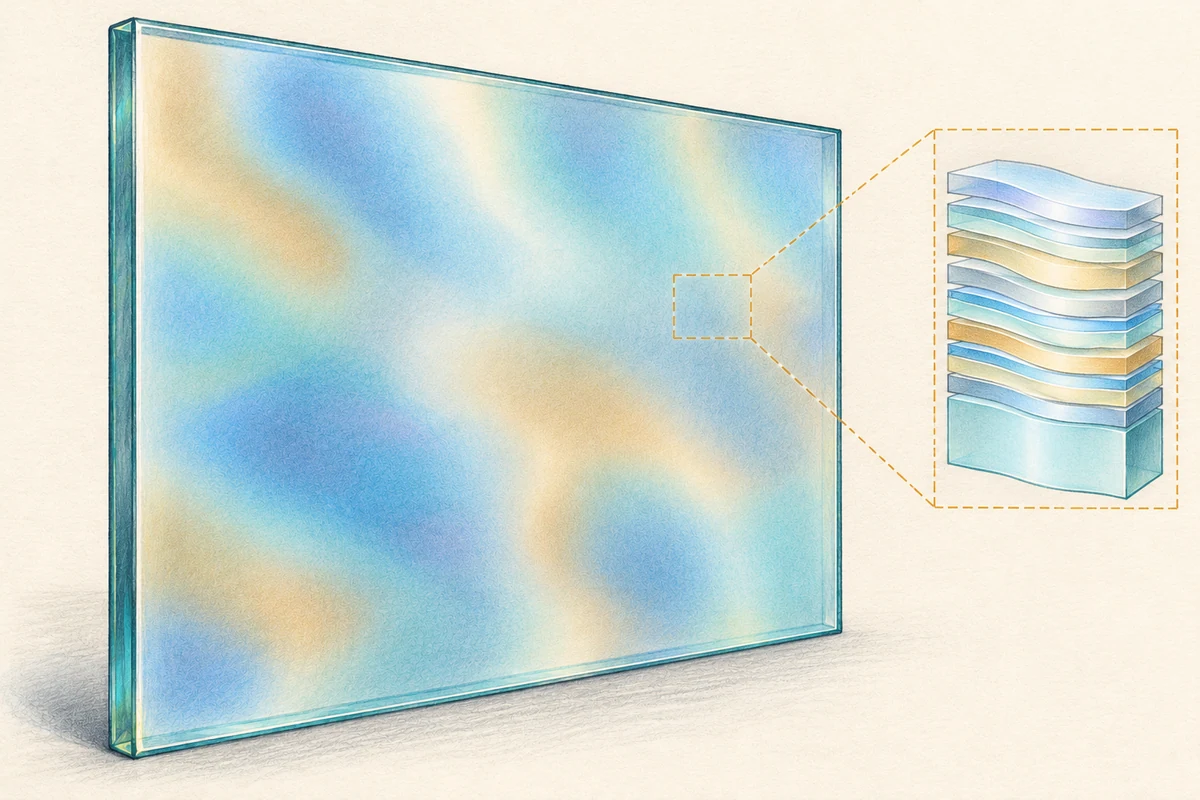
A localized change in color cast, tone, or optical density within a sputtered low-E or other multilayer functional coating on an exposed face (#1 or #4, as applicable). Presents as patchy zones, clouds, or bands without chip-flank fracture morphology. Under VIS, such coating anomalies are “coating anomalies (visual)” and are treated as appearance cues on the worked surface—not between-pane/system features.
Definition (Reference)
ReferenceA localized change in color cast, tone, or optical density within a sputtered low-E or other multilayer functional coating on an exposed face (#1 or #4, as applicable). Presents as patchy zones, clouds, or bands without chip-flank fracture morphology. Under VIS, such coating anomalies are “coating anomalies (visual)” and are treated as appearance cues on the worked surface-not between-pane/system features.
Typical Presentation (Informative)
Informative- Pane-local patches or clouds of slightly different hue/brightness; strongest under raking light and oblique sweep; may align with prior contact paths (pads/cloths).
- No discrete chip flanks or cratered texture (unlike mechanical/thermal damage).
- Persists after Non-Invasive Reveal (clean & dry); if removal occurs, the cue was a face film/residue, not a coating anomaly.
Field Identification Cues (Normative)
NormativeSurface-catch class (MSRT):
- Expect SC-0 (none) if the cue is a pure coating-appearance change. Perform one light, non-marring pass only; prefer a polymer stylus on suspected coated faces-or rely on visual/location cues to avoid disturbing the coating. MSRT supports classification only, not acceptance.
Reveal / lighting / geometry:
- Complete Non-Invasive Reveal (clean & dry; no blades/chemicals) before evaluation. Inspect at 12 / 36 / 72 in, normal incidence + oblique sweep (~60°-120°) with raking light, per VIS.
Location / access:
- Confirm the observation is on the exposed coated face (not in an IGU cavity or laminate). Record pane ID and surface numbering on forms; note “functional coating present on worked surface? (Y/N/Unknown)”.
Classification Mapping (to VIS-DA) (Normative)
Normative- Typical CAT band (appearance-based):
- CAT-1 - non-tactile color patchiness; SC-0; no edge morphology at acceptance geometry.
- CAT-2 - subtle micro-texture within the patch yielding SC-1 (slight).
- CAT-3 - pronounced, patchy modeled micro-texture detectable at standard distance, still without chip flanks. (Assign CAT by observable cues using VIS visibility convention + MSRT outcome.)
- Acceptance split (critical): Even if classified CAT-1...CAT-3, coating anomalies on the worked surface are not permitted at acceptance under VIS coatings guidance (see project-spec phrasing referencing VIS §6.2.e).
Indicative Relief / Depth (Informative)
Informative- For true coating patchiness, glass-face relief is typically nil at MSRT (SC-0). Numeric μm depth is not determinative for coating-appearance anomalies; VIS acceptance is appearance-only at the required distances/angles.
Differentiation & False Positives (Informative)
Informative- vs. Mechanical scratches (M.01): Scratches show chip flanks/micro-chipping and SC-2 along a line; coating color patchiness lacks flanks and is area-based.
- vs. Face films/residues (R-family): Residues change with Non-Invasive Reveal; a true coating patch persists after reveal.
- vs. IGU/internal haze (A.01.01) or cavity fines (A.01.03): Internal cues exhibit fixed parallax and are CAT-5 by location; coating anomalies are on the worked face.
Evidence Package (Documentation Requirements) (Normative)
Normative- Photo set (VIS): 12 / 36 / 72 in, normal + oblique, include raking; add a macro frame showing boundaryless patchiness (no chip flanks/transition edge). Note reveal status and lighting/time.
- MSRT result: Record SC class (expect SC-0); one pass, non-marring; on coated faces prefer polymer stylus or visual-only.
- Forms: Pane ID; surface numbering; worked surface Y/N; functional coating present on worked surface? (Y/N/Unknown); geometry checklist; photos attached.
Mis-ID Pitfalls (Informative)
InformativeTrying to “blend out” a color patch can enlarge the anomaly and create a worked region/transition edge, which VIS disallows at acceptance for CAT-0...CAT-4. Confirm reveal, SC class, and location before any action.
Reporting Language (Template)
Template- Co.01.02 Color Non-Uniformity / Patchiness (sputtered stack) - Localized color/brightness variation at #__ verified after Non-Invasive Reveal; MSRT = SC-0; no chip flanks. Classified CAT-1...CAT-3 by visibility/texture per VIS. Acceptance note: Coating anomalies on the worked surface are not permitted (see project spec language referencing VIS §6.2.e). Document at 12/36/72 in (normal + oblique + raking), record surface numbering and coating presence, and attach photo set.
Related glossary terms
- ChipGRK-034
- Raking lightGRK-129
- ScratchGRK-032
Source and version
GlassRenu Damage Specification Sheets (DSS), DSS-Co.01.02. Source revision and extraction date are recorded in the deployment manifest.
Open the complete published DSS with table of contents (PDF)
Normative and informative labels are preserved from the source. The downloadable one-sheet is a condensed classification aid; this web page retains the complete source-based specification content.