
On this page
- Diagnosis summary
- Safety and classification scope
- Classification & Scope (Normative)
- Typical Presentation (Informative)
- Field Identification Cues (Normative)
- Surface-catch class (MSRT)
- Visual signature
- Viewing / lighting
- Location / access
- Mechanism cue (context)
- Severity & CAT Mapping (Normative)
- Differentiation & Mis-ID Pitfalls (Informative)
- Evidence Package *(Documentation Requirements) (Normative)
- Reporting Language (Template)
- Related glossary terms
- Related DSS
- Source and version
DAMAGE SPECIFICATION STANDARD / METHOD-AGNOSTIC
DSS-Co.03.02 — Hard-Coat Micro-Mottle (Other Functional Films)
Thin/“hard” functional films other than low-E-e.g., AR hybrids, IR-control, solar-control, anti-glare-showing fine planar mottle/texture in the coating; non-directional, patchy reflectance or color micro-variation; typically SC-0, rarely SC-1 where minute imprint exists; confirm coated face before attribution
Diagnosis summary
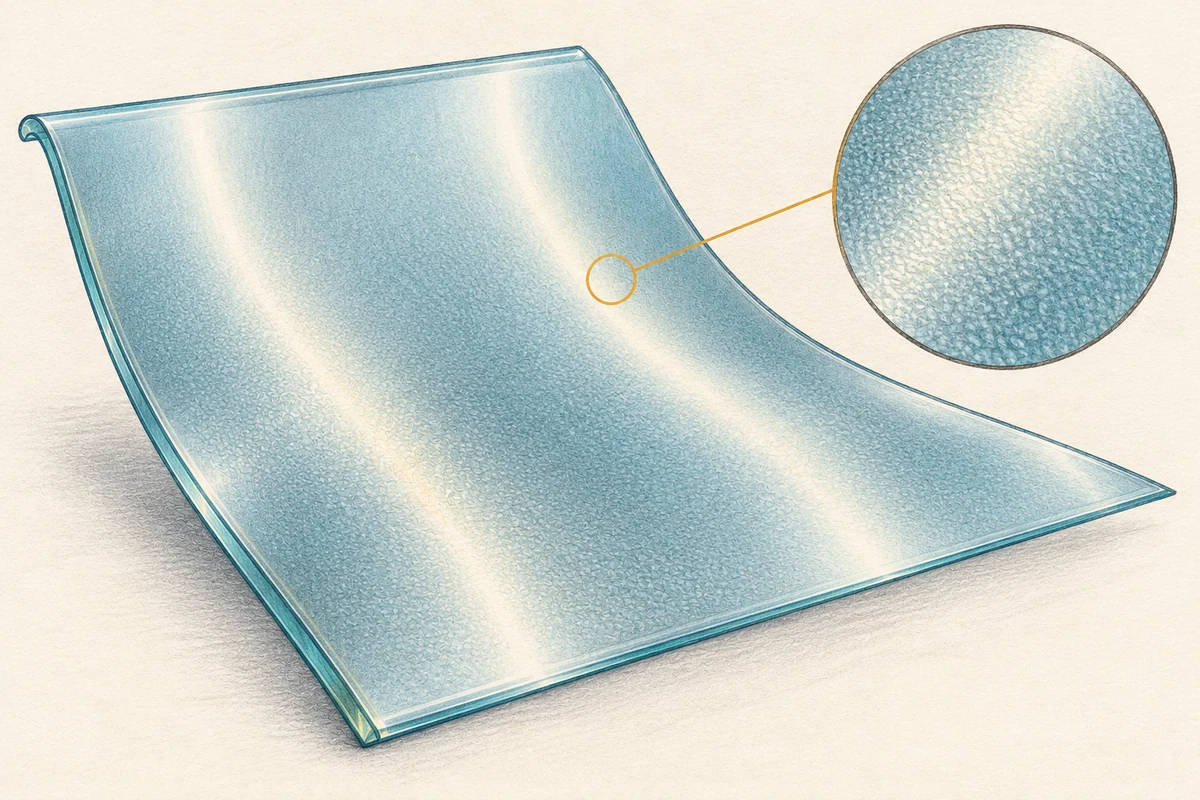
Hard-coat micro-mottle is an appearance change confined to functional hard films (non-pyrolytic low-E alternatives, AR/IR hybrids, solar/anti-glare coatings) presenting as fine, non-directional mottle—a subtle patchwork of reflectance or color within the coated area. The effect is planar within the coating and usually non-tactile. Classification is appearance-only per VIS (method-agnostic).
Classification & Scope (Normative)
NormativeHard-coat micro-mottle is an appearance change confined to functional hard films (non-pyrolytic low-E alternatives, AR/IR hybrids, solar/anti-glare coatings) presenting as fine, non-directional mottle-a subtle patchwork of reflectance or color within the coated area. The effect is planar within the coating and usually non-tactile. Classification is appearance-only per VIS (method-agnostic). Inspect after Non-Invasive Reveal under VIS lighting/geometry; record surface numbering and worked-surface status.
Face identification is critical. Many functional films are specified on #2 (or #1/#4 by design). Confirm the coated face prior to classification.
Typical Presentation (Informative)
Informative- Fine, cloud-like micro-mottle or orange-peel-like optical texture that becomes apparent in oblique sweep or broad specular reflection.
- No coherent directionality (not a rub trail or swirl); no periodic pitch (not roller ghosting).
- Can present lot-wide subtlety (global cast) with localized zones of higher contrast.
Field Identification Cues (Normative)
NormativeSurface-catch class (MSRT)
- SC-0 typical (planar optical variation).
- SC-1 localized only if a minute contact imprint (pad weave/foreign dust) coincides with mottled zone.
- Perform one light, non-marring pass on a small revealed test patch; polymer stylus only on suspected coated faces. MSRT supports classification only; do not abrade the coating.
Visual signature
- Non-directional, fine-scale mottle in reflectance or color; boundaries often soft/feathered.
- No chip-flank sparkle, no discrete grooves, no pits/fused nodules.
- Angle-dependent “flash”-mottle appears/disappears as the observer sweeps.
Viewing / lighting
- Evaluate clean & dry at 12 / 36 / 72 in, normal and oblique sweep (~60°-120°); use broad specular to compare inside vs. outside the mottled zone. Record distances/angles in-frame.
Location / access
- Record pane ID and surface numbering (#1-#4; laminate-internal). If on #2/#3 (IGU interior), it is inaccessible in place → CAT-5 by location (classification remains Co.03.02).
Mechanism cue (context)
- Coating process micro-nonuniformity, post-coat handling/stacking pressure optics, or localized over-cleaning with incompatible media altering the thin-film interference response.
Severity & CAT Mapping (Normative)
NormativeAssign CAT by visibility at acceptance geometry and MSRT.
- CAT-1 (Benign / non-relief): Very faint mottle legible mainly at oblique/raking; SC-0. Indicative relief: 0-10 μm (optical only).
- CAT-2 (Light): Discernible micro-mottle at standard distance in certain lighting; SC-0 (or SC-1 localized if micro-imprint). Indicative relief: ~10-40 μm (apparent optical).
- CAT-3 (Moderate): Pane-noticeable mottled panel at standard distance, affecting uniformity; SC-0/SC-1. Indicative relief: ~40-120 μm (apparent optical).
- Reclassify when: Parallel periodic bands → Co.02.01 Roller pickup; wipe-arc-linked → Co.02.02 Rub/Scuff (pyrolytic) or Co.03.01 AR bloom; linear grooves with chip flanks → M.01 Scoring; rings/runs → Ch.01/Ch.03 chemistry; peppered fusing → Th.01.02 Hot particle.
- CAT-5 (by condition/location): Between-pane/inaccessible or coating-side constraints preclude compliant presentation → CAT-5.
CAT is appearance-based; acceptance is separate under VIS-A at 12/36/72 in. Do not abrade coated faces to “force” a response.
Differentiation & Mis-ID Pitfalls (Informative)
Informative- vs. AR bloom/scuff (Co.03.01): AR bloom often shows distinct reflectivity increase with contact context; Co.03.02 is a fine, non-directional mottle that may be process-intrinsic.
- vs. Pyrolytic rub/scuff (Co.02.02): Pyrolytic rubs are localized wipe/contact panels; Co.03.02 lacks wipe geometry and can appear lot-distributed.
- vs. Mineral/chemical films (Ch family): Chemistry shows rings/runs and may yield SC-1/2; Co.03.02 is planar, ringless, typically SC-0.
- vs. Abrasion fields (M.02): Abrasion presents directional texture with consistent SC-1 along paths; Co.03.02 lacks coherent directionality.
Evidence Package *(Documentation Requirements) (Normative)
Normative- Photo set (VIS): 12 / 36 / 72 in, normal + oblique; raking macros across mottle boundary; broad specular comparison (inside vs. outside zone). Record distance/angle in-frame.
- Face ID + MSRT. Confirm functional coated face; MSRT (polymer stylus only) on a revealed patch to record SC-class (SC-0 typical; SC-1 localized if present).
- Context notes. Lot repetition (intrinsic) vs. isolated (handling/cleaning); cleaners/media used; storage/stacking history.
- Forms: Pane ID; product family & surface numbering; worked surface Y/N; functional coating present on worked surface? (Y/N/Unknown); reveal status; lighting/time; geometry checklist; photos attached.
- Acceptance split: Post-restoration acceptance per VIS-A §6; classification ≠ acceptance. Coated-face appearance rules apply per VIS §6.2.e when the worked surface is the functional coating.
Reporting Language (Template)
Template- Co.03.02 Hard-Coat Micro-Mottle - Fine, non-directional mottle/optical texture on surface #___ (functional coated face confirmed); MSRT (polymer): SC-0 [SC-1 localized if micro-imprint]; visible at [12/36/72 in] under VIS geometry. Morphology: planar thin-film nonuniformity, soft boundaries, no chip-flank grooves, no pits. Classification: CAT-[1/2/3] by visibility; reclassify per notes if roller-pitch, contact rub, mechanical scoring, chemical, or hot-particle indicators are present; CAT-5 if between-pane or coating-side constraints preclude in-place work. Forms + photo set attached; acceptance per VIS-A §6.
Related glossary terms
- Test patchGRK-144
- AbrasionGRK-035
Source and version
GlassRenu Damage Specification Sheets (DSS), DSS-Co.03.02. Source revision and extraction date are recorded in the deployment manifest.
Open the complete published DSS with table of contents (PDF)
Normative and informative labels are preserved from the source. The downloadable one-sheet is a condensed classification aid; this web page retains the complete source-based specification content.