
On this page
- Diagnosis summary
- Safety and classification scope
- Classification & Scope (Normative)
- Typical Presentation (Informative)
- Field Identification Cues (Normative)
- Severity & CAT Mapping (Normative)
- Differentiation & Mis-ID Pitfalls (Informative)
- Evidence Package (Documentation Requirements) (Normative)
- Reporting Language (Template)
- Related glossary terms
- Related DSS
- Source and version
DAMAGE SPECIFICATION STANDARD / METHOD-AGNOSTIC
DSS-Th.01.02 — Grinder Spark Embed (ferrous peppering)
Thermal / hot-particle impingement — fine ferrous particles embedded and/or pitting
Diagnosis summary
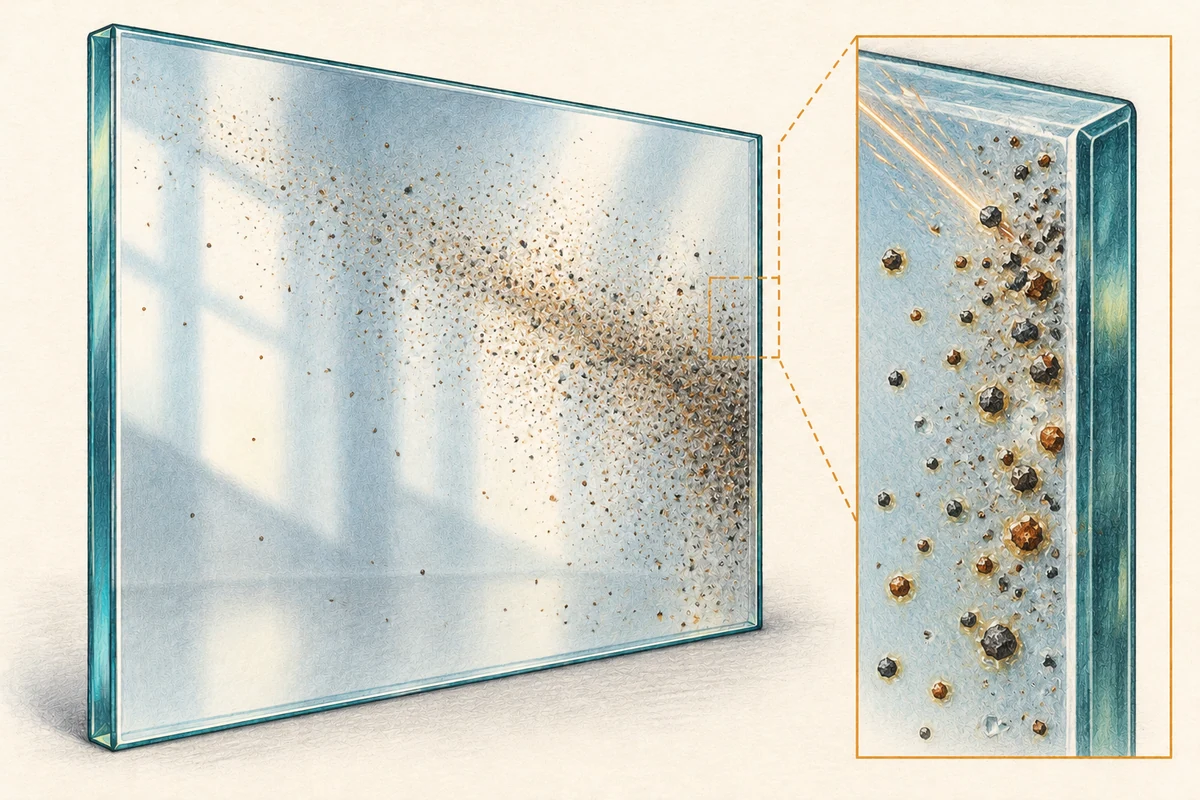
Grinder spark embed presents as a fine “peppered” field of ferrous particles ejected from metal grinding/cutting that impact, fuse, and/or oxidize on the glass. Some particles remain proud/fused; others detach leaving micro-pits. Classification is appearance-only per VIS; methodology is out of scope. Inspect under VIS lighting/geometry after Non-Invasive Reveal;
Classification & Scope (Normative)
NormativeGrinder spark embed presents as a fine “peppered” field of ferrous particles ejected from metal grinding/cutting that impact, fuse, and/or oxidize on the glass. Some particles remain proud/fused; others detach leaving micro-pits. Classification is appearance-only per VIS; methodology is out of scope. Inspect under VIS lighting/geometry after Non-Invasive Reveal; record surface numbering and worked-surface status on Forms:
Typical Presentation (Informative)
InformativeBroad fine peppering oriented toward the grinding work area; individual particles appear dark/rust-colored specks; where detached, bright micro-craters show in raking light.
Often more uniform and finer than welding slag spatter; can extend across panels aligned with airflow or gravity.
May include light rust halos around retained ferrous specks.
Field Identification Cues (Normative)
NormativeSurface-catch class (MSRT)
On retained specks and micro-pits, a single, light, non-marring pass typically yields SC-1 (slight) to SC-2 (clear) on representative features. Do not abrade; one pass only. Use a polymer stylus if a coating is suspected. MSRT supports classification only.
Visual signature
High-density field of minute, discrete points; many with tiny bright pit rims in raking light; lacks long continuous tracks of linear scoring.
Some specks show oxidized (brown) tonality; pits read as sparkly rims under oblique.
Viewing / lighting
Evaluate clean & dry at 12 / 36 / 72 in, normal incidence and oblique sweep (~60°-120°) with raking light per VIS.
Location / access
Record pane ID and surface numbering (#1-#4; laminate-internal). If fixed parallax indicates between-pane, record CAT-5 by location (out of in-place scope).
Mechanism cue (context)
Frequently associated with construction grinding/cutting near exposed glass (rebar, studs, railings), producing nearly molten shards that embed in the surface.
Severity & CAT Mapping (Normative)
NormativeAssign CAT by appearance + MSRT + morphology (three-part cueing). Depth bands below are indicative only-numeric measurement not required for field classification.
CAT-2 (Light): Sparse to light peppering, mostly SC-1 on select points; visible mainly at raking and close/standard view; limited field impact. Indicative pit depth: ~10-40 μm; pit diameter commonly ≤0.2 mm.
CAT-3 (Moderate): Noticeable cluster fields with frequent SC-2 micro-pits and bright rims; clearly visible at standard distance; occasional retained specks. Indicative pit depth: ~40-120 μm.
CAT-4 (Severe): Dense, widespread peppering; many clear-catch pits and intermittent fused nodules; readily apparent at standard and wide-field views. Indicative pit depth: ~120-300 μm+.
CAT-5 (by location/condition): Between-pane cues, active cracks/pane instability, or confirmed functional-coating loss on the surface to be worked → CAT-5 (non-repairable/out of in-place scope).
CAT is appearance-based; acceptance is separate and governed by VIS §6 at 12/36/72 in under defined conditions.
Differentiation & Mis-ID Pitfalls (Informative)
Informativevs. Welding slag spatter (Th.01.01): Slag fields tend to include larger fused nodules and rougher craters; grinder pepper is finer, more uniform and more “dust-like.”
vs. Linear scoring (M.01): Scoring forms continuous lines with abrasive chip-flank sparkle; peppering is discrete points without run-length.
vs. Sand abrasion (E.02.01): Eolian abrasion appears as directional matte fields (non-discrete) and may show modeled micro-texture rather than discrete pits.
vs. Coating anomalies (Co.01/Co.03): Coating rub/patchiness shows sheen/color shift without pit rims; coating anomalies on the worked coated surface are not permitted at acceptance.
Evidence Package (Documentation Requirements) (Normative)
NormativePhoto set (VIS): 12 / 36 / 72 in; normal + oblique; include raking macros that resolve pit rims/retained specks and at least one context frame showing proximity to grinding operations. Record distance/angle in-frame.
MSRT result: One light, non-marring pass on a representative spot; record SC class (SC-1/SC-2 as observed). Prefer polymer stylus if a coating is suspected.
Forms: Pane ID; product family & surface numbering; worked surface Y/N; functional coating present on worked surface? (Y/N/Unknown); reveal status; lighting/time; geometry checklist; photos attached.
Acceptance split: Post-restoration acceptance per VIS §6 at 12/36/72 in; classification ≠ acceptance. Coated-face appearance rules apply per VIS §6.2.e.
Reporting Language (Template)
InformativeTh.01.02 Grinder Spark Embed (Ferrous Peppering) - Fine discrete pepper field with retained specks / micro-pits on surface #___ documented at 12/36/72 in, normal + oblique with raking; MSRT = SC-[1/2] on representative points. Morphology shows discrete pits with bright rims; no continuous scoring. Classification: CAT-[2/3/4] by density and relief; CAT-5 if between-pane, integrity cues, or coating-side loss on the surface to be worked. Forms + photo set completed; acceptance per VIS §6 (separate).
Related glossary terms
- Metallic grinding debris damageGRK-096
- PittingGRK-078
- Thermal stressGRK-024
Source and version
GlassRenu Damage Specification Sheets (DSS), DSS-Th.01.02. Source revision and extraction date are recorded in the deployment manifest.
Open the complete published DSS with table of contents (PDF)
Normative and informative labels are preserved from the source. The downloadable one-sheet is a condensed classification aid; this web page retains the complete source-based specification content.