
On this page
- Diagnosis summary
- Safety and classification scope
- Classification & Scope (Normative)
- Typical Presentation (Informative)
- Field Identification Cues (Normative)
- Surface-catch class (MSRT)
- Visual signature
- Viewing / lighting
- Location / access
- Mechanism cue (context)
- Severity & CAT Mapping (Normative)
- Differentiation & Mis-ID Pitfalls (Informative)
- Evidence Package *(Documentation Requirements) (Normative)
- Reporting Language (Template)
- Related glossary terms
- Related DSS
- Source and version
DAMAGE SPECIFICATION STANDARD / METHOD-AGNOSTIC
DSS-Co.02.01 — Roller Pickup / Line Ghosting (Pyrolytic Line)
Pyrolytic [hard-coat] low-E anomaly - transport/handling imprint during high-temperature deposition or subsequent hot processing; quasi-parallel sheen-shift bands at roller pitch; generally planar, film-level optical variation; typically SC-0, occasionally SC-1 at lightly textured pickup
Diagnosis summary
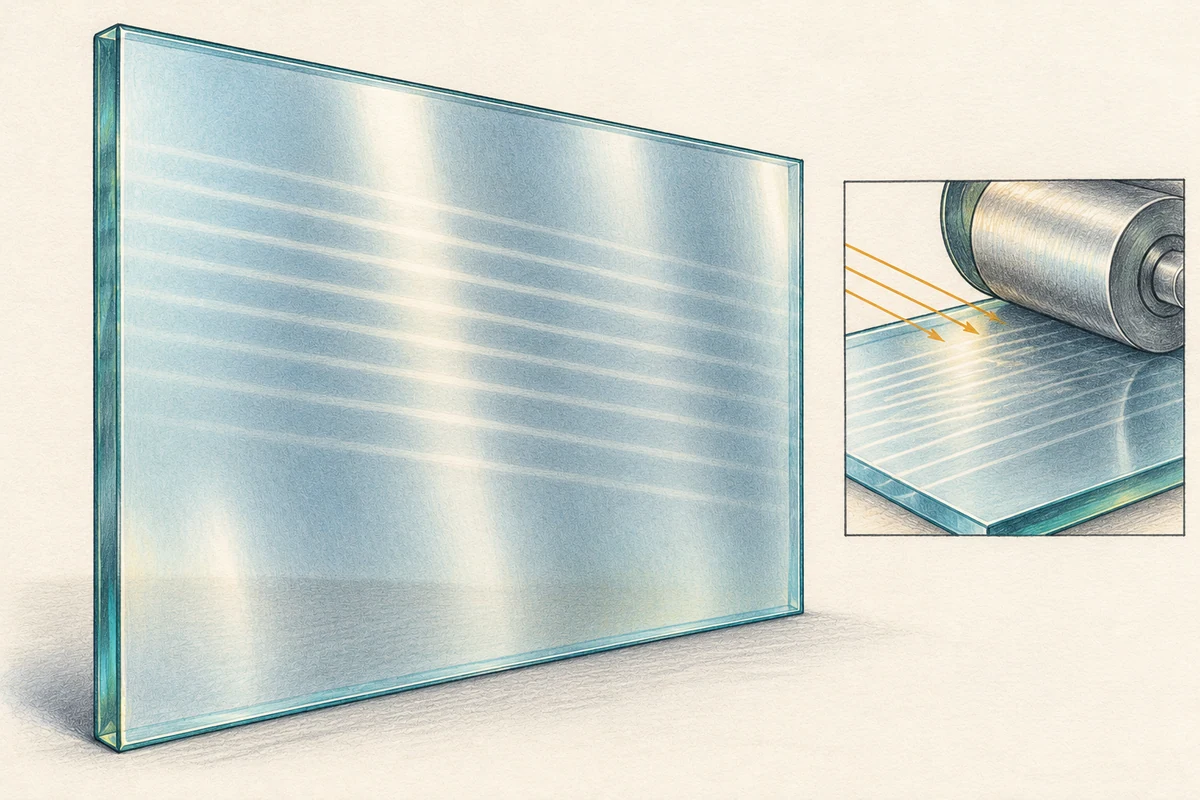
Roller pickup/line ghosting (pyrolytic line) is an appearance change confined to pyrolytic (hard-coat) low-E or comparable high-temperature functional coatings. It presents as quasi-parallel, longitudinal bands (machine/transport direction) at spacings consistent with support/transport rollers, with subtle sheen or color shift (ghosting). The phenomenon is planar within the coating and usually non-tactile.
Classification & Scope (Normative)
NormativeRoller pickup/line ghosting (pyrolytic line) is an appearance change confined to pyrolytic (hard-coat) low-E or comparable high-temperature functional coatings. It presents as quasi-parallel, longitudinal bands (machine/transport direction) at spacings consistent with support/transport rollers, with subtle sheen or color shift (ghosting). The phenomenon is planar within the coating and usually non-tactile. Classification is appearance-only per VIS (method-agnostic). Inspect after Non-Invasive Reveal under VIS lighting/geometry; record surface numbering and worked-surface status.
Face identification is critical. Pyrolytic hard-coats are commonly placed at #2 in IGUs (or #1/#4 where design requires). Confirm coated face before classification.
Typical Presentation (Informative)
Informative- Multiple, parallel, low-contrast bands running consistently in one direction (line direction); band width and pitch repeat pane-to-pane within a lot.
- Bands read as sheen shift / slight color cast in reflection; contrast rises under oblique sweep and raking.
- May co-present with very faint roller “kiss” arcs at edges or entry/exit zones.
Field Identification Cues (Normative)
NormativeSurface-catch class (MSRT)
- SC-0 (planar optical variation within coating; no surface relief).
- SC-1 rare, where lightly textured pickup or fine particulate imprint provides very shallow relief.
- Perform one light, non-marring pass on a small revealed test patch. Use a polymer stylus only on suspected coated faces. MSRT supports classification only; do not abrade the coating.
Visual signature
- Quasi-parallel stripe set; fixed pitch and consistent direction across the pane; no chip-flank sparkle, no discrete pits.
- Planar behavior: bands persist uniformly when moving viewpoint along the band; no localized “worked region” edge.
- Often lot-repetitive: adjacent lites from same supply may show identical spacing/orientation.
Viewing / lighting
- Evaluate clean & dry at 12 / 36 / 72 in, normal and oblique sweep (~60°-120°); raking amplifies sheen shift; use broad specular reflection to read band pitch. Record distances/angles in-frame.
Location / access
- Record pane ID and surface numbering (#1-#4; laminate-internal). If the anomaly is on #2/#3 within an IGU, it is inaccessible in place → CAT-5 by location for in-place restoration scope (classification remains Co.02.01).
Mechanism cue (context)
- Pyrolytic deposition or hot handling history; consistent line direction with roller transport; lot repetition; absence of field activities that cause scoring or chemical halos.
Severity & CAT Mapping (Normative)
NormativeAssign CAT by visibility at acceptance geometry and MSRT. Depth values are indicative-field measurement not required.
- CAT-1 (Benign / non-relief): Faint banding legible mainly at oblique/raking; SC-0; minimal impact at standard view. Indicative relief: 0-10 μm (film-level optical only).
- CAT-2 (Light): Discernible bands at standard distance in certain lighting; SC-0 (or rare SC-1 if lightly textured pickup). Indicative relief: ~10-40 μm (apparent optical).
- CAT-3 (Moderate): Pane-noticeable band set at standard distance across significant area; SC-0/SC-1; clearly affects uniform appearance. Indicative relief: ~40-120 μm (apparent optical).
- Reclassify when: If chip-flank sparkle or tactile grooves appear → M.01 Linear scoring; if uniform granular frost in masked regions → V.01.01 abrasive blast; if runs/cream swirls exist → V.02 chemical etch; if peppered fused nodules present → Th.01.02 hot particle.
- CAT-5 (by condition/location): Anomaly on #2/#3 (between panes) or coating-side to be worked where compliant presentation cannot be achieved → CAT-5.
CAT is appearance-based; acceptance is separate under VIS-A at 12/36/72 in. Do not abrade coated faces to “force” a response.
Differentiation & Mis-ID Pitfalls (Informative)
Informative- vs. M.01/M.02 mechanical: Mechanical defects show directional grooves/swirl with SC-1/SC-2 and chip-flank sparkle; Co.02.01 is planar sheen shift, typically SC-0.
- vs. Co.01 sputtered low-E patchiness: Sputtered films often show color non-uniformity without roller-pitch periodicity; pyrolytic roller ghosting shows regular spacing aligned to transport direction.
- vs. Ch.03 mineral staining/etch: Mineral systems show ringed halos/runs and can be SC-1/SC-2; roller ghosting lacks wetting geometry and remains lot-repetitive.
- vs. E.01 atmospheric film: Atmospheric films are random or flow-mapped and lift on reveal; roller ghosting persists and is coating-intrinsic.
Evidence Package *(Documentation Requirements) (Normative)
Normative- Photo set (VIS): 12 / 36 / 72 in, normal + oblique; raking macros across band transitions; overview frames capturing parallelism and pitch. Record distance/angle in-frame.
- Face ID + MSRT. Confirm coated surface via project documentation or controlled reflection tests; MSRT (polymer stylus only) on a small reveal patch: record SC-class (SC-0 typical).
- Lot/replication check. Where possible, document adjacent lites for repeated spacing/orientation (supports coating-intrinsic attribution).
- Forms: Pane ID; product family & surface numbering; worked surface Y/N; functional coating present on worked surface? (Y/N/Unknown); reveal status; lighting/time; geometry checklist; photos attached.
- Acceptance split: Post-restoration acceptance per VIS-A §6; classification ≠ acceptance. Coated-face appearance rules apply per VIS §6.2.e when the worked surface is the functional coating.
Reporting Language (Template)
Template- Co.02.01 Roller Pickup / Line Ghosting (Pyrolytic) - Quasi-parallel sheen-shift bands at consistent roller pitch on surface #___ (pyrolytic hard-coat confirmed); MSRT (polymer): SC-0 [SC-1 localized if applicable]; visible at [12/36/72 in] under VIS geometry. Morphology: planar coating variation, no chip-flank sparkle, no pits/runs. Classification: CAT-[1/2/3] by visibility; reclassify per notes if mechanical/chemical indicators present; CAT-5 if between-pane or coating-side constraints preclude in-place work. Forms + photo set attached; acceptance per VIS-A §6.
Related glossary terms
- Test patchGRK-144
- AbrasiveGRK-168
- DepositGRK-045
Source and version
GlassRenu Damage Specification Sheets (DSS), DSS-Co.02.01. Source revision and extraction date are recorded in the deployment manifest.
Open the complete published DSS with table of contents (PDF)
Normative and informative labels are preserved from the source. The downloadable one-sheet is a condensed classification aid; this web page retains the complete source-based specification content.