
On this page
- Diagnosis summary
- Safety and classification scope
- Classification & Scope (Normative)
- Typical Presentation (Informative)
- Field Identification Cues (Normative)
- Surface-catch class (MSRT)
- Visual signature
- Viewing / lighting
- Location / access
- Mechanism cue (context)
- Severity & CAT Mapping (Normative)
- Differentiation & Mis-ID Pitfalls (Informative)
- Evidence Package *(Documentation Requirements) (Normative)
- Reporting Language (Template)
- Related glossary terms
- Related DSS
- Source and version
DAMAGE SPECIFICATION STANDARD / METHOD-AGNOSTIC
DSS-Co.05.02 — Pinholes / Voids (Ceramic Frit)
Ceramic frit anomaly - discrete clear points or micro-voids within the fired frit field; reads through glass from the viewing side; typically SC-0 at the viewing face. Confirm frit face, artwork intent, and location before attribution.
Diagnosis summary
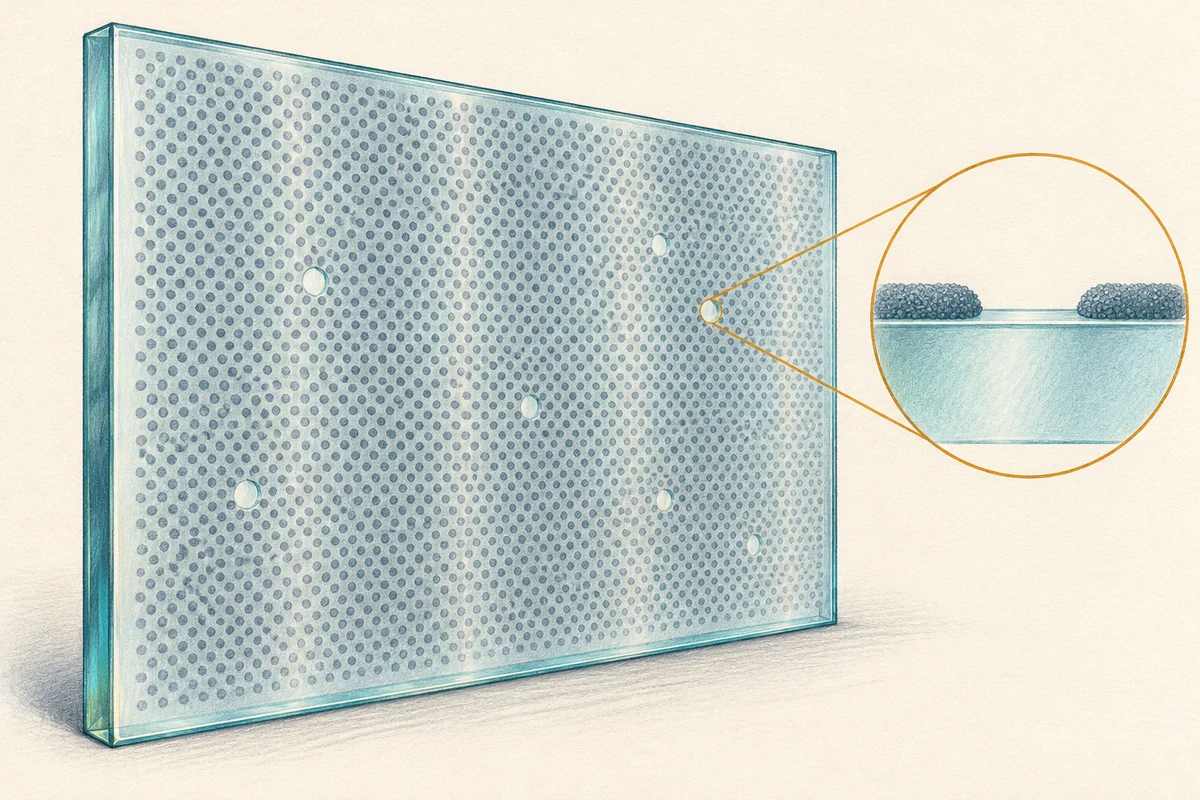
Frit pinholes/voids are discrete, point-like clearings or ultra-thin spots occurring within a fired ceramic frit pattern (dots/lines/solid fields). From the viewing face they appear as tiny bright/clear points in transmission or sparkle points in reflection. The defect is planar within the frit layer (commonly on #2 or #4) and non-tactile at the viewing surface.
Classification & Scope (Normative)
NormativeFrit pinholes/voids are discrete, point-like clearings or ultra-thin spots occurring within a fired ceramic frit pattern (dots/lines/solid fields). From the viewing face they appear as tiny bright/clear points in transmission or sparkle points in reflection. The defect is planar within the frit layer (commonly on #2 or #4) and non-tactile at the viewing surface. Classification is appearance-only per VIS (method-agnostic). Inspect after Non-Invasive Reveal at the viewing face under VIS lighting/geometry; record surface numbering and worked-surface status.
System ID is critical. Verify frit location (surface #), pattern specification (dot size/spacing/coverage), vision vs. non-vision zones, and intended tolerances (shop drawings/submittals).
Typical Presentation (Informative)
Informative- Isolated or clustered clear points typically 0.1-2.0 mm diameter, occasionally larger where solvent pop or trapped air discharged.
- Constellations may align along application direction, screen edges, or contamination trails.
- Under back-lighting pinholes present as bright windows; under broad specular they sparkle against the frit field.
Field Identification Cues (Normative)
NormativeSurface-catch class (MSRT)
- At the viewing (glass) surface: SC-0 (defect is behind the viewing face in the frit layer).
- Do not MSRT the frit face in situ. MSRT supports classification only on the viewing face.
Visual signature
- Sharp-edged clear points inside the frit region; no chip-flank sparkle, no grooves/pits on the viewing surface.
- Size distribution within a cluster is often narrow; repeatability across lites suggests process origin (screen/ink/wet-film/cure).
Viewing / lighting
- Evaluate clean & dry at 12 / 36 / 72 in, normal and oblique sweep (~60°-120°); capture back-lit frames (ambient interior lighting) and raking macros to verify smooth viewing face. Record distances/angles in-frame.
Location / access
- Record pane ID and surface numbering (#1-#4; laminate-internal). If the frit is on #2/#3 (IGU interior) or otherwise non-exposed, in-place correction is out of scope → CAT-5 by location (classification remains Co.05.02).
Mechanism cue (context)
- Particulate contamination on glass or screen, insufficient wet film, air entrapment/solvent pop, screen mesh anomalies, edge draw-down, or local adhesion loss at point seeds post-fire.
Severity & CAT Mapping (Normative)
NormativeAssign CAT by visibility at acceptance geometry and count/density within critical sightlines. Depth values are apparent optical, not substrate relief.
- CAT-1 (Benign / non-relief): Few, very fine pinholes legible mainly at oblique/back-lit; SC-0 viewing face; cumulative affected area negligible.
- CAT-2 (Light): Scattered pinholes visible at standard distance in common lighting; SC-0; cumulative area ≤0.5% of the frit field.
- CAT-3 (Moderate): Clusters/bands or repeatable rows visible at standard distance affecting perceived uniformity >0.5% area or along critical sightlines/margins; SC-0.
- Reclassify when:
- Points accompanied by front-face pits/fused nodules → consider Th.01 Hot particle impingement.
- Loose paint on viewing face lifts on reveal → R.02.01 Paint overspray film (not frit voids).
- Opacity mottle without discrete points → Co.04.01 Mottle/Cloudiness.
- CAT-5 (by condition/location): Between-pane/inaccessible frit face or system constraints preclude in-place work → CAT-5.
CAT is appearance-based; acceptance is separate under VIS-A at 12/36/72 in. When on non-exposed faces, frit pinholes are typically producer/system-governed and outside in-place restoration scope.
Differentiation & Mis-ID Pitfalls (Informative)
Informative- vs. Back-paint pinholes (Co.04.02): Both read as bright points, but system and location differ; confirm ceramic frit vs. organic back-paint and face.
- vs. Mineral peppering (Ch.03): Mineral systems show ring/run wetting geometry and may yield SC-1/2; Co.05.02 is ringless and SC-0 at the viewing face.
- vs. Surface abrasion pitting (M/Th): True surface pits exhibit SC-1/2 and micro-crater morphology at the viewing face; frit pinholes remain planar behind glass.
- vs. AR/low-E pinholes (Co.01.03): Functional low-E/AR pinholes alter interference color on vision coatings; frit pinholes occur within opaque/semi-opaque ceramic artwork.
Evidence Package *(Documentation Requirements) (Normative)
Normative- Photo set (VIS): 12 / 36 / 72 in, normal + oblique; back-lit frames to reveal points; macro/raking frames confirming smooth viewing surface.
- System ID. Confirm frit face, pattern spec, lot/date; obtain shop drawings/submittals if available.
- MSRT (viewing face). Record SC-0.
- Lot/replication check. Survey adjacent units for coordinate repetition (supports producer-intrinsic origin).
- Forms: Pane ID; surface numbering & worked-surface status; reveal status; lighting/time; geometry checklist; photos attached.
- Acceptance split: Post-restoration acceptance per VIS-A §6; classification ≠ acceptance.
Reporting Language (Template)
Template- Co.05.02 Pinholes / Voids (Ceramic Frit) - Discrete clear points within fired frit on surface #___ (frit face confirmed); MSRT (viewing face): SC-0; visible at [12/36/72 in] under VIS geometry (back-lit/specular). Morphology: point voids, no chip-flank grooves/pits at viewing face. Classification: CAT-[1/2/3] by visibility/density; CAT-5 if between-pane/inaccessible. Forms + photo set attached; acceptance per VIS-A §6.
Related glossary terms
- Ceramic fritGRK-234
- Paint oversprayGRK-063
- RepeatabilityGRK-150
- AbrasionGRK-035
- PittingGRK-078
Source and version
GlassRenu Damage Specification Sheets (DSS), DSS-Co.05.02. Source revision and extraction date are recorded in the deployment manifest.
Open the complete published DSS with table of contents (PDF)
Normative and informative labels are preserved from the source. The downloadable one-sheet is a condensed classification aid; this web page retains the complete source-based specification content.