
On this page
- Diagnosis summary
- Safety and classification scope
- Definition (Reference).
- Typical Presentation (Informative).
- Field Identification Cues (Normative).
- Classification Mapping (to VIS-DA) (Normative).
- Indicative Relief / Depth (Informative).
- Differentiation & False Positives (Informative).
- Evidence Package (Documentation Requirements) (Normative).
- Mis-ID Pitfalls (Informative).
- Reporting Language (Template).
- Related glossary terms
- Related DSS
- Source and version
DAMAGE SPECIFICATION STANDARD / METHOD-AGNOSTIC
DSS-M.02.05 — Squeegee Burn Lines (Friction Film)
Mechanical / Abrasion Fields - Non-linear; often residue-assisted friction mark rather than true relief
Diagnosis summary
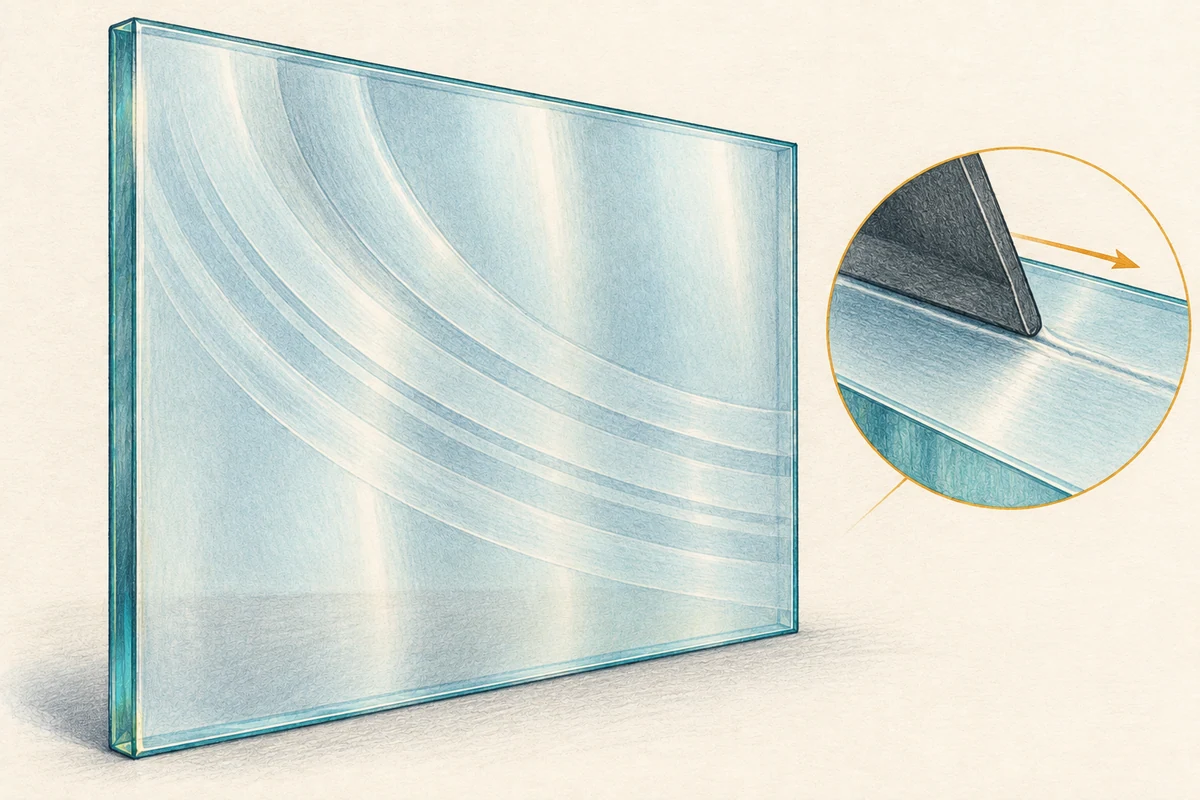
Narrow, linear or banded appearance change that follows squeegee travel paths during window cleaning. Typically a friction-film or light burnish produced by dry/dirty rubber, residue-lubricant mismatch, or excessive pressure. Presents primarily as a visibility cue under raking/oblique light; may be non-tactile (film) or show trace relief where the surface has been lightly burnished.
Definition (Reference).
ReferenceNarrow, linear or banded appearance change that follows squeegee travel paths during window cleaning. Typically a friction-film or light burnish produced by dry/dirty rubber, residue-lubricant mismatch, or excessive pressure. Presents primarily as a visibility cue under raking/oblique light; may be non-tactile (film) or show trace relief where the surface has been lightly burnished. Use VIS inspection lighting/geometry and Non-Invasive Reveal to separate removable films from bonded/burnished appearance change.
Typical Presentation (Informative).
Informative- Parallel, evenly spaced narrow lines that match known squeegee strokes (top-to-bottom pulls or lateral finishes).
- Most apparent in reflection at oblique sweep with raking light; fades at normal incidence.
- On reveal, detergent/surfactant films may diminish; a true burnish/haze line can persist.
Field Identification Cues (Normative).
NormativeSurface-catch class (MSRT):
- SC-0 (film only) to SC-1 (trace burnish); one, light, non-marring pass only to sense relief-do not abrade. Prefer a polymer stylus on suspected coated faces.
Reveal/lighting/geometry:
- Inspect after Non-Invasive Reveal (clean & dry). View at 12 in, 36 in, 72 in at normal incidence and by 60°-120° oblique sweep under raking light.
Location/access:
- Worked/exposed face only; log product family and surface numbering (#1-#4; laminate-internal) on Forms:
Classification Mapping (to VIS-DA) (Normative).
Normative- If post-reveal cue remains visible but non-tactile → trend CAT-1 (faint/non-relief film/transfer).
- If trace relief is detected (SC-1) with clean, fine edges and no chip flanks → CAT-2 (light).
- Presence of chip flanks, pits/craters, or modeled micro-texture elevates to CAT-3/4 per morphology (mechanical abrasion rather than mere film).
- If fixed parallax indicates between-pane look-alike → CAT-5 (out of in-place scope by location).
Indicative Relief / Depth (Informative).
Informative- Residual film / lubricant line: ~0 μm (SC-0).
- Light burnish (appearance change without edge flaking): ~0.1-0.5 μm equivalent (SC-0 to SC-1).
- Depth values are indicative and used only to align with VIS CAT ranges; acceptance remains appearance-based under VIS.
Differentiation & False Positives (Informative).
Informative- vs. Detergent/surfactant film (R.04.01): films respond to reveal; true burnish persists post-reveal.
- vs. Micro-abrasion swirls / pad trails (M.02.01): swirls are arcuate/cross-hatch and not strictly linear; squeegee burn follows straight pulls and window edges. (Use VIS directional-patterning definitions.)
- vs. Coating rub/patchiness (Co.01/Co.03): coating anomalies are on coated worked surfaces and are disallowed at acceptance on coated faces; document coating presence in Forms:
- vs. True scoring (M.01.*): scoring shows clear catch and often chip flanks; escalate CAT accordingly.
Evidence Package (Documentation Requirements) (Normative).
Normative- Photo set (VIS): 12 / 36 / 72 in at normal + oblique; include raking frames that show linearity parallel to squeegee travel; include a straight-edge reflection for alignment.
- MSRT result: record SC-0/SC-1 (single, non-marring pass; polymer stylus on suspected coatings).
- Forms: Pane ID; product family & surface numbering; worked surface Y/N; functional coating present on worked surface? Y/N/Unknown; reveal status; lighting/time; geometry checklist; photos attached.
- Classification call: CAT per cues above; note “film vs. burnish” basis (post-reveal, MSRT class, morphology).
Mis-ID Pitfalls (Informative).
Informative- “Testing” with repeated hard passes can create the burnish you are trying to diagnose; MSRT is single-pass only.
- Treating a coating rub as a cleaning line-coating anomalies on worked surfaces are not permissible at acceptance; escalate appropriately.
- Calling a removable film “damage” without completing reveal.
Reporting Language (Template).
Template- M.02.05 Squeegee Burn Lines (Friction Film) - Narrow linear bands aligned with documented squeegee travel, visible under VIS geometry after Non-Invasive Reveal. MSRT: SC-0 (film) / SC-1 (trace burnish) noted; no chip flanks/pitting. Classification: CAT-1 (non-relief film) or CAT-2 (trace burnish) per cues; no between-pane parallax. Photos at 12/36/72 in (normal/oblique; raking) attached; forms completed per VIS Appendix X3.
Related glossary terms
- Raking lightGRK-129
- Coating rubGRK-115
- AbrasionGRK-035
- PittingGRK-078
Source and version
GlassRenu Damage Specification Sheets (DSS), DSS-M.02.05. Source revision and extraction date are recorded in the deployment manifest.
Open the complete published DSS with table of contents (PDF)
Normative and informative labels are preserved from the source. The downloadable one-sheet is a condensed classification aid; this web page retains the complete source-based specification content.