
On this page
- Diagnosis summary
- Safety and classification scope
- Classification & Scope (Normative)
- Typical Presentation (Informative)
- Field Identification Cues (Normative)
- Surface-catch class (MSRT)
- Visual signature
- Viewing / lighting
- Location / access
- Mechanism cue (context)
- Severity & CAT Mapping (Normative)
- Differentiation & Mis-ID Pitfalls (Informative)
- Evidence Package *(Documentation Requirements) (Normative)
- Reporting Language (Template)
- Related glossary terms
- Related DSS
- Source and version
DAMAGE SPECIFICATION STANDARD / METHOD-AGNOSTIC
DSS-R.04.01 — Detergent / Surfactant Film
Residue/film - cleaning solution residue; streaks, shear marks, rainbowing/iridescence in raking; typically SC-0, SC-1 if micro-texture from abrasive wiping
Diagnosis summary
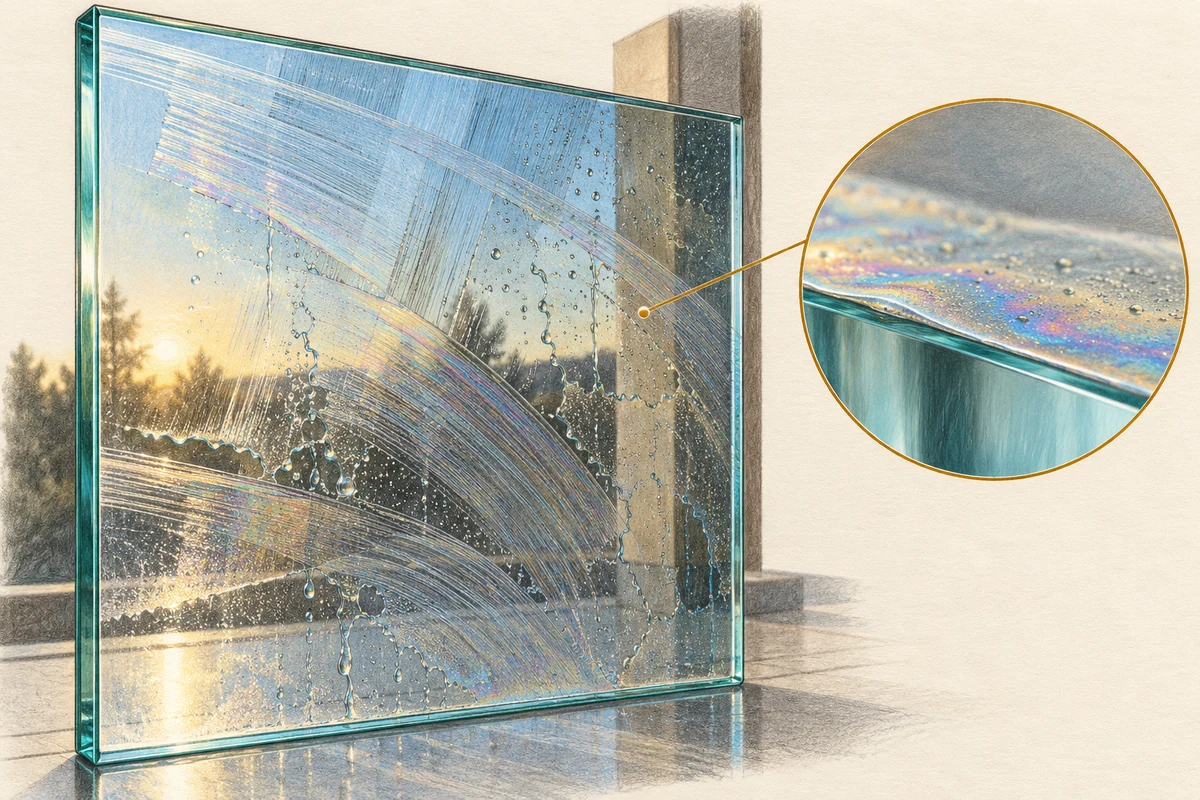
Detergent/surfactant film is an appearance change on glass from leftover cleaning agents (surfactants, wetting agents, soaps) due to incomplete rinse, over-concentration, hard-water mixing, or re-deposition from tools. It presents as shear streaks, drag/wipe overlaps, rainbow/iridescent sheens in low-angle light, and re-wet spotting. Classification is appearance-only per VIS (method-agnostic).
Classification & Scope (Normative)
NormativeDetergent/surfactant film is an appearance change on glass from leftover cleaning agents (surfactants, wetting agents, soaps) due to incomplete rinse, over-concentration, hard-water mixing, or re-deposition from tools. It presents as shear streaks, drag/wipe overlaps, rainbow/iridescent sheens in low-angle light, and re-wet spotting. Classification is appearance-only per VIS (method-agnostic). Inspect after Non-Invasive Reveal under VIS lighting/geometry; record surface numbering and worked-surface status.
Typical Presentation (Informative)
Informative- Directional wipe streaks (vertical squeegee pulls, circular hand wipes) with overlap edges and stop-start stamps.
- Iridescent/rainbow sheen at oblique/raking angles; ghosting returns when lightly misted (re-wet reveals surfactant).
- Heavier at edge starts, high-touch zones, or where microfiber/soap was over-used.
Field Identification Cues (Normative)
NormativeSurface-catch class (MSRT)
- Typically SC-0 (thin organic film on surface).
- SC-1 may occur where abrasive cloths/pads introduced very shallow micro-texture while detergent residue acted as a binder; SC-2 is uncommon and suggests misclassification.
- Perform one light, non-marring pass on a small revealed test patch (substrate). Use polymer stylus if a functional coating is suspected. MSRT supports classification only.
Visual signature
- Shear streaks and overlap lines that mirror tool paths; rainbowing/iridescence in raking; re-wet beading anomalies (film “breaks” unevenly).
- No chip-flank sparkle (not mechanical scoring); no discrete pits (not hot-particle peppering).
Viewing / lighting
- Evaluate clean & dry at 12 / 36 / 72 in, normal incidence and oblique sweep (~60°-120°); use raking light macros to show shear streaks and iridescent film. Record distances/angles in-frame.
Location / access
- Record pane ID and surface numbering (#1-#4; laminate-internal). If pattern appears between panes by parallax on #2/#3, classify CAT-5 by location and refer.
Mechanism cue (context)
- Recently cleaned panels, soap buckets nearby, detergent residue on sills, dirty/saturated microfiber, high TDS mix water, or no final rinse.
Severity & CAT Mapping (Normative)
NormativeAssign CAT by visibility at acceptance geometry and MSRT after a controlled reveal test. Depth values are indicative-field measurement not required.
- CAT-1 (Benign / non-relief): Thin detergent veil with shear streaks/iridescence; SC-0; mainly angle/raking visible. Indicative relief: 0-10 μm (optical film).
- CAT-2 (Light): Persistent film with overlap edges and SC-1 in small zones (from abrasive wiping); limited impact at standard view. Indicative relief: ~10-40 μm.
- CAT-3 (Moderate): Wide-area streaking/veils legible at standard distance due to heavy deposition or soil capture; localized SC-1. Indicative relief: ~40-120 μm.
- Reclassify when: After true residue removal, any modeled micro-texture or SC>0 persists → evaluate under M.02 (abrasion fields) or Ch.03 (mineral) if water deposits are involved.
- CAT-5 (by condition/location): Between-pane/inaccessible by parallax, integrity indicators, or confirmed functional-coating loss on the surface to be worked → CAT-5.
CAT is appearance-based; acceptance is separate under VIS-A at 12/36/72 in. Do not abrade to “force” film removal during classification.
Differentiation & Mis-ID Pitfalls (Informative)
Informative- vs. Fabric softener/additive film (R.04.02): Additive films often show sweet/fragrance cue, silicone/quaternary feel, and strong wetting anomalies; detergent film is classic streak/iridescence with cleaning pattern geometry.
- vs. Mineral staining (Ch.03.02): Minerals leave ring/runs and crystalline edges; detergent films present tool-path streaks and uniform iridescence without ring crystals.
- vs. Hydrophobic mismatch (Ch.06.02): Mismatch exhibits sharp wetting boundaries; detergent film shows gradual streaks that re-wet uniformly (but highlight streak lines).
- vs. Silicone/PIB smears (R.01.xx): Sealant smears are oily/tacky with corduroy or stringers; detergent film is thin, non-tacky, with wiping geometry.
Evidence Package *(Documentation Requirements) (Normative)
Normative- Photo set (VIS): 12 / 36 / 72 in, normal + oblique; raking macros of shear streaks and iridescence; optional light mist frame to show re-wet behavior (avoid flooding edges). Record distance/angle in-frame.
- MSRT result (substrate): After a small reveal test patch, perform one light, non-marring pass; record SC-class (SC-0/SC-1/SC-2).
- Forms: Pane ID; product family & surface numbering; worked surface Y/N; functional coating present on worked surface? (Y/N/Unknown); reveal status; lighting/time; geometry checklist; photos attached.
- Acceptance split: Post-restoration acceptance per VIS-A §6; classification ≠ acceptance. Coated-face appearance rules apply per VIS §6.2.e when the worked surface is a factory functional coating.
Reporting Language (Template)
Template- R.04.01 Detergent / Surfactant Film - Directional shear streaks with iridescent veil on surface #___; post-reveal test patch shows [SC-0/SC-1]; visible at [12/36/72 in] under VIS geometry. Morphology: tool-path overlaps, re-wet highlighting, no chip-flank sparkle, no pits. Classification: CAT-[1/2/3] by visibility and SC-class; CAT-5 if between-pane or coating-side loss on the surface to be worked. Forms + photo set attached; acceptance per VIS-A §6.
Related glossary terms
- DepositGRK-045
- Raking lightGRK-129
- Test patchGRK-144
- AbrasionGRK-035
- AbrasiveGRK-168
Source and version
GlassRenu Damage Specification Sheets (DSS), DSS-R.04.01. Source revision and extraction date are recorded in the deployment manifest.
Open the complete published DSS with table of contents (PDF)
Normative and informative labels are preserved from the source. The downloadable one-sheet is a condensed classification aid; this web page retains the complete source-based specification content.