
On this page
- Diagnosis summary
- Safety and classification scope
- Definition (Normative)
- Typical Presentation (Informative)
- Field Identification Cues (Normative)
- Severity & Category Mapping (Normative)
- Differentiation & False Positives (Informative)
- Evidence Package (Documentation Requirements) (Normative)
- Mis-ID Pitfalls (Informative)
- Reporting Language (Template)
- Related glossary terms
- Related DSS
- Source and version
DAMAGE SPECIFICATION STANDARD / METHOD-AGNOSTIC
DSS-M.05.03 — Wash-Line Scratch Bands
Fabrication Debris / factory wash handling lines
Diagnosis summary
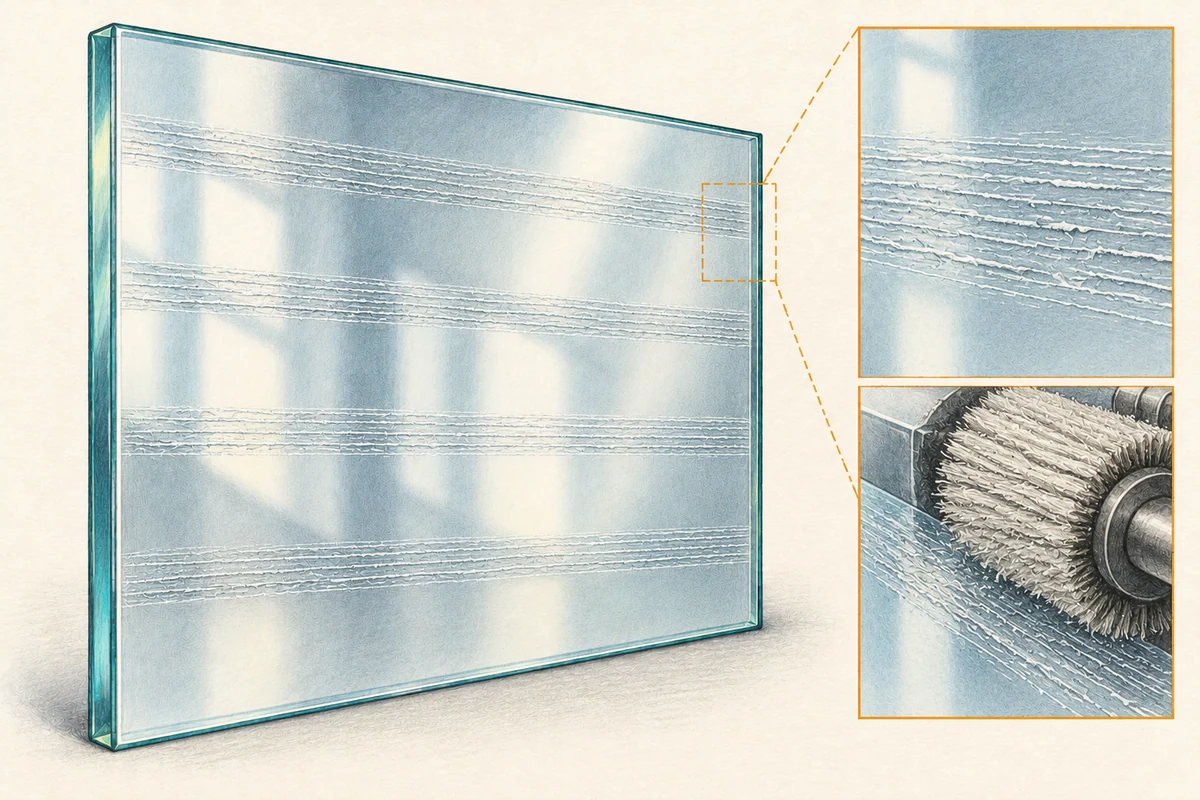
Parallel, height-consistent bands of linear surface scoring produced when particulates or trapped fines are carried across the lite by factory washing/handling equipment prior to or after heat-treating. Bands typically align perpendicular to glass travel and traverse significant widths of the face. Classification is appearance-based under VIS inspection conditions; acceptance is governed separately by VIS-A.
Definition (Normative)
NormativeParallel, height-consistent bands of linear surface scoring produced when particulates or trapped fines are carried across the lite by factory washing/handling equipment prior to or after heat-treating. Bands typically align perpendicular to glass travel and traverse significant widths of the face. Classification is appearance-based under VIS inspection conditions; acceptance is governed separately by VIS-A. Use VIS inspection geometry and documentation conventions.
Typical Presentation (Informative)
Informative- Parallel stripes/belts of fine to moderate scratches at repeatable elevations across adjacent lites from the same batch/run.
- Lines read strongest in raking light; at standard view, bands may collapse into a faint “striped haze” when shallow.
- Often span long distances, intersecting mullion reflections; individual lines within a band can vary in prominence.
- May co-occur with other FD manifestations (e.g., long FD fields) on the same elevation.
Field Identification Cues (Normative)
Normative- MSRT (Manual Surface-Relief Test) class - one light, non-marring pass only:
- SC-1 (slight) for shallow band sets;
- SC-2 (clear) where chip flanks are present on stronger lines. Numeric depth is not required for classification; prioritize MSRT class + morphology.
- Visual signature - multiple, co-planar lines forming a belt; some lines show clean edges, others exhibit micro-chipping/chip flanks under raking light. (Use VIS §5 lighting/geometry.)
- Viewing & lighting - Capture at 12 / 36 / 72 in; normal + oblique sweep; include raking-light frames. Surfaces clean/dry per VIS “Non-Invasive Reveal.”
- Location / access - Present on the exposed face being evaluated. Where fixed parallax proves a between-pane condition, classify CAT-5 (out of in-place scope) and refer per project protocol.
Severity & Category Mapping (Normative)
Normative(Informative micrometer ranges are for context; classification does not require measurement.)
Differentiation & False Positives (Informative)
Informative- vs. Long FD scratch field (M.05.02) - fields may wander; wash-line bands are elevation-consistent, often repeating across lites. (M.05 indexing.)
- vs. Conveyor/belt line scoring (M.01.04) - M.01.04 typically produces one or a few straight, travel-aligned tracks; wash-line bands present as stacked belts of lines at a set height.
- vs. Squeegee burn lines (M.02.05) - squeegee burns are friction films (haze) with SC-0 to SC-1 and no chip flanks; wash-line bands show line relief and may present chip flanks.
- vs. Coating rub/patchiness (Co.01/Co.03) - coating anomalies are worked-surface appearance changes and are not permitted at acceptance on coated faces; wash-line bands are mechanical lineations in the glass surface. Apply VIS §6.2.e where coatings are involved.
- vs. Factory optical features (e.g., roller wave, ream/cord) - optical features are pane-scale, SC-0, and lack line relief/chip flanks; do not spot-work factory optical patterns per VIS.
Evidence Package (Documentation Requirements) (Normative)
Normative- Photo set (VIS): 12/36/72 in; normal + oblique; include raking. Capture at least one context frame across adjacent lites to show height-repeat and one macro with chip-flank detail.
- MSRT result: Record SC-class (SC-1 / SC-2). Single non-marring pass; on suspected coated faces, prefer polymer stylus.
- Forms/Logs: Pane ID; surface numbering; worked surface Y/N; functional coating present on worked surface? (Y/N/Unknown); reveal status; lighting/time; geometry checklist.
- Scope split: Classification under VIS-DA (this DSS); post-restoration acceptance under VIS-A-do not conflate factory features with acceptance criteria.
Mis-ID Pitfalls (Informative)
Informative- Treating band haze as a film only (R-series) and skipping MSRT-misses line relief and chip flanks diagnostic of FD.
- Attempting localized “spot-buffs” that create a transition edge; VIS disallows visible worked boundaries at acceptance.
Reporting Language (Template)
Template- M.05.03 Wash-Line Scratch Bands - Parallel, elevation-consistent bands of linear scoring observed under VIS geometry; MSRT = SC-1/SC-2 with chip-flank morphology on primary lines. Classified CAT-2 / CAT-3 / CAT-4 by cue set as documented. If fixed parallax indicates a between-pane condition, record CAT-5 and refer per project protocol.
Related glossary terms
- ScratchGRK-032
- Acceptance criteriaGRK-151
- Scratch fieldGRK-108
- Raking lightGRK-129
- Coating rubGRK-115
Source and version
GlassRenu Damage Specification Sheets (DSS), DSS-M.05.03. Source revision and extraction date are recorded in the deployment manifest.
Open the complete published DSS with table of contents (PDF)
Normative and informative labels are preserved from the source. The downloadable one-sheet is a condensed classification aid; this web page retains the complete source-based specification content.